Dioo Microcircuits (688381)

Search documents
帝奥微(688381.SH):实际控制人与一致行动人解除一致行动关系
Ge Long Hui A P P· 2025-09-26 11:00
格隆汇9月26日丨帝奥微(688381.SH)公布,收到公司实际控制人鞠建宏先生与其一致行动人郑慧女士的 通知,双方协商一致签署了《一致行动协议书之终止协议》,郑慧女士退出与公司实际控制人的一致行 动关系,公司控股股东和实际控制人未发生变化。本次一致行动关系解除后,郑慧女士不再是公司实际 控制人鞠建宏先生的一致行动人,公司实际控制人鞠建宏先生和其控制的企业合计持有22.77%股份对 应的表决权,不会导致公司控股股东、实际控制人发生变化,不会影响公司治理结构和经营。 ...

帝奥微(688381) - 关于实际控制人与一致行动人解除一致行动关系暨权益变动的提示性公告
2025-09-26 10:46
证券代码:688381 证券简称:帝奥微 公告编号:2025-052 江苏帝奥微电子股份有限公司 关于实际控制人与一致行动人解除一致行动关系暨 权益变动的提示性公告 本公司董事会及全体董事保证本公告内容不存在任何虚假记载、误导性陈述 或者重大遗漏,并对其内容的真实性、准确性和完整性依法承担法律责任。 重要内容提示: 本次权益变动不涉及股东各方实际持股数量及比例的增减,系公司实际 控制人与其一致行动人解除一致行动关系; 本次一致行动关系解除后,郑慧女士不再是公司实际控制人鞠建宏先生 的一致行动人,公司实际控制人鞠建宏先生和其控制的企业合计持有 22.77%股 份对应的表决权,不会导致公司控股股东、实际控制人发生变化,不会影响公司 治理结构和经营。 江苏帝奥微电子股份有限公司(以下简称"帝奥微"或"公司")于 2025 年 9 月 26 日收到公司实际控制人鞠建宏先生与其一致行动人郑慧女士的通知, 双方协商一致签署了《一致行动协议书之终止协议》,郑慧女士退出与公司实际 控制人的一致行动关系,公司控股股东和实际控制人未发生变化。现将相关情况 公告如下: 一、一致行动人协议签署及履行情况 鉴于: 1.2022 年 3 ...
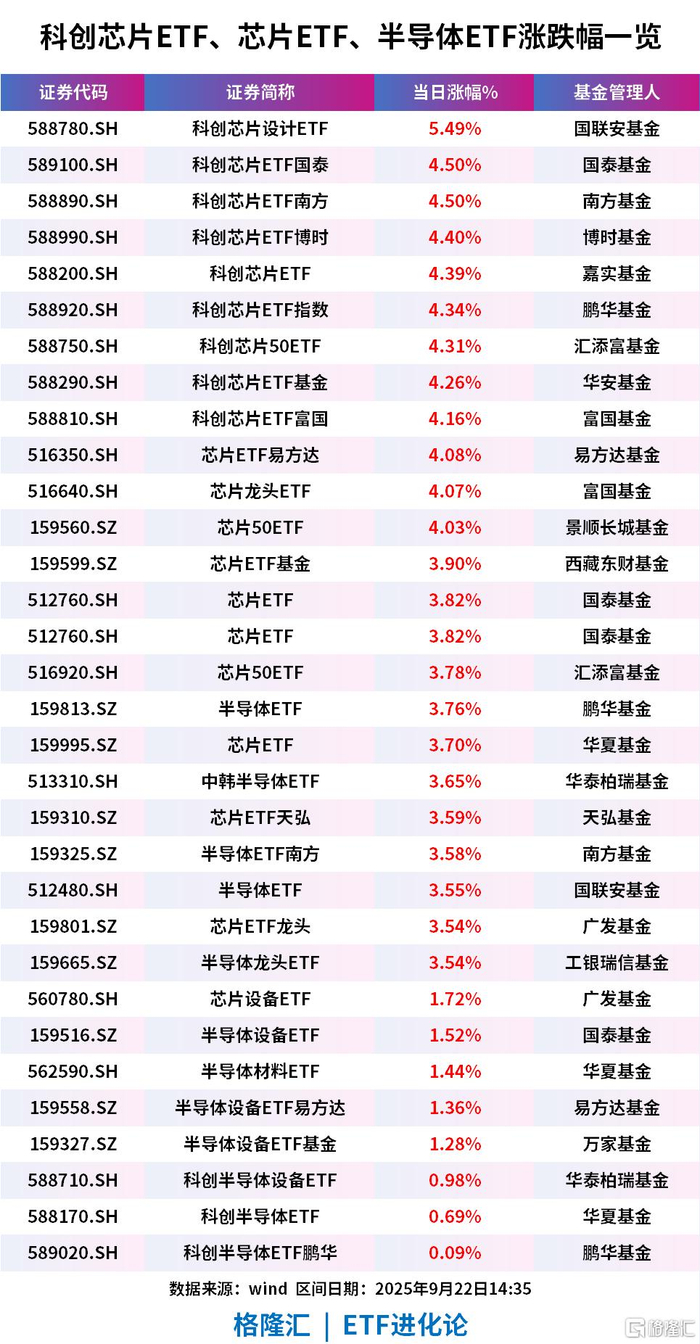
芯片股上涨,科创芯片设计ETF涨超5%,科创芯片ETF、科创芯片ETF指数、科创芯片50ETF涨超4%
Ge Long Hui A P P· 2025-09-22 08:28
Core Viewpoint - The semiconductor sector is experiencing significant growth, with various chip stocks rising over 10%, leading to a surge in related ETFs by more than 4% to 5% [1][2]. Group 1: Stock Performance - Chip stocks such as Zhongke Lanyun, Chip Origin, Jucheng, Haiguang Information, and Diaomicro have seen increases exceeding 10% [1]. - The Sci-Tech Innovation Chip Design ETF rose by 5.49%, while other related ETFs also reported gains ranging from 3.54% to 4.50% [2][3]. Group 2: Industry Developments - The semiconductor industry is witnessing an influx of domestic tech giants entering chip R&D, with Huawei announcing the timeline for its Ascend chip iteration [5]. - Companies like SMIC and Huahong Semiconductor are optimistic about future orders and market conditions [5]. - The upcoming IPO of Moore Threads, a leading domestic GPU company, is expected to enhance the domestic GPU landscape [5]. Group 3: Market Trends - According to Huatai Securities, global semiconductor equipment revenue is projected to grow by 14% year-on-year in 2025, reaching $148 billion [6]. - The Chinese semiconductor equipment market is experiencing a slight decline, with a 1% decrease in the first half of 2025, while the domestic equipment localization rate has increased by 6 percentage points to 21% [6][7]. - The overseas semiconductor equipment market is driven by AI demand, with a 40% year-on-year growth in the second quarter of 2025 [7][8]. Group 4: Future Outlook - The global semiconductor equipment revenue is expected to grow by 8% in 2026, with the Chinese market projected to remain stable [8]. - The focus on AI-related investments and the expansion of advanced logic in China are seen as structural opportunities for growth [8].


帝奥微跌2.04%,成交额1.33亿元,主力资金净流出643.45万元
Xin Lang Cai Jing· 2025-09-19 02:59
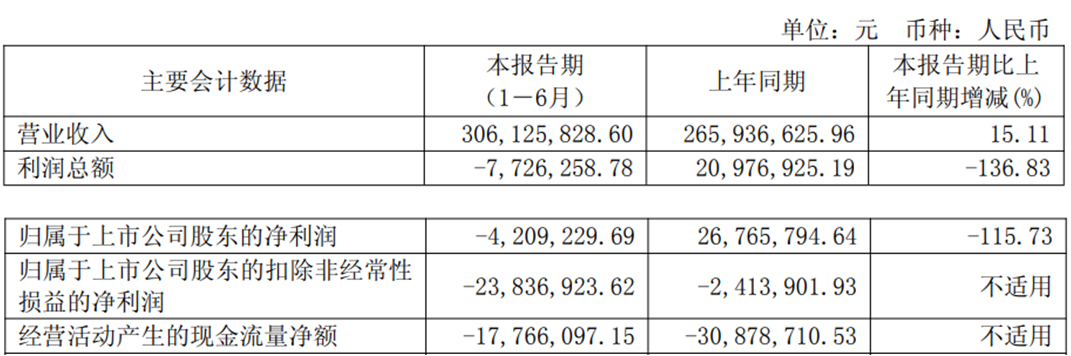
Core Viewpoint - The stock of DiAo Micro has shown significant volatility, with a year-to-date increase of 43.76%, but recent trading patterns indicate mixed investor sentiment and a decline in net profit [2][3]. Group 1: Stock Performance - As of September 19, DiAo Micro's stock price was 27.42 CNY per share, down 2.04% for the day, with a total market capitalization of 6.786 billion CNY [1]. - Year-to-date, the stock has increased by 43.76%, with a 2.97% rise in the last five trading days, a 3.55% decline over the last 20 days, and a 28.73% increase over the last 60 days [2]. Group 2: Trading Activity - On September 19, the net outflow of main funds was 643.45 thousand CNY, with large orders showing a buy of 3.1465 million CNY and a sell of 3.4104 million CNY [1]. - The company has appeared on the "Dragon and Tiger List" twice this year, with the most recent instance on August 19, where it recorded a net buy of -20.3621 million CNY [2]. Group 3: Financial Performance - For the first half of 2025, DiAo Micro reported revenue of 306 million CNY, a year-on-year increase of 15.11%, but a net profit loss of 4.2092 million CNY, a decrease of 115.73% compared to the previous year [2]. - The company's main business revenue composition is 51.58% from power management and 48.42% from signal chains [2]. Group 4: Shareholder Information - As of June 30, 2025, the number of shareholders increased to 15,600, with an average of 11,799 circulating shares per person, a decrease of 0.25% [2]. - DiAo Micro has distributed a total of 153 million CNY in dividends since its A-share listing [3].
破发股帝奥微扣非连亏2年半 2022上市即巅峰募26.3亿
Zhong Guo Jing Ji Wang· 2025-09-18 06:00
Core Viewpoint - DiAo Microelectronics (688381.SH) reported a decline in net profit for the first half of 2025 despite a revenue increase, indicating potential challenges in profitability and cash flow management [1][3]. Financial Performance Summary - For the first half of 2025, the company achieved operating revenue of 306.13 million yuan, a year-on-year increase of 15.11% compared to 265.94 million yuan in the same period last year [1][3]. - The net profit attributable to shareholders was -4.21 million yuan, a significant decrease from 26.77 million yuan in the previous year, reflecting a decline of 115.73% [1][3]. - The net profit excluding non-recurring gains and losses was -23.84 million yuan, compared to -2.41 million yuan in the same period last year [1][3]. - The net cash flow from operating activities was -17.77 million yuan, an improvement from -30.88 million yuan in the previous year [1][3]. Previous Year Comparison - In 2024, the company reported operating revenue of 526.25 million yuan, a year-on-year increase of 37.98% from 381.40 million yuan in 2023 [4]. - The net profit attributable to shareholders for 2024 was -47.07 million yuan, down from 15.39 million yuan in 2023, indicating a decline of 405.76% [4]. - The net profit excluding non-recurring gains and losses for 2024 was -93.68 million yuan, compared to -56.30 million yuan in 2023 [4]. - The net cash flow from operating activities in 2024 was -76.16 million yuan, worsening from -2.35 million yuan in 2023 [4]. IPO and Fundraising - DiAo Microelectronics went public on the Shanghai Stock Exchange's Sci-Tech Innovation Board on August 23, 2022, raising a total of 262.79 million yuan, with a net amount of 241.56 million yuan after deducting issuance costs [5]. - The company initially planned to raise 150 million yuan for product upgrades, R&D center construction, and working capital [5]. - The underwriting fees totaled 21.23 million yuan, with the main underwriter being CITIC Securities [5].
帝奥微:高效率DCDC、模拟开关、电平转换等产品已在头部客户导入
Ju Chao Zi Xun· 2025-09-17 10:40
Core Viewpoint - The company DiAo Micro (301319) has launched multiple products for optical modules, aiming to enhance its market share in high-speed interconnect applications driven by increasing AI computing demands and data traffic [3]. Product Development - DiAo Micro has introduced high-efficiency DCDC converters, analog switches, and level shifters, which have been adopted by leading customers [3]. - The company has also released several new products specifically for high-speed optical modules, including the first domestic high-precision optical module [3]. Market Context - Optical modules are critical components for optical communication and high-speed interconnects in data centers, requiring higher power efficiency, precision, and stability from analog chips [3]. - Despite the growing demand, domestic analog chip manufacturers have a low penetration rate in high-end applications like optical modules [3]. Future Outlook - With the iterative development of products such as DCDC converters, level shifters, and current-limiting switches, DiAo Micro is expected to accelerate the domestic substitution process in the optical module market and increase its market share [3].
帝奥微(688381.SH):不涉及DSP相关的产品
Ge Long Hui· 2025-09-17 08:03
Group 1 - The company, DiAo Micro (688381.SH), stated on its interactive platform that it currently does not engage in any products related to DSP (Digital Signal Processing) [1]
帝奥微(688381.SH):推出的PCIE开关和电平转换已经拿到国内客户订单
Ge Long Hui· 2025-09-17 08:03
Core Viewpoint - The company has received domestic customer orders for its PCIE switches and voltage converters in the server sector, indicating a positive market response to its new product offerings [1] Group 1: Product Development - The company has launched several products, including the first domestic I3C bus hub series, providing comprehensive solutions for scenarios such as DIMM module management, multi-node storage systems, and smart sensor networks [1] - The company has introduced a complete server signal switch solution covering all interfaces, establishing a product system from PCIE to I2C, USB, SPI, and I3C [1] - Future plans include further development of high-speed interface products such as Retimer and PCIE, enhancing the company's offerings in the server field [1]
反倾销或缓解价格战压力,国产模拟芯片承接空间广阔
2 1 Shi Ji Jing Ji Bao Dao· 2025-09-16 01:49
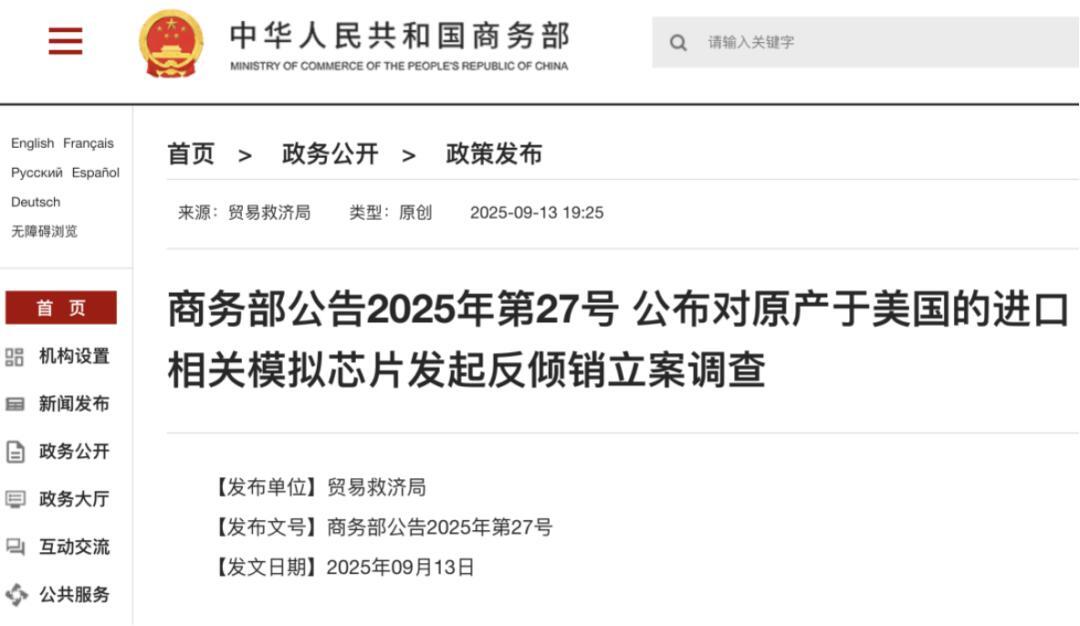
Core Viewpoint - The A-share simulation chip sector experienced a significant surge following the announcement of an anti-dumping investigation by China's Ministry of Commerce against imported simulation chips from the United States, which is expected to alleviate pricing pressures and enhance profitability for domestic manufacturers [1][6]. Group 1: Market Dynamics - The anti-dumping investigation targets general interface chips and gate driver chips, which are crucial components in various electronic devices [6]. - The U.S. accounts for over 50% of the global production capacity of related simulation chips, with major manufacturers including Texas Instruments, ADI, Broadcom, and ON Semiconductor [6]. - The price of the investigated products has reportedly decreased significantly, with dumping margins exceeding 300%, capturing an average market share of 41% in China [6][7]. Group 2: Financial Performance - In the first half of 2025, the A-share simulation chip design sector achieved revenue of 24.405 billion yuan, a year-on-year increase of 13.12%, and a net profit of 502 million yuan, reflecting a substantial growth of 280.49% [2]. - Despite the overall profitability improvement, leading domestic simulation chip companies like Naxin Micro faced significant losses in 2023 and 2024, with net losses of 305 million yuan and 403 million yuan, respectively [2]. Group 3: Industry Trends - The simulation chip industry entered a downward cycle starting from Q4 2022, facing challenges such as high inventory and weak demand, but is expected to transition into an upward cycle beginning Q1 2025 as inventory levels normalize [2]. - The gross margin for the simulation chip design sector in the first half of 2025 was 35.34%, a slight decline of 0.51 percentage points year-on-year, while the net margin improved to 1.91%, an increase of 1.34 percentage points [3]. Group 4: Competitive Landscape - The ongoing price war initiated by overseas manufacturers has significantly pressured the simulation chip sector, particularly in automotive, industrial, and communication fields [4]. - Texas Instruments announced a new round of price increases, indicating a shift in its competitive strategy, which may lead downstream customers to seek alternatives, thereby creating new opportunities for domestic chip companies [5]. - The anti-dumping investigation is anticipated to liberate domestic manufacturers from competitive pressures, potentially leading to a market expansion of 3.3 to 13.4 times for general interface chips and 1.6 to 8.8 times for gate driver chips in China [7].


反倾销落地,国产模拟芯片迎转机
Tai Mei Ti A P P· 2025-09-15 11:21
Core Viewpoint - The Chinese Ministry of Commerce has initiated anti-dumping investigations against imported analog chips from the United States, responding to domestic industry applications and aligning with WTO rules. The investigations focus on general interface and gate driver chips, revealing a significant increase in import volume and a drastic decrease in import prices, which have negatively impacted domestic sales prices and operations [1][2][4]. Group 1: Market Overview - The global semiconductor market reached $346 billion in the first half of 2025, marking an 18.9% year-on-year growth, with analog chips growing by 4% [4]. - In the A-share market, the semiconductor industry reported revenues of 321.2 billion yuan and a net profit of nearly 24.5 billion yuan, reflecting a year-on-year growth of approximately 30% [4]. - The demand for analog chips, particularly in mobile fast charging and power management, is significantly increasing, with domestic products rapidly capturing market share [4]. Group 2: Company Performance - Companies like Xilin Micro and Chipone reported substantial revenue growth, with Xilin Micro achieving a 36.83% increase and a 131.25% rise in net profit [6]. - Chipone's revenue grew by 40.32%, with net profit increasing by 106.02%, driven by new product categories and market expansion [7]. - Jiewa Tech reported a 58.2% revenue increase, primarily from power and signal chain chips, with a total revenue of 11.87 billion yuan [7]. Group 3: Profitability and Margins - The analog chip industry's gross margin improved, with the median gross margin rising from 34.72% in Q1 to 35.05% in Q2 of 2025 [11]. - Leading companies like Saimo Micro and Shengbang Co. maintain gross margins above 50%, showcasing their competitive advantage in the market [11]. - Companies such as Naxin Micro and Aiwai Electronics reported significant improvements in gross margins due to high-value product offerings and operational efficiencies [12][13]. Group 4: Inventory Management - The inventory turnover days for most analog chip companies decreased significantly in 2025 compared to 2024, indicating improved inventory management efficiency [16]. - Companies like Jiewa Tech and Xilin Micro saw their inventory turnover days reduced by over 100 days, reflecting enhanced operational performance [16]. Group 5: Mergers and Acquisitions - The anti-dumping investigations have prompted domestic analog chip companies to pursue mergers and acquisitions to enhance their technological capabilities and market presence [17][19]. - Recent acquisitions include Biyimei's purchase of Shanghai Xingan Semiconductor for approximately 295 million yuan and Jingfeng Mingyuan's acquisition of Yichong Technology for 3.283 billion yuan [18][19]. - These strategic moves aim to consolidate resources, fill technological gaps, and improve competitiveness against international giants [19].