
Qingdao Gaoce(688556)

Search documents
机器人板块及各环节复盘:交易的情绪与水位:机械行业专题报告
Guohai Securities· 2026-02-04 10:35
Investment Rating - The report maintains a "Recommended" rating for the humanoid robot industry [1] Core Insights - The report analyzes the humanoid robot sector, highlighting trading emotions, low trading levels, and rapid rotation, with market trends lasting approximately 2-3 months [6] - It reviews the historical performance of various indices related to the humanoid robot sector and discusses the logic and opportunities for 2025 and 2026 [6] - The report anticipates significant growth in the humanoid robot sector in 2026, driven by macro, meso, and micro factors [6] Summary by Sections 1. Review of 2025 Trading - The humanoid robot sector's performance in 2025 was influenced by trading emotions and low trading levels, with significant events driving market fluctuations [12] - Key events included Tesla's performance announcements and the debut of robots at major events, which significantly impacted trading sentiment [12] 2. Opportunities in 2026 - The report identifies several opportunities for 2026, including: - Macro: Strong transmission and rotation of technology themes, with a clear trend of growth in the robot sector driven by upstream AI [19] - Meso: Expected volume production in humanoid robots, with several companies planning significant production increases [22] - Micro: Specific catalytic events related to major companies and their production plans [25] 3. Key Indices and Components - The report compiles indices for core components of humanoid robots, noting that the screw component outperformed the motor component in 2025 [15] - It highlights the importance of core suppliers and their impact on sector performance, particularly in the screw and motor segments [15] 4. Related Companies and Investment Suggestions - The report suggests monitoring several key companies in the humanoid robot sector, including: - Companies focused on embodied intelligence such as UBTECH and Geek+ [28] - Gear and material suppliers like Harmonic Drive and Keda Li [28] - Motor manufacturers such as Weichuang Electric and Mingzhi Electric [28] - Companies involved in dexterous hands and electronic skin like Hanwei Technology and Nanshan Zhishang [28]



解密钙钛矿电池:凭何扛起太空算力引擎重任?校企联合攻关+马斯克赋能,光伏核心风口强势回归
Xin Lang Cai Jing· 2026-02-03 12:52
Group 1 - Zairun New Energy focuses on the research and development of perovskite battery core materials and equipment, with a strong emphasis on high-purity and high-stability products suitable for large-scale production [1] - The company has completed multiple pilot tests and its product performance has been validated by third-party authorities [1] - Zairun's high-radiation-resistant perovskite precursor materials enhance battery stability in extreme space environments, positioning the company to become a core supplier in the space photovoltaic supply chain [1] Group 2 - Aotwei is a leading domestic photovoltaic equipment enterprise, with early layouts in perovskite production line equipment and technology covering key processes such as laser etching and thin film deposition [2] - The company's self-developed laser repair equipment significantly improves battery yield and is at the forefront of industry standards [2] - Aotwei's equipment optimizes battery manufacturing processes to meet the stringent requirements of space photovoltaic applications, potentially making it a core supplier in this sector [2] Group 3 - Haiyou New Materials is a core supplier of photovoltaic packaging materials, focusing on the development of POE films and back sheets for perovskite batteries [3] - The company has developed radiation-resistant packaging films that ensure long-term stable operation of perovskite batteries in space environments [3] - As the space photovoltaic market scales, Haiyou is positioned to become a key supplier of packaging materials for perovskite batteries [3] Group 4 - Gaoce Co., Ltd. is a leading domestic company in photovoltaic cutting equipment and silicon wafer processing, actively developing ultra-thin silicon cutting technology for perovskite batteries [4] - The company's ultra-thin silicon wafers, with thicknesses as low as 50μm, meet the lightweight requirements of perovskite batteries [4] - Gaoce's technology supports the stringent demands of space photovoltaic applications, positioning it to become a core supplier of silicon wafers for perovskite batteries [4]


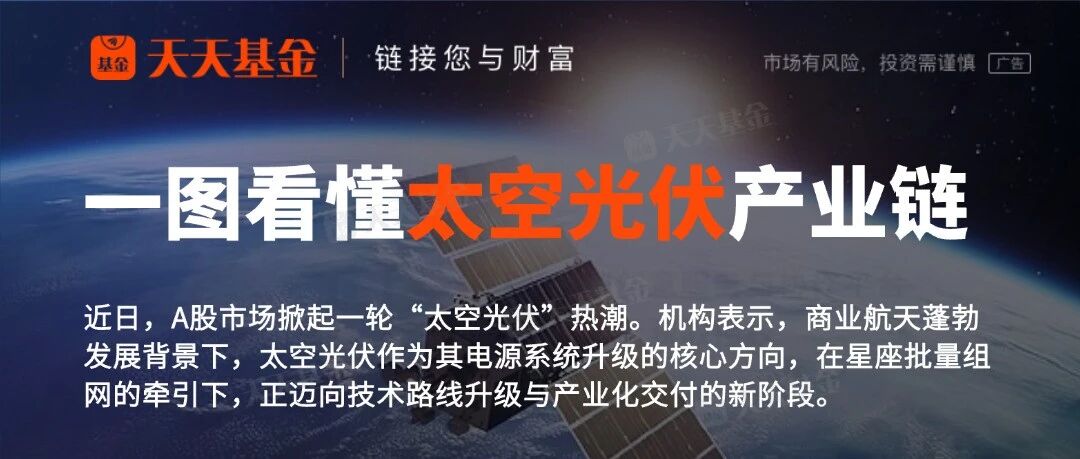
太空光伏掀涨停潮!一图看懂相关概念
天天基金网· 2026-02-03 08:42
Core Viewpoint - The article highlights the emerging trend of "space photovoltaics" in the A-share market, driven by the rapid development of commercial aerospace and the need for upgraded power systems in satellite constellations [1]. Industry Chain - The space photovoltaic industry chain includes various components such as photovoltaic auxiliary materials, photovoltaic cells, and photovoltaic equipment, with key players like Double Good Energy, Junda Co., and Trina Solar [3]. Institutional Interpretation - As China's low-orbit satellite constellations enter a phase of intensive deployment, the industry is expected to undergo significant transformation, with a focus on manufacturing and technological advancements [4][11]. Market Potential - Space photovoltaics are projected to achieve commercialization within the next 10 to 15 years, with the Chinese low-orbit satellite photovoltaic market expected to exceed $3 billion by 2030. If the deployment reaches 100GW for space data centers, the global market could reach between $500 billion to $1 trillion [5][12]. Technological Advantages - Space photovoltaics can generate power continuously, unaffected by day-night cycles or weather changes, achieving 7-10 times the annual generation hours and energy density compared to ground-based photovoltaics [10]. Recent Developments - The recent acquisition of xAI by SpaceX aims to create a vertically integrated innovation engine, which is expected to enhance SpaceX's space computing capabilities, directly benefiting the space photovoltaic industry [9].






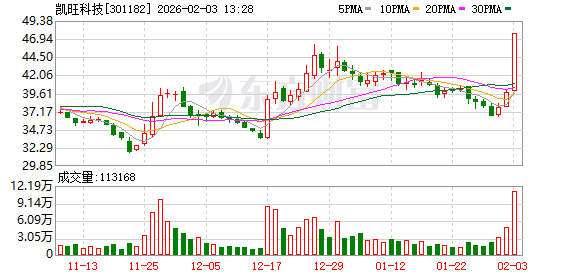
机器人概念股震荡走强,凯旺科技20cm涨停
Mei Ri Jing Ji Xin Wen· 2026-02-03 05:28
Group 1 - The core viewpoint of the article highlights a strong performance in the robotics sector, with several stocks experiencing significant gains [2] - Kaiwang Technology reached a 20% limit up, indicating strong investor interest and confidence in the company [2] - Jintuo Co. also hit the limit up, showcasing a similar trend among robotics stocks [2] Group 2 - High Measurement Co. saw an increase of over 10%, further reflecting the positive momentum in the robotics industry [2] - Other companies such as Huazi Technology and Huayi Technology also experienced gains, contributing to the overall strength of the sector [2] - Previously, companies like Shenjian Co. and Taihao Technology had their stocks locked up, indicating prior investor confidence [2]





炸了!集体大反攻,掀涨停潮!
天天基金网· 2026-02-03 05:23
Market Overview - A-shares experienced a significant rebound with all three major indices rising, particularly the ChiNext Index which surged over 2% [2] - The photovoltaic industry index saw a notable increase of 4.78%, while military and aerospace indices also rose by over 3% [2] - The market structure indicates that the main drivers of the rebound were the active photovoltaic and commercial aerospace sectors [2] Photovoltaic Sector - The photovoltaic sector saw widespread gains, with TOPcon battery concept stocks leading the market [6] - Key stocks included: - Aotewei recorded a 20% limit-up - Shuangliang Energy and Fostek both hit 10% limit-up - Maiwei shares rose by 11.77% [7][8] - The demand for space-based photovoltaic energy is expected to become a new growth area, driven by global space energy needs and supply chain restructuring [9] Commercial Aerospace Sector - The commercial aerospace sector also saw rapid gains, with stocks like Tongyu Communication and Aerospace Development hitting the 10% limit-up [10][11] - The successful testing of a liquid rocket engine by a private aerospace company is expected to bolster confidence in the sector [11] Precious Metals Sector - The precious metals sector continued to decline, with several stocks hitting the 10% limit-down, including Zhaojin Gold and Sichuan Gold [15] - Despite the drop in stocks, spot gold and silver prices rebounded, with gold reaching $4,809 per ounce, up over 3% [17]





机器人概念股午后走强 凯旺科技20cm涨停
Xin Lang Cai Jing· 2026-02-03 05:17
午后,机器人概念股震荡走强,凯旺科技20cm涨停,晋拓股份涨停,高测股份涨超10%,华自科技、 华依科技等跟涨。神剑股份、泰豪科技等此前封板。 ...
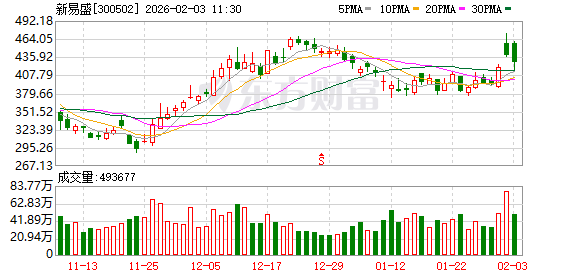
300502 成交额再度A股第一
Shang Hai Zheng Quan Bao· 2026-02-03 05:00
Market Overview - A-shares experienced a collective rise in major indices, with the Shanghai Composite Index closing at 4031.07 points, up 0.38%, and the Shenzhen Component Index rising by 0.93% [2] - The total trading volume in the Shanghai and Shenzhen markets reached 161.69 billion yuan by midday [2] Sector Performance - The commercial aerospace sector saw significant gains, with multiple stocks hitting the daily limit up, including Aerospace Development and JuLi Sockets [4] - The photovoltaic sector continued to strengthen, with stocks like Shuangliang Energy and JunDa Co. reaching their daily limit up shortly after market open [4] - The chemical sector also experienced a rally, with WanFeng Co. achieving a fourth consecutive limit up [9] Key Stocks - Aotewei reached a 20% limit up, while other stocks such as Dike Co. and Maiwei Co. saw increases of over 10% [6][7] - JunDa Co. announced a share placement to fund research and production of space photovoltaic battery products, and it also invested 30 million yuan for a 16.67% stake in Shanghai Xingyi Xinneng [8] Industry Insights - According to CICC, the development of commercial aerospace is driving the space photovoltaic sector towards a new phase of technological upgrades and industrial delivery [8] - Guosheng Securities noted that the demand for space photovoltaic energy is expected to become a new growth area, driven by the global demand for space energy and the restructuring of supply chains [8] - The chemical industry is expected to evolve with a shift from market share focus to profitability, alongside opportunities for high-end export replacements due to declines in Europe and Japan [9][10]

近3000家公司“交卷”,A股2025年业绩预告收官:宁波富邦预增超30倍居首,还有147家公司业绩超预期
Mei Ri Jing Ji Xin Wen· 2026-02-01 15:00
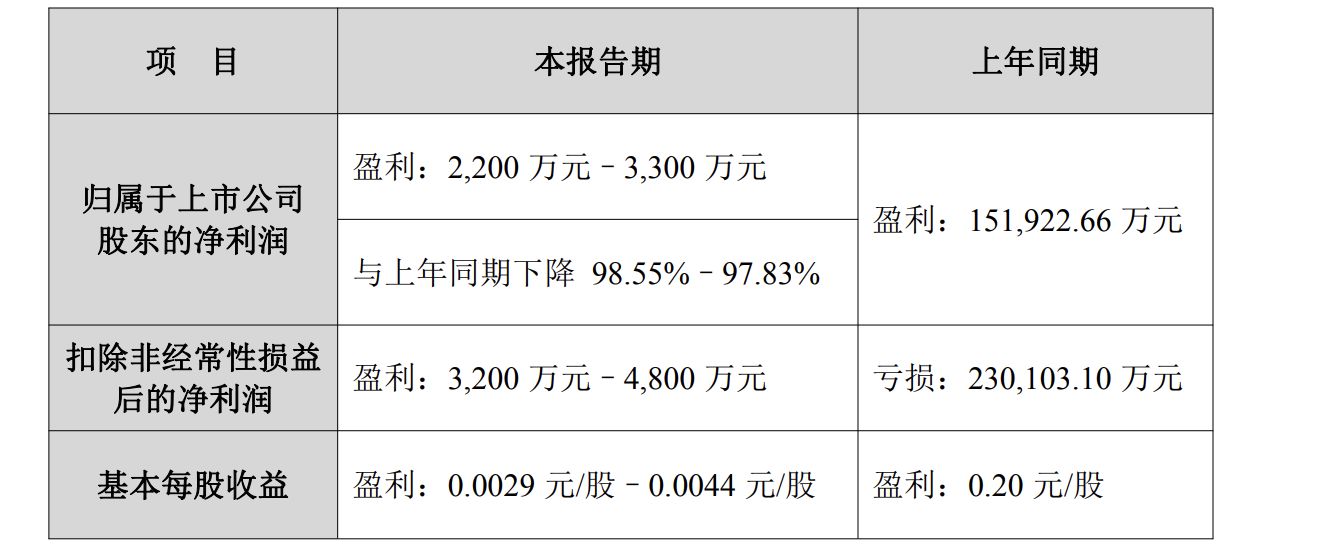
Core Viewpoint - The A-share market has seen a significant number of companies disclose their 2025 annual performance forecasts, with approximately 3,000 companies participating, providing crucial insights for market performance predictions. Group 1: Performance Forecasts - A total of 2,956 companies in the Shanghai, Shenzhen, and Beijing stock exchanges disclosed their 2025 performance forecasts, with 705 companies expecting profit increases, 420 companies anticipating profit decreases, and 987 companies projecting continued losses. Additionally, 374 companies expect to turn losses into profits [1] - Ningbo Fubang (SH600768) leads with an expected profit increase of over 30 times, while Vanke A (SZ000002) is projected to incur a loss of 82 billion yuan, marking it as the "loss leader" [1] Group 2: Notable Profit Increases - Ningbo Fubang is expected to achieve a net profit of 50 million to 70 million yuan, with a staggering increase of 3,099.59% to 4,379.43% attributed to non-recurring gains from the sale of a stake in Ningbo Zhonghua Paper Industry [2] - Guangdong Mingzhu (SH600382) anticipates a net profit of approximately 166 million to 203 million yuan, reflecting a growth of 2,908.49% to 3,577.04% due to increased operational performance and non-operating gains [2] - Sino Medical (SH688108) expects a net profit of about 43 million to 50 million yuan, representing a year-on-year increase of 2,767% to 3,233% due to revenue growth and reduced asset impairment losses [2][3] Group 3: Significant Profit Decreases - Helitai (SZ002217) forecasts a net profit of 22 million to 33 million yuan, a decline of 97.83% to 98.55% compared to the previous year, primarily due to the absence of non-recurring gains from debt restructuring [4][5] - Longhong High-Tech (SH605008) and Yuancheng Co. (SZ002692) also expect significant profit declines of 97.88% to 98.41% and 96.8%, respectively, due to market conditions and strategic adjustments [6] - Vanke A projects a net loss of 82 billion yuan for 2025, up from a loss of approximately 49.48 billion yuan the previous year, attributed to decreased project settlement scales and increased impairment provisions [6][7] Group 4: Companies Exceeding Expectations - Among the 2,956 companies that disclosed forecasts, 147 companies exceeded institutional consensus estimates, including Zijin Mining (SH601899) with a projected net profit of 51 billion to 52 billion yuan, surpassing the consensus of approximately 49.95 billion yuan [8][9] - Industrial Fulian (SH601138) expects a net profit of 351 billion to 357 billion yuan, exceeding the consensus estimate of about 344.86 billion yuan [9] Group 5: Companies Falling Short of Expectations - Conversely, 858 companies reported forecasts below institutional consensus estimates, such as Muyuan Foods (SZ002714) with a projected net profit of 14.7 billion to 15.7 billion yuan, below the consensus of approximately 18.21 billion yuan [10] - Shenghong Technology (SZ300476) anticipates a net profit of 4.16 billion to 4.56 billion yuan, also falling short of the consensus estimate of about 5.03 billion yuan [10]






光伏设备:低轨星座竞赛与太空算力革命,引爆太空光伏需求新周期
国盛证券有限责任公司· 2026-02-01 10:24
Investment Rating - The report provides a positive investment rating for solar equipment suppliers, specifically recommending "Buy" for companies like Gaoce Co., Ltd. and "Increase" for Maiwei Co., Ltd. and Mingyang Smart Energy [7][33]. Core Insights - The demand for space photovoltaic systems is expected to surge due to the explosive growth in satellite deployment and AI computing power in space. The competition between China and the U.S. for low Earth orbit resources is intensifying, with China planning to submit applications for 203,000 satellites by the end of 2025, while the U.S. has already launched over 10,000 satellites [1][10]. - New technological pathways such as P-type HJT and perovskite tandem cells are emerging, which promise lower costs and improved performance compared to traditional gallium arsenide batteries. These technologies are seen as the future of space photovoltaic systems [2][16]. - The global manufacturing landscape is shifting, presenting historic opportunities for Chinese equipment and battery manufacturers to expand internationally, particularly in the context of the growing demand for space energy [3][29]. Summary by Sections Section 1: Satellite Deployment and Space AI Computing - The report highlights the critical period for low Earth satellite deployment, emphasizing the fierce competition between China and the U.S. for orbital resources. The U.S. has launched a significant number of satellites under the SpaceX Starlink program, while China is advancing its national satellite constellation plans [1][10]. - The AI computing power explosion is creating a new paradigm for space-based data centers, which can operate continuously in sunlight and utilize the cold of space for cooling, leading to a substantial increase in demand for space photovoltaic systems [1][10]. Section 2: Technological Advancements - The report discusses the advantages of P-type HJT cells and perovskite tandem cells, which are expected to dominate the future of space photovoltaic technology due to their high efficiency and lower production costs. These technologies are particularly suited for the harsh conditions of space [2][16][27]. - The report notes that traditional gallium arsenide batteries, while efficient, are too costly for large-scale deployment in satellite constellations, thus paving the way for new technologies [2][26]. Section 3: Global Manufacturing Opportunities - The report identifies a mismatch in global manufacturing capabilities, with U.S. companies lacking the necessary equipment for HJT and perovskite production. Chinese manufacturers are positioned to benefit from this gap, as they have already established leadership in these technologies [3][29]. - The report suggests that the increasing demand for space energy, coupled with the restructuring of supply chains between China and the U.S., will create significant growth opportunities for Chinese photovoltaic companies [3][29]. Section 4: Key Companies and Recommendations - The report recommends several key companies for investment, including Maiwei Co., Ltd., Gaoce Co., Ltd., and others that are well-positioned to capitalize on the growing demand for space photovoltaic systems [7][33]. - It emphasizes the importance of companies with aerospace certification and proven technology in the context of the expanding space energy market [3][29].

低轨星座竞赛与太空算力革命,引爆太空光伏需求新周期
GOLDEN SUN SECURITIES· 2026-02-01 10:08
Investment Rating - The report provides a positive investment rating for solar equipment suppliers, particularly highlighting companies like Maiwei Co., Ltd. and others with potential capabilities in the solar photovoltaic sector [7][33]. Core Insights - The demand for space photovoltaic systems is expected to surge due to the explosive growth in satellite deployment and AI computing power in space, with China planning to submit applications for 203,000 satellites by the end of 2025, while the U.S. has already launched over 10,000 satellites [1][10]. - New technological pathways such as P-type HJT and perovskite tandem cells are emerging, offering lower costs and improved performance compared to traditional gallium arsenide batteries, which are currently too expensive for large-scale deployment [2][27]. - The global manufacturing landscape is shifting, presenting historic opportunities for Chinese equipment and battery manufacturers to expand internationally, especially as the U.S. lacks capabilities in HJT and perovskite production lines [3][29]. Summary by Sections Section 1: Satellite Deployment and Space AI - The global low Earth orbit satellite deployment is entering a critical phase, with intense competition between China and the U.S. for orbital resources and frequency bands [10]. - The AI computing explosion is creating a new paradigm for space-based data centers, which can operate continuously under sunlight and utilize the cold of space for cooling, leading to exponential growth in demand for space photovoltaic systems [1][10]. Section 2: Technological Advancements - P-type HJT batteries and silicon/perovskite tandem cells are identified as the main directions for future space photovoltaic technology, with significant advantages in efficiency and cost [2][16]. - The report highlights the limitations of traditional gallium arsenide batteries, which are costly and reliant on scarce materials, making them unsuitable for large-scale satellite constellations [2][26]. Section 3: Global Market Dynamics - The report emphasizes that the demand for solar photovoltaic systems in space is set to enter a new cycle, benefiting domestic equipment and battery manufacturers as they transition from ground support to core space applications [29][30]. - Companies like Junda Co., Ltd., Trina Solar, and others are noted for their advancements in space-grade batteries and solar technologies, positioning them well for future growth in the space photovoltaic market [30][33].