SMIC(688981)

Search documents
中芯国际2月5日获融资买入6.28亿元,融资余额133.02亿元
Xin Lang Cai Jing· 2026-02-06 06:35
Group 1 - On February 5, SMIC's stock fell by 2.65% with a trading volume of 4.983 billion yuan, while the financing buy-in amounted to 628 million yuan and the net financing purchase was 180 million yuan [1] - As of February 5, the total financing and securities lending balance for SMIC was 13.318 billion yuan, with financing balance at 13.302 billion yuan, representing 5.95% of the circulating market value, indicating a high level compared to the past year [1] - In terms of securities lending, SMIC had a securities lending repayment of 12,700 shares and a securities lending sell-out of 15,800 shares, with a sell-out amount of 1.7674 million yuan, while the securities lending balance was 16.8648 million yuan, which is low compared to the past year [1] Group 2 - As of September 30, SMIC had 336,200 shareholders, an increase of 33.27% from the previous period, while the average circulating shares per person decreased by 25.41% to 6,134 shares [2] - For the period from January to September 2025, SMIC reported operating revenue of 49.51 billion yuan, a year-on-year increase of 18.22%, and a net profit attributable to shareholders of 3.818 billion yuan, up 41.09% year-on-year [2] - Among the top ten circulating shareholders as of September 30, 2025, notable changes included a decrease in holdings by several ETFs, while new shareholders included the Jiashi Shanghai Stock Exchange Science and Technology Innovation Board Chip ETF and the E Fund CSI 300 ETF [2]

半导体ETF(159813)开盘跌1.34%,重仓股中芯国际跌1.48%,海光信息跌1.00%
Xin Lang Cai Jing· 2026-02-06 05:40
Group 1 - The semiconductor ETF (159813) opened down 1.34% at 1.182 yuan on February 6 [1] - Major holdings in the semiconductor ETF experienced declines, including SMIC down 1.48%, Haiguang Information down 1.00%, and Cambrian down 1.49% [1] - The performance benchmark for the semiconductor ETF is the National Securities Semiconductor Chip Index return rate, managed by Penghua Fund Management Co., Ltd. [1] Group 2 - Since its establishment on April 17, 2020, the semiconductor ETF has returned 79.62%, with a return of 3.35% over the past month [1]


恒生科技创六个月新低,为何又步入技术性熊市?
Ge Long Hui· 2026-02-06 05:20
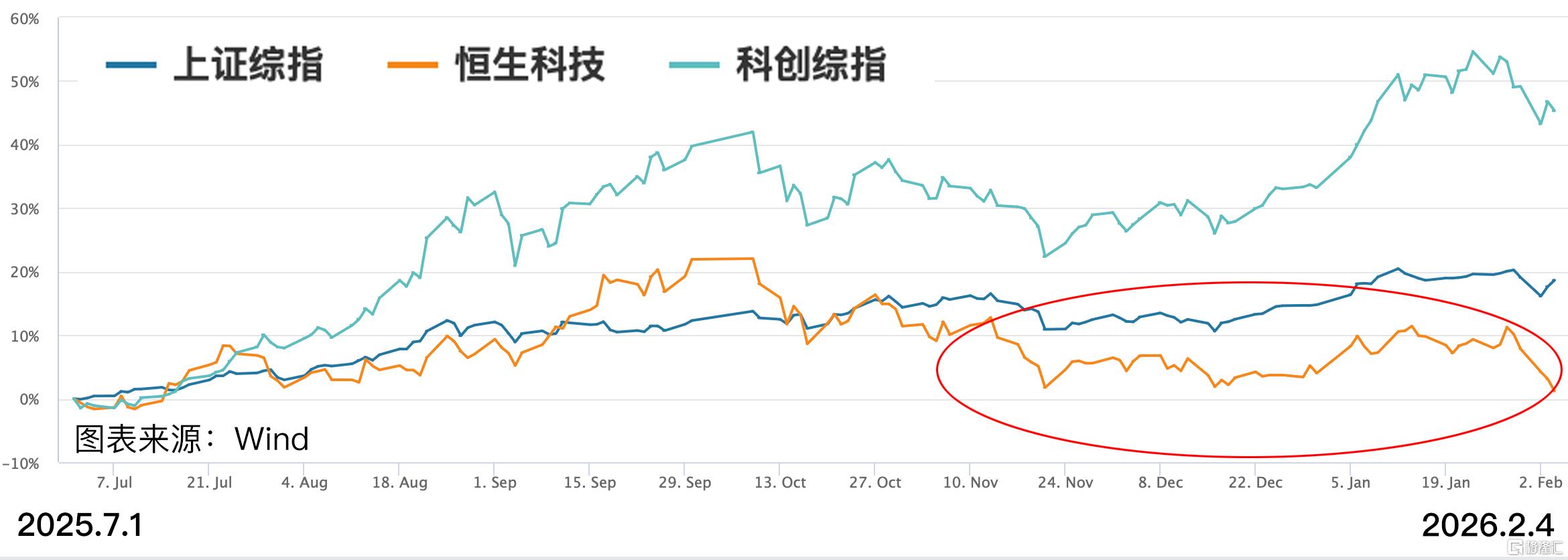
Core Viewpoint - The Hang Seng Tech Index has experienced a significant decline, entering a technical bear market, while A-shares have shown a contrasting upward trend, raising questions about the performance of the tech sector in Hong Kong compared to mainland China [1][3]. Group 1: Index Performance - The Hang Seng Tech Index peaked at 6715 points on October 3, 2025, but has since fallen to 5366 points by February 4, 2026, marking a decline of over 20% [1]. - In contrast, the Shanghai Composite Index rose from a low of 3815 points on December 16, 2025, to 4102 points, achieving a gain of over 6% [1]. - The tech-focused indices in mainland China, such as the Sci-Tech 200 and Sci-Tech 100, have shown impressive gains of 19.30% and 18.49%, respectively [1]. Group 2: Valuation and Fund Flows - The dynamic price-to-earnings ratio (PE-TTM) of the Hang Seng Tech Index decreased from 24.56 times on September 30, 2025, to 22.87 times, indicating a valuation at the 27.27% percentile over the past decade [3]. - Despite the decline in the index, net inflows from southbound funds have remained positive, with inflows of 925 billion, 1219 billion, 229 billion, and 690 billion yuan over the last four months [3]. Group 3: Component Stock Performance - Among the 30 constituent stocks of the Hang Seng Tech Index, only 5 stocks have risen, while 25 have declined, with significant drops in companies like Li Auto, NIO, and Xiaomi, all experiencing declines exceeding 30% [3]. - Major holdings such as Alibaba, Meituan, and Tencent have also seen substantial declines, with Alibaba down 9.89% and Tencent down 15.84% [3]. Group 4: Market Sentiment and Fund Allocation - Recent rumors regarding increased taxes on internet value-added services have negatively impacted market sentiment, despite being refuted by credible sources [6]. - Some funds have adjusted their regional allocations, reducing exposure to Hong Kong stocks like Alibaba while increasing positions in U.S. stocks such as Google, reflecting a shift in investment strategy [6][9]. - The latest quarterly reports indicate a trend of reallocating assets from Hong Kong to U.S. markets, particularly in sectors like AI and technology, which have shown better performance [9][13].

5日两融余额减少120.12亿元 公用事业行业获融资净买入居首
Sou Hu Cai Jing· 2026-02-06 01:52
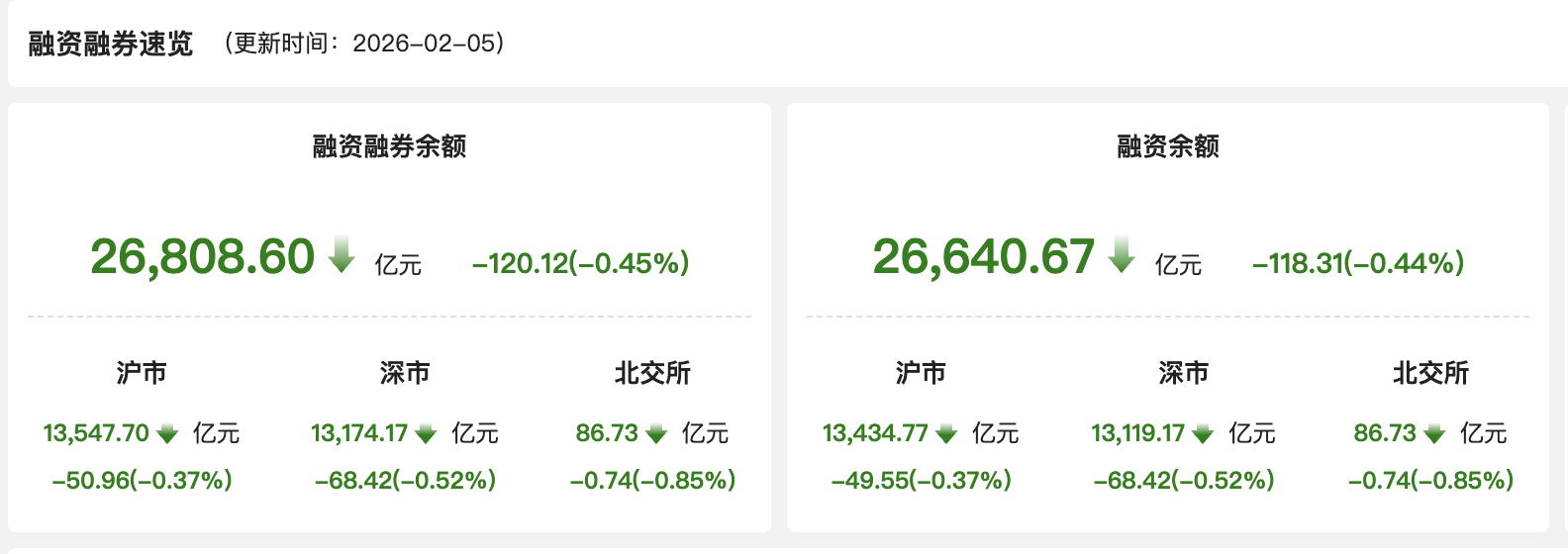
Core Viewpoint - The total margin financing and securities lending balance in A-shares decreased to 26,808.60 billion yuan, a reduction of 120.12 billion yuan from the previous trading day, representing 2.62% of the A-share circulating market value [1] Group 1: Margin Financing and Securities Lending - The margin financing and securities lending balance is 26,808.60 billion yuan, down by 120.12 billion yuan (-0.45%) from the previous day [2] - The trading volume for margin financing and securities lending was 1,993.51 billion yuan, a decrease of 260.13 billion yuan, accounting for 9.08% of the total A-share trading volume [1] Group 2: Industry and Stock Performance - Among the 31 primary industries, 9 industries experienced net financing inflows, with the public utilities sector leading with a net inflow of 3.86 billion yuan [2] - The coal, construction decoration, and basic chemicals industries also saw significant net financing inflows [2] - A total of 20 stocks had net financing inflows exceeding 1 billion yuan, with Zhongji Xuchuang leading at 9.44 billion yuan [2][3] - Other notable stocks with high net financing inflows include Hikvision, SMIC, Shiyun Circuit, Bosheng New Materials, China Railway, Shanxi Black Cat, Pingtan Development, China Satellite, and Dongshan Precision [2][3]



港股大型科网股,全线下跌
Di Yi Cai Jing Zi Xun· 2026-02-06 01:50
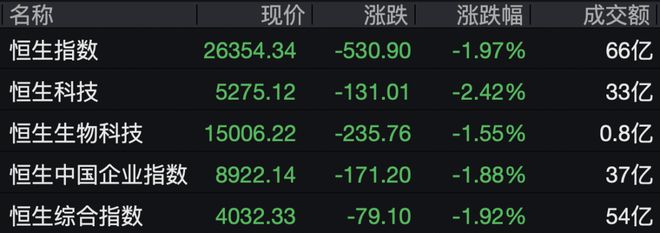
Market Overview - The Hang Seng Index opened down by 1.97%, closing at 26,354.34, a decrease of 530.90 points with a trading volume of 6.6 billion [2] - The Hang Seng Tech Index fell by 2.42%, closing at 5,275.12, down by 131.01 points with a trading volume of 3.3 billion [2] - The Hang Seng Biotech Index decreased by 1.55%, closing at 15,006.22, with a trading volume of 0.08 billion [2] - The Hang Seng China Enterprises Index dropped by 1.88%, closing at 8,922.14, with a trading volume of 3.7 billion [2] - The Hang Seng Composite Index fell by 1.92%, closing at 4,032.33, with a trading volume of 5.4 billion [2] Sector Performance - Technology stocks experienced a broad decline, with Baidu Group falling over 4%, and Alibaba, Kuaishou, Bilibili, NetEase, and Hua Hong Semiconductor all dropping over 3% [2] - Other notable declines included SenseTime, JD Group, Tencent Holdings, and SMIC, each down by more than 2% [2] Individual Stock Movements - Baidu Group-SW decreased by 4.33%, closing at 134.80 [3] - Kingdee International fell by 4.30%, closing at 10.90 [3] - JD Health dropped by 3.96%, closing at 58.25 [3] - Alibaba-W declined by 3.82%, closing at 153.50 [3] - Kuaishou-W decreased by 3.70%, closing at 70.30 [3] - Bilibili-W fell by 3.29%, closing at 234.80 [3] - NetEase-S dropped by 3.06%, closing at 186.70 [3] - Other notable declines included Xpeng Motors, SenseTime, JD Group-SW, Tencent Holdings, and SMIC, all experiencing declines between 2.15% and 2.90% [3] Commodity Sector - The non-ferrous metals sector continued to show weakness, with China Gold International, Jiangxi Copper, Lingbao Gold, and Shandong Gold all dropping over 5% [4] - China Gold International fell by 5.36%, closing at 180.00 [4] - Jiangxi Copper decreased by 5.34%, closing at 41.10 [4] - Lingbao Gold and Shandong Gold both fell by 5.11%, closing at 20.78 and 36.74 respectively [4]




科创芯片ETF(588200)开盘跌1.60%,重仓股中芯国际跌1.48%,海光信息跌1.00%
Xin Lang Cai Jing· 2026-02-06 01:41
Core Viewpoint - The Sci-Tech Chip ETF (588200) opened with a decline of 1.60%, indicating a negative market sentiment towards the semiconductor sector on February 6 [1] Group 1: ETF Performance - The Sci-Tech Chip ETF (588200) opened at 2.525 yuan, reflecting a decrease of 1.60% [1] - Since its establishment on September 30, 2022, the ETF has achieved a return of 157.22% [1] - The ETF has recorded a return of 4.60% over the past month [1] Group 2: Major Holdings Performance - Key holdings in the ETF include: - SMIC (中芯国际) down 1.48% [1] - Haiguang Information (海光信息) down 1.00% [1] - Cambricon (寒武纪) down 1.49% [1] - Lattice Semiconductor (澜起科技) down 1.87% [1] - Zhongwei Company (中微公司) down 1.23% [1] - Tuojing Technology (拓荆科技) down 0.37% [1] - Chipone (芯原股份) down 3.69% [1] - Hua Hong Semiconductor (华虹公司) down 1.90% [1] - Hu Silicon Industry (沪硅产业) unchanged [1] - Dongxin Co. (东芯股份) down 1.37% [1]


数字经济ETF工银(561220)开盘跌0.47%,重仓股中芯国际跌1.48%,海光信息跌1.00%
Xin Lang Cai Jing· 2026-02-06 01:41
Group 1 - The Digital Economy ETF (工银561220) opened at 1.480 yuan, experiencing a decline of 0.47% [1] - Major holdings in the ETF include companies like SMIC, which fell by 1.48%, and Haiguang Information, which dropped by 1.00% [1] - The ETF's performance benchmark is the China Securities Index for State-Owned Enterprises in the Digital Economy, managed by ICBC Credit Suisse Asset Management [1] Group 2 - Since its inception on May 21, 2025, the ETF has achieved a return of 48.72%, with a monthly return of 0.79% [1]


397股获融资买入超亿元,中际旭创获买入32.89亿元居首
Mei Ri Jing Ji Xin Wen· 2026-02-06 01:26
从融资买入额占当日总成交金额比重来看,有4只个股融资买入额占比超30%。其中陕西黑猫、振德医 疗、成大生物融资买入额占成交额比重排名前三,分别为61.97%、36.14%、32.04%。 从融资净买入金额来看,有20只个股获融资净买入超亿元。其中,中际旭创、海康威视、中芯国际融资 净买入金额排名前三,分别获净买入9.44亿元、2.53亿元、1.8亿元。 每经AI快讯,Wind数据显示,A股2月5日共有3769只个股获融资资金买入,有397股买入金额超亿元。 其中,中际旭创、新易盛、紫金矿业融资买入金额排名前三,分别获买入32.89亿元、17.8亿元、13.12 亿元。 ...
中芯国际股价连续4天下跌累计跌幅9.08%,诺德基金旗下1只基金持9505股,浮亏损失10.62万元
Xin Lang Cai Jing· 2026-02-05 12:55
资料显示,中芯国际集成电路制造有限公司位于上海市浦东新区张江路18号,香港中环康乐广场8号交易 广场1期29楼,成立日期2000年4月3日,上市日期2020年7月16日,公司主营业务涉及提供0.35微米至14 纳米多种技术节点、不同工艺平台的集成电路晶圆代工及配套服务。主营业务收入构成为:集成电路晶 圆代工93.83%,其他6.17%。 从基金十大重仓股角度 数据显示,诺德基金旗下1只基金重仓中芯国际。诺德兴远优选(012036)四季度持有股数9505股,占 基金净值比例为1.07%,位居第十大重仓股。根据测算,今日浮亏损失约2.89万元。连续4天下跌期间浮 亏损失10.62万元。 诺德兴远优选(012036)成立日期2021年6月1日,最新规模1.09亿。今年以来收益3.87%,同类排名 4773/8873;近一年收益34.4%,同类排名3484/8119;成立以来收益1.04%。 来源:新浪基金∞工作室 诺德兴远优选(012036)基金经理为郝旭东。 2月5日,中芯国际跌2.65%,截至发稿,报111.80元/股,成交49.83亿元,换手率2.23%,总市值8944.54 亿元。中芯国际股价已经连续4天下 ...
业绩爆表+扩产加码,这个赛道的机会藏不住了
3 6 Ke· 2026-02-05 10:12
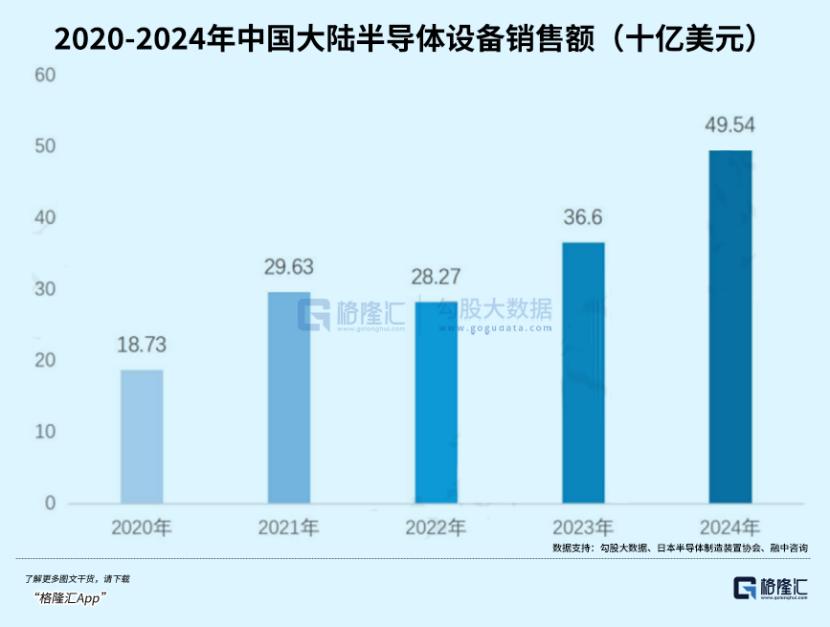
Core Insights - The semiconductor equipment industry is experiencing significant growth driven by AI computing power, domestic substitution, and global capacity expansion, marking a definitive growth cycle for the sector [1][14]. Group 1: Industry Performance - ASML reported a net sales of €32.7 billion in 2025, a 16% year-on-year increase, with a backlog of orders reaching €38.8 billion, of which €25.5 billion is from EUV [1]. - Samsung's semiconductor business saw an operating profit increase of 33%, while SK Hynix's Q4 operating profit surged by 137% [1]. - Domestic semiconductor equipment companies like Jinhaitong and Changchuan Technology also reported significant performance improvements [1]. Group 2: Demand Drivers - The scale application of generative AI has drastically reshaped storage demand, with AI servers requiring 8 times more DRAM and 3 times more NAND than regular servers, and each AI server needing up to 2TB of storage [2]. - HBM (High Bandwidth Memory) is emerging as a key growth driver, with a projected CAGR of 33% from 2024 to 2030, potentially capturing 50% of the DRAM market by 2030 [2]. - Major global storage manufacturers are ramping up production, with Samsung's capital expenditure for 2025 expected to increase by 89% and SK Hynix raising its capital expenditure to $20.3 billion [2]. Group 3: Domestic Market Dynamics - The domestic semiconductor equipment localization rate is projected to reach 35% in 2024, up from 16.4% in 2022, with etching equipment localization at 23% and CMP equipment at 30%-40% [3]. - China has maintained its position as the largest semiconductor equipment market globally for five consecutive years, with sales expected to reach $49.54 billion in 2024, accounting for 42.34% of the global market [3]. Group 4: Future Outlook - The global DRAM industry capital expenditure is forecasted to reach $61.3 billion in 2026, a 14% increase year-on-year, while NAND Flash capital expenditure is expected to be $22.2 billion, a 5% increase [5]. - ASML's order situation reflects high industry prosperity, with €13.2 billion in new orders in 2025, and a backlog extending to 2027, supporting future capacity releases [5]. - The global semiconductor equipment market is projected to reach $117 billion in 2024, with a CAGR of 8.4% from 2025 to 2033, potentially growing to $224.93 billion by 2033 [5]. Group 5: Key Trends - The competition in advanced processes is intensifying, with global semiconductor giants focusing on 2nm and below, driving demand for high-end semiconductor equipment [10][11]. - Policy and capital support are crucial for the advancement of domestic substitution, with significant investments in key technologies and local government subsidies for R&D [12]. - The demand structure is diversifying, with emerging fields like AI computing centers and electric vehicles driving growth, while domestic companies are expanding into overseas markets [13].