CHANGAN AUTOMOBILE-B(000625)

Search documents
乘用车板块1月23日涨0.49%,北汽蓝谷领涨,主力资金净流出11.47亿元
Zheng Xing Xing Ye Ri Bao· 2026-01-23 09:04
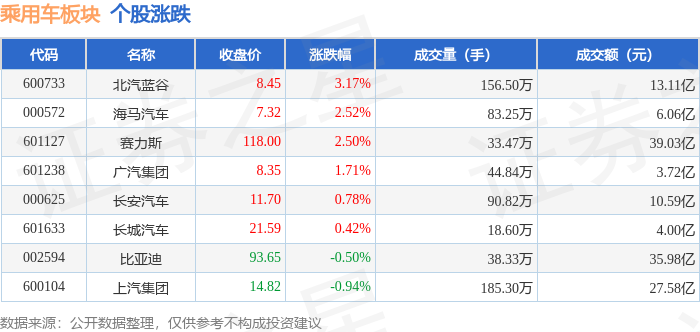
Core Viewpoint - The passenger car sector experienced a slight increase of 0.49% on January 23, with Beijing Blue Valley leading the gains. The Shanghai Composite Index closed at 4136.16, up 0.33%, while the Shenzhen Component Index closed at 14439.66, up 0.79% [1]. Group 1: Market Performance - Beijing Blue Valley (600733) closed at 8.45, up 3.17% with a trading volume of 1.565 million shares and a transaction value of 1.311 billion yuan [1]. - Haima Automobile (000572) closed at 7.32, up 2.52% with a trading volume of 832,500 shares and a transaction value of 606 million yuan [1]. - Seres (601127) closed at 118.00, up 2.50% with a trading volume of 334,700 shares and a transaction value of 3.903 billion yuan [1]. - GAC Group (601238) closed at 8.35, up 1.71% with a trading volume of 448,400 shares and a transaction value of 372 million yuan [1]. - Changan Automobile (000625) closed at 11.70, up 0.78% with a trading volume of 908,200 shares and a transaction value of 1.059 billion yuan [1]. - Great Wall Motors (601633) closed at 21.59, up 0.42% with a trading volume of 186,000 shares and a transaction value of 400 million yuan [1]. - BYD (002594) closed at 93.65, down 0.50% with a trading volume of 383,300 shares and a transaction value of 3.598 billion yuan [1]. - SAIC Motor (600104) closed at 14.82, down 0.94% with a trading volume of 1.853 million shares and a transaction value of 2.758 billion yuan [1]. Group 2: Fund Flow Analysis - The passenger car sector saw a net outflow of 1.147 billion yuan from institutional investors, while retail investors contributed a net inflow of 718 million yuan [1]. - The main fund inflow for Seres (601127) was 118 million yuan, accounting for 3.02% of the total, while retail investors had a net outflow of 11.6 million yuan [2]. - Beijing Blue Valley (600733) had a main fund inflow of 108 million yuan, representing 8.26% of the total, with retail investors contributing a net inflow of 35.217 million yuan [2]. - Changan Automobile (000625) experienced a main fund inflow of 43.554 million yuan, accounting for 4.11%, while retail investors had a net inflow of 19.761 million yuan [2]. - Haima Automobile (000572) saw a main fund inflow of 26.734 million yuan, representing 4.41%, with a retail net outflow of 9.9696 million yuan [2]. - GAC Group (601238) had a main fund inflow of 18.375 million yuan, accounting for 4.94%, while retail investors experienced a net outflow of 26.513 million yuan [2]. - Great Wall Motors (601633) had a main fund inflow of 12.320 million yuan, representing 3.08%, with a retail net outflow of 35.988 million yuan [2]. - BYD (002594) experienced a significant net outflow of 686 million yuan from institutional investors, while retail investors had a net inflow of 51 million yuan [2]. - SAIC Motor (600104) faced a substantial net outflow of 788 million yuan from institutional investors, while retail investors had a net inflow of 34.2 million yuan [2].







内存领衔、涨价潮压顶 汽车行业供应链迎成本与自主升级大考
Zhong Guo Zheng Quan Bao· 2026-01-22 23:22
Core Insights - The automotive industry is facing significant cost pressures due to a shortage of memory chips and rising prices of raw materials, which are impacting supply chain dynamics and competition rules [1][2][3] Group 1: Cost Pressures - The shortage of memory chips has escalated into a systemic issue affecting the entire automotive supply chain, with prices for automotive-grade DDR4 and DDR5 memory increasing by over 150% and 300% respectively since the second half of 2025 [2] - Global storage prices are expected to rise by an additional 40% to 50% in the first quarter of 2026, with a supply gap for general DRAM projected to remain between 15% and 20% [2] - The automotive sector is at a disadvantage in the competition for memory resources, as leading manufacturers prioritize supply to AI and cloud computing sectors, which offer higher profit margins [3] Group 2: Raw Material Price Increases - Prices for essential metals like copper and silver, which are critical for automotive electrical systems and batteries, have also seen significant increases since the second half of 2025 [3] - The competition for these raw materials between the automotive and AI industries has intensified, although current price increases have not yet fully reached end consumer prices [3] Group 3: Supply Chain Strategies - Automotive companies are implementing various strategies to mitigate cost pressures, including technological innovations and supply chain partnerships [5] - Companies like CATL are leveraging scale and technology to manage battery costs, while others are optimizing memory usage through software upgrades [5] - Long-term supply agreements and price locking strategies are being adopted by companies like Changan and Leap Motor to counteract rising costs of critical components [6] Group 4: Industry Dynamics and Competition - The memory crisis is leading to a differentiation in the automotive industry, with larger companies better able to absorb costs compared to smaller firms [7] - The ability to manage supply chains effectively is becoming a critical factor for competitiveness, with larger firms benefiting from established supply chain systems [7] - The crisis may result in a slowdown in the adoption of advanced driving technologies as companies may cut back on non-core storage configurations [7] Group 5: Future Outlook - The automotive industry is encouraged to shift from reactive measures to building autonomous systems, including securing long-term supply agreements and accelerating the validation of domestic storage chips [8] - The ongoing price increases and the transition to electric and intelligent vehicles are expected to concentrate resources among companies with core capabilities, leading to a shift in competition from hardware to integrated software and hardware solutions [8]




注定悲剧的2026,还有多少车企不信邪?
汽车商业评论· 2026-01-22 23:07
Core Viewpoint - The article discusses the challenges and strategies of the Chinese automotive industry as it faces declining domestic sales and increasing pressure to transition towards higher-value and technology-intensive vehicles. The focus is on the 2026 sales targets set by various automakers amidst a backdrop of changing government policies and market dynamics [3][6][8]. Group 1: Market Overview - In 2025, China's automotive production and sales reached 34.4 million units, a 9.4% increase year-on-year, maintaining its position as the world's largest market for the 17th consecutive year [3]. - Domestic sales, excluding exports, were 27.3 million units, up 6.7%, with passenger vehicles accounting for approximately 24.1 million units, growing by 8.0% [5]. - However, December 2025 saw a significant decline in domestic sales, with only 2.519 million units sold, marking a 6.7% month-on-month drop and a 15.6% year-on-year decrease [5]. Group 2: Industry Challenges - The average profit margin in the Chinese automotive industry has fallen to 4.4%, only slightly above the historical low of 4.3% in 2024, indicating extremely thin profit margins [6]. - The new vehicle replacement subsidy policy, shifting from fixed subsidies to percentage-based subsidies, targets higher-priced vehicles, which may pressure companies that rely heavily on low-cost models [8]. Group 3: Sales Targets and Strategies - Major automakers have set ambitious sales targets for 2026, with a combined goal of approximately 35 to 36 million passenger vehicles, reflecting a year-on-year increase of 12% to 15% [5]. - Traditional automakers are focusing on stability and efficiency improvements, while new entrants are experiencing significant divergence in their growth strategies [10][30]. - For instance, Changan aims for a total sales target of 3.3 million units in 2026, with a strong emphasis on new energy vehicles, projecting 1.43 million units from this segment [12][15]. Group 4: New Energy Vehicle Focus - The article highlights the increasing importance of new energy vehicles (NEVs) in the sales strategies of various automakers, with companies like Dongfeng targeting 1.7 million NEVs in 2026, representing a significant portion of their overall sales goals [15][26]. - Geely plans to launch over ten new models in 2026, focusing on a comprehensive product matrix to drive sales growth [23]. Group 5: Export Market Dynamics - The export market for Chinese vehicles is thriving, with exports reaching 7 million units in 2025, a 21% increase year-on-year, and NEV exports doubling to 2.6 million units [49]. - Automakers are increasingly prioritizing overseas markets, with many setting aggressive export targets that significantly exceed their overall sales growth targets [51][54]. - For example, Changan's overseas sales target for 2026 is set at 750,000 units, accounting for nearly a quarter of its total sales goal [52].


汽车行业供应链迎成本与自主升级大考
Zhong Guo Zheng Quan Bao· 2026-01-22 20:56
Core Viewpoint - The automotive industry is facing significant cost pressures due to a systemic crisis in the supply chain, particularly driven by shortages and price increases in memory chips and raw materials like copper and silver [1][2][3]. Group 1: Cost Pressures and Supply Chain Challenges - The shortage of memory chips has escalated into a critical issue, with prices for automotive-grade DDR4 and DDR5 memory increasing by over 150% and 300% respectively since the second half of 2025 [2]. - Global storage prices are expected to rise by an additional 40% to 50% in the first quarter of 2026, with a supply gap for general DRAM projected to remain between 15% and 20% [2]. - The automotive sector is at a disadvantage in the competition for memory resources, as leading manufacturers prioritize supply to AI and cloud computing sectors, which offer higher profit margins [3]. Group 2: Raw Material Price Increases - Prices for essential raw materials such as copper and silver have also risen significantly since the second half of 2025, impacting the costs of automotive electrical systems and power batteries [3]. - The competition for these materials between the automotive and AI industries has intensified, although current price increases have not yet fully reached end consumers [3]. Group 3: Strategies for Mitigation - Automotive companies are implementing various strategies to combat rising costs, including technological innovations and supply chain partnerships [5]. - Companies like CATL are leveraging scale and technology to manage battery costs, while others are optimizing memory usage through software improvements [5]. - Long-term supply agreements and strategic partnerships are being established to mitigate price volatility in raw materials [6][7]. Group 4: Industry Impact and Future Outlook - The ongoing memory crisis is likely to lead to increased competition and differentiation within the automotive industry, with profit margins under pressure [8]. - Companies with robust supply chain management capabilities are better positioned to withstand these challenges, while smaller firms may struggle [8]. - The crisis may accelerate a shift towards vertical integration and the development of proprietary supply chains, as companies seek to enhance their resilience against future disruptions [9].
美的与长安汽车共探“人-车-家”价值融合
Xin Hua Cai Jing· 2026-01-22 12:41
Core Viewpoint - Midea Group and Changan Automobile have signed a strategic cooperation agreement to focus on the "human-vehicle-home" smart ecosystem, aiming to enhance the interconnectivity between smart homes and smart cars, facilitating comprehensive collaboration from consumer scenarios to enterprise production [1]. Group 1: Strategic Cooperation - The partnership aims to leverage Changan's extensive vehicle lineup and production capacity of nearly 3 million units annually to enhance data and service systems for the "human-vehicle-home" ecosystem [1]. - Midea has previously established collaborations with leading automotive companies such as BYD and Changan since launching its "human-vehicle-home" ecosystem strategy in August of the previous year [1]. Group 2: Industry Trends - The concept of "human-vehicle-home" is evolving from mere remote control of devices to a seamless smart experience across various life scenarios, with vehicle-home interconnectivity becoming a necessity [2]. - Midea is attempting to create new value by focusing on connection, scenarios, and services, rather than just adding functionalities [2]. Group 3: Technological Integration - Midea provides standardized open interfaces and development tools to partners, allowing them to utilize Midea's comprehensive smart home services without being "tied down," thus lowering the psychological barriers and costs for partners to join the ecosystem [2]. - The integration of AI and proactive service capabilities is expected to enhance user experience, such as automatically entering "home mode" when a vehicle approaches within one kilometer of the home [2]. Group 4: Ecosystem Development - Midea is building a more inclusive and sustainable smart ecosystem through open collaboration with partners like Changan, transforming various lifestyle concepts into reality [3].

1月22日深证国企股东回报(970064)指数跌0.25%,成份股山金国际(000975)领跌
Sou Hu Cai Jing· 2026-01-22 10:44
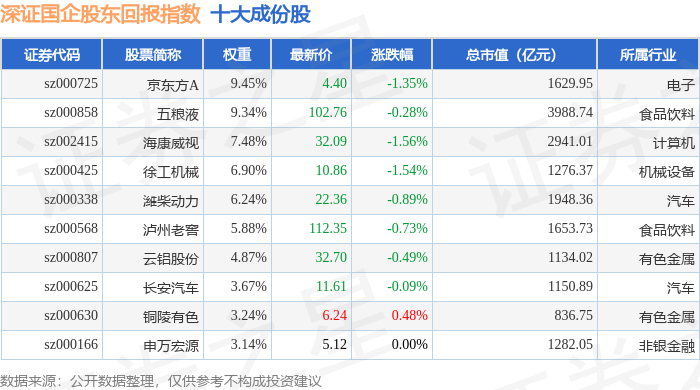
Core Viewpoint - The Shenzhen State-Owned Enterprises Shareholder Return Index (970064) closed at 1740.66 points, down 0.25%, with a trading volume of 37.125 billion yuan and a turnover rate of 1.46% [1] Group 1: Index Performance - On the day, 31 constituent stocks rose, with North New Building Materials leading with a 4.99% increase, while 17 stocks fell, with Shanjin International leading the decline at 2.07% [1] - The index's top ten constituent stocks include: - BOE Technology Group (sz000725) with a weight of 9.45%, closing at 4.40 yuan, down 1.35% [1] - Wuliangye Yibin (sz000858) with a weight of 9.34%, closing at 102.76 yuan, down 0.28% [1] - Hikvision (sz002415) with a weight of 7.48%, closing at 32.09 yuan, down 1.56% [1] - XCMG Machinery (sz000425) with a weight of 6.90%, closing at 10.86 yuan, down 1.54% [1] - Weichai Power (sz000338) with a weight of 6.24%, closing at 22.36 yuan, down 0.89% [1] Group 2: Capital Flow - The net outflow of main funds from the index's constituent stocks totaled 872 million yuan, while retail investors saw a net inflow of 1.149 billion yuan [1] - Detailed capital flow for selected stocks includes: - Yuexiu Capital (000987) with a main fund net inflow of 107 million yuan, but retail outflows of 54.4 million yuan [2] - Huazhong Steel (000932) with a main fund net inflow of 85.6 million yuan, but retail outflows of 33.9 million yuan [2] - Yun Aluminum (000807) with a main fund net inflow of 54.8 million yuan, but retail outflows of 68.3 million yuan [2]




长安+美的推“车控家”功能,首搭启源车型
Nan Fang Du Shi Bao· 2026-01-22 04:04
Group 1 - The core viewpoint of the articles is the strategic partnership between Changan Automobile and Midea Group, focusing on the development of the "Car Control Home" feature to enhance smart connectivity between vehicles and home devices [1][2] - The "Car Control Home" feature will first be available in Changan's new models, Q05 and A06, allowing users to control home appliances remotely through voice commands, creating a seamless integration of home and vehicle management [1] - Future developments will enable users to utilize the Midea App for "Home Control Car" functionalities, providing real-time vehicle status updates and pre-trip preparations, enhancing the overall user experience [1] Group 2 - The signing of the agreement signifies a deeper collaboration between Changan Automobile and Midea Group in areas such as digitalization, smart manufacturing, green energy, logistics coordination, and public welfare, with a focus on vehicle-home connectivity and marketing strategies [2] - The partnership aims to transition vehicle-home connectivity from "technical collaboration" to "experience implementation," creating a more convenient and comfortable smart living environment for users [2]
长安启源Q05首搭“车控家”功能 用户可在车内远程控制智能家电
Feng Huang Wang· 2026-01-22 01:45
Core Viewpoint - Changan Automobile and Midea Group have signed a comprehensive strategic cooperation agreement to deepen collaboration in areas such as vehicle-home connectivity, components, and omnichannel marketing [1] Group 1: Strategic Cooperation - The agreement was signed in Foshan, Guangdong, indicating a significant partnership between the two companies [1] - Both companies aim to enhance the user experience by integrating smart home devices with automotive technology [1] Group 2: Technological Innovations - Changan's "Car Control Home" feature allows users to control home appliances like air conditioning and lighting through voice commands while on the go [1] - This feature will first be available in select models of Changan's Qiyuan series and will be updated via OTA [1] Group 3: Future Developments - The companies are jointly developing "Home Control Car" functionalities to optimize user experience in scenarios like remote vehicle preparation [1] - The collaboration aims to transition vehicle-home connectivity from technical synergy to practical application, creating a smart living environment that integrates people, vehicles, and homes [1]

汽车早报|红旗全固态电池首台样车成功下线 大众汽车集团拟将核心品牌董事会成员削减三分之一
Xin Lang Cai Jing· 2026-01-22 00:41
Group 1: Regulatory Changes - The Ministry of Industry and Information Technology (MIIT) has revised the "Access Review Requirements for Road Motor Vehicle Production Enterprises" and "Access Review Requirements for Road Motor Vehicle Products," effective from January 1, 2027 [1] - The revised "Enterprise Review Requirements" includes 163 articles, maintaining the original framework while enhancing requirements for intelligent and connected capabilities, cybersecurity, data security, and software upgrades [2] - The "Product Review Requirements" have been updated to include safety, environmental, energy-saving, and anti-theft standards, with a focus on reliability testing and the integration of new technologies and materials [2] Group 2: Industry Developments - Hongqi's first solid-state battery prototype has successfully passed extreme heat abuse tests, achieving a high ionic conductivity of over 10 mS/cm [3] - Changan Automobile and Midea Group have signed a comprehensive strategic cooperation agreement to deepen collaboration in digitalization, smart manufacturing, and logistics [4] - Samsung Display will supply three types of car-mounted OLED screens for Zeekr's flagship SUV model, Zeekr 9X, starting in 2024 [5] - Zeekr has established a new sales service company in Taizhou, Zhejiang, with a registered capital of 5 million RMB, focusing on the sale of electric vehicles and related components [6] - Volkswagen Group plans to reduce the number of board members in its core brand group by one-third by summer 2026, aiming to streamline management and achieve cost savings of 1 billion euros by 2030 [7] - Ford is recalling over 119,000 vehicles in the U.S. due to a fire risk associated with engine block heaters, urging affected owners to contact dealers for free inspections [8]

2025四季度国内热销SUV质量排行:小米YU7第一,投诉销量比为万分之0.9
Xin Lang Cai Jing· 2026-01-21 12:53
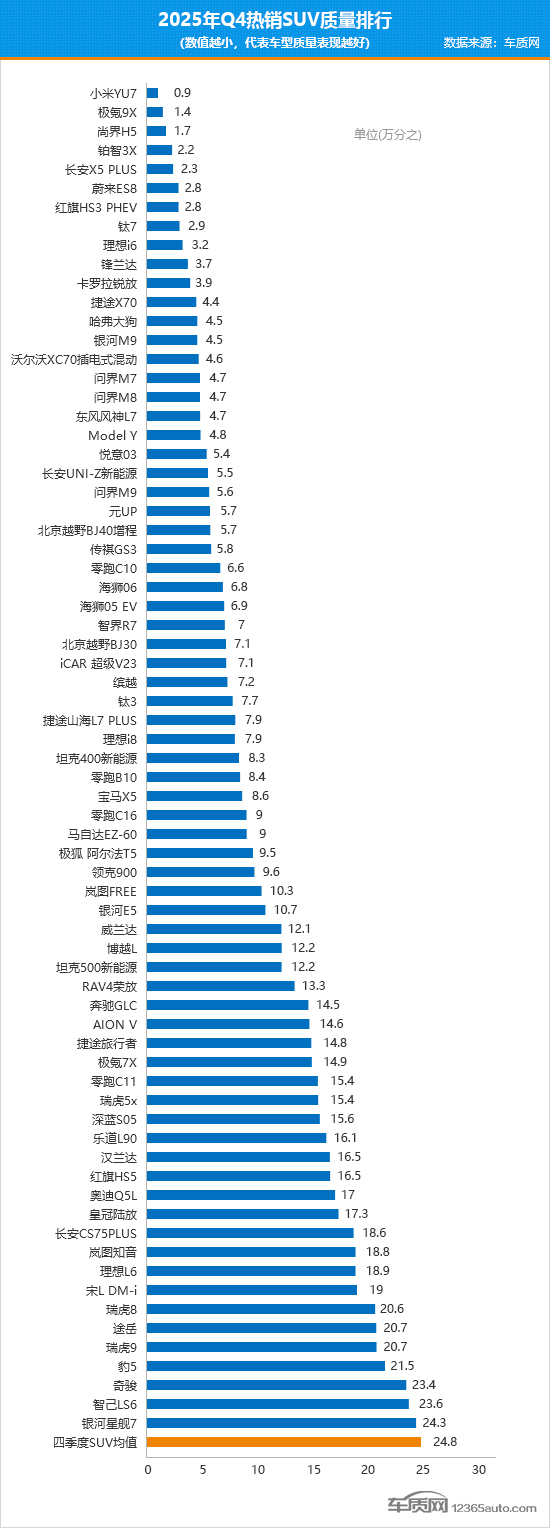
Core Insights - The report from the third-party automotive quality complaint platform Chezhizhong indicates a significant decrease in quality complaints for domestic SUVs in Q4 2025, with a total of 11,984 complaints received, reflecting a quality complaint-to-sales ratio of 24.8 per ten thousand units, a notable improvement from Q3 [1][4]. Group 1: Quality Performance - The average quality complaint-to-sales ratio for domestic SUVs in Q4 2025 is 24.8 per ten thousand units, which shows a substantial recovery in overall quality performance compared to Q3 [1][4]. - Among the 358 models analyzed, 71 models performed better than the average complaint ratio of 24.8 per ten thousand units [1][4]. Group 2: Top Performing Models - The top-performing SUV in terms of quality is the Xiaomi YU7, with a complaint ratio of 0.9 per ten thousand units [1][4]. - The second and third positions are held by the Zeekr 9X and the Shangjie H5, with complaint ratios of 1.4 and 1.7 per ten thousand units, respectively [1][4]. - Other notable models in the top eight include the Toyota Platinum 3X, Changan X5 Plus, NIO ES8, Hongqi HS3 PHEV, and the Fangcheng Bao Titanium, with complaint ratios ranging from 2.0 to 3.0 per ten thousand units [1][4].