
EVE(300014)

Search documents
解码基金“擒牛术”!从同花顺到新易盛,三波牛市验证三大选股核心逻辑
券商中国· 2026-01-12 10:16
Core Insights - The article highlights the exceptional performance of the Yongying Technology Smart A fund, managed by Ren Jie, which achieved a record annual return of 233.29% in 2025, driven by significant holdings in stocks like Xinyi Sheng and Shenghong Technology, both of which saw cumulative increases exceeding 10 times during 2024-2025 [1] - The analysis of A-shares over the past decade reveals that public funds have consistently played a crucial role in the rise of "tenfold stocks" during three notable bull markets, with deep involvement in stocks like Tonghuashun and Yiyuan Lithium Energy [1][2] Investment Logic for Tenfold Stocks - Each bull market is characterized by distinct themes, with public funds aligning their investment strategies closely with policy directions and industrial changes. For instance, during the "leverage bull" from 2014-2015, funds focused on sectors like finance and defense, leading to significant gains in stocks like Tonghuashun and Guangqi Technology [2] - The "core asset bull" from 2019-2021 saw funds targeting high-growth, high-barrier stocks, reflecting a shift towards quality investments amid consumption and industrial upgrades [2][3] Performance Metrics of Tenfold Stocks - The article notes that the average compound profit growth rate of tenfold stocks during the 2019-2021 period was 69.61%, with an average price increase of 12.9 times. Notable examples include Sunshine Power, which saw a price increase of 15.54 times, and Shanxi Fenjiu, benefiting from consumption upgrades [3] - In the 2024-2025 market, driven by policies promoting technological self-reliance, funds focused on tech companies with core technologies, leading to significant profit growth for stocks like Xinyi Sheng and Shenghong Technology, with peak fund holding ratios of 40.65% and 23.68%, respectively [3] Fund Investment Strategies - Public funds have evolved their stock selection strategies from short-term trend capturing to long-term value digging, with a clear trajectory of improvement in selection capabilities. During the "leverage bull," funds primarily engaged in short-term speculation, while the "core asset bull" period saw a more in-depth analysis of company fundamentals [6][7] - The current strategy emphasizes forward-looking research and precise selection based on industry fundamentals, moving away from broad trend-following approaches to a more nuanced understanding of market dynamics [7] Practical Insights for Investors - Investors are advised to focus on funds' capabilities in core sectors, as evidenced by the performance of funds like Yongying Technology Smart A, which significantly outperformed the market by concentrating on leading stocks [8] - The sustainability of fund holdings and their alignment with performance metrics is crucial for long-term returns. Stocks that consistently deliver earnings, like Yiyuan Lithium Energy, have proven to be beneficial for funds, while those reliant on external events may pose higher risks [9] - Maintaining a diversified investment portfolio is essential for risk management, as concentrated funds may face volatility during industry rotations. Investors should consider allocating funds across various themes to balance opportunities and risks [9]






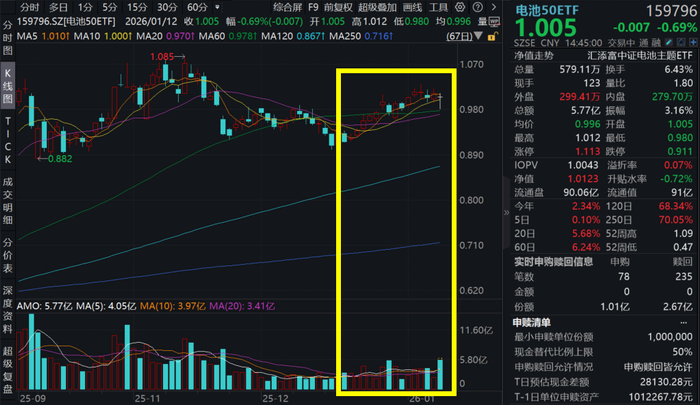
A股现天量,两市成交超3.6万亿元创新高!电池50ETF(159796)逆市爆量收跌,电池出口退税政策调整,影响几何?
Xin Lang Cai Jing· 2026-01-12 08:55
Core Viewpoint - The A-share market experienced a significant surge on January 12, with over 4,100 stocks closing in the green and a record trading volume of 3.64 trillion yuan, surpassing the previous high on October 8, 2024. The adjustment of export tax rebate policies for batteries has influenced market dynamics, leading to a notable increase in trading activity for the Battery 50 ETF (159796), which closed down 0.69% despite a trading volume nearing 600 million yuan [1][3]. Group 1: Market Performance - The Battery 50 ETF (159796) saw most of its constituent stocks decline, with notable drops including Sunshine Power and Xian Dao Intelligent, both down over 3%, while Ningde Times and Guoxuan High-Tech fell over 2% [3]. - The trading volume of the Battery 50 ETF (159796) surged to nearly 600 million yuan, indicating heightened investor interest despite the ETF's decline [1][3]. Group 2: Policy Impact - On January 9, two departments announced adjustments to export tax rebate policies, effective from April 1, 2026, which will reduce the VAT export rebate rate for battery products from 9% to 6%, and eliminate it entirely by January 1, 2027 [4][5]. - The previous reduction in export tax rebates for certain photovoltaic and battery products from 13% to 9% in November 2024 had already triggered a rush in exports, and the latest adjustments may lead to a similar surge, benefiting the lithium carbonate sector [5]. Group 3: Industry Outlook - Global demand for energy storage is expected to grow steadily, with projections indicating that global energy storage installations will reach 404 GWh by 2026, representing a 38% year-on-year increase [5]. - The battery sector is experiencing a sustained upward trend, driven by the growth of the global electric vehicle market, with domestic battery installations expected to maintain high growth rates through 2026 [5][6]. - Solid-state battery technology is advancing, with potential for significant industry upgrades, as companies that can provide stable supply and mature processes are likely to benefit [6]. Group 4: Investment Strategy - The Battery 50 ETF (159796) is positioned to benefit from its high content in energy storage (18.7%) and solid-state batteries (45%), making it a strong candidate for investors looking to capitalize on these growing segments [7][9]. - The ETF's focus on battery chemicals, which account for 31% of its weight, positions it well to benefit from the recovery of upstream material prices, enhancing the overall industry outlook [9][12].




碳酸锂行情“V型反转”2026年能否继续“狂飙”?
Zhong Guo Jing Ying Bao· 2026-01-12 08:13
Group 1: Market Trends - The lithium carbonate market is expected to experience a rebound in 2025, with prices initially fluctuating around 75,200 CNY/ton and dropping to a low of 59,000 CNY/ton by June, before surging to over 130,000 CNY/ton by December, marking an increase of over 120% from the low [1][2] - The price trajectory of lithium carbonate in 2025 is characterized by a typical V-shaped curve, with a significant drop in early months followed by a strong recovery in the latter half of the year [1][2] - By December 2025, the price of lithium carbonate futures reached 134,500 CNY/ton, despite a slight pullback afterward, indicating a robust market recovery [2] Group 2: Industry Dynamics - The demand for lithium carbonate is supported by the growth in the energy storage market and the increasing orders from battery manufacturers, which have led to a reduction in market inventory [3][4] - The new energy storage capacity in China has exceeded 100 million kilowatts, representing a growth of over 30 times compared to the end of the 13th Five-Year Plan, accounting for over 40% of the global total [4] - The performance of lithium battery companies has improved significantly, with companies like Tianqi Lithium and Ganfeng Lithium seeing stock price increases of over 160% and 173% respectively from their lows in 2025 [3] Group 3: Future Outlook - The lithium market is expected to face uncertainties in 2026, with potential price fluctuations influenced by supply and demand dynamics, as well as the impact of futures trading [6][7] - The global demand for lithium is projected to reach 2 million tons of lithium carbonate equivalent by 2026, driven by the growth in electric vehicles and energy storage sectors [7] - The development of alternative technologies, such as sodium batteries, may introduce new variables into the market, potentially exerting downward pressure on lithium carbonate prices [9]


电池出口退税下调,看好海外产能布局企业
HTSC· 2026-01-12 07:21
Investment Rating - The industry rating is "Overweight" [6] Core Viewpoints - The adjustment of the battery export tax rebate is expected to boost exports in 2026 and optimize the industry structure, benefiting companies with overseas production capacity [1][2] - The reduction in export tax rates aims to curb low-price competition in the export market and promote the exit of outdated production capacity [2][3] - The battery export tax rebate will lead to two rounds of export rush before the end of 2026, tightening supply and demand across the lithium battery supply chain [3][4] Summary by Sections Export Tax Rebate Adjustment - The export tax rebate for battery products will be reduced from 9% to 6% starting April 1, 2026, and will be eliminated entirely from January 1, 2027 [1] - This policy is expected to drive a surge in battery exports in 2026, intensifying supply-demand tensions in lithium mining and lithium hexafluorophosphate [1][2] Supply Chain Impact - The reduction in export tax is anticipated to tighten the supply-demand balance in the lithium battery industry, with major lithium material utilization rates projected at 92% for lithium hexafluorophosphate and 81% for copper foil in 2026 [3] - The ongoing demand for energy storage and the increasing sales of new energy vehicles in Europe are expected to further support this tightening [3] Recommendations - Companies with established overseas production capacity, such as CATL and Yiwei Lithium Energy, are recommended for investment [1][4] - Other companies in the supply chain, including Tianqi Lithium, New Chemical Materials, and Shangtai Technology, are also highlighted as potential beneficiaries of the tightening supply-demand dynamics [4]



储能大电芯迎来规模化量产元年—CNESA年终盘点
中关村储能产业技术联盟· 2026-01-12 03:32
Core Viewpoint - The energy storage industry is transitioning from a focus on "paper parameters" to practical applications, with large capacity battery cells achieving mass production and delivery, indicating a significant shift towards commercial viability and cost efficiency in energy storage systems [2]. Group 1: Mass Production of Large Capacity Battery Cells - Since 2025, several battery companies have reported significant progress in the mass production of 500Ah+ battery cells, with production capacity and delivery rates accelerating [4]. - CATL has initiated mass production of its 587Ah energy storage battery in June, with a production capacity exceeding 22,000 units per day, aiming for 3GWh of shipments by the end of the year [4]. - EVE Energy plans to start mass production of its 628Ah battery by the end of 2024, with a target of 750,000 units in 2025, and has successfully applied it in a 200MW/400MWh independent energy storage project [4]. - Envision AESC has achieved mass production of its 500+Ah battery cells, with plans for next-generation 700Ah+ products [4]. - Hicharge Energy has launched the world's first 1175Ah battery cell and has completed deliveries of its 587Ah battery [4]. - A number of other companies, including Chuang Neng New Energy and Penghui Energy, are also announcing timelines for the mass production of 500Ah+ and 600Ah+ products, indicating a competitive landscape by 2026 [5]. Group 2: Strategic Collaborations and Supply Chain Dynamics - The relationship between system integrators and battery manufacturers is evolving towards long-term, large-scale, and deeply integrated collaborations [7]. - By the end of 2025, significant orders of over 100GWh highlight the importance of supply chain stability and cost control in market competition [7]. - CATL has signed a procurement agreement for no less than 200GWh with a partner, with its 587Ah battery already applied in a 400MW/2400MWh energy storage project [7]. - EVE Energy has established a three-year collaboration for 20GWh with a partner, including 10GWh of large battery cells [7]. - These long-term agreements not only secure production capacity but also indicate a trend towards early collaborative development between systems and battery cells, enhancing overall product performance and safety [7]. Group 3: Global Market Expansion - The competitiveness of China's energy storage industry is being tested globally, with significant progress in the export of 500Ah+ battery cells [9]. - CATL delivered its 587Ah battery for a project in Abu Dhabi, while EVE Energy secured orders in Australia and signed a project agreement for 1GWh [9]. - Hicharge Energy has partnered with a Saudi power company for a 1GW/4GWh energy storage project, utilizing its 1175Ah battery cell [9]. - The export of large battery cells represents not only product output but also the extension of system solutions and standards, opening new opportunities for Chinese energy storage companies in the global long-duration energy storage market [9]. Group 4: Industry Trends and Future Directions - The 500Ah+ battery cells are still in a rapid development phase characterized by diverse sizes and specifications, but there is a consensus that 6MWh+ energy storage systems will accelerate the replacement of previous 5MWh+ solutions, driving down energy storage costs [10]. - The year 2025 is positioned as a pivotal year for large battery cells transitioning from laboratory settings to practical applications in energy storage systems [10].
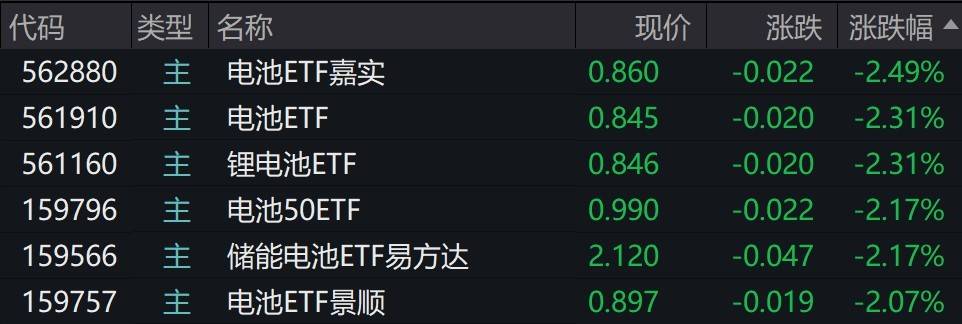
电池概念股走弱,多只电池相关ETF跌超2%
Sou Hu Cai Jing· 2026-01-12 02:50
Group 1 - Battery concept stocks weakened, with major players like Sunshine Power and CATL dropping over 4%, while companies such as Yiwei Lithium Energy, Xianlead Intelligent, Guoxuan High-Tech, and Xinwanda fell more than 3% [1] - Several battery-related ETFs declined by over 2% due to the impact of heavy-weight stock declines [1] Group 2 - Recent analysis indicates that policy support has injected strong momentum into the battery industry, with the government continuously launching encouraging policies for new energy vehicles, including trade-in programs, charging infrastructure development, and promoting new energy in rural areas, which further releases consumer potential [2] - The gradual implementation of "anti-involution" policies is leading to more rational competition within the industry, suggesting an improvement in the overall profitability environment [2]


中银国际:供需格局有望重塑 固态电池加速落地
Zhi Tong Cai Jing· 2026-01-12 02:33
Core Viewpoint - The report from Zhongyin International indicates that global sales of new energy vehicles (NEVs) are expected to maintain high growth, potentially reaching a historical high by 2026, driven by strong demand and technological advancements in the industry [1][2]. Group 1: New Energy Vehicle Market - Global demand for new energy vehicles is projected to continue growing, with sales expected to reach approximately 26 million units in 2026, representing a year-on-year increase of about 15% [2]. - The market is experiencing steady growth, with increasing penetration rates and expanding market space, supported by the introduction of new models and advancements in smart and connected technologies [2]. Group 2: Battery Industry Outlook - The demand for power batteries is expected to grow significantly, with domestic installed capacity projected to maintain a high growth rate in 2026 [3]. - The market share of lithium iron phosphate batteries is anticipated to continue rising, while the costs of lithium battery raw materials have increased since October 2025, posing challenges for battery manufacturers in cost management [3]. Group 3: Material Sector Dynamics - The consensus on "anti-involution" in the midstream materials sector suggests that high demand coupled with cautious capacity expansion may lead to a supply-demand mismatch, particularly in the lithium hexafluorophosphate segment, which is expected to see price recovery [4]. - Companies in the tight supply segments, such as lithium iron phosphate cathodes, separators, anodes, and copper foils, are recommended for investment due to their potential for profit recovery [4]. Group 4: Solid-State Battery Development - The industrialization of solid-state batteries is accelerating, entering a phase of pilot testing and small-scale vehicle validation, which is expected to benefit equipment manufacturers and high-value material segments [5]. - Companies that can achieve stable supply, have mature processes, and clear cost reduction paths are recommended for investment, especially those that have collaborated early with industry leaders [5]. Group 5: Investment Recommendations - The new energy vehicle supply chain is expected to maintain high growth, with battery cell segments showing strong resilience in profitability [6]. - Investment focus is suggested on leading companies in tight supply segments and those involved in solid-state battery technology, including firms like CATL, EVE Energy, and others listed in the report [6].
全球首款量产固态电池已诞生在芬兰,中国企业为何不怕?
3 6 Ke· 2026-01-12 01:44
Core Viewpoint - The Finnish startup Donut Lab has announced the release of a solid-state battery, claiming it has a cycle life of up to 100,000 times, an energy density of 400 Wh/kg, and a rapid charging capability of 5 minutes, which has surprised the market and raised questions about the competitive landscape in solid-state battery technology [1][3][5]. Group 1: Donut Lab's Solid-State Battery - Donut Lab's solid-state battery is claimed to have a cycle life of 100,000 times and an energy density of 400 Wh/kg, with a charging time of just 5 minutes [3][5]. - The company asserts it has the capability for gigawatt-hour level mass production and can supply globally [3]. - The announcement has caused concern among investors, questioning whether the solid-state battery's "D-Day" has arrived while others remain passive [5]. Group 2: Market Reactions and Competitor Responses - Despite the significant announcement, the response from global battery and automotive manufacturers, particularly Chinese companies, has been muted [5][6]. - Chinese companies may not be worried due to previous announcements of breakthroughs in solid-state battery technology by other firms like Nissan and Toyota, which have not yet materialized into market-ready products [6][10]. - The lack of immediate reaction from Chinese firms suggests confidence in their existing technology and market position [21][29]. Group 3: Challenges and Skepticism - There are doubts about the feasibility of Donut Lab's claims, particularly regarding the cycle life and cost of solid-state batteries, which are traditionally much higher than lithium-ion batteries [14][16]. - The solid-state battery industry faces significant challenges, including interface resistance, slow ion transport, high manufacturing costs, and low yield rates [18][20]. - The skepticism is further fueled by the lack of detailed specifications and pricing information from Donut Lab [20]. Group 4: China's Position in Solid-State Battery Development - China has a comprehensive and robust supply chain for electric vehicle batteries, with significant advancements in solid-state battery technology expected in the coming years [27][29]. - Major Chinese companies like CATL and BYD are planning to launch solid-state batteries with competitive energy densities and production timelines, indicating a strong domestic market focus [25][26]. - The Chinese market's scale and the established supply chain provide a competitive advantage, making it less likely for Chinese firms to be intimidated by new entrants like Donut Lab [22][29].

GGII:2026年电池行业十大预测(下)
高工锂电· 2026-01-11 11:09
Core Viewpoint - The industry is transitioning from an emotion-driven phase to a rational value-return cycle by 2026 [3]. Group 1: Solid-State Battery Market - The shipment volume of semi-solid-state batteries is expected to exceed 15 GWh in 2026, driven by the acceleration of pilot and early production lines, such as those from GAC Group and Qingtao Energy [5]. - Significant improvements in solid-state battery core materials and processes are anticipated, with energy density reaching 400 Wh/kg by 2025, a notable increase from below 350 Wh/kg in 2024 [5]. - The market growth remains uncertain due to challenges in controlling consistency in oxide and polymer routes, affecting product yield and delivery stability [5]. - Full solid-state batteries will enter intensive road testing phases but are unlikely to achieve mass production within the year due to technical bottlenecks and high costs [6]. Group 2: IPO Trends in Lithium Industry - A wave of IPO applications from lithium industry chain companies is expected in 2026, with leaders in materials, equipment, energy storage integration, and solid-state batteries likely to benefit first [6]. - Material companies are seeing an expanded supply-demand gap for high-end products, accelerating the IPO process for those with technological advantages and strong customer ties [7]. - Resource companies with lithium mining capabilities are more likely to restart IPOs due to inventory reduction and rising price levels [8]. - Equipment companies are benefiting from the recovery in battery factory expansion demands, focusing on semi-solid and full solid-state battery equipment [8]. - Energy storage integration companies are transitioning to a profitable model based on technology and service premiums, increasing their chances of successful IPOs [8]. Group 3: Sodium-Ion Battery Market - The shipment volume of sodium-ion batteries in China is projected to exceed 10 GWh in 2026, doubling year-on-year, driven by rising lithium battery material prices and cost advantages in energy storage applications [10]. - Sodium batteries are expected to address performance limitations of lithium batteries, particularly in low-temperature environments, making them suitable for northern markets [10]. - Leading companies like CATL are accelerating their sodium battery deployment across various sectors, including energy storage and electric vehicles [10]. - The NFPP sodium-ion battery is expected to dominate with over 80% market share due to its advantages in stability and cost [10]. Group 4: Cylindrical Battery Market - The shipment volume of cylindrical batteries in China is expected to grow over 50% year-on-year, surpassing 45 GWh, with energy storage being a key growth area [12]. - The demand for cylindrical batteries is driven by the need to replace square cell structures in home storage products, providing a low-cost and high-safety solution [12]. - Rapid capacity release in 2025 is expected to support supply, with major companies focusing on different market segments, ensuring a breakthrough in shipment volumes [12]. Group 5: Silicon-Based Anode Materials - The application of CVD silicon-based composite anode materials in the 3C digital battery market is expected to exceed 50% by 2026, leading to significant growth in output [15]. - The demand for higher energy density and lighter batteries in 3C products is driving the adoption of silicon-carbon composite anodes [15]. - However, technological challenges remain in the large-scale application of these materials in power batteries, particularly regarding consistency in manufacturing processes [15].
锂电产业链双周报(2026年1月第1期):四部委召开会议规范产业竞争,锂电池出口退税政策将陆续退出-20260111
Guoxin Securities· 2026-01-11 09:07
Investment Rating - The investment rating for the lithium battery industry is "Outperform the Market" (maintained) [1] Core Insights - The solid-state battery industry is accelerating, with the first national standard for automotive solid-state batteries being publicly solicited for opinions. Key projects include the production of a 2GWh solid-state lithium metal battery by Xinjie Energy and the successful trial production of a full solid-state battery pack by Hongqi [6][19] - A meeting held by four ministries highlighted the need to regulate competition in the power and energy storage battery industry, addressing issues like irrational competition and overcapacity risks. The meeting emphasized the importance of market order and quality supervision [6][16] - Recent adjustments to export tax policies for lithium batteries and materials are expected to enhance the competitive advantage of leading companies in the industry, potentially leading to price increases and alleviating low-price competition issues [6][16] Industry Dynamics - Domestic new energy vehicle sales reached 1.478 million units from January to November, a year-on-year increase of 31%, with a penetration rate of 53.2% [6] - In Europe, new energy vehicle sales in December reached 324,000 units, up 39% year-on-year, while in the US, sales were 83,600 units, down 42% year-on-year [6] - Lithium salt prices have risen, with lithium carbonate priced at 140,000 yuan per ton, an increase of 28,100 yuan compared to two weeks ago [6][26] Investment Recommendations - Focus on leading companies in the lithium battery industry with low valuations amid sustained demand, including CATL, Yiwei Lithium Energy, and others [6] - Consider companies leading in the low-carbon economy and robotics sectors, as well as those with solid-state battery material capabilities [6] - Monitor companies in the charging pile industry and those leading in lead-acid batteries for electric bicycles [6]