EVE(300014)

Search documents
【硬科技头条】算力中心加剧全球电力短缺,巨额储能订单涌入深圳供应链
Xin Lang Cai Jing· 2026-02-24 01:08
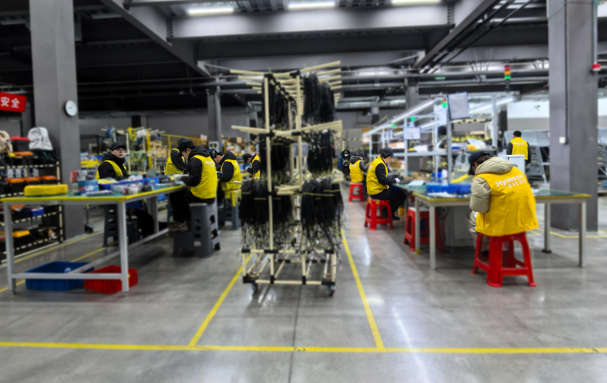
智通财经记者 | 梁宝欣 智通财经编辑 | 林腾 随着全球新能源基建的加速扩张,叠加AI数据中心对电量极大的渴求,储能设备正被全球争相采购。 拥有完善新能源电池产业链的深圳供应链们,正在获得极速增长的庞大订单。 深圳储能激光设备供应商海目星负责人向界面《硬科技头条》记者透露,因为不断涌入的订单,公司一 线生产员工数量几乎翻倍,2025年下半年发货量同比增长约80%,目前订单排产已处于满载状态,仅 2026年1月新增订单金额就有望超过10亿元。 "有一段时间,每天都有1个亿的订单量",上述人士激动地说。 界面《硬科技头条》记者注意到,近期,海目星在深圳、常州等地同步扩招,重点集中在电气工程、设 备装配和现场调试等岗位。其中,一线制造与厂内/售后现场机电安装调试岗位一次性扩招规模超过500 人。 海目星常州厂 区锂电设备产线现场。 图源:海目星 这种生产节奏的"拉满",正是订单压力传导至用工端的直接表现。而下游扩产预期的升温,也让2025年 曾面临大额亏损的海目星在财务上迎来了拐点。2025年第四季度,海目星的净利润实现扭亏为盈,结束 了此前的业绩承压状态。 "储能逆变器从2025年一季度开始有需求,年内陆续开始 ...





锂电1月洞察:动储收官迎新高,碳酸锂趋势反转
SINOLINK SECURITIES· 2026-02-23 10:45
Investment Rating - The report maintains a "Buy" rating for the electric power equipment and new energy industry [1] Core Insights - The lithium battery sector is experiencing a price surge, with lithium carbonate prices rising to 170,000 CNY/ton, a 42% increase from the previous month, and lithium hydroxide prices increasing by 62% to 165,000 CNY/ton [1] - In December, the wholesale sales of domestic new energy passenger vehicles reached 1.42 million units, with a year-on-year increase of 26% for the entire year [1] - The report highlights a reversal in the lithium carbonate cycle, driven by domestic energy storage capacity subsidy policies and the explosive growth of global new energy demand [3][32] Summary by Sections Section 1: Research Insights - The lithium carbonate market is at a cyclical turning point, with prices expected to rise significantly, impacting the entire lithium battery supply chain [14][15] - Sodium batteries are emerging as a cost-effective alternative, with a clear long-term cost advantage over lithium iron phosphate batteries [26][30] Section 2: Industry Tracking and Review - The global new energy vehicle market showed strong growth in December, particularly in China and Europe, while the U.S. market faced challenges [34][36] - In December, domestic energy storage installations reached 63 GWh, a 95% year-on-year increase, indicating a shift towards market-driven growth [40] Section 3: Investment Recommendations - The report recommends focusing on companies involved in lithium carbonate, separators, and solid-state battery technologies, including Ningde Times, Yiwei Lithium Energy, and others [7][32]


锂电产业链双周报(2026年2月第2期):宁德亿纬等推出员工持股及激励计划,美国OBBBA法案细则更新
Guoxin Securities· 2026-02-23 10:45
Investment Rating - The investment rating for the lithium battery industry is "Outperform the Market" (maintained) [1] Core Insights - The lithium salt price has decreased, while the prices of battery cells have increased slightly. As of February 13, the price of lithium carbonate is 144,000 CNY per ton, down by 17,000 CNY from two weeks ago. The prices of ternary cathodes, lithium iron phosphate cathodes, electrolytes, and lithium hexafluorophosphate have also decreased, while the prices of anodes and separators remain stable. The prices for square ternary power cells, lithium iron phosphate power cells, and energy storage cells have increased slightly [2][3] - The solid-state battery industry is accelerating its commercialization, with the first national standard for automotive solid-state batteries expected to be reviewed and approved in April and officially released in July. Companies like Gotion High-Tech and BASF are collaborating to develop solid-state battery technology [3][10][11] - The domestic new energy vehicle sales in January 2026 reached 945,000 units, a slight year-on-year increase, while the penetration rate is 40.3%, up by 1.3 percentage points year-on-year [3][12] Industry Dynamics - The report highlights several leading companies in the lithium battery sector that are undervalued amid improving demand, including CATL, EVE Energy, and others. It also points to companies leading in low-altitude economy and robotics, solid-state and sodium battery materials, and charging pile industries [3] - The U.S. Treasury Department has updated details regarding the OBBBA Act, tightening certification for specific foreign entities and detailing the calculation of material assistance ratios [3][13][14] - The report notes significant investments in battery production projects, including an 80GWh project by Chuangneng in Wuhan and a 33 billion CNY investment by Penghui Energy for new battery production lines [10][18] Price Trends - The report provides a detailed overview of lithium battery material prices as of February 13, 2026, indicating a decrease in lithium carbonate prices by 10.4% compared to two weeks prior, while other materials like nickel sulfate and cobalt sulfate have shown varying price changes [19] - The price of square lithium iron phosphate batteries has increased by 1.5% to 0.336 CNY/Wh, while the price of square ternary power cells remains stable at 0.582 CNY/Wh [19]
锂电产业链双周报(2026年2月第2期):宁德亿纬等推出员工持股及激励计划,美国OBBBA法案细则更新-20260223
Guoxin Securities· 2026-02-23 07:54
Investment Rating - The investment rating for the lithium battery industry is "Outperform the Market" (maintained) [1] Core Insights - The lithium salt price has decreased, while cell prices have increased. As of February 13, the price of lithium carbonate is 144,000 yuan/ton, down 17,000 yuan/ton from two weeks ago. The prices of ternary cathodes, lithium iron phosphate cathodes, electrolytes, and lithium hexafluorophosphate have also decreased, while the prices of anodes and separators remain stable. The prices for square ternary power cells, lithium iron phosphate power cells, and energy storage cells have increased slightly [2][3] - The solid-state battery industry is accelerating, with the first national standard for automotive solid-state batteries expected to be reviewed and approved in April and officially released in July. Companies like Gotion High-Tech and BASF are collaborating to develop solid-state battery technology [3][10] - The report suggests focusing on leading companies in the lithium battery industry with low valuations amid improving demand, including CATL, EVE Energy, and others [3] Industry Dynamics - The domestic new energy vehicle sales in January 2026 reached 945,000 units, a slight year-on-year increase but a 45% decrease month-on-month. The penetration rate of new energy vehicles in China is 40.3%, up 1.3 percentage points year-on-year [3] - In January 2026, new energy vehicle sales in nine European countries reached 205,200 units, a 20% year-on-year increase but a 37% month-on-month decrease. The penetration rate in Europe is 30.6%, up 7.1 percentage points year-on-year [3] - The U.S. saw new energy vehicle sales of 77,600 units in January 2026, a 31% year-on-year decrease and a 30% month-on-month decrease, with a penetration rate of 7.0% [3] Company Developments - CATL announced an employee stock ownership plan on February 9, 2026, with a total investment of no more than 743 million yuan, involving approximately 404,680 shares [3][15] - EVE Energy released its seventh stock option and restricted stock incentive plan on February 13, 2026, with a total of 150 million shares to be granted [3][18] - The U.S. Treasury Department updated details on the OBBBA Act on February 12, 2026, tightening certification for specific foreign entities and detailing the calculation of material assistance ratios [3][13][14] Market Performance - Over the past two weeks, the lithium battery sector has increased by 4.1%, while the battery chemicals sector has risen by 4.7%. The lithium-specific equipment sector has decreased by 1.8% [7] - Key stock price changes from February 8 to February 13 include a 1.0% decrease for CATL and a 12.3% increase for Enjie [7]
美国1750亿美元关税退税,对A股的影响(附50股)
Sou Hu Cai Jing· 2026-02-21 11:41
Group 1 - The core point of the article is that the recent US Supreme Court ruling on the $175 billion tariff refund has significant implications for both China and the A-share market, despite the refund being an internal US matter [2][6][28] - The $175 billion in tariffs was primarily collected from imports, including a 10% tariff on Chinese goods, and is now being refunded to US importers [8][10] - The refund will indirectly benefit Chinese companies as US importers, who have been financially strained by tariffs, will use the refunded money to pay off debts to Chinese suppliers and resume orders [12][14][28] Group 2 - The immediate impact on the A-share market is expected to be positive, with a potential "opening red" for A-shares as market sentiment improves following the ruling [40][46] - The ruling is seen as a signal that the previous high tariffs on Chinese goods may not be a permanent state, which could lead to a more favorable environment for Chinese exports [20][48] - Structural opportunities in the A-share market are identified, focusing on five main lines: export-oriented sectors, domestic substitution, strategic resources, domestic consumption, and new energy [51][62][88] Group 3 - Export-oriented sectors, particularly those with high exposure to the US market, are expected to benefit directly from the tariff refunds, with companies like Midea Group and Haier expected to see improved performance [52][72][73] - Domestic substitution and self-sufficiency in sectors like semiconductors and military equipment are highlighted as long-term strategic focuses, with companies like SMIC and AVIC Shenyang Aircraft being key players [53][78][86] - Strategic resources such as rare earths and gold are also expected to see price support due to ongoing global supply chain disruptions, benefiting companies like Northern Rare Earth and Shandong Gold [56][87]




【兴证策略张启尧团队】2026年出海链有哪些投资机会?
Xin Lang Cai Jing· 2026-02-21 01:42
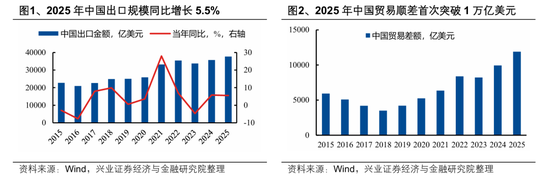
Group 1 - In 2025, China's foreign trade showed strong resilience, with total exports reaching a historical high, growing by 5.5% year-on-year, despite a complex external environment [1][57] - China's trade surplus exceeded $1 trillion for the first time, marking a significant increase of 19.8% year-on-year [1][57] - The net export of goods and services contributed 1.64 percentage points to GDP growth, the second-highest level since 2007, only behind 2021 [3] Group 2 - The diversification of external demand has strengthened, with emerging markets compensating for the decline in exports to the US, which fell by 19.79% year-on-year [6] - Exports to ASEAN, Africa, and the Middle East saw significant growth rates of 25.9%, 13.64%, and 9.7% respectively, contributing positively to the overall export scale [6] - The share of US exports in China's total exports decreased by 3.53 percentage points to 11.15% [6] Group 3 - The product structure of China's foreign trade is shifting towards higher value chains, with high-end products like electrical machinery, machinery, automobiles, and ships being the main export drivers [8] - Traditional light industrial products such as furniture and toys have seen a decline in export scale due to tariff friction and industrial chain relocation [8] Group 4 - The restructuring of global supply chains is creating significant opportunities for Chinese companies, with a notable increase in the number of Chinese enterprises establishing production capacities abroad, reaching 229 in 2025, nearly doubling from 2024 [18] - ASEAN, Mexico, and India are the primary destinations for Chinese production capacity outflows, with ASEAN covering a wide range of industries [18] Group 5 - The AI expansion cycle is a core focus in the Chinese capital market, with significant growth expected in AI computing hardware, supported by macro investment scales and healthy balance sheets of major tech companies [29][30] - The capital expenditure of major cloud service providers is projected to increase significantly, reflecting strong demand for AI computing [35] Group 6 - Cultural and technological value output is becoming a major trend for Chinese enterprises going abroad, with significant growth in IP exports and innovative products in sectors like gaming and new dining [39][41] - The Chinese innovative pharmaceutical sector is increasingly integrated into the global supply chain, with more products commercialized in the US and Europe [41] Group 7 - Key sectors with strong overseas expansion opportunities in 2026 include new energy (batteries, grid equipment), machinery, TMT (technology, media, telecommunications), and innovative pharmaceuticals [46] - The gaming industry is also highlighted for its potential, with significant overseas revenue growth expected [49]


巴克莱:2035年AI机器人或成万亿美元赛道 中国占据主导地位
智通财经网· 2026-02-17 23:31
报告举例称,梅赛德斯-奔驰集团正利用英伟达(NVDA.US)的Omniverse平台,对工厂进行"虚拟化改 造",以尽量减少生产中断;而特斯拉(TSLA.US)在最新财报电话会上,也将机器人业务作为核心关注 点之一。 在产业链上游,分析师重点提及为机器人和物理AI提供底层支撑的软件与硬件厂商,包括台积电 (TSM.US)、三星电子以及英伟达等半导体与基础设施供应商。同时,执行具体物理动作的机器人硬件 与运动控制系统,以及为其提供能源基础的电池环节,也被视为关键组成部分,其中包括亿纬锂能 (300014)和宁德时代(03750)等厂商。 巴克莱还将部分企业归类为"赋能者",即要么直接制造完整机器人系统,如特斯拉;要么通过技术与平 台塑造更广泛生态体系,如亚马逊(AMZN.US)。 物理AI的应用趋势已在大型物流和零售体系中显现。分析师指出,亚马逊目前在其履约网络中已部署 超过100万台机器人,但这一规模"很可能仍只是长期潜力的一小部分"。类似趋势也正在沃尔玛 (WMT.US)等大型零售商的运营体系中逐步展开,进一步印证机器人与自主机器市场的广阔前景。 巴克莱主题固定收益研究主管Zornitsa Todorova ...


飞哥携手锂电产业链企业领袖恭贺新春①
高工锂电· 2026-02-17 11:08
Group 1 - The lithium battery industry is experiencing a dual trend of rapid growth in energy storage while facing challenges in the power battery sector, particularly with the shift towards solid-state technology [2] - Major battery manufacturers are receiving strong orders in energy storage, leading to calls for capacity expansion, while upstream material prices are rebounding sharply, impacting profit growth [2] - The global pace of electrification is slowing, creating a "chilling effect" in the industry, but the strong momentum in energy storage remains a positive factor [2] Group 2 - The lithium battery industry is entering a critical phase of technological breakthroughs and expanding application scenarios, with a focus on innovation and collaboration for sustainable development [14][22] - Companies are emphasizing long-term strategies and technological innovation to adapt to the evolving market landscape, particularly in energy storage and solid-state battery development [28][49] - The industry is witnessing a structural improvement with increasing penetration rates in electric vehicles and rapid deployment of energy storage systems across various sectors [21][22]



GGII:国内储能锂电池市场六大变化、四大趋势
高工锂电· 2026-02-17 11:08
Core Viewpoint - The Chinese energy storage lithium battery market is expected to experience explosive growth in 2025, followed by a phase of high-quality development in 2026, driven by demand exceeding expectations, price recovery, technological iteration, and innovative business models [3][4]. Group 1: Market Performance and Trends - In 2025, the Chinese energy storage lithium battery market will see a shipment volume of 630 GWh, representing an 85% year-on-year increase, significantly surpassing industry expectations [6]. - Despite the cancellation of mandatory energy storage policies, the independent energy storage market will achieve unexpected growth, marking a new phase of market-driven development [6]. - The demand for energy storage batteries will be primarily driven by power storage, which will account for 84% of the market, with independent energy storage entering the power market and diversifying revenue sources [9]. Group 2: Competitive Landscape - The competitive landscape of the energy storage lithium battery market in 2025 will show a slight decrease in market concentration, with the top ten companies' market share dropping from 95% in 2024 to 90%, indicating increased market vitality [14]. - Mid-tier companies will see significant growth, particularly in large-capacity cells and cost control, with notable performances from companies like Hubei Chuangneng and Penghui Energy, which will double their shipment volumes compared to 2024 [14]. Group 3: Technological Advancements - The industrialization of large-capacity batteries will accelerate, with the second-generation 314 Ah cells becoming mainstream in 2025, and third-generation 500 Ah+ cells being released in small batches [17]. - By 2026, the market share of 500+ Ah large cells is expected to reach 20%, as both leading and emerging companies increase their R&D investments in this area [19]. Group 4: Supply and Demand Dynamics - The demand surge will create a persistent capacity gap, with some companies extending order schedules into the first half of 2026, leading to high capacity utilization rates and premium pricing for certain products [19]. - The industry will see a significant increase in outsourcing as leading battery manufacturers seek to alleviate capacity pressures by collaborating with contract manufacturers [19]. Group 5: Pricing Trends - The energy storage lithium battery supply chain will enter a price recovery phase in 2025, driven by significant increases in raw material prices, such as battery-grade lithium carbonate, which will rise from 58,400 CNY/ton in June to approximately 120,000 CNY/ton by year-end [20]. - The shortage of battery cells will lead to a "high price wins" scenario, with downstream companies accepting price increases to secure capacity, resulting in an average price increase of around 15% for products [20]. Group 6: Strategic Shifts - In 2025, many energy storage lithium battery companies will extend their operations downstream, increasing investments in energy stations and related services to enhance customer loyalty and profitability [21]. - The industry will focus on a comprehensive model of "battery supply + station investment + operation services," laying the groundwork for future value creation [21]. Group 7: Outlook for 2026 - The core themes for 2026 will include ensuring delivery, expanding capacity, differentiating large and small capacity cells, and innovating business models [22][23][24][25]. - The industry will shift from a focus on scale competition to value competition, with technological innovation, operational service capabilities, and global expansion becoming new competitive barriers [26].
GGII:2025年中国储能锂电池出货量榜单
高工锂电· 2026-02-16 12:09
Core Viewpoint - The article emphasizes that 2025 will be a significant growth year for China's energy storage lithium battery market, with a substantial increase in shipment volume and a shift in industry competition dynamics towards stable delivery and capacity expansion [4][5]. Group 1: Industry Overview - The energy storage lithium battery market in China is expected to see a shipment volume of 630 GWh in 2025, representing an 85% year-on-year increase [5]. - The growth is driven by three main factors: the gradual implementation of new application scenarios like data centers, the transition from passive to active investment in energy storage projects, and strong demand from overseas markets [6][9]. Group 2: Market Dynamics - The competition in the energy storage battery sector is increasingly focused on production capacity, delivery capability, and customer structure, with shipment volume serving as a key indicator of a company's overall strength [5][12]. - By 2025, China's energy storage battery shipments will account for over 90% of the global market, with the top 10 companies including CATL, BYD, and others leading the global rankings [7][8]. Group 3: Future Trends - The global household energy storage lithium battery market is projected to enter a new growth cycle in 2025, with shipments expected to reach 55 GWh, more than doubling from 26 GWh in 2024 [9]. - In 2026, the market will see a shift towards larger capacity and higher integration batteries, with a focus on overcoming thermal runaway protection challenges [11][16]. Group 4: Capacity and Pricing - The total shipment of energy storage cells is expected to exceed 850 GWh in 2026, with a capacity utilization rate of over 75% [20]. - Prices for energy storage cells are anticipated to increase by approximately 3-6 cents per Wh due to rising costs of key raw materials like lithium carbonate and electrolytes [22].