
SUNWODA(300207)

Search documents
全固态电池产业化,迈入关键验证期
DT新材料· 2026-02-12 16:04
Core Viewpoint - The solid-state battery industry is advancing rapidly, with multiple companies outlining their technological paths and industrial plans for commercialization by 2026 and beyond [1][2][3]. Group 1: Company Developments - Geely has established three technological routes for solid-state batteries, focusing on polymer, sulfide, and halide composite solutions, with a goal to launch prototype vehicles by 2026 and achieve small-scale production by 2027 [1]. - Chery plans to produce a 0.5GWh pilot line and commence continuous production of 60Ah solid-state battery cells by 2026, with vehicle demonstration work starting in 2027 [2]. - China FAW has successfully developed a prototype of its Hongqi solid-state battery, achieving significant breakthroughs in key performance metrics [2]. - BYD is focusing on sulfide solid-state batteries, aiming for small-scale production by 2027, while Sunwoda has announced plans for mass production of solid-state batteries by the same year [2]. Group 2: Policy and Industry Standards - The development of national standards for solid-state batteries is underway, with a draft expected to be completed by December 2025 and formal publication planned for July 2026 [3]. - The Ministry of Industry and Information Technology emphasizes enhancing the self-controllable capabilities of the supply chain and accelerating breakthroughs in core technologies, including solid-state batteries [3]. Group 3: Industry Challenges and Future Outlook - Despite the promising outlook for solid-state batteries, challenges remain, including unclear material systems and engineering difficulties that could impact safety and lifespan [4]. - The industry is expected to evolve from semi-solid to small-scale and then to mid-to-high-end solid-state battery production between 2026 and 2030, with potential risks related to technology iteration and raw material supply [4].




汽车行业一周热点:1月乘用车零售下滑,出口创新高
Jing Ji Guan Cha Wang· 2026-02-12 13:26
Recent Events - In January 2026, domestic passenger car retail sales reached 1.544 million units, a year-on-year decline of 13.9%, primarily due to the effects of policy withdrawal [2] - The export market showed strong performance, with 576,000 passenger cars exported in January, marking a 52% year-on-year increase and setting a historical record for the same period, including 286,000 new energy vehicles, which saw a significant increase of 103.6% [2] - On February 6, autonomous driving company Pony.ai announced a strategic partnership with domestic GPU company Moore Threads to advance the large-scale application of Level 4 autonomous driving technology [2] Stock Performance - Zotye Auto (000980) announced on February 11 that it is fully committed to resuming production in its vehicle segment [3] - On February 12, Xinwanda (300207) reported that its subsidiary reached a settlement regarding battery cell quality issues with Weir Electric Vehicles, which is expected to impact the company's net profit attributable to shareholders by 500 million to 800 million yuan for 2025 [3] - Ford Motor Company reported a fourth-quarter adjusted EBIT of $1.04 billion on February 11, a significant year-on-year decrease of 51% [3] Financial Report Analysis - Ford's total revenue for the fourth quarter was $45.9 billion, a year-on-year decrease of 4.8%, with adjusted earnings per share at $0.13, down from $0.39 in the previous year, reflecting the challenges faced by U.S. automakers in their transition to electrification [4] - General Motors emphasized on February 11 that its localization rate in the Chinese supply chain has exceeded 95%, showcasing its deep localization strategy in the Chinese market [4] Strategic Advancements - Li Auto's CEO Li Xiang previewed the new Li Auto L9 on February 5, describing it as the "pioneering work of embodied intelligent robots" [5] - Xiaomi Auto announced on February 12 the first batch of its new generation SU7 to be available in 30 stores across 7 cities, with an expected launch in April [5] - Changan Automobile (000625) officially launched its global sodium battery strategy on February 5, unveiling the world's first mass-produced passenger vehicle powered by sodium batteries [5] - Multiple new energy vehicle startups announced a dense lineup of new product plans for 2026 [5]



欣旺达动力与威睿电动一审阶段达成和解
Cai Jing Wang· 2026-02-12 12:29
Core Viewpoint - XINWANDA has reached a settlement with WEIR Electric Vehicle Technology, resolving a lawsuit regarding battery quality issues, which has led to a slight increase in its stock price [1][7]. Group 1: Settlement Details - XINWANDA's subsidiary, XINWANDA Power Technology, and WEIR Electric Vehicle Technology have signed a settlement agreement, which has been effective as of February 12, 2026, leading to the withdrawal of the lawsuit by WEIR [1][7]. - The lawsuit initiated in December 2025 claimed that XINWANDA's battery cells delivered from June 2021 to December 2023 had quality issues, resulting in a claim for damages amounting to 2.314 billion yuan [7]. - As part of the settlement, XINWANDA will pay WEIR 608 million yuan for costs incurred up to December 31, 2025, and both parties will share costs for future expenses according to an agreed ratio [7]. Group 2: Financial Impact - The settlement is expected to impact XINWANDA's net profit for 2025 by approximately 500 million to 800 million yuan, which represents 35.6% to 56.9% of the company's net profit for the first three quarters of 2025 [7]. - XINWANDA's financial performance shows a revenue increase of 15.24% year-on-year for the current reporting period, with total revenue reaching approximately 16.55 billion yuan [8]. - The net profit attributable to shareholders increased by 41.51% year-on-year, amounting to approximately 549.56 million yuan [8]. Group 3: Company Background and Market Position - XINWANDA, founded in 1997 and listed on the Shenzhen Stock Exchange in 2011, is a leading player in the lithium-ion battery sector, focusing on consumer batteries, electric vehicle batteries, and energy storage systems [9]. - The company is currently in the process of applying for a listing on the Hong Kong Stock Exchange, having submitted its application twice, with the first submission in July 2025 [9]. - WEIR Electric Vehicle Technology, established in 2013 and part of the Geely Holding Group, specializes in the research, manufacturing, and sales of new energy vehicle power batteries and related systems [9].
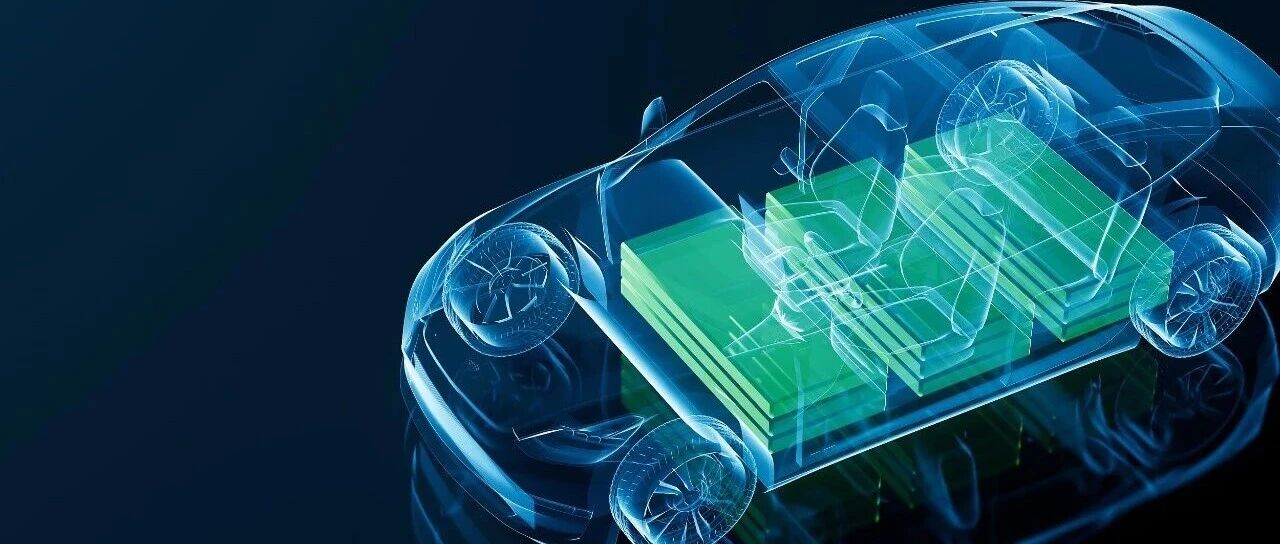
全固态电池产业化,迈入关键验证期
财联社· 2026-02-12 12:06
Core Viewpoint - The solid-state battery industry is advancing rapidly, with multiple companies outlining their technological paths and industrial plans for commercialization by 2026 and beyond [1][2][3]. Group 1: Company Developments - Geely has established three technological routes for solid-state batteries, focusing on polymer, sulfide, and halide composite solutions, with a goal to launch prototype vehicles by 2026 and achieve small-scale production by 2027 [1]. - Chery plans to produce a 0.5GWh pilot line and commence continuous production of 60Ah solid-state cells by 2026, with vehicle demonstration work starting in 2027 [2]. - FAW's Hongqi brand has successfully developed a solid-state battery prototype, achieving significant breakthroughs in key areas such as sulfide electrolyte performance and cell testing [2]. - BYD is focusing on sulfide solid-state batteries, aiming for small-scale production by 2027, while Sunwoda has already achieved mass production of its first and second-generation semi-solid batteries [2]. Group 2: Policy and Standards - The development of national standards for solid-state batteries is underway, with a draft expected to be completed by December 2025 and formal publication planned for July 2026 [3]. - The Ministry of Industry and Information Technology emphasizes enhancing the self-controllability of the supply chain and accelerating breakthroughs in core technologies, including solid-state batteries [3]. Group 3: Industry Challenges and Future Directions - Despite the recognized potential of solid-state batteries, challenges remain, including unclear material systems and engineering difficulties that could affect safety and lifespan [4]. - The domestic solid-state battery market is expected to evolve from semi-solid scale production to small-scale full solid-state production and then to mid-to-high-end large-scale production between 2026 and 2030 [4].
欣旺达:子公司欣旺达动力与威睿电动达成和解,原告已撤回起诉
Xin Lang Cai Jing· 2026-02-12 09:44
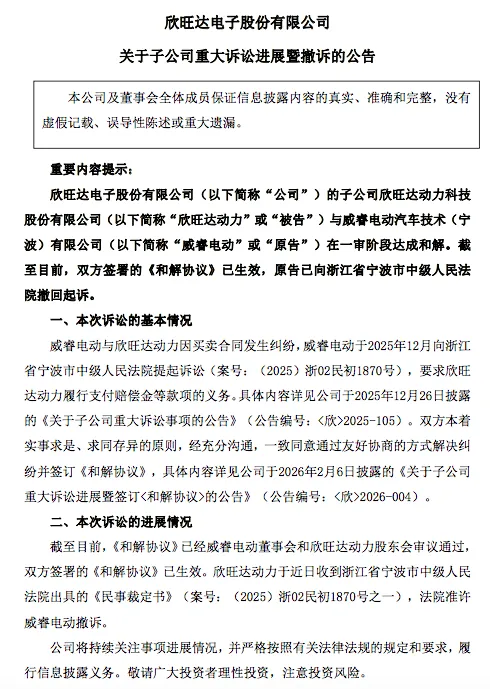
欣旺达公告,子公司欣旺达动力科技股份有限公司与威睿电动汽车技术(宁波)有限公司因买卖合同发 生纠纷,威睿电动于2025年12月向浙江省宁波市中级人民法院提起诉讼,要求欣旺达动力履行支付赔偿 金等款项的义务。双方经充分沟通,一致同意通过友好协商的方式解决纠纷并签订《和解协议》。截至 目前,《和解协议》已生效,原告已向浙江省宁波市中级人民法院撤回起诉。 ...
欣旺达(300207) - 关于子公司重大诉讼进展暨撤诉的公告
2026-02-12 09:36
证券代码:300207 证券简称:欣旺达 公告编号:<欣>2026-016 欣旺达电子股份有限公司 关于子公司重大诉讼进展暨撤诉的公告 本公司及董事会全体成员保证信息披露内容的真实、准确和完整,没有 虚假记载、误导性陈述或重大遗漏。 重要内容提示: 二、本次诉讼的进展情况 截至目前,《和解协议》已经威睿电动董事会和欣旺达动力股东会审议通过, 双方签署的《和解协议》已生效。欣旺达动力于近日收到浙江省宁波市中级人民 法院出具的《民事裁定书》(案号:(2025)浙02民初1870号之一),法院准许 威睿电动撤诉。 公司将持续关注事项进展情况,并严格按照有关法律法规的规定和要求,履 行信息披露义务。敬请广大投资者理性投资,注意投资风险。 三、备查文件 1 1、《民事裁定书》。 特此公告。 欣旺达电子股份有限公司 欣旺达电子股份有限公司(以下简称"公司")的子公司欣旺达动力科技 股份有限公司(以下简称"欣旺达动力"或"被告")与威睿电动汽车技术(宁 波)有限公司(以下简称"威睿电动"或"原告")在一审阶段达成和解。截 至目前,双方签署的《和解协议》已生效,原告已向浙江省宁波市中级人民法 院撤回起诉。 一、本次诉讼的基本 ...
欣旺达再战港股!已与威睿达成和解
起点锂电· 2026-02-12 06:17
Core Viewpoint - The company is determined to successfully complete its secondary listing in Hong Kong, having resubmitted its application and financial data to the Hong Kong Stock Exchange, indicating confidence in its performance and commitment to the listing process [3]. Financial Performance - Revenue for the years 2022, 2023, and 2024 was reported at 52.162 billion, 47.862 billion, and 56 billion RMB respectively, with a compound annual growth rate of 3.6%. For the first three quarters of 2025, revenue reached 43.534 billion RMB, reflecting a year-on-year growth of 13.7% [5][6]. - The adjusted net profit for 2022, 2023, and 2024 was 1.03 billion, 535 million, and 729.5 million RMB respectively, with the adjusted net profit for the first three quarters of 2025 at 939 million RMB, a 29.3% increase from the previous year [8]. Business Structure - The company’s revenue sources are diversifying, with consumer products accounting for 51.7% of revenue in the first three quarters of 2025, while power products and energy storage systems have also seen increased contributions [6][7]. - The gross profit margin has improved from 12% in 2022 to 16.2% in the first three quarters of 2025, attributed to product structure optimization and economies of scale [8][9]. Market Expansion - The company is primarily focused on the Chinese market, but sales in the EU and Southeast Asia are gradually increasing, indicating successful overseas expansion efforts [10]. - The company has established 25 major production bases, with 19 in China and 6 overseas, enhancing its global delivery and support capabilities [10]. Production Capacity - As of September 2025, the company’s production capacity for consumer batteries was 558.9 million units, power batteries at 46.5 GWh, and energy storage systems at 21.3 GWh, with utilization rates of 90.5%, 64.3%, and 86.3% respectively [11][12]. R&D Investment - R&D expenditures from 2022 to 2024 were 2.742 billion, 2.711 billion, and 3.33 billion RMB, with a significant increase to 3.202 billion RMB in the first three quarters of 2025, reflecting a 41.2% year-on-year growth [12]. Legal Challenges - The company is currently facing two major legal disputes, one involving a lawsuit from a subsidiary of Zeekr Automotive claiming 2.314 billion RMB in damages due to battery quality issues, and another related to a recall by Volvo due to safety concerns with batteries supplied by a joint venture [14][15][18]. - The company has reached a settlement in the lawsuit with Zeekr, agreeing to pay 608 million RMB over five years, which is expected to impact its net profit for 2025 by 500 to 800 million RMB [16][18].
欣旺达:关于公司开展套期保值业务的公告
Zheng Quan Ri Bao Zhi Sheng· 2026-02-11 13:45
Core Viewpoint - The company, XWANDA, announced plans to engage in foreign exchange hedging and commodity hedging activities with a total investment of up to RMB 26 billion, aiming to manage financial risks effectively [1] Group 1: Foreign Exchange Hedging - The company intends to use transaction margin and option premium not exceeding RMB 26 billion (or equivalent in other currencies) for foreign exchange hedging activities [1] - The maximum contract value held on any trading day is expected to not exceed RMB 44 billion (or equivalent in other currencies) [1] - The authorization period for this activity will be valid for twelve months from the date of approval by the shareholders' meeting [1] Group 2: Commodity Hedging - The company plans to conduct commodity hedging with a maximum guarantee amount not exceeding RMB 1.3 billion (or equivalent in other currencies), excluding physical delivery payments for futures [1] - The expected maximum contract value held on any trading day for commodity hedging is projected to be up to RMB 12 billion (or equivalent in other currencies) [1] - The funds allocated for these activities can be used in a rolling manner [1]
欣旺达:公司及控股子公司不存在逾期担保
Zheng Quan Ri Bao· 2026-02-11 13:09
Core Viewpoint - XINWANDA announced that neither the company nor its subsidiaries have overdue guarantees, are involved in any litigation related to guarantees, or have incurred losses due to guarantee-related judgments [2] Summary by Categories Company Status - The company and its subsidiaries do not have any overdue external guarantees [2] - There are no ongoing lawsuits related to guarantees involving the company or its subsidiaries [2] - The company has not been judged to bear losses due to guarantee-related issues [2]
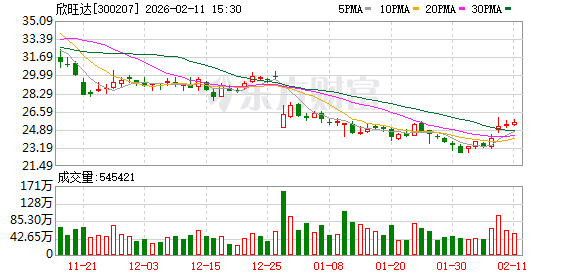
欣旺达:公司及其子公司对外已担保余额约为443.12亿元
Mei Ri Jing Ji Xin Wen· 2026-02-11 10:50
Group 1 - The company announced that the total amount of guarantees as of the announcement date accounts for 11.38% of the audited net assets as of December 31, 2024 [1] - The company and its subsidiaries have an outstanding guarantee balance of approximately 44.312 billion yuan, which represents 186.75% of the audited net assets as of December 31, 2024 [1] - The company and its controlling subsidiaries have provided guarantees for subsidiaries outside the consolidated financial statements, with an outstanding guarantee balance of approximately 324 million yuan, accounting for 1.37% of the audited net assets as of December 31, 2024 [1]