
TRS(300229)

Search documents
8.98亿主力资金净流入,MLOps概念涨3.05%
Zheng Quan Shi Bao Wang· 2025-07-11 09:06
Core Viewpoint - The MLOps concept has shown a significant increase of 3.05%, ranking second among concept sectors, with notable stocks like StarRing Technology, Yuxin Technology, and TuoerSi leading the gains [1][2]. Market Performance - The MLOps concept sector saw a net inflow of 899 million yuan, with 13 stocks experiencing net inflows, and 5 stocks exceeding 30 million yuan in net inflow. Yuxin Technology led with a net inflow of 435 million yuan, followed by TuoerSi and Runhe Software with net inflows of 188 million yuan and 183 million yuan respectively [2][3]. Stock Performance - Key stocks in the MLOps sector include: - Yuxin Technology: Increased by 7.18% with a turnover rate of 16.64% and a net inflow of 435 million yuan, resulting in a net inflow ratio of 12.38% [3] - TuoerSi: Increased by 6.72% with a turnover rate of 11.30% and a net inflow of 188 million yuan, resulting in a net inflow ratio of 10.11% [3] - Runhe Software: Increased by 2.77% with a turnover rate of 5.61% and a net inflow of 183 million yuan, resulting in a net inflow ratio of 8.31% [3] Additional Insights - Other stocks with notable performance in the MLOps sector include: - Dongfang Guoxin: Increased by 4.00% with a net inflow of 54.9 million yuan and a net inflow ratio of 6.57% [3] - StarRing Technology: Increased by 12.40% with a net inflow of 24.77 million yuan and a net inflow ratio of 5.20% [3]


今日55只个股跨越牛熊分界线
Zheng Quan Shi Bao Wang· 2025-07-11 04:01
Market Overview - The Shanghai Composite Index closed at 3546.50 points, above the annual line, with a gain of 1.05% [1] - The total trading volume of A-shares reached 10310.63 billion yuan [1] Stocks Breaking Annual Line - A total of 55 A-shares have broken above the annual line today, with notable stocks including XWANDA, Fuxing Co., and Guolian Minsheng, showing divergence rates of 5.64%, 3.70%, and 3.15% respectively [1] - Stocks with smaller divergence rates that just crossed the annual line include Wangfujing, Tonghe Pharmaceutical, and Sanxia Water Conservancy [1] Top Stocks by Divergence Rate - The top three stocks with the highest divergence rates are: - XWANDA (9.13% increase, 5.12% turnover rate, latest price 21.16 yuan, divergence rate 5.64%) [1] - Fuxing Co. (4.31% increase, 5.52% turnover rate, latest price 2.42 yuan, divergence rate 3.70%) [1] - Guolian Minsheng (6.66% increase, 3.68% turnover rate, latest price 11.21 yuan, divergence rate 3.15%) [1] Additional Stocks with Notable Performance - Other stocks with significant performance include: - Tuoer Si (3.05% increase, 3.72% turnover rate, latest price 18.56 yuan, divergence rate 2.82%) [1] - ST Huaming (4.83% increase, 10.28% turnover rate, latest price 10.21 yuan, divergence rate 2.73%) [1] - Green Beauty (3.01% increase, 2.26% turnover rate, latest price 6.50 yuan, divergence rate 2.32%) [1]






华为盘古概念下跌2.40%,9股主力资金净流出超3000万元
Zheng Quan Shi Bao Wang· 2025-06-10 09:23
Group 1 - Huawei Pangu concept declined by 2.40%, ranking among the top declines in the concept sector as of June 10 [1] - The concept sector saw a net outflow of 8.09 billion yuan, with 24 stocks experiencing net outflows, and 9 stocks seeing outflows exceeding 30 million yuan [2] - The stock with the highest net outflow was Tuowei Information, with a net outflow of 1.76 billion yuan [2] Group 2 - The top gainers in the Huawei Pangu concept included Meiansen and Jiecheng Shares, which rose by 1.72% and 0.19% respectively [1][3] - The concept sector's performance was contrasted with other sectors, such as the Transgenic sector which gained 3.15% [2] - The stocks with the highest net inflow included Meiansen, Huakai Yibai, and Fanwei Network, with inflows of 285.5 million yuan, 6.71 million yuan, and 4.69 million yuan respectively [2][3]



研判2025!中国自然语言处理行业产业链、相关政策及市场规模分析:技术突破推动行业增长,低成本算力与小样本学习加速技术落地[图]
Chan Ye Xin Xi Wang· 2025-06-08 02:10
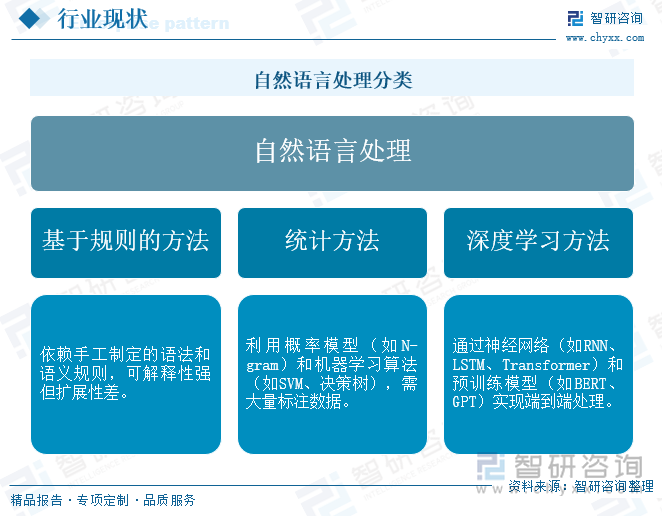
Core Insights - The natural language processing (NLP) industry in China is projected to reach a market size of approximately 12.6 billion yuan in 2024, reflecting a year-on-year growth of 14.55% [1][15] - The cost of model training has significantly decreased due to the "East Data West Computing" initiative, which provides low-cost computing power, and the adoption of few-shot learning frameworks has reduced the demand for training data by 90% [1][15] - Major companies in the NLP sector include Baidu, iFlytek, and Alibaba, each leveraging their technological strengths to capture market share in various applications [2][17][21] Industry Overview - NLP is a crucial branch of computer science and artificial intelligence, aimed at enabling computers to understand, interpret, and generate human language [1][8] - The technology types in NLP are primarily categorized into rule-based methods, statistical methods, and deep learning methods [1][8] Industry Development History - The development of NLP in China has gone through four main stages: the initial phase (1950s-60s) focused on machine translation, the rule-dominated phase (1970s-80s) involved complex rule systems, the statistical learning phase (1990s-2012) integrated statistical models with machine learning, and the deep learning phase (2013-present) is characterized by the dominance of deep learning models and pre-trained language models [4][5][6] Industry Value Chain - The upstream of the NLP industry chain includes hardware devices, data services, open-source models, and cloud services, while the midstream focuses on NLP technology research and development, and the downstream encompasses applications in finance, healthcare, education, and smart manufacturing [1][8] Market Size - The NLP industry in China is experiencing significant growth, with a projected market size of 12.6 billion yuan in 2024, driven by advancements in pre-trained language models and reduced training costs [1][15] Key Companies' Performance - Baidu leads the NLP industry with a strong technological foundation and extensive commercialization, maintaining the largest market share [17][21] - iFlytek excels in voice recognition and machine translation, particularly in the education and healthcare sectors [17][20] - Alibaba has made breakthroughs in machine reading comprehension and natural language understanding, integrating its technology into various business scenarios [17][20] Industry Development Trends - The NLP industry is witnessing a trend towards the integration of large models and multimodal capabilities, enhancing performance and user interaction [24] - There is a growing focus on vertical applications in sectors like healthcare and finance, as well as the integration of NLP with smart hardware [26] - Data security and ethical standards are becoming increasingly important, driving sustainable development in the NLP sector [27]


2025年中国多模态大模型行业核心技术现状 关键在表征、翻译、对齐、融合、协同技术【组图】
Qian Zhan Wang· 2025-06-03 05:12
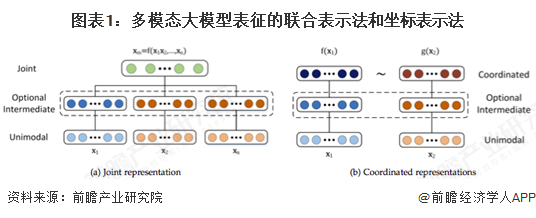
Core Insights - The article discusses the core technologies of multimodal large models, focusing on representation learning, translation, alignment, fusion, and collaborative learning [1][2][7][11][14]. Representation Learning - Representation learning is fundamental for multimodal tasks, addressing challenges such as combining heterogeneous data and handling varying noise levels across different modalities [1]. - Prior to the advent of Transformers, different modalities required distinct representation learning models, such as CNNs for computer vision (CV) and LSTMs for natural language processing (NLP) [1]. - The emergence of Transformers has enabled the unification of multiple modalities and cross-modal tasks, leading to a surge in multimodal pre-training models post-2019 [1]. Translation - Cross-modal translation aims to map source modalities to target modalities, such as generating descriptive sentences from images or vice versa [2]. - The use of syntactic templates allows for structured predictions, where specific words are filled in based on detected attributes [2]. - Encoder-decoder architectures are employed to encode source modality data into latent features, which are then decoded to generate the target modality [2]. Alignment - Alignment is crucial in multimodal learning, focusing on establishing correspondences between different data modalities to enhance understanding of complex scenarios [7]. - Explicit alignment involves categorizing instances with multiple components and measuring similarity, utilizing both unsupervised and supervised methods [7][8]. - Implicit alignment leverages latent representations for tasks without strict alignment, improving performance in applications like visual question answering (VQA) and machine translation [8]. Fusion - Fusion combines multimodal data or features for unified analysis and decision-making, enhancing task performance by integrating information from various modalities [11]. - Early fusion merges features at the feature level, while late fusion combines outputs at the decision level, with hybrid fusion incorporating both approaches [11][12]. - The choice of fusion method depends on the task and data, with neural networks becoming a popular approach for multimodal fusion [12]. Collaborative Learning - Collaborative learning utilizes data from one modality to enhance the model of another modality, categorized into parallel, non-parallel, and hybrid methods [14][15]. - Parallel learning requires direct associations between observations from different modalities, while non-parallel learning relies on overlapping categories [15]. - Hybrid methods connect modalities through shared datasets, allowing one modality to influence the training of another, applicable across various tasks [15].


2025年中国多模态大模型行业市场规模、产业链、竞争格局分析及行业发趋势研判:将更加多元和深入,应用前景越来越广阔[图]
Chan Ye Xin Xi Wang· 2025-05-29 01:47
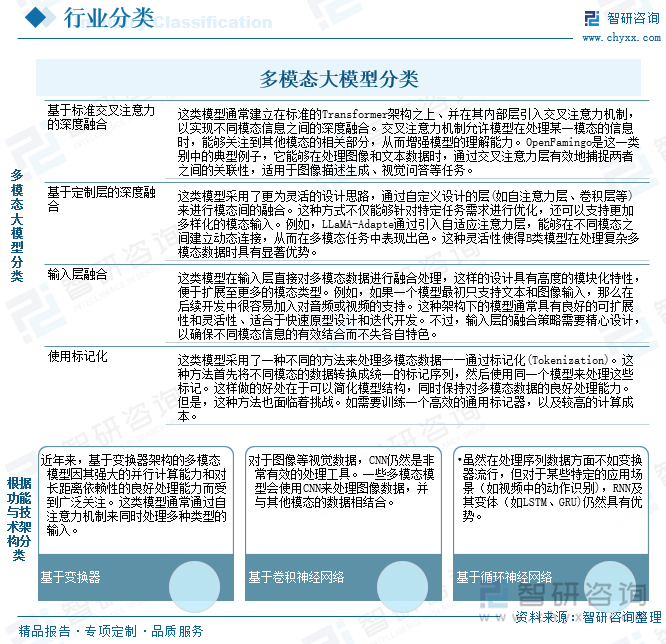
Core Insights - The multi-modal large model market in China is projected to reach 15.63 billion yuan in 2024, an increase of 6.54 billion yuan from 2023, and is expected to grow to 23.48 billion yuan in 2025, indicating strong market demand and government support [1][6][19] Multi-Modal Large Model Industry Definition and Classification - Multi-modal large models are AI systems capable of processing and understanding various data forms, including text, images, audio, and video, using deep learning technologies like the Transformer architecture [2][4] Industry Development History - The multi-modal large model industry has evolved through several stages: task-oriented phase, visual-language pre-training phase, and the current multi-modal large model phase, focusing on enhancing cross-modal understanding and generation capabilities [4] Current Industry Status - The multi-modal large model industry has gained significant attention due to its data processing capabilities and diverse applications, with a market size projected to grow substantially in the coming years [6][19] Application Scenarios - The largest application share of multi-modal large models is in the digital human sector at 24%, followed by gaming and advertising at 13% each, and smart marketing and social media at 10% each [8] Industry Value Chain - The industry value chain consists of upstream components like AI chips and hardware, midstream multi-modal large models, and downstream applications across various sectors including education, gaming, and public services [10][12] Competitive Landscape - Major players in the multi-modal large model space include institutions and companies like the Chinese Academy of Sciences, Huawei, Baidu, Tencent, and Alibaba, with various models being developed to optimize training costs and enhance capabilities [16][17] Future Development Trends - The multi-modal large model industry is expected to become more intelligent and humanized, providing richer and more personalized user experiences, with applications expanding across various fields such as finance, education, and content creation [19]
重磅!2025年中国及部分省市多模态大模型行业政策汇总及解读(全)政策鼓励多模态大模型应用场景创新
Qian Zhan Wang· 2025-05-26 03:25
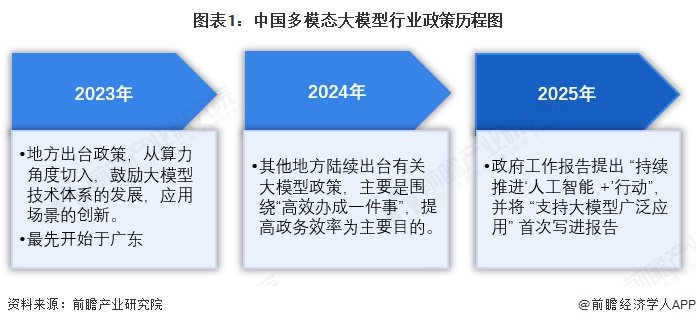
Core Insights - The article discusses the development and support of the multimodal large model industry in China, highlighting various policies and initiatives at both national and local levels aimed at enhancing AI capabilities and applications [1][4][11]. Policy Development Timeline - In 2023, local policies began to emerge, focusing on computational power to encourage the development of large model technology and innovative application scenarios, starting with Guangdong, Beijing, and Shanghai. By 2024, more regions are expected to introduce relevant policies aimed at improving administrative efficiency [1]. - By 2025, government work reports will emphasize the ongoing promotion of the "Artificial Intelligence +" initiative, with a focus on supporting the widespread application of large models [1]. National Policy Summary - The Chinese government has implemented several measures to support the AI industry, particularly multimodal large models, which are seen as crucial products within the AI sector. The State Council has identified embodied intelligence as a future industry, promoting the integration of digital technology with manufacturing and market advantages [4][5]. - Key national policies include the "Guidelines for the Development of Artificial Intelligence Industry" and the "Three-Year Action Plan for Data Elements," which aim to enhance data utilization and promote high-quality economic development through data-driven initiatives [11][13]. Local Policy Highlights - Various provinces have introduced specific policies to support the development of AI large models. For instance, Guangdong aims to develop a comprehensive technology system for large models with trillion-parameter capabilities, while Beijing targets the creation of 3-5 advanced, controllable foundational model products by the end of 2025 [13][15]. - Local initiatives also include the establishment of intelligent computing centers and the promotion of AI applications in various sectors, such as manufacturing, healthcare, and urban governance [13][14]. Key Development Directions - The article outlines that provinces like Guangdong, Beijing, and Shanghai have set ambitious goals for the development of large models, focusing on creating a robust ecosystem for AI innovation and application [15]. - The emphasis is on fostering collaboration between government, industry, and academia to drive advancements in AI technologies and their practical applications across different sectors [15].
拓尔思(300229) - 第六届董事会第二十次会议决议公告
2025-05-22 14:10
一、董事会会议召开情况 证券代码:300229 证券简称:拓尔思 公告编号:2025-028 拓尔思信息技术股份有限公司 第六届董事会第二十次会议决议公告 本公司及董事会全体成员保证信息披露内容的真实、准确和完整,没有虚假记载、误导 性陈述或重大遗漏。 本议案已经公司董事会薪酬与考核委员会审议通过。 1 董事李琳女士为本次激励计划激励对象,对本议案回避表决。 表决结果:同意 6 票、反对 0 票、弃权 0 票,本议案获得通过。 三、备查文件 拓尔思信息技术股份有限公司(以下简称"公司")第六届董事会第二十次 会议于 2025 年 5 月 22 日在公司会议室以现场结合通讯表决的方式召开,经全体 董事一致同意,豁免本次董事会会议的提前通知期限,会议通知于 2025 年 5 月 22 日以电话、电子邮件及专人送达方式发出,会议召集人已在会议上作出说明。 本次会议应出席董事 7 名,实际出席会议董事 7 名。本次会议由董事长兼总经理 施水才先生主持,公司部分高级管理人员列席了本次会议。本次会议的召集和召 开符合《中华人民共和国公司法》等有关法律、行政法规、部门规章、规范性文 件和《拓尔思信息技术股份有限公司章程》的 ...
拓尔思(300229) - 关于向2025年限制性股票激励计划激励对象首次授予限制性股票的公告
2025-05-22 14:10
根据拓尔思信息技术股份有限公司(以下简称"公司")《2025 年限制性股 票激励计划(草案)》的规定,公司 2025 年限制性股票激励计划(以下简称"本 激励计划")规定的首次授予条件已经成就,根据公司 2025 年第一次临时股东 会的授权,公司于 2025 年 5 月 22 日召开第六届董事会第二十次会议和第六届监 事会第十四次会议,审议通过了《关于向 2025 年限制性股票激励计划激励对象 首次授予限制性股票的议案》,确定以 2025 年 5 月 22 日为首次授予日,向符合 条件的 98 名激励对象授予 410.00 万股限制性股票。现将有关事项说明如下: 证券代码:300229 证券简称:拓尔思 公告编号:2025-030 拓尔思信息技术股份有限公司 关于向 2025 年限制性股票激励计划激励对象 首次授予限制性股票的公告 本公司及董事会全体成员保证信息披露内容的真实、准确和完整,没有虚假记载、误导 性陈述或重大遗漏。 重要内容提示: 一、本激励计划简述及已履行的相关审批程序 (一)本激励计划简述 1.股权激励方式:第二类限制性股票 2.授予数量:本激励计划拟授予的限制性股票数量为 450.00 万股 ...
拓尔思(300229) - 北京市天元律师事务所关于拓尔思信息技术股份有限公司2025年第一次临时股东会的法律意见
2025-05-22 14:10
北京市天元律师事务所 关于拓尔思信息技术股份有限公司 2025 年第一次临时股东会的法律意见 京天股字(2025)第 338 号 致:拓尔思信息技术股份有限公司 拓尔思信息技术股份有限公司(以下简称"公司")2025 年第一次临时股东 会(以下简称"本次股东会")采取现场投票与网络投票相结合的方式召开,现 场会议于 2025 年 5 月 22 日 14:00 在北京市海淀区建枫路(南延)6 号院金隅西 三旗科技园 3 号楼 1 层召开。北京市天元律师事务所(以下简称"本所")接受 公司聘任,指派本所律师参加本次股东会现场会议,并根据《中华人民共和国公 司法》、《中华人民共和国证券法》(以下简称"《证券法》")、《上市公司 股东会规则》(以下简称"《股东会规则》")以及《拓尔思信息技术股份有限 公司公司章程》(以下简称"《公司章程》")等有关规定,就本次股东会的召 集、召开程序、出席现场会议人员的资格、召集人资格、会议表决程序及表决结 果等事项出具本法律意见。 为出具本法律意见,本所律师审查了《拓尔思信息技术股份有限公司第六届 董事会第十九次会议决议公告》《拓尔思信息技术股份有限公司第六届监事会第 十三次会议决 ...