Senior(300568)

Search documents
星源材质2月9日获融资买入6108.79万元,融资余额11.27亿元
Xin Lang Zheng Quan· 2026-02-10 01:21
Core Viewpoint - The company, Xingyuan Material, has shown fluctuations in its stock performance and financing activities, indicating a mixed outlook for its financial health and investor sentiment [1][2]. Financing Activities - On February 9, Xingyuan Material's stock rose by 1.63%, with a trading volume of 638 million yuan. The financing buy-in amount for the day was 61.09 million yuan, while the financing repayment was 69.31 million yuan, resulting in a net financing outflow of 8.22 million yuan [1]. - As of February 9, the total balance of margin trading for Xingyuan Material was 1.133 billion yuan, with the financing balance accounting for 5.84% of the circulating market value, which is above the 70th percentile of the past year [1]. - In terms of securities lending, on February 9, 24,100 shares were repaid, and 11,800 shares were sold short, with a selling amount of 169,200 yuan. The remaining short-selling volume was 409,900 shares, with a balance of 5.88 million yuan, also above the 90th percentile of the past year [1]. Financial Performance - For the period from January to September 2025, Xingyuan Material reported a revenue of 2.958 billion yuan, reflecting a year-on-year growth of 13.53%. However, the net profit attributable to shareholders decreased by 67.25% to 114 million yuan [2]. - Since its A-share listing, the company has distributed a total of 791 million yuan in dividends, with 490 million yuan distributed over the past three years [3]. Shareholder Structure - As of September 30, 2025, the number of shareholders for Xingyuan Material was 113,800, a decrease of 1.27% from the previous period. The average number of circulating shares per shareholder increased by 1.29% to 10,668 shares [2]. - Among the top ten circulating shareholders, Hong Kong Central Clearing Limited is the second-largest shareholder with 19.18 million shares, an increase of 4.05 million shares from the previous period. The Guangfa Guozhen New Energy Vehicle Battery ETF is the third-largest shareholder, holding 13.31 million shares as a new entrant [3].
锂电产业链历史不会重演,但会押韵
Zhong Guo Neng Yuan Wang· 2026-02-10 01:01
Core Viewpoint - The lithium battery supply chain has experienced significant price increases from 2020 to 2022, driven by strong demand and a smooth transmission of price hikes across the industry [2][3]. Group 1: Price Trends - Electrolyte prices started at 70,000 CNY/ton in September 2020, rising to 100,000 CNY/ton by the end of the year, and reaching a peak of 580,000 CNY/ton in February 2022, with long-term contract prices stabilizing between 200,000 to 300,000 CNY/ton [2][3]. - Iron lithium cathode prices, including phosphoric acid iron and processing fees, doubled in 2021, peaking at over 40,000 CNY/ton by the end of that year [2][3]. - Anode prices began to rise in Q3 2021 due to graphite production constraints, increasing from 12,000 CNY/ton to a high of 25,000 to 28,000 CNY/ton by Q2 2022 [2][3]. Group 2: Supply Chain Dynamics - Lithium carbonate prices rebounded from a low of 40,000 CNY/ton at the end of 2020 to 50,000 CNY/ton in early 2021, and surged to 300,000 CNY/ton by the end of 2021, eventually reaching 520,000 CNY/ton by February 2022 [2][3]. - The battery sector has effectively transmitted raw material price increases, with battery prices rising by 1 cent/wh in Q1 2021 and accelerating to 2-3 cents/wh in Q1 and Q2 of 2022, reaching over 1 CNY/wh [2][3]. Group 3: Future Outlook - Current market conditions resemble Q4 2020, with expectations for continued price increases due to strong demand and low profitability levels compared to previous years [3]. - The industry's expansion willingness is significantly lower than in 2021, with limited new supply expected by 2026, suggesting a more stable price environment [3]. - The anticipated price increases are not expected to be as dramatic as in 2021, with supply-demand tightness projected to be lower, particularly for hexafluorophosphate and lithium carbonate [3]. Group 4: Investment Recommendations - The current valuation of leading companies is considered reasonable, with expected industry growth of 20% in 2027, suggesting potential for investment in the battery sector, including companies like CATL, Yiwei Lithium Energy, and others [4]. - Material leaders such as Keda Lithium and others are also highlighted as strong investment opportunities, alongside companies in the lithium carbonate sector [4]. - The solid-state battery sector is recommended for investment, particularly with catalysts expected to materialize in Q4 2025 [4].




谋局固态+出海,星源材质赴港上市背后
高工锂电· 2026-02-07 11:16
Core Viewpoint - The article discusses the potential of Xingyuan Material's IPO in Hong Kong as a stepping stone for its growth, focusing on solid-state battery technology and overseas expansion strategies [2][21]. Group 1: Company Overview - Xingyuan Material, a leading separator manufacturer for lithium batteries, has submitted a new IPO application to the Hong Kong Stock Exchange after its previous application expired [2]. - The company ranks second in China's battery separator market by shipment volume for 2024, with dry-process separators holding the top global position and wet-process separators ranked second [2][4]. Group 2: Financial Performance - The company's revenue for 2023 and 2024 is projected to be 2.982 billion yuan and 3.506 billion yuan, respectively, reflecting year-on-year growth of 4.62% and 17.52%. However, net profit is expected to decline to 576 million yuan and 364 million yuan, down 19.87% and 36.87% [5]. - The gross margin for the separator business has decreased from 30% in the first three quarters of 2024 to 21.3% in the same period of 2025, a drop of 8.7 percentage points, attributed to increased market competition [6]. Group 3: Market Dynamics - The battery separator industry in China is expected to grow at a compound annual growth rate (CAGR) of 63.8% from 2022 to 2024, outpacing the shipment growth of 35.8%, leading to oversupply and downward pressure on prices [6]. - Xingyuan Material's competitive advantage lies in its diverse customer base and its ability to maintain profitability despite industry challenges, unlike its main competitor, Enjie, which has reported losses [7][8]. Group 4: Overseas Expansion - The company plans to allocate 60% of its IPO proceeds to support overseas production capacity, with factories established in Malaysia, Sweden, and the United States, targeting a total planned capacity of over 2 billion square meters by 2026-2027 [4][9]. - The demand for energy storage batteries is expected to surge, with China's energy storage lithium battery shipments projected to reach 630 GWh in 2025, a year-on-year increase of 85% [11]. Group 5: Technological Advancements - Xingyuan Material is focusing on the development of solid-state electrolyte membranes, with plans to launch products in the second half of 2026, aligning with industry trends towards solid-state battery production [19][20]. - The company has completed pilot testing for solid-state battery separators and is conducting scale-up trials, aiming for integration with existing production processes [20]. Group 6: Strategic Positioning - The article emphasizes the importance of Xingyuan Material's IPO as a means to leverage international capital for expanding production capacity and advancing new technologies, positioning the company for future growth in a competitive market [21][22].

3月19-20日 常州!2026锂电关键材料及应用市场高峰论坛
鑫椤锂电· 2026-02-06 08:15
Core Viewpoint - The lithium battery industry is poised for a significant growth cycle in 2026, characterized by strong demand recovery, accelerated global expansion, and disruptive technological advancements, leading to a "spiral rise" in both volume and price [3]. Group 1: Market Predictions - Global lithium battery production is expected to reach 2297 GWh by 2025, with a growth rate of 34.6% in 2026. The shipment growth rate for energy storage cells is projected to be as high as 70%, driven by both domestic and international demand [5]. - There is a notable supply gap in the effective production capacity of battery cells and various materials, making supply chain stability and efficiency crucial for capitalizing on this growth opportunity [5]. Group 2: Conference Details - The 2026 Lithium Key Materials and Applications Market Summit will be held on March 19-20, 2026, in Changzhou, Jiangsu, organized by Xinluo Information [4]. - The summit will focus on two main topics: in-depth discussions on cutting-edge technologies and market supply-demand dynamics, and B2B procurement matchmaking to connect top battery manufacturers and material suppliers [6]. Group 3: Key Topics and Speakers - The conference will feature discussions on lithium carbonate futures and options, market volatility responses from lithium battery companies, and the potential of global lithium resources in 2026 [7][8]. - Other topics include the strategic resource competition in nickel and cobalt supply, the development opportunities presented by solid-state batteries, and the current market trends for various battery materials [8][9].


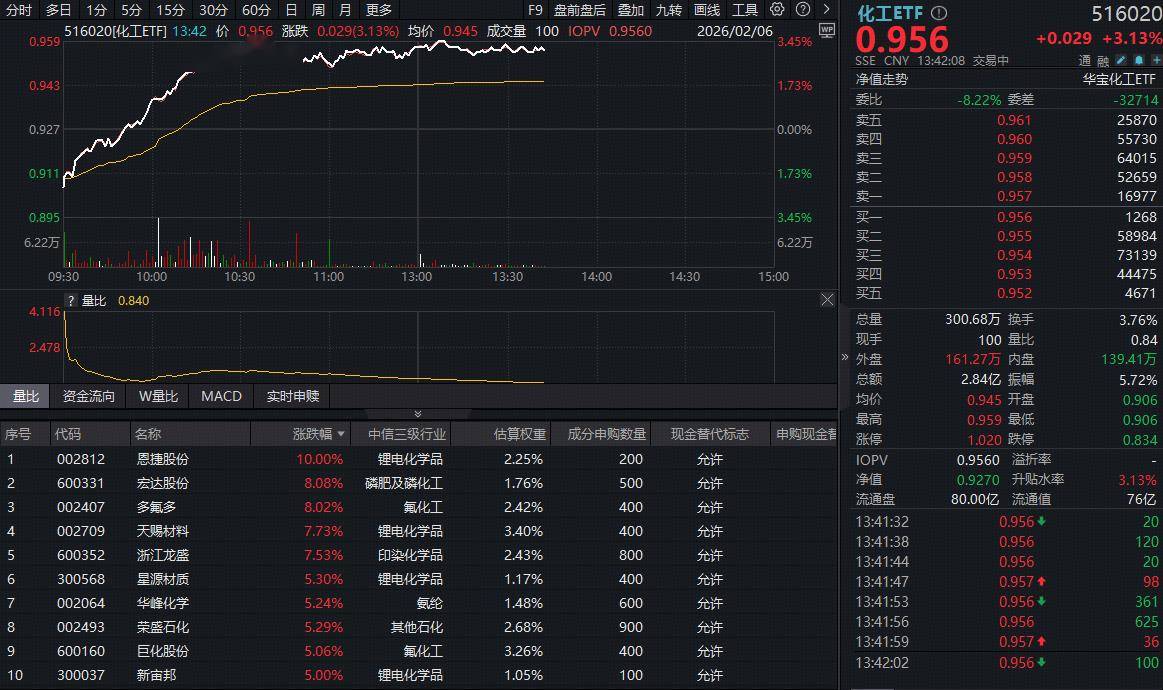
ETF盘中资讯|资金猛攻、价格普涨!化工板块持续高位震荡,化工ETF(516020)涨超3%!
Sou Hu Cai Jing· 2026-02-06 06:38
Group 1 - The chemical sector is showing strong performance, with the Chemical ETF (516020) experiencing a price increase of 3.13% as of the report time [1][2] - Key stocks in the sector, including Enjie Co., Ltd., Hongda Co., and Duofuduo, have seen significant gains, with Enjie Co. reaching the daily limit up and others rising over 8% [1][2] - The basic chemical sector has attracted substantial capital inflow, with nearly 20 billion yuan in net inflow, leading among 30 major sectors [1][3] Group 2 - Prices for mainstream refrigerants have continued to rise, with R32 long-term contract prices at 61,200 yuan per ton, up 1,000 yuan from the previous quarter, marking a 1.66% increase [3] - The outlook for the industry suggests that regulatory measures and self-discipline initiatives will strengthen supply constraints, benefiting certain sub-sectors like chlor-alkali and pesticides [3] Group 3 - The Chemical ETF (516020) tracks the CSI sub-sector chemical industry index, covering popular themes such as AI computing power and new energy [4] - Investors can also access the chemical sector through the Chemical ETF linked funds, which provide a more efficient way to invest [4]


资金猛攻、价格普涨!化工板块持续高位震荡,化工ETF(516020)涨超3%!
Xin Lang Cai Jing· 2026-02-06 06:00
Group 1 - The chemical sector is showing strong performance, with the Chemical ETF (516020) experiencing a price increase of 3.13% as of the report [1][8] - Key stocks in the sector, including lithium battery, phosphorus chemical, and fluorine chemical industries, are seeing significant gains, with Enjie Co. hitting the daily limit, and Hongda Co. and Duofuduo both rising over 8% [1][8] - The basic chemical sector has attracted substantial capital, with a net inflow of nearly 20 billion yuan, leading among 30 major sectors [5][10] Group 2 - In the first quarter, the prices of mainstream refrigerants are continuing to rise, with R32 long-term contract prices expected to reach 61,200 yuan per ton, a 1.66% increase from the previous quarter [2][10] - The report suggests that with ongoing anti-involution policies, supply constraints in the industry are expected to strengthen, benefiting certain sub-sectors such as chlorine-alkali, pesticides, and polyester filament [2][10] Group 3 - The Chemical ETF (516020) tracks the CSI sub-sector chemical industry theme index, covering popular topics such as AI computing power, anti-involution, robotics, and new energy [3][11] - Investors can also access the Chemical ETF through linked funds (Class A 012537/Class C 012538) for more efficient exposure to the chemical sector [3][11]
星源材质股价涨5.37%,广发基金旗下1只基金位居十大流通股东,持有1330.9万股浮盈赚取971.56万元
Xin Lang Ji Jin· 2026-02-06 05:39
Group 1 - The core viewpoint of the news is that Xingyuan Material's stock has seen a significant increase of 5.37%, reaching a price of 14.32 CNY per share, with a trading volume of 663 million CNY and a turnover rate of 3.93%, resulting in a total market capitalization of 19.271 billion CNY [1] - Xingyuan Material, established on September 17, 2003, and listed on December 1, 2016, specializes in the research, production, and sales of lithium-ion battery separators, with 99.08% of its main business revenue coming from this sector [1] - The company is located in Shenzhen, Guangdong Province, and its main business activities are focused on new energy materials related to lithium-ion battery separators [1] Group 2 - According to data from the top ten circulating shareholders of Xingyuan Material, the Guangfa Fund has a fund that ranks among the top shareholders, specifically the Guangfa National Index New Energy Vehicle Battery ETF (159755), which entered the top ten in the third quarter with 13.309 million shares, accounting for 1.1% of circulating shares [2] - The Guangfa National Index New Energy Vehicle Battery ETF (159755) was established on June 15, 2021, with a current scale of 14.086 billion CNY, and has experienced a loss of 2.62% this year, ranking 5395 out of 5564 in its category [2] - Over the past year, the fund has achieved a return of 60.98%, ranking 499 out of 4288 in its category, and has a total return of 4.12% since its inception [2]
星源材质:公司与佛山仙湖实验室的合作聚焦于氢能源关键膜材料的开发工作
Mei Ri Jing Ji Xin Wen· 2026-02-06 01:06
Core Viewpoint - The company is actively collaborating with Foshan Xianhu Laboratory on key membrane materials for hydrogen energy and fuel cells, focusing on the development and industrial application of membrane technology in seawater hydrogen production scenarios [1] Group 1: Strategic Collaboration - The strategic cooperation agreement signed in November 2023 emphasizes the development of key membrane materials related to hydrogen energy [1] - The collaboration includes research and industrial application of membrane technology specifically for seawater hydrogen production [1] - The partnership also explores relevant technologies in the fuel cell sector [1]
星源材质递表港交所,拟于港交所主板上市!
Xin Lang Cai Jing· 2026-02-05 12:24
Core Viewpoint - Shenzhen Xingyuan Material Technology Co., Ltd. has submitted its listing application to the Hong Kong Stock Exchange, with CITIC Securities International as the sole sponsor [2][5]. Company Overview - Xingyuan Material is a manufacturer of lithium-ion battery separators, established in 2003, with over 20 years of experience in R&D, production, and sales [2][5]. - The company is recognized as the first in China to master the dry uniaxial stretching technology for lithium-ion battery separators [2][5]. Market Growth - The Chinese battery separator market has shown stable growth, driven by the rising demand for electric vehicles and energy storage, with a projected compound annual growth rate (CAGR) of 59.5% from 2020 to 2024 [2][5]. - The shipment volume of battery separators in China is expected to increase from 3.6 billion square meters in 2020 to approximately 23.3 billion square meters by 2024 [2][5]. Competitive Position - By 2024, the company is projected to rank second in the global battery separator market, holding a market share of 14.4% [2][5]. - The company has established a competitive production line for battery separators, demonstrating excellence in key performance indicators such as thickness, porosity, thermal shrinkage, permeability, and puncture strength [6]. Clientele - The company serves leading lithium-ion battery manufacturers, including LG Energy, Samsung SDI, CATL, BYD, and others, showcasing its commitment to quality and technical expertise [6].
星源材质再闯上市:营收增长,毛利率下滑,产品售价跌幅大
Sou Hu Cai Jing· 2026-02-04 08:52
Core Viewpoint - Shenzhen Xingyuan Material Technology Co., Ltd. (referred to as "Xingyuan Material") has submitted a new prospectus for listing on the Hong Kong Stock Exchange after a previous attempt was unsuccessful. The company aims to use the funds for research and development of solid-state batteries, expanding its overseas network, and repaying loans for its Swedish production base [1][3]. Company Overview - Xingyuan Material is a manufacturer of lithium-ion battery separators and is recognized as the first company in China to master the dry uniaxial stretching technology for lithium-ion battery separators. As of 2024, it ranks second in the global battery separator market with a market share of 14.4% [5]. - The company was established in September 2003 and was listed on the Shenzhen Stock Exchange's Growth Enterprise Market on December 1, 2016. It also went public on the Swiss Stock Exchange in December 2023 [5]. - Xingyuan Material has a comprehensive global network covering production bases in China, Europe, Southeast Asia, and the United States, with R&D centers in South China, East China, Japan, and Sweden, serving over 100 lithium-ion battery clients [5]. Financial Performance - The revenue for Xingyuan Material in 2022, 2023, 2024, and the first three quarters of 2025 was approximately 2.87 billion, 2.98 billion, 3.51 billion, and 2.93 billion RMB, respectively. The net profit figures for the same periods were about 748 million, 594 million, 371 million, and 141 million RMB [6][7]. - The adjusted net profit, according to non-IFRS measures, was approximately 782 million, 599 million, and 383 million RMB for 2022, 2023, and 2024, with 183 million RMB for the first three quarters of 2025 [8]. - Despite revenue growth, the company's profit has been declining, with net profit decreasing by 20.6% from 2022 to 2023 and further declining by 37.6% in 2024. The net profit for the first three quarters of 2025 saw a significant drop of 59.9% year-on-year [6][8]. Profitability and Margins - The gross margin for Xingyuan Material has been declining, with figures of 44.8%, 43.3%, 28.1%, and 21.3% for 2022, 2023, 2024, and the first three quarters of 2025, respectively [8][9]. - The company attributes the decline in gross margin to increased market competition, which has led to a drop in average selling prices exceeding the decrease in production costs. The revenue growth is primarily driven by increased orders from existing customers for new products [10]. Future Outlook - Xingyuan Material anticipates a sharp decline in net profit for 2025 due to intensified market competition and a significant drop in average selling prices, which is expected to outpace the reduction in production costs [10].