PDD(PDD)

Search documents
美股三大指数集体收跌,纳指、标普500指数跌逾1%,博通跌超11%
Ge Long Hui· 2025-12-12 22:26
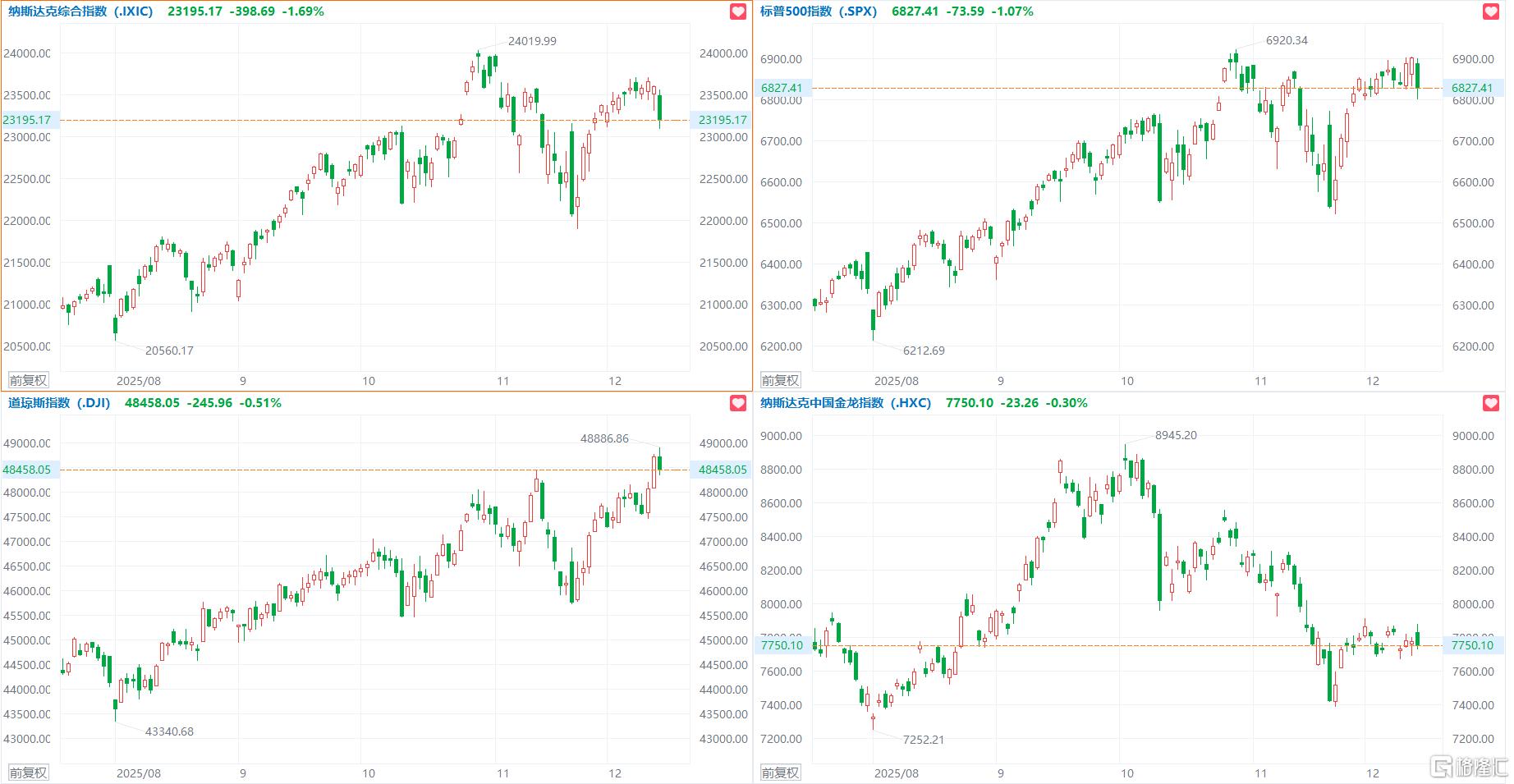
Market Overview - The three major U.S. stock indices closed lower, with the Dow Jones down 0.51%, the Nasdaq down 1.69%, and the S&P 500 down 1.07% [1] - Popular tech stocks experienced declines, with Broadcom falling over 11%, Nvidia down over 3%, and Google, Microsoft, Meta, and Amazon all dropping over 1%. Tesla, however, saw an increase of over 2% [1] Sector Performance - The storage sector, cryptocurrency mining companies, and semiconductor stocks faced significant declines, with Corning down nearly 8%, Quantum down over 7%, and Micron Technology, Dell Technologies, and Logitech all dropping over 6%. AMD fell nearly 5%, Intel was down over 4%, and HP dropped over 2% [1] - The automotive manufacturing sector saw gains, with Polestar rising over 19%, Rivian up over 12%, and Toyota increasing by over 2% [1] Chinese Stocks - The Nasdaq Golden Dragon China Index fell by 0.30%. Among popular Chinese stocks, Pony.ai dropped 5.6%, WeRide fell 3.2%, and Baidu and NIO both declined over 2%. XPeng was down 1.1%, Alibaba fell 0.9%, and Pinduoduo remained flat. However, Li Auto rose 0.3%, Yum China increased by 1.8%, and New Oriental and NetEase both gained 2.1% [1]




晚间重磅!35龙头集体跳水,阿里拼多多破位,美股7巨头大跌
Sou Hu Cai Jing· 2025-12-12 17:01
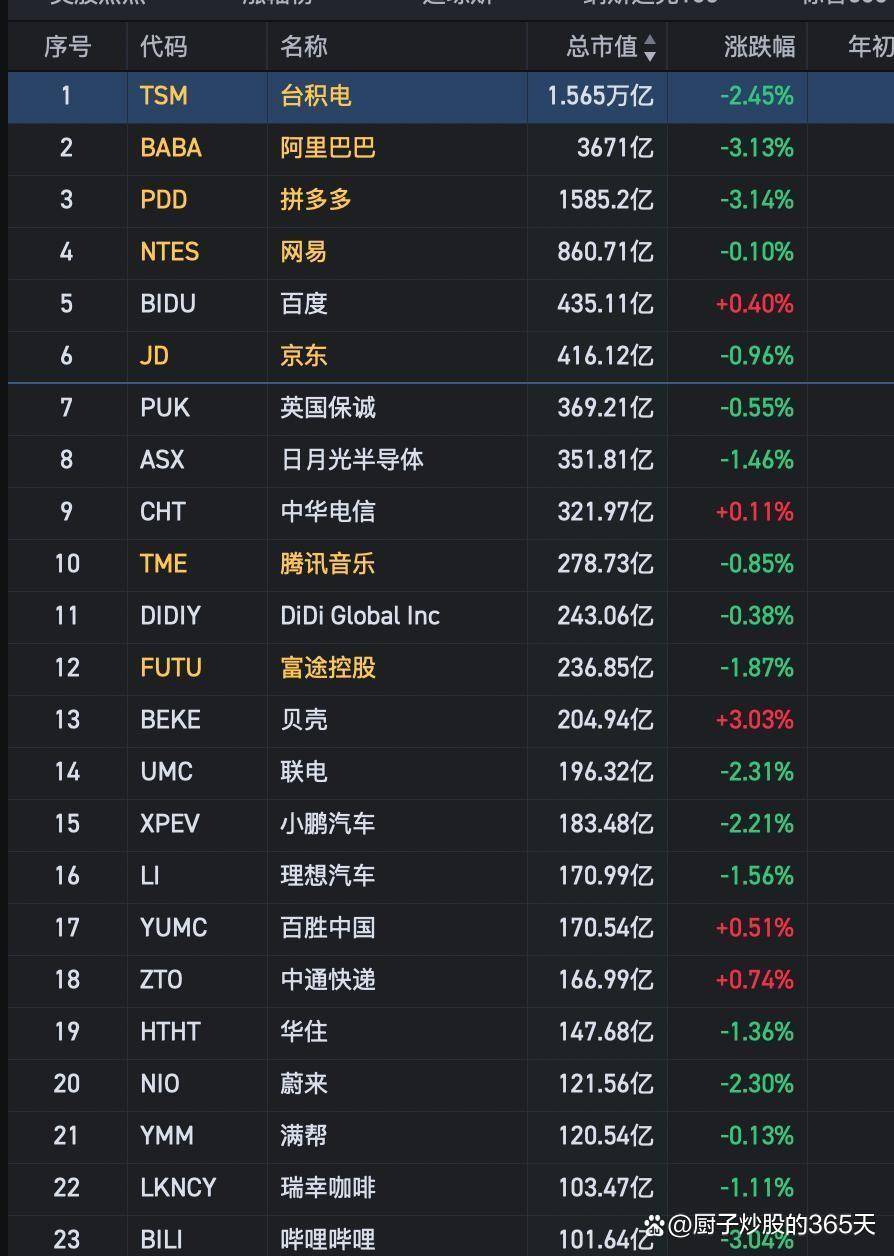
Core Viewpoint - The U.S. stock market experienced a significant capital flight on December 11, 2025, with Chinese concept stocks plummeting, including major players like Alibaba and Pinduoduo, alongside declines in the seven major U.S. tech giants [1][3]. Group 1: Market Performance - The Nasdaq China Golden Dragon Index fell by 0.43%, with 35 leading Chinese concept stocks experiencing substantial declines [1]. - Major U.S. tech stocks also faced losses, with Nvidia down 3.29%, Broadcom down 3.31%, and Tesla down 1.82%, while only Visa saw an increase of 2.88% [3][5]. - Alibaba's market value decreased by 3.13%, and Pinduoduo dropped by 3.14%, reflecting a broader trend of capital avoidance of high-volatility assets as year-end approaches [3][4]. Group 2: Contributing Factors - The tightening of U.S. chip policies has become a primary factor suppressing tech-related Chinese concept stocks, with Nvidia required to pay 25% of revenue from sales to Chinese companies, increasing operational costs and uncertainty for these firms [4]. - The anticipated tightening of regulations on Chinese concept stocks under the Trump administration has further contributed to market fears, particularly regarding audit scrutiny and potential delisting risks [4]. - The Bank of Japan's interest rate hike has added pressure on Chinese concept stocks, as capital flows shifted, leading to liquidity issues and a sell-off of these stocks [5][6]. Group 3: Institutional Behavior - As the year-end approaches, institutions are rebalancing their portfolios, leading to reduced liquidity and a preference for locking in profits, which has resulted in a withdrawal from high-volatility Chinese concept stocks [6][8]. - The uncertainty surrounding the Federal Reserve's interest rate decisions has also prompted investors to exit riskier assets, with expectations for rate cuts diminishing significantly [6][8]. Group 4: Cross-Market Impact - The decline in U.S. tech stocks has negatively impacted Chinese concept stocks, with the Nasdaq index down 0.86% and the S&P 500 down 0.20%, while only the Dow Jones index saw a slight increase [8][9]. - Historical trends indicate that when the Nasdaq China Golden Dragon Index performs poorly, it often drags down the Hang Seng Index and A-shares, highlighting the interconnectedness of global capital flows [12]. Group 5: Market Sentiment and Future Outlook - The significant drop in Chinese concept stocks has led to increased interest in safe-haven assets, with silver prices surging by 73% year-to-date, contrasting sharply with the decline in Chinese stocks [14]. - The market's volatility is seen as a self-correcting mechanism, with the recent downturn viewed as a necessary adjustment following substantial gains earlier in the year [14]. - Companies that have completed secondary listings in Hong Kong, such as Alibaba and JD.com, are perceived to have stronger risk resilience due to their enhanced liquidity options [14].


PDD Holdings: My Top E-Com Pick For 2026
Seeking Alpha· 2025-12-12 10:42
Core Insights - PDD Holdings Inc. is experiencing growth in its core e-commerce business, driven by strong interest in its online marketing and transaction services [1] - The company is outperforming its e-commerce rivals in terms of earnings growth and is benefiting from favorable economic conditions [1]

美股中概股盘前涨跌互现,好未来涨3%
Jin Rong Jie· 2025-12-12 09:19
Core Viewpoint - US-listed Chinese stocks showed mixed performance in pre-market trading, with notable gains for several companies [1] Group 1: Company Performance - TAL Education Group (好未来) increased by 3% [1] - Xpeng Motors (小鹏汽车) rose by 0.8% [1] - Pinduoduo (拼多多) saw a gain of 0.7% [1] - Alibaba (阿里巴巴) experienced a 0.5% increase [1]


拼多多“千亿扶持”落地半年,电商平台“包邮区”持续扩大,更多地区享受便利网购服务
Quan Jing Wang· 2025-12-12 06:27
Core Insights - Pinduoduo's "100 Billion Support" initiative has been recognized for enhancing e-commerce accessibility and enabling more consumers to benefit from the growth of the e-commerce sector [1][2] - The initiative aims to create a high-quality e-commerce ecosystem by investing significant resources to support small and medium-sized businesses, particularly in remote areas [1][3] Group 1: Initiative Overview - The "100 Billion Support" program was launched in April and focuses on building a multi-win commercial ecosystem involving users, merchants, and the platform [1] - Over the past six months, the program has led to a 51% year-on-year increase in quality product SKUs and a 42% increase in the number of merchants aged 95 and 00 [2] Group 2: Agricultural Support - Pinduoduo has initiated the "DuoDuo Good Specialty" project to promote agricultural products, helping farmers increase production and income [3] - The project has developed customized growth plans for hundreds of agricultural merchants across various regions, enhancing the value of agricultural products [3][4] Group 3: Market Expansion - The initiative has successfully integrated remote areas into the e-commerce ecosystem, with regions like Inner Mongolia and Gansu now included in the "free shipping zone" [2][8] - Pinduoduo has implemented measures to reduce logistics costs for remote areas, significantly improving delivery times and expanding market access for local businesses [7][8] Group 4: Consumer Engagement - The platform has introduced various promotional strategies, such as "Billion Subsidies" and group buying, to enhance consumer engagement and increase purchase frequency [7] - The initiative has led to a notable increase in orders from county-level regions, indicating a growing acceptance of e-commerce among consumers in these areas [7][8] Group 5: Industry Transformation - Pinduoduo's support has enabled traditional manufacturers to transition from wholesale to direct online sales, fostering brand development and product innovation [5][6] - The "New Quality Supply" initiative has seen a rapid increase in the number of merchants, particularly among younger demographics, with a 31% increase in 95s and a 44% increase in 00s [6]
纳斯达克中国金龙指数跌幅扩至1% 热门中概股普跌 BOSS直聘跌4.45%
Xin Lang Cai Jing· 2025-12-12 01:37
Core Viewpoint - The Nasdaq China Golden Dragon Index has seen a decline, with major Chinese concept stocks experiencing significant drops in their share prices [1] Group 1: Index Performance - The Nasdaq China Golden Dragon Index's decline has expanded to 1% [1] Group 2: Individual Stock Performance - BOSS Zhipin has decreased by 4.45% [1] - Kingsoft Cloud has fallen by 3.89% [1] - Alibaba's stock price has dropped by 3.16% [1] - Pinduoduo has seen a decline of 3.2% [1] - Bilibili has decreased by 2.92% [1]

白酒低迷、AI订单排队,景林高云程,投资得学会“两边下注”
Sou Hu Cai Jing· 2025-12-11 17:37
Core Viewpoint - The market is experiencing a dichotomy, with traditional industries like high-end liquor and real estate facing significant challenges, while new economies such as AI and renewable energy are thriving [2][6]. Group 1: Traditional Industries - High-end liquor wholesale prices have been declining for six months, with distributors reporting minimal profits [2]. - The real estate market is seeing record-high listings, but buyers are cautious and negotiating aggressively, leading to frustration among sellers [2]. - The consumer sector is also under pressure, with companies in the food delivery space suffering significant losses despite heavy subsidies [7]. Group 2: New Economy - Companies in the AI supply chain are rapidly expanding production capacity, with some operating 24/7 to meet demand [4]. - The renewable energy sector is booming, with local governments proactively seeking partnerships for storage projects [4]. - AI technology is advancing quickly, with companies leveraging AI for efficiency gains, such as reducing meeting documentation time from two hours to ten minutes [9]. Group 3: Investment Strategies - The company is focusing on a framework called "MCGF," which identifies five key sectors for investment: social platforms, chip industry, scarce resources, AI models with public cloud integration, and outdoor brands [13][15]. - The strategy emphasizes investing in companies with strong economic moats, ensuring long-term viability regardless of market fluctuations [15][17]. - The company advises against trying to time the market, instead recommending a focus on companies with consistent returns on equity and reasonable valuations [17]. Group 4: Market Outlook - The company anticipates a challenging market in 2026, suggesting investors lower their return expectations and focus on fundamental research [18][19]. - There is an opportunity for reverse investment strategies, targeting companies that are undervalued but fundamentally sound [21]. - The market is viewed as a "淘汰赛" (elimination race), where only companies with strong technology and profitability will survive [23].

美股异动丨热门中概股盘前多数走弱 拼多多跌超2%
Ge Long Hui A P P· 2025-12-11 13:16
Core Viewpoint - Pinduoduo's pre-market drop exceeded 2%, while Alibaba, Bilibili, Li Auto, and Xpeng Motors fell over 1%, and JD.com decreased by 0.54%. In contrast, Baidu saw an increase of nearly 1% [1] Company Performance - Pinduoduo experienced a pre-market decline of more than 2% [1] - Alibaba, Bilibili, Li Auto, and Xpeng Motors each saw a drop of over 1% [1] - JD.com recorded a decrease of 0.54% [1] - Baidu's stock rose by nearly 1% [1]


电商税收规范专家交流
2025-12-11 02:16
Summary of Key Points from the Conference Call Industry Overview - The conference call focuses on the **e-commerce industry** in China, highlighting recent regulatory changes and their implications for e-commerce companies. Core Insights and Arguments 1. **Regulatory Changes and Impact**: - In 2025, several policies will be introduced, including the **National Tax Document No. 37** and the **State Development and Reform Commission's** opinions on building a unified market, aimed at breaking local protectionism and promoting fair competition in the e-commerce sector [1][2] - The revised **Anti-Unfair Competition Law** effective from October 15, 2025, will further regulate the e-commerce industry, ensuring that online businesses comply with tax regulations similar to traditional businesses [6][4] 2. **Increased Tax Compliance**: - The **State Council's Order No. 8,081** mandates e-commerce platforms to report tax-related information monthly, enhancing transparency and making tax evasion more difficult [1][6] - The **Golden Tax System IV** has improved data transparency, aiding tax authorities in effective supervision and enforcement [6][21] 3. **Data Monitoring and Compliance**: - Tax authorities are investing in data services for better oversight, with a reported expenditure of **965,000 yuan** for regular monitoring of listed companies [8] - E-commerce platforms like **Taobao** have **90 million merchants**, indicating a significant number of small and medium-sized sellers who will face stricter regulations under the new policies [5][7] 4. **Key Tax Policy Considerations for E-commerce**: - E-commerce companies must adhere to the same tax policies as traditional businesses, including VAT exemptions for small businesses with sales below **300,000 yuan** quarterly [10][11] - Companies should avoid practices that could be seen as tax evasion, such as improper fundraising and refund policies [10] 5. **Future Regulatory Environment**: - Stricter regulations are anticipated from the third to fourth quarter of 2026, prompting companies to prepare by organizing their data and seeking professional assistance [3][35] Additional Important Insights - **Market Dynamics**: The new regulations are expected to create a more level playing field between online and offline businesses, fostering a healthier market environment [4] - **Operational Strategies**: E-commerce companies are advised to regularly verify sales and profit data, maintain complete transaction records, and actively utilize available tax incentives [3][14] - **Challenges Ahead**: The industry faces challenges such as increased data transparency and higher advertising costs compared to traditional methods, necessitating strategic adjustments [27][34] Conclusion The e-commerce industry is undergoing significant regulatory changes that will enhance compliance and transparency. Companies must adapt to these changes to ensure sustainable operations and avoid potential penalties.
全线大涨!美联储降息!特朗普回应!鲍威尔重磅发声!
天天基金网· 2025-12-11 01:11
Core Viewpoint - The article highlights significant market movements following the Federal Reserve's interest rate cut, with a focus on the performance of various sectors, particularly technology and e-commerce, indicating a shift in investor sentiment towards growth and defensive assets [4][10][17]. Market Performance - The three major U.S. stock indices closed higher, with the Dow Jones up 1.05%, S&P 500 up 0.67%, and Nasdaq up 0.33% [8]. - Notable gainers included Nike (+3.91%), Caterpillar (+3.56%), and Johnson & Johnson (+3.32%), leading the Dow components [9][10]. Federal Reserve Actions - The Federal Reserve cut interest rates by 25 basis points, bringing the target range to 3.50%–3.75%, marking the third cut of the year [17]. - Fed Chair Jerome Powell indicated that the economic outlook remains stable, with moderate expansion and a cooling labor market, while inflation remains above the 2% target [19]. Technology Sector - The Philadelphia Semiconductor Index rose 1.29%, reaching a historical high, driven by strong performances from companies like Micron Technology (+4.47%) and Qualcomm (+3.53%) [22][25]. - The rise in semiconductor stocks reflects growing investor confidence in the technology sector amid broader market gains [23]. E-commerce Trends - Morgan Stanley forecasts that by 2030, smart agent shopping could account for 10%–20% of the e-commerce market, representing a potential $190 billion to $385 billion in U.S. e-commerce spending [27][28]. - Approximately 23% of Americans have used AI for shopping in the past month, indicating significant adoption potential for AI-driven shopping experiences [28].