XPENG(XPEV)

Search documents
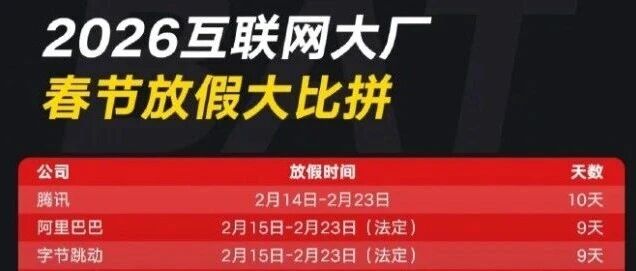
2026年互联网大厂春节放假大比拼,最高17天假。
猿大侠· 2026-02-15 04:11
Holiday Arrangements - Major companies have announced their holiday schedules for the upcoming Spring Festival, with most adhering to the national statutory holiday of 9 days [3][4] - Tencent will have a holiday from February 14 to February 23, totaling 10 days, while 58.com has the longest holiday of 17 days from February 7 to February 23 [4] - Other companies like Alibaba, ByteDance, Baidu, Meituan, Didi, Pinduoduo, Kuaishou, JD, and Xiaomi will follow the statutory holiday from February 15 to February 23, each with 9 days off [4] Employee Sentiment - There is a general satisfaction among employees regarding the holiday duration, with many expressing hope that future holidays will not be less than 9 days [3]





XPeng (XPEV) Draws Mixed Analyst Calls, Expands Global Payments
Yahoo Finance· 2026-02-14 13:17
Core Viewpoint - XPeng Inc. is enhancing its digital payment experience for EV charging services through a collaboration with Ant International's Antom payment platform, marking a significant step in its global expansion strategy [1][2]. Group 1: Collaboration and Payment Integration - XPeng has partnered with Antom to enable drivers to manage charging and payments directly within the XPeng mobile app, starting with AlipayHK in Hong Kong and planning to add credit card options soon [2]. - The collaboration aims to integrate various payment methods, including global credit cards and local alternatives like e-wallets and mobile banking apps [2][3]. Group 2: Market Position and Analyst Insights - XPeng is recognized as the first Chinese next-generation EV maker to collaborate with Antom, highlighting its innovative approach in the EV market [3]. - JPMorgan has lowered its price target for XPeng from $50 to $34 while maintaining an Overweight rating, citing challenges in China's auto industry and a forecasted loss for the company due to weaker sales and margins [3]. Group 3: Company Overview - XPeng Inc. designs, manufactures, and sells smart electric vehicles, focusing on advanced autonomous driving technologies and connected car systems, with products including electric SUVs and sedans like the G9 and P7 [4].

小鹏汽车-W(09868):看好VLA2.0能力,即将在26Q1全量推送
GOLDEN SUN SECURITIES· 2026-02-14 08:37
Investment Rating - The report maintains a "Buy" rating for the company [8] Core Insights - The company is expected to launch VLA 2.0 in March 2026, significantly enhancing its autonomous driving capabilities with advanced hardware and software integration [1] - 2026 is projected to be the year of Robotaxi commercialization, with three models expected to be launched, featuring L4 autonomous driving capabilities [2] - The company anticipates strong growth in overseas markets, with a projected delivery of 45,000 units in 2025, representing a 96% year-on-year increase, and expects overseas revenue to exceed 20% in 2026 [3] - 2026 will also mark the mass production of advanced humanoid robots, aimed at commercial applications [4] - The investment recommendation highlights the company's strong product cycle, overseas expansion, advancements in autonomous driving, and emerging business opportunities in robotics and Robotaxi [5] Financial Projections - The company forecasts total vehicle sales of approximately 430,000 units in 2025, increasing to 566,000 units in 2026, and 836,000 units in 2027 [15] - Revenue is projected to reach 75.2 billion RMB in 2025, 103.1 billion RMB in 2026, and 145.5 billion RMB in 2027, with a significant increase in gross profit margins [15] - The non-GAAP net profit margin is expected to improve from -1.2% in 2025 to 2.3% in 2026 and 3.2% in 2027 [7][15] - The company anticipates a total revenue of 100.1 billion RMB from its core business in 2026, with an estimated profit contribution of 2.7 billion RMB from its collaboration with Volkswagen [5] Market Strategy - The company plans to introduce three new models in overseas markets in 2026, focusing on Europe, Southeast Asia, the Middle East, and Latin America [3] - The production strategy includes partnerships with local firms in Europe and Southeast Asia to better meet local demand [3] - The introduction of the Mona SUV series is expected to enhance the company's market presence in the competitive pricing segment while maintaining advanced intelligent driving capabilities [3]
小鹏汽车-W:看好VLA 2.0能力,即将在26Q1全量推送-20260214
GOLDEN SUN SECURITIES· 2026-02-14 08:24
Investment Rating - The report maintains a "Buy" rating for the company [8] Core Insights - The company is set to launch VLA 2.0 in March 2026, significantly enhancing its autonomous driving capabilities with advanced hardware and software integration [1] - 2026 is anticipated to be the year of Robotaxi for the company, with plans to introduce three Robotaxi models equipped with advanced autonomous driving systems [2] - The company is expected to see rapid growth in overseas sales, projecting a delivery volume of 45,000 units in 2025, a 96% year-on-year increase, with expectations to exceed 20% of total revenue from international markets by 2026 [3] - The company plans to mass-produce advanced humanoid robots by the end of 2026, aiming to integrate them into commercial scenarios [4] - The investment recommendation highlights strong product cycles, overseas expansion, advancements in autonomous driving, and emerging business opportunities in robotics and Robotaxi [5] Financial Projections - The company forecasts total vehicle sales of approximately 430,000 units in 2025, increasing to 566,000 units in 2026, and 836,000 units in 2027 [15] - Revenue is projected to reach 75.2 billion RMB in 2025, 103.1 billion RMB in 2026, and 145.5 billion RMB in 2027, with a significant increase in gross profit margins [7][15] - The non-GAAP net profit margin is expected to improve from -1.2% in 2025 to 2.3% in 2026 and 3.2% in 2027 [5][15] - The company anticipates a main business revenue of 100.1 billion RMB in 2026, with a profit contribution from partnerships expected to be around 2.7 billion RMB [5] Market Strategy - The company plans to launch three new models in overseas markets in 2026, focusing on Europe, Southeast Asia, the Middle East, and Latin America [3] - The introduction of the Mona SUV series is expected to cater to the mass market while providing advanced intelligent driving capabilities [3]
中概股全线走低、美股全线大跌,有色金属、半导体芯片、苹果重挫
Sou Hu Cai Jing· 2026-02-14 04:30
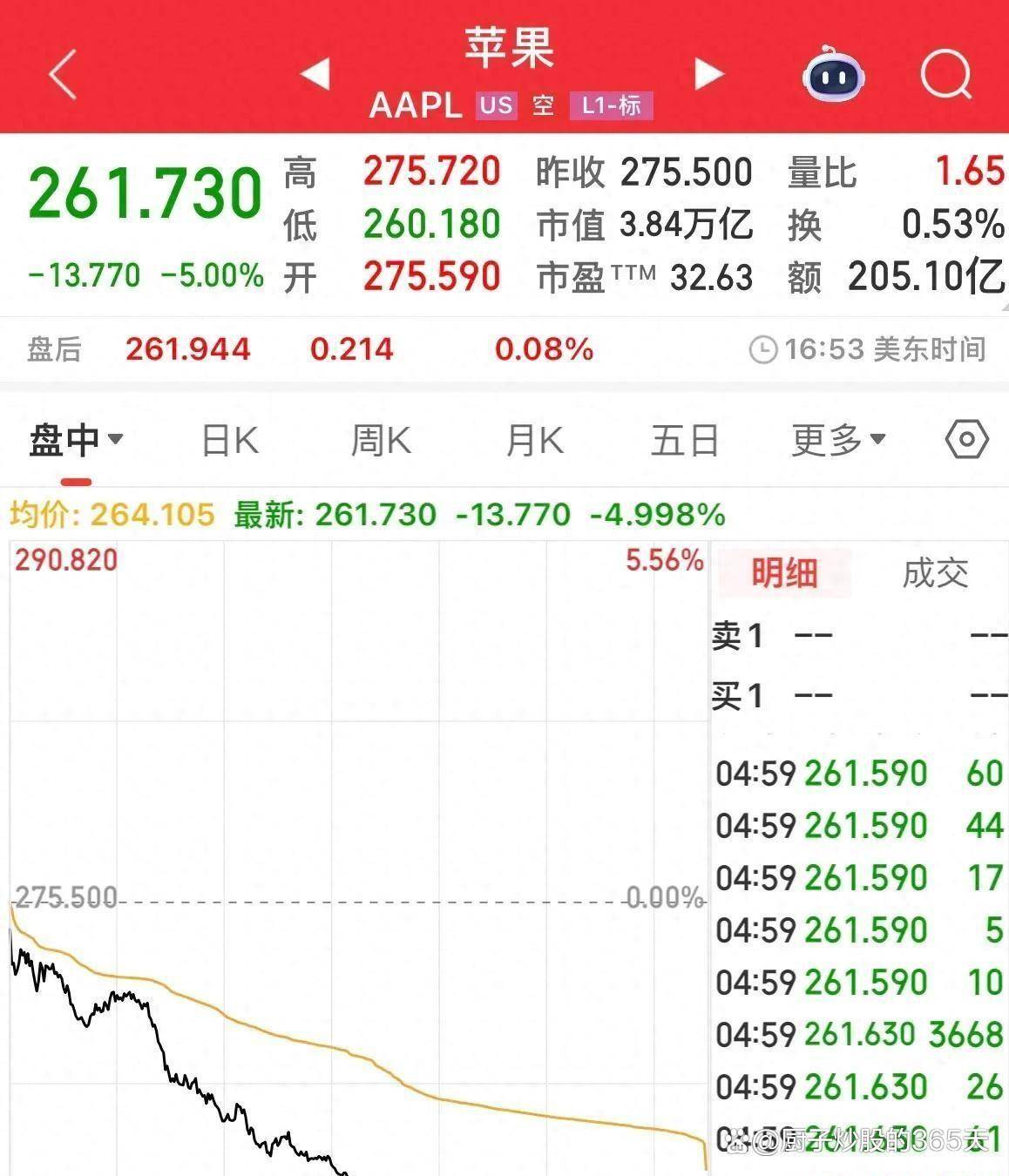
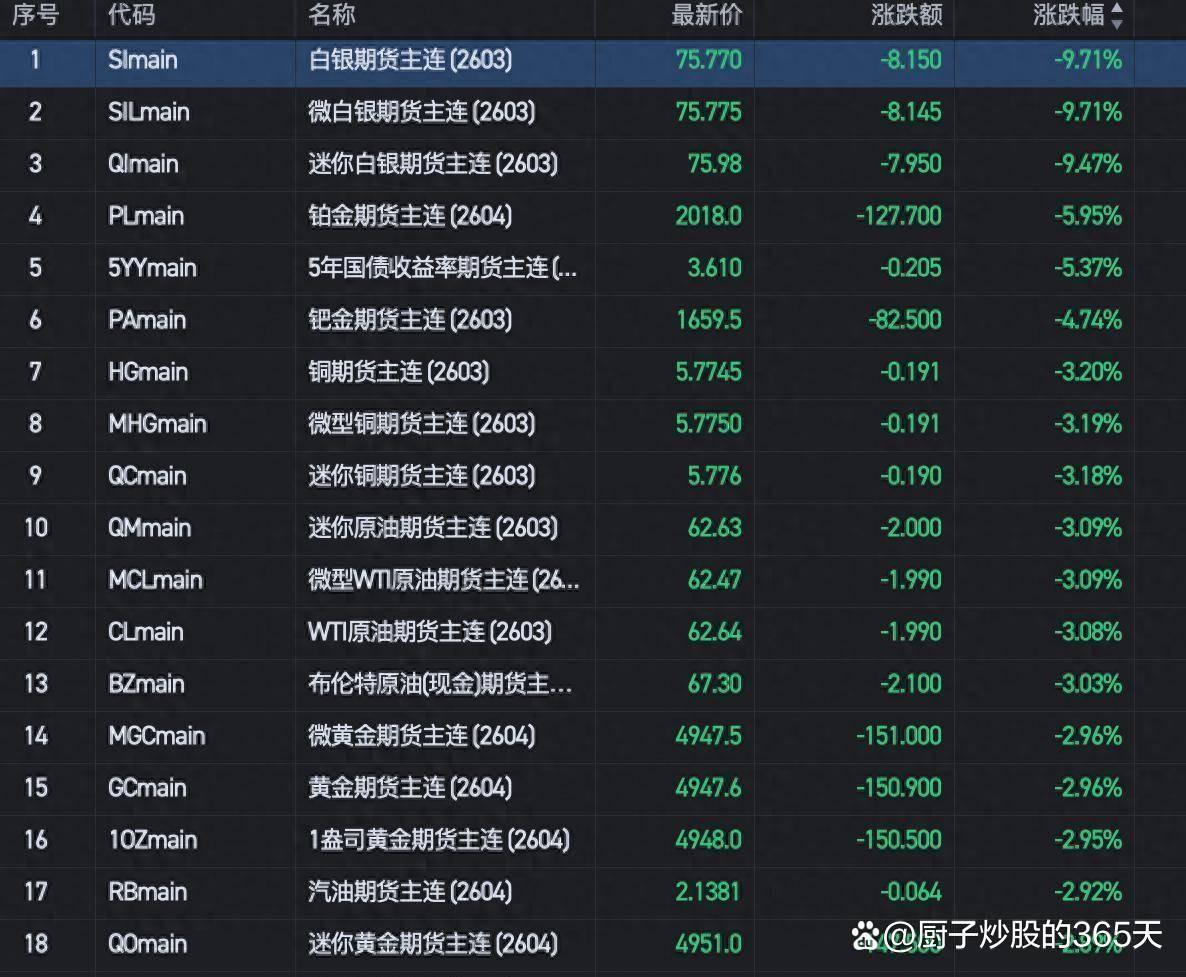
Market Overview - The US stock market experienced a significant decline, with the Dow Jones Industrial Average dropping 669.42 points (1.34%) to close at 49,451.98 points, the Nasdaq Composite falling 469.32 points (2.03%) to 22,597.15 points, and the S&P 500 decreasing by 108.71 points (1.57%) to 6,832.76 points [1][2][3] Market Sentiment - Over 4,100 stocks declined, indicating widespread market panic as investors rushed to sell assets, particularly in the tech and growth sectors. The VIX index surged, reflecting heightened risk aversion [2][3] Sector Performance - The sell-off affected nearly all sectors, with notable declines in precious metals and semiconductor stocks. The precious metals sector saw significant drops, with gold futures down 3.08% and silver futures plummeting 10.62% [4][5][6][8] - The Philadelphia Semiconductor Index fell by 2.5%, with individual stocks like AEHR Test Systems down 17.58% and Intel down over 3% [8][10] Major Companies - Apple Inc. experienced a substantial drop of 5.00%, resulting in a market cap loss of over $120 billion, attributed partly to regulatory concerns [12] - Other major tech companies also faced declines, with Tesla down 1.62%, Amazon down 2.20%, and Meta Platforms down nearly 3% [12] Financial Sector - Bank stocks fell across the board, with JPMorgan Chase down over 2%, Goldman Sachs down over 4%, and Citigroup down over 5%, driven by concerns over AI disrupting traditional wealth management [13][14] Economic Indicators - Recent economic data, including a drop in initial jobless claims and lower-than-expected existing home sales, contributed to market anxiety about potential economic overheating and prolonged high interest rates [24][25][26] Global Market Impact - The sell-off in the US markets had a ripple effect on global markets, with European indices also closing lower after initially opening higher, indicating a widespread sentiment of fear [18][19][20] AI Concerns - The market's decline was exacerbated by fears regarding the disruptive impact of AI technologies on various industries, leading to significant stock price drops in sectors perceived to be at risk [21][22][30] Storage Chip Sector - In contrast to the overall market trend, storage chip stocks saw gains, with companies like SanDisk and Seagate Technology rising significantly, reflecting a belief that AI's growth will increase demand for data storage [29]


晚间暴雷!黄金、白银、原油、美股全线崩盘,42只中概集体下跌
Sou Hu Cai Jing· 2026-02-14 04:22
Market Overview - On February 13, 2026, a significant asset sell-off occurred in global financial markets, particularly impacting U.S. stock indices. The Dow Jones Industrial Average fell by 669.42 points (1.34%) to close at 49,451.98, while the Nasdaq Composite Index dropped 469.32 points (2.03%) to 22,597.15. The S&P 500 Index also declined by 108.71 points (1.57%) to 6,832.76 [1]. Commodity Market Impact - The sell-off extended to the commodity markets, with gold and silver experiencing substantial declines. COMEX gold futures fell by 3.08% to $4,941.4 per ounce, while COMEX silver futures plummeted by 10.62% to $75.01 per ounce [2][3]. Technology Sector Reaction - Major technology companies were severely affected, with Apple’s stock price dropping by 5%, resulting in a market value loss of over $120 billion (approximately 800 billion RMB). Other tech giants like Microsoft, Amazon, Tesla, Meta, and Nvidia also saw significant declines [3][4]. Chinese Concept Stocks - The Nasdaq Golden Dragon China Index, which includes many Chinese concept stocks, fell by 3% on the same day, indicating a collective sell-off in this sector. Over 40 Chinese concept stocks experienced substantial declines, with Tencent Music down 10.57% and Alibaba down 3.40% [3][4][6]. Employment Data Influence - The catalyst for this market turmoil was a strong U.S. employment report released on February 11, showing a non-farm payroll increase of 130,000 in January, significantly above the expected 70,000. This led to a shift in market expectations regarding Federal Reserve interest rate cuts, with the probability of a March rate cut dropping from 19.6% to 6% [5][6]. Capital Expenditure Concerns - Major tech companies announced aggressive capital expenditure plans for 2026, with Alphabet projecting $175 billion to $185 billion and Amazon estimating $200 billion, both nearly doubling their 2025 expenditures. This raised investor concerns about the return on such investments, especially as many companies reported record profits but saw stock price declines [10][11]. Market Sentiment and Volatility - The market's fear and volatility increased sharply, with the VIX index rising significantly. The sell-off was exacerbated by algorithm-driven trading, which triggered stop-loss orders and led to extreme price movements [15][16][17]. Global Market Impact - The financial turmoil that began in Wall Street quickly spread to global markets, with Asian and European stock markets opening lower in response to the U.S. declines [18].



美股三大指数周线齐跌
财联社· 2026-02-14 00:39
Market Overview - The three major indices showed mixed performance, with the Dow Jones up 0.10% to 49,500.93 points, the S&P 500 up 0.05% to 6,836.17 points, and the Nasdaq down 0.22% to 22,546.67 points [3] - All three indices recorded weekly declines, with the S&P 500 down 1.4%, the Dow down 1.2%, and the Nasdaq down 2.1% [3] Economic Indicators - The U.S. Bureau of Labor Statistics reported that the January CPI rose 2.4% year-over-year and 0.2% month-over-month, both below market expectations [3] - The core CPI, excluding volatile food and energy prices, increased by 2.5% year-over-year and 0.3% month-over-month, aligning with market expectations [3] - Phil Blancato, Chief Market Strategist at Osaic, indicated that this data could pave the way for interest rate cuts and inflation control if the trend continues [3] Sector Performance - Concerns over AI disruption led to market sell-offs, affecting various sectors including software, real estate, trucking, and financial services [6] - Financial stocks such as Charles Schwab and Morgan Stanley fell by 10.8% and 4.9%, respectively, while software company Workday dropped 11% and commercial real estate firm CBRE fell 16% [6] - The media sector was also impacted, with Disney down approximately 3% and Netflix down 6% [7] Technology Stocks - Major tech stocks mostly declined, with Nvidia down 2.21%, Apple down 2.27%, Microsoft down 0.13%, Google down 1.06%, and Amazon down 0.41% [7] - Tesla saw a slight increase of 0.09%, while Oracle rose by 2.34% and Netflix increased by 1.33% [7] Chinese Stocks - The Nasdaq Golden Dragon China Index fell by 0.10%, with Alibaba down 1.89%, JD.com down 1.38%, and Pinduoduo up 0.06% [7] - NIO remained flat, while Xpeng rose by 1.36% and Li Auto fell by 1.81% [7]



【重磅深度】2026年主流车企城市NOA试驾报告—2月上海篇
东吴汽车黄细里团队· 2026-02-13 15:40
Investment Highlights - The main contradiction in C-end automotive intelligence has shifted from coverage to experience optimization in 2026. Major intelligent driving manufacturers and solution providers have achieved urban NOA (Navigation on Autopilot) experiences in complex scenarios such as roundabouts and U-turns, and have improved advanced functions like parking and ETC passage. The primary optimization direction moving forward will be the handling capability of Corner Cases to enhance the driving experience for passengers and safety operators [2][7]. Road Testing Overview - This report conducted both large-sample concentrated road tests and small-sample in-depth road tests. It qualitatively and quantitatively evaluated the intelligent driving experiences of six manufacturers/solution providers: Horizon, Li Auto, Qianli Zhijia, Qingzhou Zhihang, WeRide, and Xpeng, based on dimensions such as scenario implementation, takeover frequency, and comfort. Due to subjective scales, actual road conditions, and the trust level of safety operators in intelligent driving, the report does not rank the intelligent capabilities of specific manufacturers/solution providers [3][7]. Performance Improvement - Compared to 2025, all major manufacturers have improved their intelligent driving capabilities in Q1 2026, while third-party suppliers have also demonstrated excellent implementation results. The self-research camp of manufacturers is expected to continue iterating. Li Auto and Xpeng have developed mature self-research solutions that cover full-scene NOA on public roads and some internal roads, showing improvements in static and dynamic lateral perception, scenario understanding, and Corner Case handling. Li Auto's OTA 8.2 iteration has made AD Max smoother, reducing driving jolts and stabilizing responses. Xpeng's XOS 5.8.5 version can achieve three-point U-turns and autonomously learn from parking to parking, with VLA 2.0 expected to launch after the Spring Festival, enhancing reasoning efficiency and response speed [4][7]. Third-Party Supplier Performance - Third-party intelligent driving suppliers have shown impressive results. Their solutions have been launched to cover all external public roads seamlessly, with roundabouts and U-turns executed without interruptions. Horizon's HSD demonstrated smooth performance, achieving a full hour of deep road testing with zero takeovers (with one intervention for acceleration). Qianli Zhijia's G-ASD solution on the Zeekr model significantly reduced takeover rates. Qingzhou Zhihang utilized a single J6M chip (with 128 TOPS computing power) to achieve mass production of urban NOA, which is the lowest computing power among urban NOA models. WeRide's solution won the championship at the China Intelligent Driving Competition in Taizhou, showcasing excellent lane selection logic with no safety takeovers [4][7].


2026车企新车规划盘点 这些新车值得关注
Zhong Guo Zhi Liang Xin Wen Wang· 2026-02-13 06:54
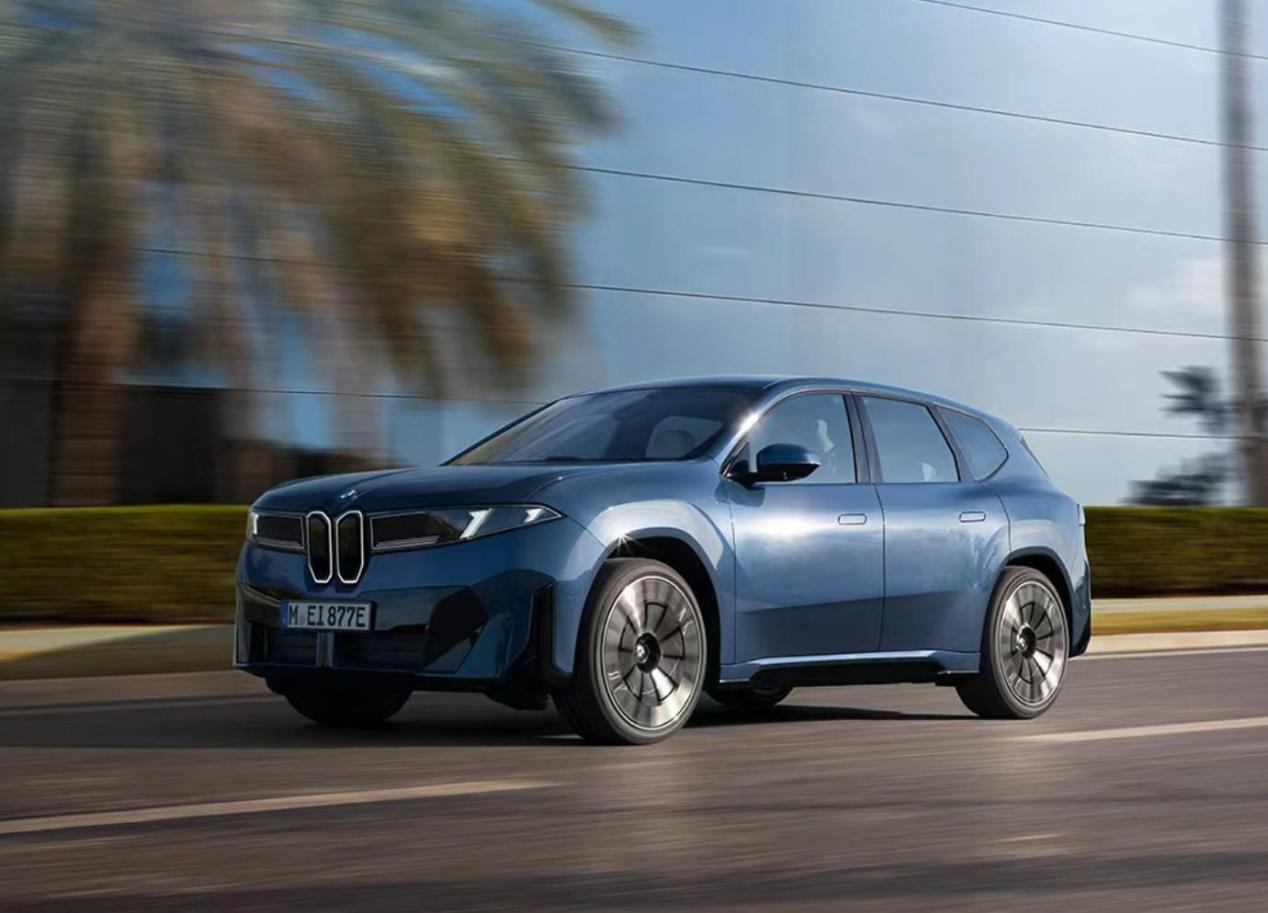
Industry Overview - The domestic automotive industry is entering a new phase focused on quality and efficiency, moving away from price competition to technology innovation and product upgrades to attract consumers [1] - In 2025, domestic passenger car production and sales are expected to reach new highs, with various automakers announcing new vehicle plans across different segments [1] BMW Group - BMW Group plans to launch approximately 20 new models across its three brands by 2026, including the locally produced BMW iX3 long-wheelbase version [2] - The new models will incorporate advanced technologies such as BMW's new generation electric drive technology and AI integration [2][4] Mercedes-Benz - Mercedes-Benz will introduce over 15 new and updated products in 2026, adhering to a strategy of "oil-electric homogeneity" and "oil-electric intelligence" [5] - The lineup will include new models like the long-wheelbase pure electric GLC SUV and the next-generation S-Class sedan [5][7] FAW-Volkswagen - FAW-Volkswagen plans to launch up to 13 new models in 2026, covering fuel, hybrid, and pure electric vehicles [9] - New models will include the all-new Sagitar S, Tayron S, and several Audi models, with a focus on advanced intelligent cockpit and driving assistance systems [9] SAIC Volkswagen - SAIC Volkswagen aims to release at least 7 new energy vehicles in 2026, emphasizing a strategy of "oil-electric co-progression" [11] - The ID.ERA 9X will be the first model in the new ID.ERA series, marking a significant step in the brand's transition to new energy [11] BYD - BYD plans to launch multiple new models across its various brands in 2026, including flagship models in the Dynasty and Ocean series [13] - The company will hold 12 product launch events throughout the year, covering high-end SUVs, performance supercars, and sedans [13] Geely - Geely is expected to introduce over 10 new energy models in 2026, covering various segments such as sedans, SUVs, and MPVs [15] - The Galaxy series will see the addition of new mid-to-large sedans and SUVs, while the Zeekr brand will focus on high-end models [15] Leap Motor - Leap Motor plans to launch 4 new models targeting the mainstream and high-end markets, including a small pure electric SUV and a flagship MPV [17] NIO - NIO will introduce several new models across its three brands, including the flagship ES9 SUV and the L80, a "super five-seat SUV" [18] XPeng Motors - XPeng Motors will launch 7 new "dual-energy" models in 2026, including the new AI luxury SUV [20] - The company emphasizes the integration of self-developed technologies in its new models [20] Hongmeng Zhixing - Hongmeng Zhixing plans to launch 12 new models in 2026, covering a wide price range from family cars to ultra-luxury vehicles [22] - The lineup will include new SUVs and MPVs, with a focus on differentiating market segments [22]

中国汽车:市场反馈及行业预期下调 -1 月季节性表现弱于往常,且物料成本通胀加剧-China Automobiles_ Marketing feedback & lowering estimates for the sector on weaker-than-usual Jan seasonality with BOM cost inflation
2026-02-13 02:18
Summary of Conference Call Notes on the Automotive Industry Industry Overview - **Industry**: Automotive, specifically focusing on electric vehicles (EVs) and new energy vehicles (NEVs) in China - **Current Market Sentiment**: Investor positioning in the automotive sector is underweight as of early 2026, with concerns about demand and cost inflation impacting outlooks [1][2] Key Points 1. Industry Volume Trajectory - **January 2026 Performance**: Domestic passenger vehicle retail volume decreased by 20% month-over-month (mom), compared to a 14% decrease in January 2024 [3] - **Market Expectations**: Anticipation of continued volume decline into February 2026, attributed to the Chinese New Year holiday and reduced stimulus effects [3] - **Future Outlook**: Expected recovery in consumer demand starting March 2026, coinciding with new product launches from BYD and the Beijing Auto Show [3] 2. Raw Material and Memory Cost Inflation - **Cost Increases**: Year-to-date increases in commodity prices (lithium, copper, aluminum) range from 27% to 85% year-over-year [4][18] - **Impact on BOM Costs**: Estimated average increase in Bill of Materials (BOM) costs for EVs is approximately Rmb4,000, leading to a gross margin decline of 2.0% and a net margin decline of 1.7% [4][11] - **OEM Negotiations**: OEMs are negotiating cost-sharing with suppliers, but are expected to absorb 100% of memory cost increases [4] 3. Potential Policy Stimulus - **Government Support Expectations**: Investors anticipate additional government support if demand remains weak, including subsidies for Level 3 vehicles and domestic chip usage [7] - **Economic Contribution**: Passenger vehicles accounted for about 5% of GDP in 2025, indicating the sector's significance to the economy [7] 4. Sensitivity Analysis on Costs - **Margin Concerns**: Rising raw material and memory costs are raising concerns about potential margin impacts for OEMs [8] - **Cost Pass-Through Assumptions**: Analysis assumes a 50/50 cost pass-through ratio for battery and metals, while memory costs are fully absorbed by OEMs [9][12] 5. Target Price Adjustments - **Price Target Reductions**: Target prices for covered OEMs and suppliers have been cut by up to 12% due to weaker demand and higher costs, with average estimates lowered by approximately 16% [2][24] - **Specific Company Adjustments**: - **BYD**: Target price reduced from Rmb144 to Rmb137 due to weaker delivery volumes and higher BOM costs [25] - **Li Auto**: Target price reduced from US$27 to US$24, reflecting lower sales and higher costs [25] - **XPeng**: Target price reduced from US$25 to US$22, driven by weaker sales and pricing pressures [25] - **NIO**: Target price reduced from US$7.0 to US$6.6, impacted by BOM cost inflation [25] 6. Long-term Projections - **Revenue and Net Income Changes**: Projections for revenue and net income have been adjusted downward for several companies, reflecting anticipated market conditions through 2030 [24][30] Additional Insights - **Investor Concerns**: There is a growing concern among investors regarding the sustainability of margins in light of rising costs and competitive pressures [8] - **Market Dynamics**: The automotive sector is facing significant challenges from both internal cost pressures and external market conditions, necessitating close monitoring of policy developments and consumer demand trends [7][8] This summary encapsulates the critical insights from the conference call, highlighting the automotive industry's current challenges and future outlook.