中行

Search documents
金价巨震寻底 三支撑定反弹成败
Jin Tou Wang· 2026-02-03 02:14
【要闻速递】 摘要今日周一(2月2日)亚盘时段,国际黄金最新报价为1081.13元/克,较前一交易日上涨41.40元,涨幅 3.98%,日内呈现强势反弹走势。当日开盘价报1042.24元/克,盘中最高触及1083.42元/克,最低下探至 1040.93元/克。 今日周一(2月2日)亚盘时段,国际黄金最新报价为1081.13元/克,较前一交易日上涨41.40元,涨幅 3.98%,日内呈现强势反弹走势。当日开盘价报1042.24元/克,盘中最高触及1083.42元/克,最低下探至 1040.93元/克。 业内分析,直接导火索是特朗普提名凯文.沃什为美联储主席,"美联储独立性危机"担忧降温,美元反 弹压制金价。2月以来金价续跌,投资者心态分化:有人观望等更低点(如某投资者称工行5克金条两日 降价200元),也有人趁跌抄底"补货"。 值得关注的是,世界黄金协会1月29日数据显示,2025年全球黄金总需求首破5000吨(达5002吨),实物 投资需求(金条金币1374吨)创12年峰值。机构对短期风险提示密集:工行、中行等多家银行警示波动加 剧,需理性控仓。 但长期共识未改:天风证券(601162)认为年内或重回升浪,全 ...
金价爆了,直逼5000美元,金饰克价超1500元!这种存款火了,收益率可达3.2%,有银行一度售罄,多家上市公司争相买入
Mei Ri Jing Ji Xin Wen· 2026-01-23 07:41
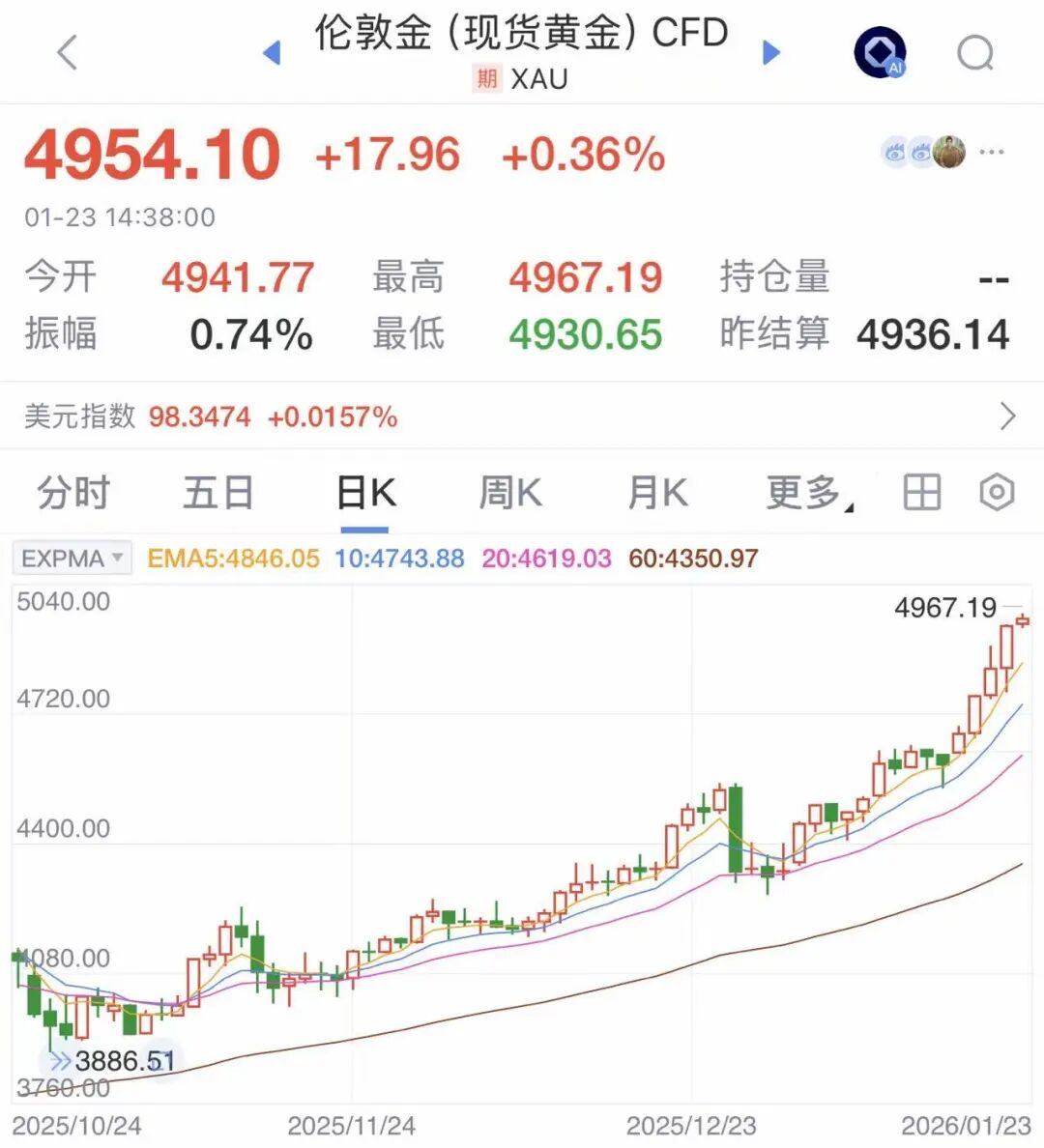
Core Viewpoint - International gold prices have been rising since the beginning of the year, nearing the $5000 mark, driven by geopolitical uncertainties and strong demand for gold as a safe-haven asset [1][3][4]. Group 1: Gold Price Trends - As of January 23, the London spot gold price exceeded $4960 per ounce, marking a nearly 15% increase within the month [1]. - The Shanghai Gold Exchange's spot gold price and the main gold futures contract on the Shanghai Futures Exchange both surpassed 1110 yuan per gram on January 23, reaching new highs [3]. - Several gold jewelry brands reported prices for pure gold jewelry exceeding 1500 yuan per gram, with some reaching 1548 yuan, an increase of over 50 yuan from the previous day [3]. Group 2: Influencing Factors - Geopolitical uncertainties, particularly actions by U.S. President Trump regarding Venezuela, Iran, and other international issues, are contributing to the long-term support for gold prices [3]. - Fluctuations in the U.S. dollar and U.S. Treasury yields are increasing the demand for gold as a safe-haven asset [3]. - Analysts predict that gold prices may rise further due to factors such as expectations of U.S. Federal Reserve interest rate cuts and ongoing geopolitical uncertainties [4]. Group 3: Investment Products - In response to rising gold prices, structured deposits linked to gold have become popular investment options, with several listed companies announcing subscriptions [5]. - Major banks have introduced structured deposits linked to gold, with some experiencing high demand and limited availability [5]. - Despite the strong gold price trend, the overall yield of these structured deposits is not particularly high, with most products offering annualized returns not exceeding 2% [5][6]. Group 4: Structured Deposit Details - An example of a structured deposit product from a bank offers a yield ranging from 0.5% to 3.2%, depending on the performance of gold prices during the observation period [6]. - The product's maximum yield is contingent on gold prices not exceeding a 6% increase; otherwise, the yield is capped at 1.7% [6]. - Investors are advised to consider the conditions for achieving the highest yields and the implications of the minimum yield in case of unfavorable price movements [7].

信达国际港股晨报快-20251030
Xin Da Guo Ji Kong Gu· 2025-10-30 01:58
Market Overview - The Hang Seng Index is expected to fluctuate around 26,000 points due to mixed signals from the Federal Reserve and ongoing U.S.-China trade tensions [2][4] - The U.S. Federal Reserve has reduced interest rates by 0.25%, with the target range now at 3.75% to 4.00%, and plans to end quantitative tightening by December [4][9] - Economic activity in the U.S. is expanding at a moderate pace, but uncertainty remains high, particularly regarding employment and inflation data [4][9] Company Performance - China Life Insurance (2318) reported a 46% year-on-year increase in new business value and an 11.5% rise in net profit for the first three quarters [11] - Ping An Insurance (2318) achieved a net profit of 132.86 billion yuan, up 11.5% year-on-year, with a significant increase in new business value [11] - China Merchants Bank (3968) saw a modest 1% increase in net profit to 38.84 billion yuan, with net interest income rising by 2.1% [11] - HSBC (0005) reported a 14% decline in pre-tax profit but raised its full-year net interest income forecast [11] - CICC (3908) experienced a 129.75% increase in net profit, driven by a rise in commission income and gains from financial instruments [11] Economic Indicators - The unemployment rate in urban areas of China decreased to 5.2% in September, with over 10.57 million new jobs created in the first three quarters [10] - The U.S. government shutdown has resulted in an estimated economic loss of $18 billion, with potential GDP growth impacts if the shutdown continues [9][10] Sector Focus - The insurance sector is expected to benefit from strong investment returns in the third quarter, with companies likely to report positive earnings [8] - AI-related stocks are gaining traction as mainland China accelerates the application of artificial intelligence technologies [8]

沪指重登4000点 这次不一样
Mei Ri Jing Ji Xin Wen· 2025-10-28 14:10
Core Insights - The Shanghai Composite Index (SHCI) has surpassed the 4000-point mark for the first time since April 2015, marking a significant milestone in the market's performance [1] - This upward movement is characterized by a longer duration and a more stable trajectory compared to previous surges, indicating a shift in market dynamics [2] Market Dynamics - The previous two surges to 4000 points occurred within 3 and 4 months, while the current rise has taken over a year, reflecting a more gradual increase [2] - The driving forces behind the SHCI's rise have shifted from traditional industries to new productivity represented by the information technology sector, which contributed 455 points to the index, compared to less than 150 points from industrial, materials, and financial sectors [2] Structural Changes - The composition of listed companies has undergone significant changes, with the number of information technology firms increasing from 75 in 2015 to 391 in 2025, while the weight of the financial sector has decreased from 30.8% to 23.9% [3] - The market capitalization of leading technology stocks has surged, with notable increases in companies like Industrial Fulian and Cambricon, indicating a shift in market leadership towards technology [3] Market Stability and Growth - The overall market stability has improved, with the rolling price-to-earnings ratio remaining at 16.62 times, suggesting that undervalued stocks like banks will continue to act as stabilizers [4] - The current market environment is supported by a new wave of technological revolution and industrial transformation, backed by China's systemic advantages and a robust talent pool [4] Future Outlook - The recent rise above 4000 points is viewed as a significant step in a new upward phase rather than a mere repetition of history, encouraging investors to remain patient for potential gains [5]

光大新鸿基每日策略-20250929
光大新鸿基· 2025-09-29 07:04
Market Overview - The Hang Seng Index closed at 26,128.20, down 1.35% for the day and up 30.25% year-to-date[5] - The Tech Index fell by 2.89%, with a year-to-date increase of 38.65%[5] - Total market turnover was HKD 323.67 billion, an increase of 2.8% from the previous day[7] Sector Performance - The Financial Index rose by 0.24%, with a year-to-date increase of 14.21%[5] - The Property Index increased by 0.39%, with a year-to-date rise of 8.70%[5] - The Industrial Index decreased by 2.24%, with a year-to-date increase of 12.96%[5] Key Company Updates - JD Health announced a leadership change, with a new CEO appointed effective September 29[7] - Lai Kai Pharmaceutical reported positive initial results from its obesity treatment study in China[7] Economic Indicators - U.S. inflation data met expectations, reducing concerns about delayed interest rate cuts by the Federal Reserve[7] - The U.S. Dow Jones Index rose by 0.65%, closing at 46,247 points[7] Commodity Prices - New York crude oil increased by 1.14%, closing at USD 65.72 per barrel[7] - Brent crude oil rose by 1.02%, closing at USD 70.13 per barrel[5]
湖北商业价值信用贷为经济增动能 57万企业入库324亿资金直达中小企业
Chang Jiang Shang Bao· 2025-08-20 06:04
Core Insights - Hubei Province has pioneered a dual-driven reform of commercial value credit loans for small and medium-sized enterprises (SMEs), addressing the financing difficulties faced by asset-light companies [1][2] - As of August 19, 2023, a total of 57.47 million enterprises have been registered, with 10,886 companies receiving bank credit amounting to 35.8 billion yuan, and a cumulative loan amount of 32.468 billion yuan [1][2] Group 1: Reform Implementation - The reform was initiated in April 2025 with the introduction of the "Implementation Measures for Commercial Value Credit Loans for SMEs in Hubei Province," focusing on "light assets, wide credit, and convenience" [2] - The loan model is based on quantifiable data such as tax payments, social security contributions, and business turnover, allowing companies to apply for loans ranging from 1 million to 10 million yuan without collateral or guarantees [2][3] Group 2: Impact on Loan Processing - The average loan approval time has been reduced to 2.84 days, with a weighted average interest rate of 3.49%, which is 0.41 percentage points lower than the provincial average for small and micro enterprises [3][4] - The reform has led to a significant increase in the number of enterprises receiving loans, with over 50% of borrowers being rated C and D, indicating that previously underserved SMEs are now gaining access to financing [5] Group 3: Case Studies and Benefits - The reform has resulted in faster loan disbursement, with some companies receiving funds as quickly as the next day after application [4] - For instance, a company named Hubei Wangke House Green Building Materials Co., Ltd. was able to secure a 5 million yuan loan within one hour of assessment, which helped them stabilize their market position [4] - The Postal Savings Bank of China has issued a total of 1.245 billion yuan in commercial value credit loans, serving 702 enterprises, demonstrating the effectiveness of the new financing model [4]

浮动费率基金“代销榜”:建行居首,招行意外落后
Sou Hu Cai Jing· 2025-06-19 13:11
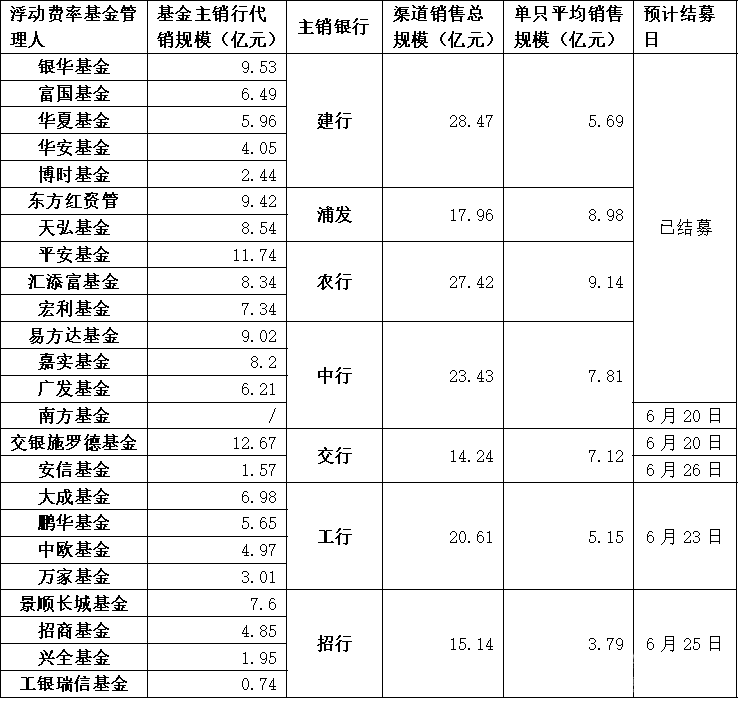
Core Insights - The issuance and sales competition of the first batch of floating rate funds has progressed significantly, with 24 out of 26 approved funds currently in the issuance phase [1] - Major banks have revealed their sales rankings for floating rate funds, with China Construction Bank leading in sales volume [2] - There are concerns regarding the alignment of marketing themes with fund managers' expertise, indicating potential miscommunication in product positioning [6][7] Group 1: Fund Issuance and Sales - As of June 18, 2023, 24 out of 26 approved floating rate funds are in the issuance phase, with several funds from major asset management companies having completed their fundraising [1] - China Construction Bank, Shanghai Pudong Development Bank, and Agricultural Bank of China have all completed fundraising for their floating rate funds, with China Construction Bank leading with a total sales volume of 28.47 billion yuan [2] - The sales performance of floating rate funds varies across banks, with most funds achieving sales between 5 to 10 billion yuan [2][3] Group 2: Marketing and Product Positioning - Floating rate funds are designed to align management fees with fund performance, creating a better investment experience for investors [6] - There are instances where marketing materials for certain funds do not align with the fund managers' actual investment capabilities, raising concerns about the clarity of product positioning [6][7] - The emphasis on specific investment themes in marketing may mislead investors if not accurately represented by the fund manager's historical performance [7]
谁在买港股新消费和创新药?
2025-06-18 00:54
Summary of Conference Call Records Industry or Company Involved - The records focus on the Hong Kong stock market, specifically the new consumption and innovative pharmaceutical sectors. Core Points and Arguments - **Capital Inflows**: Southbound funds have been the primary driver of the rise in the new consumption and innovative pharmaceutical sectors. From April 8 to June 9, net inflows into the innovative pharmaceutical sector exceeded 28.8 billion HKD, while the new consumption sector saw net inflows of over 6.3 billion HKD. In contrast, international intermediaries (foreign capital) experienced a net outflow of 22.6 billion HKD during the same period [1][3]. - **Year-to-Date Performance**: As of mid-June, southbound funds have contributed over 55 billion HKD to the innovative pharmaceutical sector and over 18 billion HKD to the new consumption sector. Cumulatively, over 660 billion HKD has flowed into the Hong Kong stock market through southbound trading, marking it as a significant support for the market [5][7]. - **Market Trends**: The Hong Kong stock market has entered a technical bull market since the low on April 7, with the new consumption and innovative pharmaceutical sectors averaging over a 50% increase from April 7 to June 11, outperforming other sectors [2][9]. - **Investment Strategies**: Southbound funds typically follow a right-side trend-following strategy, while foreign capital tends to buy in early and take profits at market peaks. For instance, during the period from February 20 to March 7, the new consumption sector rose over 20%, with foreign capital buying 3.6 billion HKD while southbound funds reduced their positions by 300 million HKD [6][11]. Other Important but Possibly Overlooked Content - **Sector Performance**: The sectors with the most significant capital increases included software services, pharmaceutical research and biotechnology, automotive, professional retail, and industrial engineering. Conversely, sectors that saw the most reductions included banking, other financial services, oil and gas, insurance, and general metals and minerals [4][10]. - **Differentiation of Capital Types**: The most impactful capital this year has been from southbound funds, which have consistently shown net inflows, contrasting with the lack of significant foreign capital return. Despite some inflows earlier in the year, foreign capital has generally been in a state of outflow since March [8][9]. - **Individual Stock Strategies**: Southbound funds have adopted a "barbell" strategy, significantly increasing positions in growth stocks like Meituan and Alibaba while also investing in high-dividend stocks such as China Construction Bank and China Mobile. They have reduced holdings in Tencent, Xiaomi, and other stocks [11][12][13].
首批26只浮费基金发行规模突破70亿元
news flash· 2025-06-09 11:08
Core Viewpoint - The first batch of 26 floating fee funds has been fully issued, with a total issuance scale exceeding 7 billion yuan, indicating strong market demand and participation from various financial institutions [1] Fund Issuance Overview - The total issuance scale of the first batch of floating fee funds has surpassed 7 billion yuan, with banks contributing over 6 billion yuan [1] - Major banks such as China Construction Bank, Agricultural Bank of China, and Industrial and Commercial Bank of China have shown significant activity, with daily issuance exceeding 100 million yuan [1] - The leading issuer, Shanghai Pudong Development Bank, has achieved a cumulative issuance of 1.45 billion yuan, while Bank of China has nearly reached 1.3 billion yuan [1] Individual Fund Performance - The fund "Oriental Red Core Value" has reached its fundraising cap of 2 billion yuan and has been established first [1] - Other leading funds in the current issuance phase include "E Fund Growth Progress" and "Harvest Growth Win," with issuance exceeding 500 million yuan and 400 million yuan respectively through Bank of China channels [1] - Other notable funds include "Tianhong Quality Value," "Jiaoyin Schroder Ruian," and "Dacheng Ultimate Return," which are also performing well in terms of issuance [1] Securities Channel Contribution - In the securities channel, Dongfang Securities has contributed nearly 500 million yuan in sales for "Oriental Red Core Value," while CITIC Securities has surpassed 200 million yuan in sales for floating fee funds [1]
【财闻联播】这家公司即将从A股摘牌!国家电网最新发布,解决世界级难题
券商中国· 2025-05-20 11:16
Macro Dynamics - In the first four months of 2025, the national general public budget revenue reached 80,616 billion yuan, a year-on-year decrease of 0.4%, with the decline narrowing by 0.7 percentage points compared to the first quarter [1] - Central government revenue decreased by 3.8%, but in April, it saw a growth of 1.6%, marking the first month of positive growth this year [1] - Local government revenue increased by 2.2%, consistent with the growth rate in the first quarter [1] Automotive Industry - In the first four months of 2025, the top ten car manufacturers sold 2.502 million vehicles, accounting for 68.7% of total car sales [2] - Among these manufacturers, BYD, Geely, SAIC-GM-Wuling, and FAW saw varying degrees of sales growth compared to the same period last year, while other companies experienced declines [2] Financial Institutions - Several banks have lowered the interest rates on large-denomination time deposits, bringing them into the "1" era [5][6] - The recent trend of deposit rate cuts includes major banks like ICBC, BOC, and CCB, affecting various deposit products [6] Market Data - The Shanghai Composite Index rose by 0.38%, with significant activity in the consumer sector, leading to a surge in stock prices for beauty care, food and beverage, and pet economy sectors [8] - The total financing balance in the two markets increased by 35.43 billion yuan, with the Shanghai Stock Exchange reporting a balance of 9,096.57 billion yuan and the Shenzhen Stock Exchange at 8,833.67 billion yuan [9] Company Dynamics - State Grid has released a self-developed large-scale renewable energy grid operation control system, addressing the challenge of integrating large-scale renewable energy into the grid [11][12] - Yulong Co., Ltd. will have its stock delisted on May 27, 2025, without entering a delisting transition period [13] - Zhaoyi Innovation plans to issue H-shares and list on the Hong Kong Stock Exchange [14] - BYD and Shenzhou Car Rental signed a strategic cooperation agreement to promote sustainable development in green travel and car rental markets [15] - Vipshop reported Q1 2025 net revenue of 26.3 billion yuan, a year-on-year decline of approximately 5%, with a Non-GAAP net profit of 2.3 billion yuan [16]