腾讯控股有限公司

Search documents
港股收盘,AI应用概念大涨
第一财经· 2026-02-16 04:39
微信编辑 | 苏小 | 名称 | 现价 | 涨跌幅 | | --- | --- | --- | | 阿里巴巴-W | 154.700 | -0.45% | | 9988.HK | | | | MINIMAX-WP | 847.000 | 24.56% | | 0100.HK | | | | 腾讯控股 | 533.000 | 0.19% | | 0700.HK | | | | 兆易创新 | 406.200 | 9.78% | | 3986.HK | | | | 紫金矿业 | 43.520 | 4.67% | | 2899.HK | | | | 洛阳钼业 | 23.100 | 6.35% | | 3993.HK | | | | 小米集团-W | 36.660 | -0.49% | | 1810.HK | | | | 美团-W | 82.050 | -0.12% | | 3690.HK | | | | 果见洪察圈母 | 25.140 | 3.71% | | 0883.HK | | | 春节前最后一个交易日,港股开市半日。恒指报26723.0点,涨0.59%,恒生科技指数报5367.28点,涨0.13%。AI应用概念 ...


阿里千问携30亿元入局 角逐春节期间“AI超级入口”
Zheng Quan Ri Bao Wang· 2026-02-03 06:05
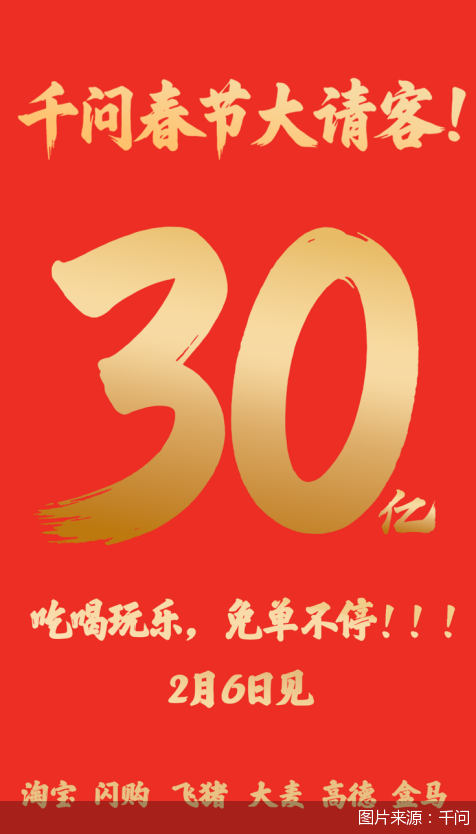
Group 1 - Alibaba's Qianwen APP has launched a 3 billion yuan "Spring Festival Treat Plan" to invite users to experience AI-driven lifestyle during the Spring Festival, marking the largest investment in a Spring Festival activity in Alibaba's history [1] - The initiative includes participation from Alibaba's core ecosystem businesses such as Taobao, Fliggy, Damai, Hema, Tmall Supermarket, and Alipay, creating a vast consumer scenario for testing [1] - Tencent's Yuanbao APP has initiated a 1 billion yuan red envelope activity, aiming to replicate the success of WeChat red envelopes, with the app reaching the top of the free app rankings on the Apple Store [1] Group 2 - Baidu has announced a cash red envelope activity totaling 500 million yuan, with individual red envelopes reaching up to 10,000 yuan, while ByteDance's Volcano Engine becomes the exclusive AI cloud partner for the 2026 Spring Festival Gala [2] - Analysts from Citigroup suggest that the red envelope competition is not merely a promotional event but a significant validation window for AI assistants' transition to widespread application, emphasizing the importance of user dependency on AI [2] - The Spring Festival red envelope battle serves as a public stage for major companies to showcase their technological capabilities and ecosystem collaboration, acting as both a defensive strategy against competitors and an offensive method to enhance AI model optimization [2] Group 3 - To achieve long-term user retention, a dual-driven system of "value retention + experience loop" is essential, focusing on high-frequency essential scenarios for users to recognize AI's core value [3] - The competition has evolved from a focus on technology and products to a new stage centered on large ecosystems and service loops, with Qianwen aiming to establish itself as a key player during the Spring Festival [3] - The previous Spring Festival highlighted DeepSeek's capabilities, while this year emphasizes the competition among major players like Tencent, Baidu, Alibaba, and ByteDance in the AI assistant ecosystem [3]


重金砸向春节档,阿里腾讯AI贴身肉搏
Bei Jing Shang Bao· 2026-02-02 13:09
Core Insights - The competition between Alibaba's AI assistant "Qianwen" and Tencent's "Yuanbao" has intensified during the Spring Festival, with both companies investing heavily to attract users and establish a dominant presence in the AI space [2][9] Group 1: Alibaba's Strategy - Alibaba has launched a 3 billion yuan "Spring Festival Treat Plan" for its AI assistant Qianwen, allowing users to enjoy free dining and entertainment during the holiday [2][4] - Qianwen aims to integrate into real-life consumption by connecting with various Alibaba services such as Taobao, Alipay, and Fliggy, enabling seamless AI shopping experiences [3][4] - The initiative represents Alibaba's largest investment in a Spring Festival campaign to date, emphasizing a focus on user engagement and transaction closure [4] Group 2: Tencent's Approach - Tencent's Yuanbao has initiated a 1 billion yuan cash red envelope campaign, aiming to replicate the success of the WeChat red envelope phenomenon from 11 years ago [6][10] - The campaign encourages social sharing and user engagement through various tasks, although it has faced challenges with user familiarity and complexity compared to previous red envelope offerings [7][10] - Yuanbao achieved significant app ranking success, reaching the top of multiple app charts shortly after the campaign launch, indicating strong initial user interest [8][10] Group 3: Competitive Landscape - The competition is not limited to Alibaba and Tencent; ByteDance and Baidu are also actively participating, with Baidu launching a 500 million yuan red envelope campaign using its AI assistant Wenxin [10] - Each company is adopting different strategies: Alibaba focuses on transaction integration, Tencent emphasizes social engagement, and Baidu aims for AI internalization [10] - The true test for these AI platforms will be maintaining high daily active users and engagement post-holiday, distinguishing between "tool-type AI" and "platform-level AI" [10]
京东、阿里、百度、腾讯集体下跌
2 1 Shi Ji Jing Ji Bao Dao· 2026-01-29 03:10
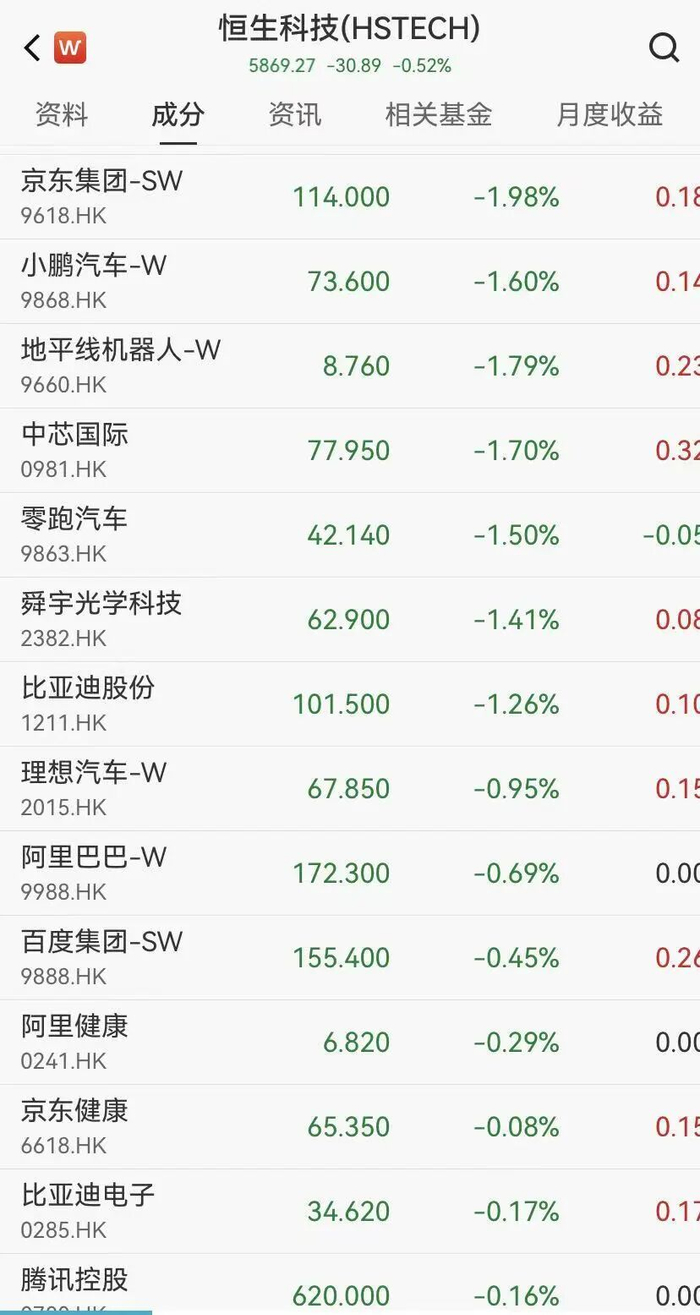
Core Viewpoint - The Hong Kong stock market experienced a collective decline on January 29, with major tech stocks like JD.com, Alibaba, Baidu, and Tencent showing negative performance, although the Hang Seng Index briefly turned positive during the day [1]. Group 1: Market Performance - The Hang Seng Index opened lower and showed a narrowing decline, with a brief recovery to positive territory [1]. - Major tech stocks saw declines, with JD.com down nearly 2%, Alibaba down approximately 0.7%, Baidu down 0.45%, and Tencent down 0.16% [1][2]. Group 2: AI Developments - Alibaba's new high-end AI chip "Zhenwu 810E" was launched on the official website of Pingtouge, marking the debut of the "Tongyun Ge" AI supercomputer, which integrates self-developed chips, cloud services, and open-source models [3][4]. - The "Zhenwu" PPU chip features a 96G HBM2e memory and a chip-to-chip interconnect bandwidth of 700 GB/s, designed for AI training, inference, and autonomous driving applications [6]. - The performance of the "Zhenwu" PPU surpasses that of NVIDIA's A800 and is comparable to the NVIDIA H20, indicating strong market demand and positive industry feedback [6][4]. Group 3: Model Performance - The Tongyi Laboratory released the Qwen3-Max-Thinking flagship inference model, achieving multiple global records and performance comparable to GPT-5.2 and Gemini 3 Pro [7]. - The number of derivative models from the Qwen open-source model has exceeded 200,000, with download volumes surpassing 1 billion, maintaining a leading position globally [7].
香港债券市场全景及投资价值分析
Huachuang Securities· 2026-01-20 12:08
1. Report Industry Investment Rating There is no information provided about the industry investment rating in the report. 2. Core Viewpoints of the Report - In 2026, the mainland bond market is expected to maintain a low - interest - rate environment. "Going outbound" to seek high - coupon bonds remains one of the main demands of non - bank institutions. The new "Southbound Connect" policy may be gradually implemented, so investors can actively focus on the Hong Kong bond market to further explore investment value [2]. - The expansion of the "Southbound Connect" mechanism will significantly broaden the channels for non - bank institutions such as securities firms, funds, insurance companies, and bank wealth management to participate in the Hong Kong bond market. It is recommended to focus on the investment opportunities of dim sum bonds, which have been continuously expanding in recent years, and Chinese - funded US dollar bonds with a large outstanding scale [8]. 3. Summary According to the Table of Contents 3.1 Hong Kong Bond Market Development History and Outstanding Structure Characteristics 3.1.1 Development History: From Dominated by US Dollar Bonds to the Rise of RMB Bonds - The Hong Kong bond market can be divided into three development stages. Before 2015, it was in a slow - development stage, with the issuance scale growing from $100 million in 1989 to $103.3 billion in 2014, mainly corporate bonds. After the launch of the "Government Bond Program" in 2009, the issuance scale of government bonds began to increase [3][15]. - From 2015 - 2021, it experienced rapid development, with the issuance scale growing from $188.5 billion to $499.4 billion. The proportion of government bonds increased, mainly due to the growth of Hong Kong government retail bonds. US dollar bonds also grew rapidly because of the relaxation of overseas debt issuance regulations by the mainland [3][16]. - Since 2022, the total market has been in a stable development stage, but the internal structure has changed. The scale of US dollar bonds has decreased significantly due to tightened mainland regulations and the Fed's interest - rate hikes, while RMB bonds have developed rapidly due to China's loose monetary environment and central government policies [4][17]. 3.1.2 Outstanding Structure Characteristics: Chinese Issuers Account for 80%, and the Financial Industry Dominates - As of the end of 2024, the outstanding scales of Hong Kong dollar bonds, offshore RMB bonds, and G3 currency bonds in the Hong Kong bond market were $195.5 billion, $173.2 billion, and $565.6 billion respectively, with corporate bonds accounting for over 70% in each category [24]. - Currently, the total outstanding bond scale in the Hong Kong market is about $1.05 trillion. About 80% of the issuers are from China, about 65% of the remaining maturities are within 3 years, the financial industry accounts for half of the market, and the currency is mainly US dollars [4][25]. 3.2 Hong Kong Bond Market Liquidity and Investor Participation - In terms of liquidity, before the end of 2020, the average daily trading volume of bonds托管 and settled by the CMU system was stable at around HK$5 billion. Since 2021, the launch of the "Southbound Connect" and the increase in the issuance of RMB bonds have promoted the trading volume to increase to HK$20 - 25 billion, and the average daily turnover rate has risen from about 0.5% to around 1% [5][37]. - In terms of investor structure, asset management institutions, banks, and hedge funds hold 75%, 9%, and 7% of the outstanding bond balances with available holder data respectively. Holders are mainly distributed in the United States, Luxembourg, and China, and foreign - funded enterprises such as BlackRock, Nomura, and HSBC have relatively large management scales [5][41][44]. 3.3 Participation Opportunities in the Hong Kong Bond Market under the Expansion of the Bond "Southbound Connect" Mechanism 3.3.1 Chinese - funded Overseas Bonds: There are Obvious Excess Spreads, with Priority Focused on - Dim sum bonds: There are opportunities for spread compression in various types of urban investment bonds and high - grade industrial bonds. The outstanding dim sum bonds in the Hong Kong market are 1,376, with a balance of about 1.47 trillion yuan. The excess spreads of high - grade urban investment and industrial bonds are mostly between 100 - 150BP, and the spreads of low - grade urban investment bonds are mostly between 200 - 400BP [50]. - Chinese - funded US dollar bonds: The excess spreads of all varieties compared with domestic bonds are over 200BP. There are 1,066 outstanding Chinese - funded US dollar bonds in the Hong Kong market, with a balance of about $352.7 billion. The excess spreads of high - grade urban investment and industrial bonds are mostly between 200 - 300BP, and those of low - grade bonds are over 300BP [53]. - Sub - varieties investment suggestions: For urban investment overseas bonds, select bonds with a maturity of less than 3 years, a yield of over 4%, a subject rating of AA+ or above, and a bond balance of over 300 million yuan/dollars. For industrial overseas bonds, focus on central and state - owned enterprise bonds, and be cautious about the real - estate industry. For financial overseas bonds, pay attention to the overseas bonds of industries such as banks and AMCs [9][57][58]. 3.3.2 Overseas Bonds of Hong Kong, Macao, Taiwan, and Foreign - funded Enterprises: Focus on High - Quality Entities with Large Outstanding Scales and High Coupons - Consider overseas bonds issued by Hong Kong, Macao, Taiwan, and foreign - funded enterprises with large outstanding scales and high coupon yields, such as Hong Kong Mortgage Corporation Limited, Hong Kong Airport Authority, and Qatar Petroleum. These bonds generally have an average yield or coupon rate of over 3% and have certain allocation value. However, credit research and risk screening of the issuers are required before investment [6][10][62].
计算机行业周观点第49期:AI应用成为新的平台入口-20260118
Western Securities· 2026-01-18 08:53
Investment Rating - The industry is rated as "Overweight," indicating an expected increase in value exceeding 10% compared to the market benchmark index over the next 6-12 months [6]. Core Insights - The report highlights the launch of the Qianwen App by Alibaba, which integrates with various Alibaba ecosystem services, enabling a seamless shopping experience within the app. This positions Qianwen as the first AI chatbot capable of completing transactions from selection to payment [1]. - Qianwen has also connected with Ant Group's life services, allowing it to handle 50 common civil affairs, thus transforming the way users interact with service requests by automating the process [2]. - The report suggests that AI applications are expected to directly address user needs, with platforms leveraging their computational and model advantages to create AI applications with agent capabilities, thereby establishing competitive barriers [2]. Summary by Sections AI Applications - Companies to watch include Hehe Information, Dingjie Smart, Hanshu Technology, Hande Information, Tax Friend Co., Hongsoft Technology, Foxit Software, and Zhuoyi Information [3]. Platforms - Key players in the platform sector include Tencent Holdings and Alibaba [3]. Domestic Computing Power - Notable companies in the domestic computing power space include Cambricon and Haiguang Information [3]. IDC - Companies to monitor in the IDC sector are Dongyangguang and Runze Technology [3].
市场避险情绪未见明显增强
工银国际· 2026-01-05 13:46
Report Summary 1. Investment Rating The report does not mention the investment rating of the industry. 2. Core Views - The market's risk - aversion sentiment has not significantly increased. The new issuance of Chinese offshore bonds was sluggish last week due to the holiday, with basically no new issuance. The yields of US Treasury bonds showed differentiation, with the 10 - year and 2 - year US Treasury bond yields rising by 6 and falling by 1 basis point respectively last week to 4.19% and 3.47% [1][2]. - The minutes of the December FOMC meeting showed that most participants supported the December rate cut. Most participants believed that if inflation declines gradually as expected, further rate cuts might be appropriate. Although inflation is still above the Fed's policy target, in the absence of a further upward trend, most Fed officials tend to cut rates to support the job market [2]. - The situation in Venezuela over the weekend did not significantly boost the market's risk - aversion sentiment. The oil price remained generally stable, and the US Treasury bond yields in the Asian session on Monday did not change much. The Bloomberg Barclays China US - dollar bond total return index remained flat last week [1][3]. - After the New Year's Day holiday, funds flowed back to the banking system, and inter - bank funding rates dropped significantly. The yields of 3 - year and 10 - year Chinese government bonds remained unchanged and fell by 1 basis point respectively to 1.38% and 1.85%. The long - term Chinese interest rates have basically entered a volatile market since the end of August 2025, and their subsequent trends may depend on the implementation of further loose monetary policies [1][4]. 3. Summary by Related Catalogs Offshore Market - **New Issuance**: Affected by the holiday, the new issuance of Chinese offshore bonds was sluggish last week, with basically no new issuance [1][2]. - **US Treasury Bond Yields**: The 10 - year and 2 - year US Treasury bond yields showed differentiation, rising by 6 and falling by 1 basis point respectively last week to 4.19% and 3.47% [1][2]. - **Market Sentiment and Bond Index**: The situation in Venezuela over the weekend did not significantly push up the market's risk - aversion sentiment. The oil price was generally stable. The US Treasury bond yields in the Asian session on Monday did not change much. The Bloomberg Barclays China US - dollar bond total return index remained flat, with the high - rating index falling slightly by 0.1% and the high - yield index rising slightly by 0.1% [1][3]. Onshore Market - **Funding Rates**: After the New Year's Day holiday, funds flowed back to the banking system, and inter - bank funding rates dropped significantly. The 7 - day deposit - type institutional pledged - repo weighted - average rate and the 7 - day inter - bank pledged - repo weighted - average rate dropped by 17 and 48 basis points respectively to 1.43% and 1.45% [4]. - **Government Bond Yields**: The yields of 3 - year and 10 - year Chinese government bonds remained unchanged and fell by 1 basis point respectively to 1.38% and 1.85%. The long - term Chinese interest rates have basically entered a volatile market since the end of August 2025, and their subsequent trends may depend on the implementation of further loose monetary policies [1][4]. Appendix: List of Chinese US - dollar Bonds The appendix lists a large number of Chinese US - dollar bonds, including information such as the issuer, guarantor, coupon rate, issuance amount, maturity date, and ratings from Moody's, S&P, and Fitch [19][20][21].
彭博:中国股市有望迎来2017年以来最佳年份
美股IPO· 2025-12-30 04:48
Core Viewpoint - The Chinese stock market is on track for its best performance since 2017, driven by a broad rally across various sectors, particularly technology, materials, and healthcare [3][4][7]. Group 1: Market Performance - The MSCI China Index has risen approximately 28% this year, indicating a potential consecutive annual increase [4][7]. - The materials sector, led by gold mining companies, has seen the most significant gains, with the MSCI China Materials Index up about 108%, marking its best annual performance since 2003 [7][8]. - The healthcare sector has rebounded, with the MSCI China Healthcare Sub-Index rising around 50%, expected to achieve its best performance since 2020 [11]. Group 2: Sector Analysis - The technology sector has been a primary driver of the market rally, with significant contributions from artificial intelligence and popular commodities [4][7]. - The entertainment sector has also thrived, with the MSCI China Communication Services Index increasing over 40%, benefiting from a shift in consumer spending towards home entertainment [14]. - In contrast, the utilities and real estate sectors have lagged, with the MSCI China Utilities Sub-Index showing little change and the real estate sector only increasing by 1.4% [17][18]. Group 3: Key Drivers and Challenges - The rally is supported by global themes such as artificial intelligence and rising commodity prices, while a potential stimulus measure addressing housing issues could further enhance market performance [4][7]. - The ongoing housing crisis and deflationary pressures in China remain significant challenges, as evidenced by the poor performance of major real estate developers like Vanke Group, which has seen a 36% decline in stock price this year [17][18].


2025港科股的“冰与火之歌”:AI价值兑现终究花落谁家?
Ge Long Hui· 2025-12-27 06:22
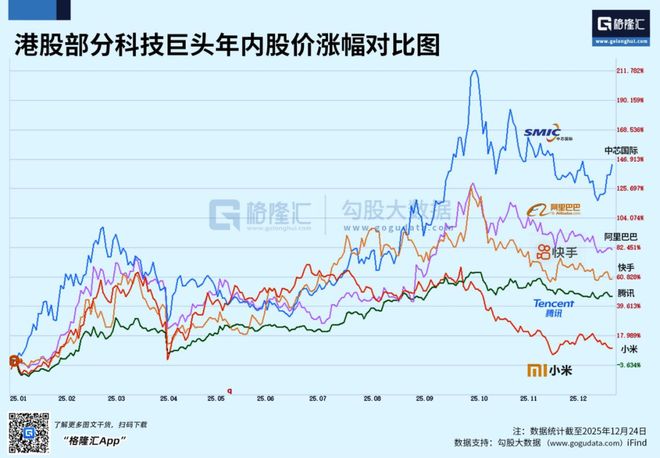
Core Viewpoint - The core narrative of the Hong Kong stock market in 2025 was driven by AI, with significant structural trends observed in the technology sector, highlighted by a notable increase in the Hang Seng Tech Index and substantial inflows of capital into AI-related stocks [2][6][33]. Group 1: AI as a Growth Driver - AI technology transitioned from a speculative concept to a value-realization phase, becoming a critical growth driver for the technology industry [6][14]. - The performance of major tech companies like Alibaba and Tencent was significantly enhanced by their AI strategies, with Alibaba's stock rising over 80% and Tencent's by over 46% due to successful AI implementations [7][9]. - The overall market sentiment towards AI remained strong, with a projected $10 trillion market opportunity for the global tech industry over the next five years due to AI penetration [13][14]. Group 2: Individual Company Performance - Alibaba's AI-related revenue saw triple-digit growth for multiple quarters, with a 34% revenue increase in Q3 2025, reflecting strong market expectations [16][18]. - Tencent's AI initiatives, including the launch of over 30 new models, contributed to a 19% year-on-year increase in adjusted net profit, although its valuation expansion was less pronounced compared to Alibaba [18][21]. - Xiaomi's stock performance lagged behind its peers, with a 13% increase, attributed to a slower realization of AI value despite significant R&D investments exceeding 100 billion RMB over five years [19][20]. Group 3: Valuation Disparities - The valuation of AI-related companies showed clear differentiation, with Alibaba's AI value fully reflected in its stock price, while Xiaomi's AI capabilities had not yet translated into market consensus [21][22]. - AI vertical companies like SenseTime experienced high valuation premiums, with stock prices increasing over 80% due to their technological advancements [18][19]. - The market has yet to fully price in the AI value of leading Hong Kong tech companies, indicating potential for upward valuation adjustments [20][21]. Group 4: Future Outlook - The investment focus for 2026 is expected to shift from "technological breakthroughs" to "commercialization," with a faster pace of value realization anticipated [33]. - Companies that can effectively integrate AI into their business models and demonstrate scalable applications are likely to continue releasing growth value [33]. - The deep integration of AI with the physical world is seen as an irreversible trend, suggesting that the Hong Kong tech sector will continue to evolve and present investment opportunities [33].
“千问”AI梗图引阿里、腾讯下场 岁末流量大战一触即发
Nan Fang Du Shi Bao· 2025-12-20 00:02
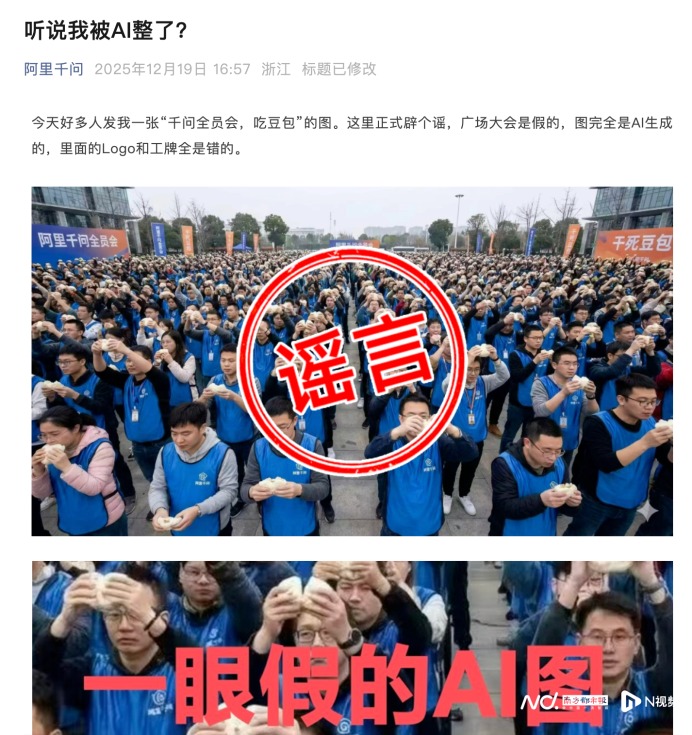
Core Viewpoint - The article discusses a recent incident involving AI-generated images that sparked a "traffic war" between major Chinese tech companies Alibaba and Tencent, highlighting their competitive strategies in the AI sector [1][4][10]. Group 1: Incident Overview - A viral AI-generated image led to speculation about a meeting involving Alibaba's "Qianwen" app and ByteDance's "Doubao" app, prompting both companies to engage in a public exchange [1][4]. - Alibaba's Qianwen app officially denied the authenticity of the image, stating it was AI-generated and encouraged users to explore its features [5][7]. - Tencent's "Yuanbao" app also joined the conversation, humorously responding to inquiries about the image and promoting its own AI capabilities [10]. Group 2: Competitive Landscape - Alibaba is intensifying its focus on consumer-facing applications, with its AI health product "Ant Aifu" achieving over 15 million monthly active users within six months [8]. - The launch of Alibaba's Qianwen app aims to integrate AI capabilities across various services, enhancing user experience and operational efficiency [8]. - ByteDance's "Doubao" model has seen significant growth, with daily token usage surpassing 50 trillion, indicating a robust demand for its AI services [9]. Group 3: Market Dynamics - The competition between Alibaba and ByteDance is characterized by a strategy where C-end applications drive B-end growth, with both companies aiming to expand the overall market rather than engage in zero-sum competition [9]. - Tencent has recently upgraded its AI model development structure to enhance its capabilities, indicating a strategic shift to strengthen its position in the AI landscape [14]. - The upcoming Spring Festival is expected to trigger a new round of competition among Alibaba, Tencent, and ByteDance, as they vie for user engagement and market share [14][15].