LI AUTO-W(02015)

Search documents
港股汽车股午后走高 理想汽车-W、比亚迪股份均涨超4%
Mei Ri Jing Ji Xin Wen· 2026-01-28 06:51
每经AI快讯,港股汽车股午后走高。截至发稿,理想汽车-W(02015.HK)涨4.44%,报68.2港元;比亚迪 股份(01211.HK)涨4.17%,报102.4港元;蔚来-SW(09866.HK)涨3.65%,报38.02港元;小鹏汽车- W(09868.HK)涨3.23%,报75港元。 ...



港股汽车股午后持续走高,理想汽车(02015.HK)、比亚迪股份(01211.HK)涨超4%,蔚来汽车(09866.HK)涨近4%,小鹏汽车(09868.HK)、长城汽车(02333.HK)涨超2%。
Jin Rong Jie· 2026-01-28 06:49
港股汽车股午后持续走高,理想汽车(02015.HK)、 比亚迪股份(01211.HK)涨超4%,蔚来汽车 (09866.HK)涨近4%,小鹏汽车(09868.HK)、 长城汽车(02333.HK)涨超2%。 ...

港股异动 | 汽车股午后走高 理想汽车-W(02015)、比亚迪股份(01211)均涨超4%
智通财经网· 2026-01-28 06:41
智通财经APP获悉,汽车股午后走高,截至发稿,理想汽车-W(02015)涨4.44%,报68.2港元;比亚迪股 份(01211)涨4.17%,报102.4港元;蔚来-SW(09866)涨3.65%,报38.02港元;小鹏汽车-W(09868)涨 3.23%,报75港元。 消息面上,银河证券指出,展望2026年,国内市场方面,尽管2026年新能源车购置税由免征改为减半征 收(5%),"两新"政策调整为按照车价给予额定比例补贴,政策支持存在边际递减效应,但2026年 是"十五五"开局之年,促销费仍是重点工作之一,预计"两新"政策延续仍将为国内车市提供一定的支撑 作用;海外市场方面,预计自主品牌新能源产品的国际市场影响力将继续提升,引领海外市场新能源转 型,我国汽车出口有望继续向好。国内政策优化延续叠加海外出口向好有望支撑2026年车市销量稳中向 好。 ...
汽车股午后走高 理想汽车-W、比亚迪股份均涨超4%
Zhi Tong Cai Jing· 2026-01-28 06:38
消息面上,银河证券指出,展望2026年,国内市场方面,尽管2026年新能源车购置税由免征改为减半征 收(5%),"两新"政策调整为按照车价给予额定比例补贴,政策支持存在边际递减效应,但2026年是"十 五五"开局之年,促销费仍是重点工作之一,预计"两新"政策延续仍将为国内车市提供一定的支撑作 用;海外市场方面,预计自主品牌新能源产品的国际市场影响力将继续提升,引领海外市场新能源转 型,我国汽车出口有望继续向好。国内政策优化延续叠加海外出口向好有望支撑2026年车市销量稳中向 好。 汽车股午后走高,截至发稿,理想汽车-W(02015)涨4.44%,报68.2港元;比亚迪(002594)股份(01211) 涨4.17%,报102.4港元;蔚来-SW(09866)涨3.65%,报38.02港元;小鹏汽车-W(09868)涨3.23%,报75港 元。 ...
理想全员内部会的思考
数说新能源· 2026-01-28 03:21
1 、 很多人都很担心新能源汽车行业会不会光伏化 , 内卷永无止境 ? 新能源乘用车20万以下会光伏化 , 20万以上会和智能手机的格局走势类似 。 这里面的原因有以下几点 : ( 1 ) 20万以下 , 智能化在这个价位主流消费者购买决策中排名更靠后 。 这并不是说这个区间的消费者不想要智能化 , 而是智能化的成本 ( 举个例子包括激光雷达 、 大算力芯片 、 研发投入摊销等等两万人民币 ) 占车价超过10% , 这个比例 太高了 , 这个价位主流的消费者宁愿选择便宜一两万 。 这也是尚界第一款车失败的原因之一 。 因此20万以下的竞争会更接 近光伏化内卷竞争 , 完全比硬件 、 比价格 , 没有任何一项投入可以获得边际成本递减效应 。 ( 2 ) 20万以上有很多投入可以获得边际成本递减效应 , 比如品牌 、 智能驾驶 、 智能座舱 。 消费者买一辆20万以上的车 , 价格是很重要的考虑因素 , 但不是唯一重要的了 , 他要综合考虑品牌 、 体验 、 智能化升级空间等等 。 厂家对品牌建 设 、 AI团队的投入 , 第一是有门槛的 , 第二是无形资产 , 第三在卖车的时候又是消费者重点决策因素 。 这里面 ...


马云最新露面谈AI;DeepSeek开源全新OCR模型;理想汽车否认网传“关闭100家门店”;“杰出女企业家”熊海涛被留置调查...
Sou Hu Cai Jing· 2026-01-28 02:52
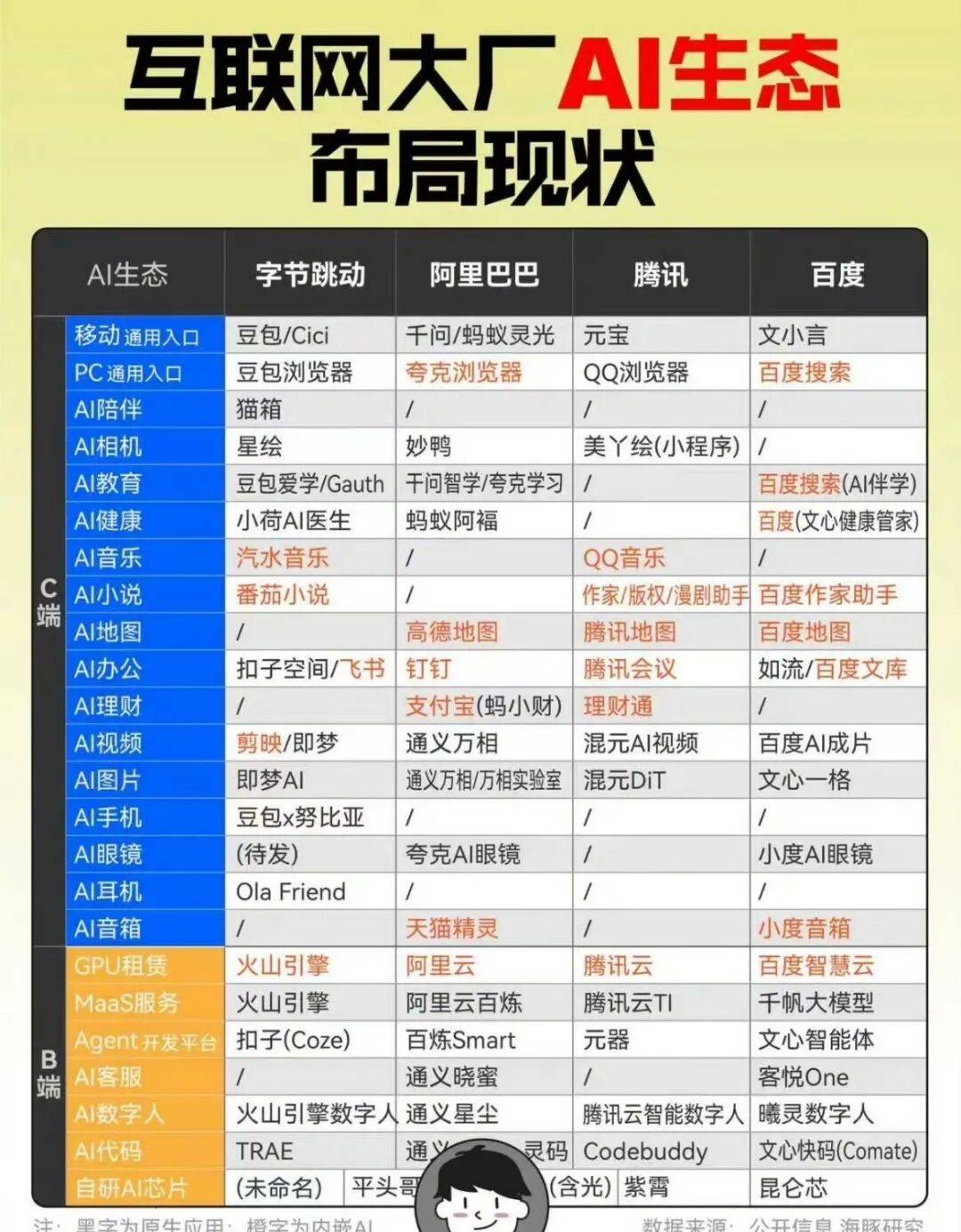
Group 1: AI Ecosystem Developments - The AI ecosystem is rapidly evolving with major players like ByteDance, Alibaba, Tencent, and Baidu developing various AI applications across multiple domains such as education, health, finance, and entertainment [1] - ByteDance's AI offerings include Doubao for education and health, while Alibaba's Qianwen focuses on financial services and education [1] - Tencent and Baidu are also expanding their AI capabilities, with Tencent offering services like QQ Browser and Baidu focusing on AI health and education [1] Group 2: Market Changes in Electricity Pricing - A significant market reform in China's electricity sector is underway, with nine regions canceling fixed time-of-use electricity pricing, marking a shift towards market-driven pricing [4] - The National Development and Reform Commission's new rules will eliminate government-set time-of-use pricing starting March 1, 2026, allowing market forces to dictate pricing [4] Group 3: AI Funding and Valuation Trends - Anthropic is planning to raise approximately $20 billion, doubling its initial target, reflecting strong investor interest and pushing its valuation to $350 billion [7][8] - The demand for investment in AI startups is surging, with investor interest reportedly reaching 5 to 6 times the original target [8] Group 4: New AI Models and Innovations - DeepSeek has released a new OCR model, DeepSeek-OCR 2, which utilizes a novel architecture to enhance AI's visual processing capabilities [7] - Alibaba has launched its flagship reasoning model, Qwen3-Max-Thinking, which surpasses leading models in performance and enhances its tool-calling capabilities [13] Group 5: Corporate Developments and Acquisitions - Anta Sports is planning to acquire a 29.06% stake in Puma for €1.5 billion, aiming to enhance its global market position [22] - DeepWay has completed a Pre-IPO financing round of ¥1.177 billion, marking a significant investment in the autonomous driving sector [23]


汽车早餐 | 春节假期免收7座及以下小型客车通行费;比亚迪与埃克森美孚签署战略合作备忘录;欧盟公布印欧贸易协议
Zhong Guo Qi Che Bao Wang· 2026-01-28 01:32
Domestic News - The Ministry of Transport has implemented a policy to waive toll fees for small passenger vehicles (7 seats or fewer) during the Spring Festival holiday [2] - The Ministry's notice emphasizes the need to enhance charging infrastructure for electric vehicles, proposing tailored strategies for busy service areas to reduce long wait times for charging [2] Industry Insights - In 2025, profits for large-scale high-tech manufacturing industries are expected to grow by 13.3% year-on-year, surpassing the overall industrial profit growth of 12.7% [3] - The smart electronics sector is driving significant profit increases, with profits in the smart consumer device manufacturing sector rising by 48%, and specific industries like smart drones and smart vehicle equipment seeing profits increase by 102% and 88.8%, respectively [3] - The automotive industry is projected to generate profits of 461 billion yuan in 2025, reflecting a modest year-on-year increase of 0.6% [4] - The automotive sector's revenue is expected to reach 1,117.96 billion yuan, with production figures at 34.78 million vehicles, marking a 10% increase year-on-year [4] International News - The EU has announced a trade agreement with India, granting EU service providers preferential access in key sectors such as finance and maritime services, while gradually reducing automotive tariffs to 10% with an annual quota of 250,000 vehicles [5] - Stellantis Group reported that despite a sluggish market, it expects to sell over 2.42 million new vehicles in Europe in 2025, achieving a market share of 16% [6] - The company leads the hybrid vehicle market with a 15% share and holds a 28.6% share in the commercial vehicle sector [6] - The European new car registration is projected to grow by 2.4% in 2025, reaching 13.3 million units, with electric vehicle registrations surging by 30% [7] - In Vietnam, the automotive market is expected to grow by 22% in 2025, although major players like Hyundai and Kia are experiencing declining sales for the third consecutive year [8] - South Africa's electric vehicle sales are projected to decline by 17% in 2025, accounting for only 0.17% of total new car sales, despite overall new car sales reaching a decade-high of 596,818 units [9] Corporate News - BYD has signed a long-term strategic cooperation memorandum with ExxonMobil, focusing on innovation in new energy hybrid technology and collaborative product development [10] - Li Auto plans to close a small number of underperforming stores as part of normal operational adjustments, clarifying that rumors of closing 100 stores are unfounded [11] - Didi plans to enhance the experience of its ride-hailing services in 2026, focusing on improving driver service levels and optimizing vehicle offerings [12] - DeepWay has completed a Pre-IPO financing round of 1.177 billion yuan, marking the largest single financing in the autonomous driving new energy heavy truck sector [13] - XPeng Motors anticipates "very strong" growth this year, with overseas sales growth potentially outpacing domestic sales [14]


一线调查|7年低息、超低首付提车!车企开打“金融战”,专家预警:超长分期暗藏风险
Mei Ri Jing Ji Xin Wen· 2026-01-28 01:12
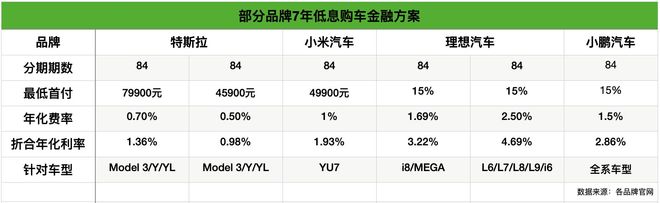
Core Viewpoint - The introduction of 7-year low-interest financing plans by various electric vehicle manufacturers aims to stimulate market demand amid a competitive landscape and inventory pressure, but the actual effectiveness and implications of these plans remain to be validated by the market [1][10]. Group 1: Financing Plans Overview - Major brands like Tesla, Xiaomi, Li Auto, and Xpeng have launched or enhanced 7-year low-interest financing options, extending traditional auto loan periods by 2 to 3 years [1]. - Monthly payments have significantly decreased due to longer loan terms, with Xiaomi's YU7 starting at 2,593 yuan, Xpeng's models at 1,355 yuan, Li Auto at 2,578 yuan, and Tesla's Model 3/Y/Y L at 1,918 yuan [1]. - Tesla offers two different 7-year financing plans with varying down payment requirements, resulting in different annualized rates [2][3]. Group 2: Comparative Analysis of Financing Options - Tesla's financing plans are noted for their flexibility, with lower annualized rates for higher down payments, while other brands have higher rates [3][6]. - Xiaomi's plan requires a minimum down payment of 20%, with an annualized rate of 1% and an effective annualized rate of 1.93% [4]. - Li Auto's financing is categorized by model, with some models offering interest-free periods, while Xpeng's plan applies to all models with a minimum down payment of 15% and an annualized rate of 1.5% [5][6]. Group 3: Market Dynamics and Consumer Behavior - Sales personnel from various brands express differing opinions on the 7-year financing plans, with some recommending shorter terms due to higher interest costs associated with longer loans [7][8]. - The overall market for passenger vehicles has seen a significant decline, with retail sales down 28% year-on-year and wholesale volumes down 35% [9][10]. - Investment firms predict a continued downturn in the Chinese passenger vehicle market, with potential sales declines of 2% to 5% in 2026 [10]. Group 4: Implications of Financing Strategies - The 7-year low-interest financing plans are seen as a strategy to lower the purchase threshold for consumers, but the effectiveness may be limited by high qualification requirements for consumers [9][10]. - Concerns are raised about the long-term implications of extended financing terms, including potential risks of negative equity and the sustainability of demand post-incentive [12].



车企掀7年低息促销潮,特斯拉、小米、小鹏等都在列,月供低至千元
2 1 Shi Ji Jing Ji Bao Dao· 2026-01-28 00:59
Core Insights - The automotive industry is experiencing a promotional wave of "7-year low-interest" financing plans, initiated by companies like Tesla, Xiaomi, and Xpeng, aimed at stimulating consumer demand and increasing sales before the Chinese New Year [1][2][4] Group 1: Financing Plans Overview - Various automakers have launched "7-year low-interest" loan policies to lower the purchase threshold and stimulate end-consumer demand [4] - The financing plans differ significantly among brands in terms of lending institutions, down payment requirements, funding costs, and model coverage [4][5] - Tesla offers a lower financing cost with a 0.50% annualized fee for a 25%+ down payment option, while other brands like Li Auto have higher costs, reaching up to 2.50% [5][6] Group 2: Consumer Impact - The extended repayment period significantly reduces monthly payment pressure for consumers, but total interest payments will increase [8][10] - For example, under Xiaomi's "7-year low-interest" plan, a consumer would pay a total interest of 14,252.28 yuan over the loan period [8] - Consumers are advised to assess their financial situation carefully, as the longer loan terms may lead to increased financial strain if not managed properly [17] Group 3: Market Dynamics - The push for longer loan terms aligns with national policies aimed at boosting consumption, allowing banks to extend personal consumption loan terms from 5 to 7 years [2] - The automotive market is seeing a shift in consumer preferences, with some opting for higher upfront payments to avoid long-term debt, while others appreciate the lower monthly payments offered by extended loans [10][15] - Concerns about vehicle depreciation and residual values are heightened with longer loan terms, especially for electric vehicles, which may face rapid technological obsolescence [10][11] Group 4: Risk and Regulatory Considerations - Financial institutions face increased risk management challenges due to the longer loan terms and lower down payments, necessitating more stringent consumer assessments [15][16] - The distinction between traditional auto loans and financing leases is crucial, as ownership rights differ significantly, impacting consumer decisions [20][21] - Legal experts emphasize the importance of understanding contract terms related to ownership and repayment obligations in financing leases [22][23]
车企掀7年低息促销潮,特斯拉、小米、小鹏等都在列,月供低至千元
21世纪经济报道· 2026-01-28 00:53
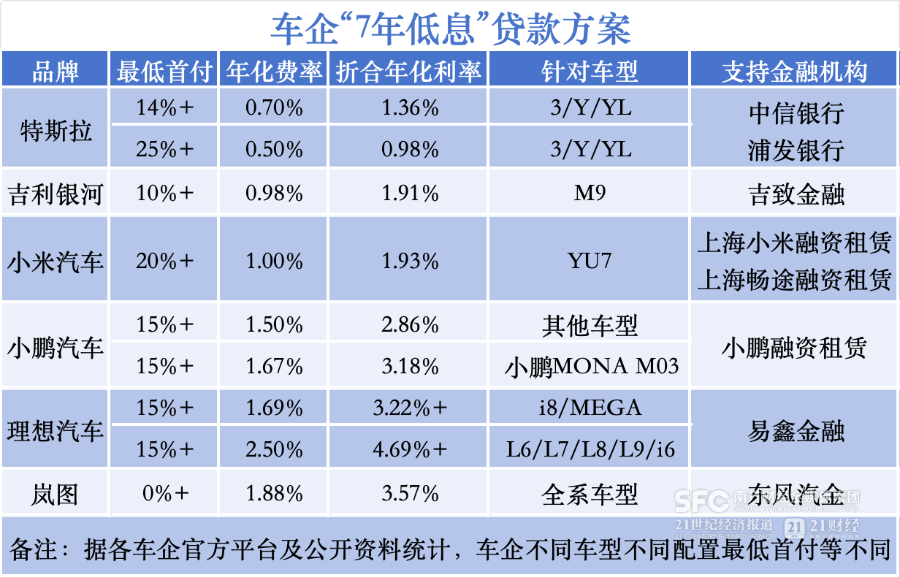
Core Viewpoint - The article discusses the recent trend of car manufacturers offering "7-year low-interest" financing plans to stimulate consumer demand, driven by government policies aimed at boosting consumption [2][5]. Group 1: Financing Trends - Various car manufacturers, including Tesla, Xiaomi, and Xpeng, have launched "7-year low-interest" financing options, breaking away from the traditional 1-5 year loan terms [1][5]. - The financing plans are designed to lower monthly payments and initial down payments, making it easier for consumers to purchase vehicles [1][5]. - The trend is a response to government initiatives encouraging consumer spending, particularly before the Lunar New Year [2][5]. Group 2: Loan Details and Variations - The financing options vary significantly among manufacturers, particularly in terms of lending institutions, down payment requirements, and interest rates [5][6]. - Tesla offers competitive rates, with a 0.50% annual fee translating to an effective annual rate of 0.98% for those making a 25% down payment [6]. - Other brands like Li Auto and Xpeng have higher effective annual rates, ranging from 1.9% to 4.69%, indicating a broader range of financing costs [6]. Group 3: Consumer Perception and Financial Implications - Consumers generally perceive the "7-year low-interest" loans as a way to reduce monthly financial burdens, although total interest payments may increase over the loan term [8][10]. - For example, a Xiaomi YU7 financed over 7 years with a 1% annual fee results in a total interest payment of approximately 14,252.28 yuan [8]. - Some consumers express caution, preferring to pay in full rather than take on long-term debt, indicating a desire to avoid overextending financially [10]. Group 4: Risk and Valuation Concerns - The longer loan terms raise concerns about vehicle depreciation and residual values, especially for electric vehicles, which may not hold their value as well as traditional combustion vehicles [11][14]. - The article notes that the average resale value for electric vehicles is lower than that of traditional vehicles, which could pose risks for consumers taking on long-term loans [11][14]. - The article highlights that the main models offered under these financing plans have relatively high resale values, which may mitigate some concerns [11][13]. Group 5: Consumer Eligibility and Approval Process - The approval process for "7-year low-interest" loans is more stringent, requiring higher credit qualifications compared to shorter-term loans [14][15]. - Financial institutions are increasing their risk assessment criteria, necessitating thorough evaluations of consumers' long-term repayment capabilities [14][15]. - Consumers are advised to assess their financial situations carefully before opting for these extended loan terms to avoid potential rejections or financial strain [15].