
TRT(600085)

Search documents
新股消息 | 同仁堂医养四度递表港交所 在非公立中医院医疗服务行业中排名第二
智通财经网· 2026-01-26 06:42
智通财经APP获悉,据港交所1月26日披露,北京同仁堂医养投资股份有限公司(简称:同仁堂医养)向港交所主板递交上市申请书,中金公司为其保荐人。这 是该公司第四次递表港交所。按2024年中医医疗服务总收入计,公司以0.2%的市场份额在非公立中医院医疗服务行业中排名第二,其市场规模占同年中国 中医医疗服务行业市场总规模的46.5%。 | 篇纂]項下的[编纂]數目 | .. | 「編纂]股H股(視乎[編纂]行使與否而定) | | --- | --- | --- | | [編纂]數目 | .. | [編纂]股H股(可予[編纂]) | | [編纂]數目 | יי | [編纂]股H股(可予[編纂]及 | | | | 視乎[編纂]行使與否而定) | | 最高[編纂] | יי | 每股H股[編纂]港元,另加1.0%經 | | | | 紀佣金、0.0027%證監會交易徵 | | | | 費、0.00015% 會財局交易徵費及 | | | | 0.00565%聯交所交易費(須於申請時 | | | | 以港元繳足,多繳股款可予退還) | | 面值 | יי | 每股H股人民幣1.00元 | | 股份代號 | | : [編纂] | ...


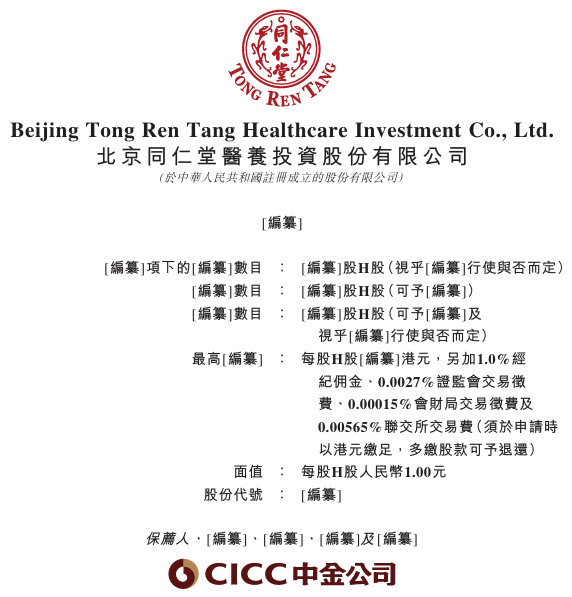
同仁堂医养递表港交所
Zhi Tong Cai Jing· 2026-01-26 06:16
据港交所1月26日披露,北京同仁堂医养投资股份有限公司(简称:同仁堂医养)向港交所主板递交上 市申请书,中金公司为其保荐人。 招股书显示,同仁堂医养是同仁堂旗下一家战略性聚焦于中国中医医疗服务的附属公司,为个人客户提 供全面中医医疗服务,为机构客户提供标准化管理服务,并提供各种健康产品及其他产品。公司已建立 分级中医医疗服务网络,包括12家自有线下医疗机构及一家互联网医院,以及12家线下管理医疗机构。 按2024年总门诊人次及住院人次计,公司是中国非公立中医院医疗服务行业中最大的中医院集团,市场 份额为1.7%。 港股频道更多独家策划、专家专栏,免费查阅>>责任编辑:栎树 ...
北京同仁堂医养投资股份有限公司向港交所提交IPO申请
Mei Ri Jing Ji Xin Wen· 2026-01-26 05:49
每经AI快讯,1月26日,北京同仁堂(600085)医养投资股份有限公司向港交所提交IPO申请,保荐人 为中金公司(601995)。 ...

新股消息 | 同仁堂医养递表港交所
智通财经网· 2026-01-26 05:47
智通财经APP获悉,据港交所1月26日披露,北京同仁堂医养投资股份有限公司(简称:同仁堂医养)向港 交所主板递交上市申请书,中金公司为其保荐人。招股书显示,同仁堂医养是同仁堂旗下一家战略性聚 焦于中国中医医疗服务的附属公司,为个人客户提供全面中医医疗服务,为机构客户提供标准化管理服 务,并提供各种健康产品及其他产品。公司已建立分级中医医疗服务网络,包括12家自有线下医疗机构 及一家互联网医院,以及12家线下管理医疗机构。按2024年总门诊人次及住院人次计,公司是中国非公 立中医院医疗服务行业中最大的中医院集团,市场份额为1.7%。 | :[编纂]股H股(視乎[編纂]行使與否而定) | 編纂]項下的[編纂]數目 | | --- | --- | | [編纂]數目 [编纂]股H股(可予[編纂]) | . . | | [編纂]數目 : [编纂]股H股(可予[編纂]及 | | | 視乎[編纂]行使與否而定) | | | 最高[編纂] : 每股H股[編纂]港元,另加1.0%經 | | | 紀佣金、0.0027%證監會交易徵 | | | 費、0.00015% 會財局交易徵費及 | | | 0.00565%聯交所交易費(須於 ...
2026年中国心脑血管药物行业市场政策汇总、产业链图谱、市场规模、竞争格局及发展趋势分析:需求群体庞大[图]
Chan Ye Xin Xi Wang· 2026-01-26 01:40
Core Insights - The aging population in China is leading to an increase in cardiovascular diseases, with rising prevalence of chronic conditions such as hypertension and hyperlipidemia, driving demand for cardiovascular drugs [1][8] - There is a significant increase in health awareness among residents, leading to earlier screening and treatment of cardiovascular diseases, which expands the applicable population for cardiovascular medications [1][8] - The implementation of centralized drug procurement policies is causing a downward trend in drug prices, putting pressure on the overall market size, which is projected to decline to 954.1 billion yuan for traditional Chinese medicine and 1,415.8 billion yuan for chemical drugs by 2025 [1][8] Market Overview - Cardiovascular diseases encompass both cardiovascular and cerebrovascular diseases, primarily caused by conditions like hyperlipidemia, blood viscosity, atherosclerosis, and hypertension [2] - Cardiovascular drugs are classified into two main categories: cardiovascular system drugs and cerebrovascular system drugs, targeting various heart and brain-related conditions [2] Policy Environment - The pharmaceutical manufacturing industry, including cardiovascular drugs, is a key focus of national policy support, with various regulations aimed at correcting malpractices and promoting industry development [3][4] Industry Chain - The upstream of the cardiovascular drug industry includes chemical raw materials, traditional Chinese medicinal materials, and pharmaceutical packaging materials, while the midstream involves research, production, and registration processes [4][5] Demand Dynamics - Cardiovascular diseases are the leading cause of death in China, with hypertension cases expected to reach 370 million and coronary heart disease cases at 30 million by 2025, indicating a growing demand for cardiovascular medications [6][8] Competitive Landscape - The market has developed a dual competitive structure, with foreign companies dominating the chemical drug sector and local companies leading in traditional Chinese medicine, creating a competitive environment [10] - Notable domestic players include Shijiazhuang Pharmaceutical Group and Shandong Buchang Pharmaceutical, which have established strong market positions through unique products and effective distribution networks [10][11] Development Trends - The industry is shifting from reliance on generic drugs to innovation, focusing on high-value drug development, including targeted and biological drugs [12] - There is a growing integration of chronic disease management with digital tools, enhancing patient adherence and treatment precision [13] - Policy reforms are reshaping market dynamics, emphasizing high clinical value drugs and expanding the market for basic medications in primary healthcare [14] - The industry is moving towards a collaborative ecosystem, with increased internationalization efforts and participation in global clinical trials [15]




研判2026!中国药食同源行业政策汇总、销售额、销量、竞争格局及发展趋势分析:市场需求爆发,新兴成分表现出强劲增长势头[图]
Chan Ye Xin Xi Wang· 2026-01-26 01:21
Core Insights - The health-conscious consumer trend is driving demand for food products that offer health benefits, leading to increased interest in "food-medicine" products like goji berries, yam, and red dates [1][3][4] Industry Overview - The "food-medicine" concept is rooted in traditional Chinese medicine, emphasizing the dual role of certain foods as both nutrition and medicine [3] - The market for "food-medicine" products in China is projected to reach 56.78 billion yuan in 2024, with a year-on-year growth of 3% [1][6] Market Dynamics - The nutritional health food market in China is expected to grow to 678 billion yuan in 2024, reflecting a 7.3% increase year-on-year, providing a solid foundation for the "food-medicine" industry [6][7] - Sales of traditional ingredients like bird's nest and goji berries remain strong, while new ingredients like poria and astragalus are gaining traction, with astragalus seeing a 75.2% increase in sales [7][8] Competitive Landscape - The "food-medicine" industry features diverse competition from traditional pharmaceutical companies, food enterprises, new retail businesses, and internet health companies [9][10] - Major players include Tongrentang, Yunnan Baiyao, and Kang En Bei, which leverage their traditional medicine expertise to develop health-oriented food products [10][11] Development Trends - Future product development will focus on functional and scenario-specific offerings, catering to various consumer needs, such as liver health for night owls and digestive health for the elderly [12][15] - Cross-industry collaborations will become common, integrating "food-medicine" with baked goods, beverages, and other food categories to enhance flavor and health benefits [14][15] - Young consumers are emerging as a new growth segment, with increased interest in health products and innovative formats appealing to their preferences [15][16] - Stricter regulatory policies are expected to drive the industry towards higher quality standards, with ongoing support for traditional health culture and product innovation [16]


中药板块1月21日跌0.39%,众生药业领跌,主力资金净流出2.81亿元
Zheng Xing Xing Ye Ri Bao· 2026-01-21 08:53
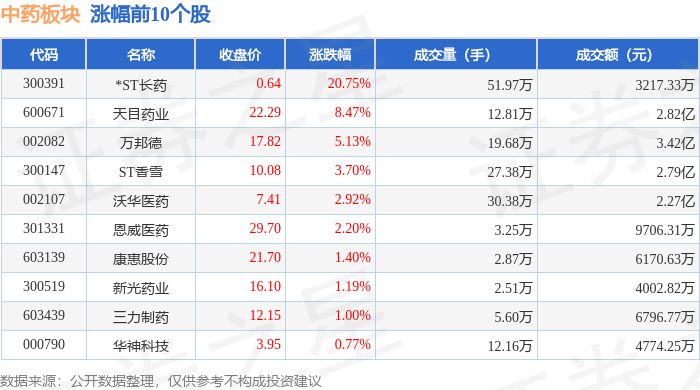
Market Overview - The Chinese traditional medicine sector experienced a decline of 0.39% on January 21, with Zhongsheng Pharmaceutical leading the drop [1] - The Shanghai Composite Index closed at 4116.94, up 0.08%, while the Shenzhen Component Index closed at 14255.12, up 0.7% [1] Stock Performance - Notable gainers in the traditional medicine sector included: - *ST Changyao: Closed at 0.64, up 20.75% with a trading volume of 519,700 shares and a turnover of 32.17 million yuan [1] - Tianmu Pharmaceutical: Closed at 22.29, up 8.47% with a trading volume of 128,100 shares and a turnover of 282 million yuan [1] - Wanbangde: Closed at 17.82, up 5.13% with a trading volume of 196,800 shares and a turnover of 34.2 million yuan [1] - Conversely, Zhongsheng Pharmaceutical saw a decline of 4.26%, closing at 21.12 with a trading volume of 685,100 shares and a turnover of 144.9 million yuan [2] Capital Flow - The traditional medicine sector experienced a net outflow of 281 million yuan from major funds, while retail investors saw a net inflow of 78.63 million yuan [2] - Major funds showed significant net inflows in stocks such as Yunnan Baiyao, which had a net inflow of 78.68 million yuan, and Wanbangde with a net inflow of 22.17 million yuan [3]


北京同仁堂股份有限公司2026年第一次临时股东会决议公告
Shang Hai Zheng Quan Bao· 2026-01-16 19:40
证券代码:600085 证券简称:同仁堂 公告编号:2026-001 北京同仁堂股份有限公司2026年第一次临时股东会决议公告 本公司董事会及全体董事保证本公告内容不存在任何虚假记载、误导性陈述或者重大遗漏,并对其内容 的真实性、准确性和完整性承担法律责任。 重要内容提示: ● 本次会议是否有否决议案:无 一、会议召开和出席情况 (一)股东会召开的时间:2026年1月16日 (二)股东会召开的地点:北京市东城区崇外大街42号同仁堂大厦5层会议室 (三)出席会议的普通股股东和恢复表决权的优先股股东及其持有股份情况: ■ (四)表决方式是否符合《公司法》及《公司章程》的规定,会议主持情况等。 本次股东会由公司董事会召集,董事长张朝华女士主持。会议采用现场投票和网络投票相结合的表决方 式进行表决。会议的召集、召开和表决符合相关法律、法规及《北京同仁堂股份有限公司章程》的规 定。 (五)公司董事和董事会秘书的列席情况 1.公司在任董事11人,出席董事11人; 2.公司董事会秘书出席本次会议;部分高级管理人员列席本次会议。 二、议案审议情况 (一)非累积投票议案 表决情况: ■ 2.议案名称:《关于与关联方签订销售框架 ...
同仁堂(600085) - 北京大成律师事务所关于北京同仁堂股份有限公司2026年第一次临时股东会的法律意见书
2026-01-16 10:02
北 京 大 成 律 师 事 务 所 关 于 北 京 同 仁 堂 股 份 有 限 公 司 2026 年 第 一 次 临 时 股 东 会 的 法 律 意 见 书 大成证字[2026]第 005 号 北 京 大 成 律 师 事 务 所 www.dentons.cn 北京市朝阳区朝阳门南大街 10 号兆泰国际中心 B 座 16-21 层(100020) ZT International Center, No.10, Chaoyangmen Nandajie, Dongdaqiao Road Chaoyang District, 100020, Beijing, China Tel:+8610-58137799 Fax:+8610-58137788 1 北京大成律师事务所 关于北京同仁堂股份有限公司 2026 年第一次临时股东会的法律意见书 致:北京同仁堂股份有限公司 根据《中华人民共和国证券法》(以下简称"《证券法》")、《中华人民共 和国公司法》(以下简称"《公司法》")和中国证券监督管理委员会《上市公司 股东会规则》(以下简称"《股东会规则》")等法律、法规和其他有关规范性文 件的要求,北京大成律师事务所(以下简 ...