ETERN(600105)

Search documents
CPO概念股普跌
Ge Long Hui· 2026-01-20 02:08
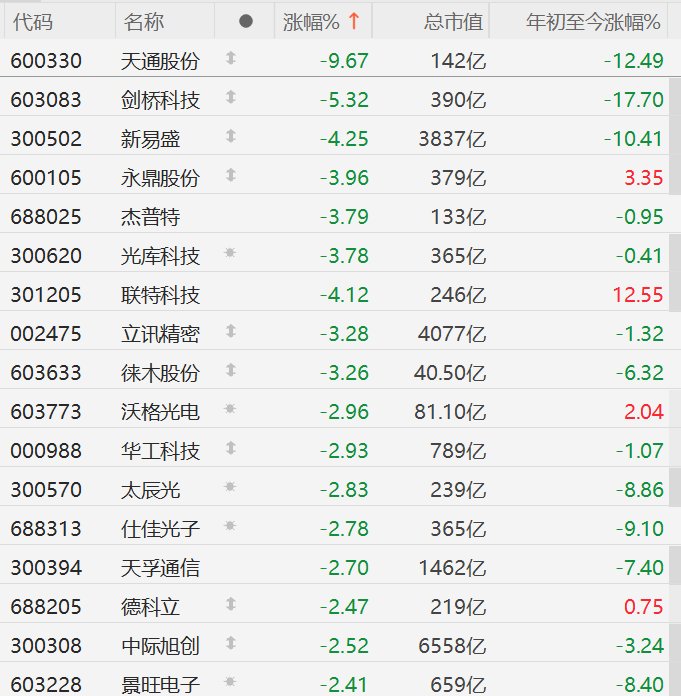
Group 1 - The A-share market saw a decline in CPO concept stocks, with Tian Tong Co. nearing the limit down, Cambridge Technology dropping over 5%, and several other companies experiencing declines of more than 3% [1] - Cambridge Technology recently released a performance forecast, expecting a net profit attributable to shareholders of 252 million to 278 million yuan for the fiscal year 2025, representing a year-on-year increase of 51.19% to 66.79% [1] - For the first three quarters of 2025, Cambridge Technology's net profit attributable to shareholders was 259 million yuan, indicating that the expected net profit for Q4 2025 is projected to be between -7 million to 19 million yuan, which is below analysts' consensus forecast of 139 million yuan [1] Group 2 - Tian Tong Co. experienced a decline of 9.67% with a total market value of 14.2 billion yuan and a year-to-date decline of 12.49% [2] - Cambridge Technology's stock fell by 5.32%, with a total market value of 39 billion yuan and a year-to-date decline of 17.70% [2] - New Yi Sheng's stock dropped by 4.25%, with a total market value of 383.7 billion yuan and a year-to-date decline of 10.41% [2]




技术突破叠加政策红利 核聚变产业入机构法眼
Zheng Quan Shi Bao· 2026-01-19 18:12
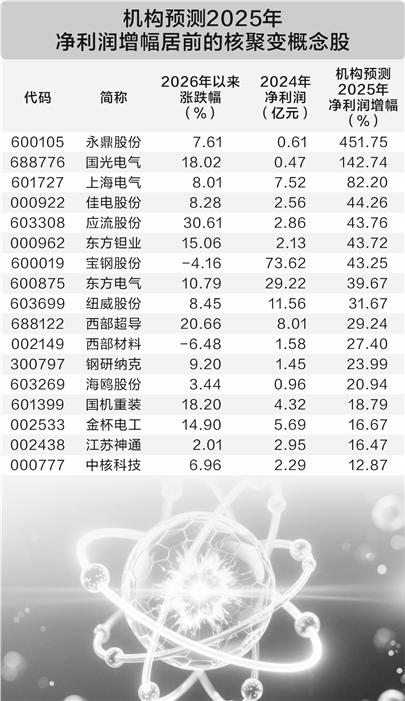
Group 1 - The core viewpoint of the news highlights significant advancements in the controlled nuclear fusion industry, which has become a national strategic focus in China, with substantial growth potential anticipated in the coming years [4][5] - The "14th Five-Year Plan" suggests a forward-looking layout for future industries, promoting hydrogen and nuclear fusion energy as new economic growth points [4] - The first fundamental law in China's nuclear energy sector, the "Atomic Energy Law," was enacted on January 15, 2023, encouraging scientific research and technological development in controlled thermonuclear fusion [4] Group 2 - Energy Singularity announced a breakthrough in high-temperature superconducting Tokamak technology, achieving a stable long pulse plasma operation of 335 seconds in its 5609th experiment [3] - The company has been focusing on the development of compact high-temperature superconducting Tokamak devices and their operational control software since its establishment in 2021 [3] - The nuclear fusion energy engineering in China has entered a substantial and systematic phase of industrial collaborative efforts, with multiple joint laboratories being established to focus on key technologies [3] Group 3 - According to CITIC Securities, the nuclear fusion industry has vast growth potential, driven by significant events and orderly domestic capital expenditures, with expectations for overseas progress to exceed forecasts [5] - The market size for nuclear fusion is projected to reach $496.55 billion by 2030, with the potential to create a trillion-dollar industrial cluster by 2050 [5] - As of January 16, 2026, there are 12 nuclear fusion concept stocks with net inflows exceeding 100 million yuan, with Western Superconducting, Western Materials, and Dongfang Electric leading the rankings [5] Group 4 - 20 nuclear fusion concept stocks are expected to see profit growth in 2025, with notable predictions for Yongding Co. and Guoguang Electric, expecting profit increases of 451.75% and 142.74% respectively [7] - Shanghai Electric is forecasted to have a profit increase of over 80%, while several other companies are expected to see growth rates exceeding 40% [7] - The controlled nuclear fusion sector is experiencing a surge in investment opportunities, particularly in the mid-to-upstream segments, driven by technological breakthroughs and policy support [5][6]





华创交运公用可控核聚变双周报(第5期):核聚变能科技与产业大会召开,可控核聚变产业化进展或加速推进
Huachuang Securities· 2026-01-19 13:20
Investment Rating - The report maintains a "Recommended" rating for the controllable nuclear fusion industry, indicating an expectation of significant growth in the sector over the next 3-6 months [3][49]. Core Insights - The 2026 Nuclear Fusion Energy Technology and Industry Conference held in Hefei is expected to accelerate the industrialization of nuclear fusion, with major procurement projects and collaborative laboratory projects being signed [1][8]. - Star Ring Fusion has completed a 1 billion yuan Series A financing round, which will expedite the commercialization of nuclear fusion technology, with plans to complete engineering validation by 2028 and establish a demonstration reactor by around 2032 [9][1]. - The report anticipates that the domestic nuclear fusion projects will see a total investment of approximately 146.5 billion yuan, with capital expenditures expected to enter an expansion phase from 2025 to 2028, leading to increased orders in the industry chain [8][1]. Summary by Sections Industry Overview - The report highlights the significant participation of over 1,500 attendees from various sectors, including government, academia, and finance, at the 2026 Nuclear Fusion Energy Technology and Industry Conference [8]. - The conference aims to foster collaboration across innovation, industry, finance, and talent chains to build a synergistic nuclear fusion energy ecosystem [8]. Financing and Investment - Star Ring Fusion's 1 billion yuan financing round was led by Shanghai Guotou and other investment groups, focusing on developing a unique high-temperature superconducting spherical tokamak technology [9][1]. - The report notes that the nuclear fusion industry is entering a capital expenditure upcycle, with significant investments expected to drive order volumes in the supply chain [1][8]. Market Performance - The report provides a performance review of the nuclear fusion sector, noting that several companies have seen substantial stock price increases, with top performers including New Wind Power (+42%) and China Nuclear Construction (+27%) [22][26]. - The report also tracks bidding activities, indicating a total bidding amount of 1.28 billion yuan in early January 2026, with several high-value projects being awarded [12][15]. Recommended Companies - The report continues to recommend companies such as Hezhong Intelligent and Lianchuang Optoelectronics, while suggesting attention to Guoguang Electric [3][23]. - It emphasizes the importance of the magnet segment, recommending companies like Western Superconducting and Yongding Co., which have significant value contributions in the nuclear fusion supply chain [33][3].


可控核聚变行业周报:2026核聚变能科技与产业大会开幕,星环聚能完成10亿元A轮融资
GUOTAI HAITONG SECURITIES· 2026-01-19 03:00
Investment Rating - The report assigns an "Accumulate" rating for the controlled nuclear fusion industry [26]. Core Insights - The controlled nuclear fusion sector is experiencing significant growth, with increasing procurement demands and notable financing activities, such as the completion of a 1 billion RMB Series A funding round by Star Ring Fusion [3][22]. - The 2026 Nuclear Fusion Technology and Industry Conference highlighted advancements in plasma technology, including the successful operation of the "Xuanlong-50U" hydrogen-boron plasma high-confinement mode discharge, marking a significant milestone in fusion research [16][19]. - The establishment of the Fusion Financial Institutions Alliance aims to facilitate the transition of nuclear fusion from laboratory research to engineering and commercialization, involving 130 financial and technology service institutions [24][25]. Summary by Sections Market Performance - During the week of January 12-16, the nuclear fusion index fell by 3.22%, underperforming the broader market indices [8][11]. Tender and Bid Information - Significant procurement activities were reported, focusing on superconducting materials and structural components, with total procurement amounts nearing 100 million RMB [10][13]. Domestic and International News - The 2026 Nuclear Fusion Technology and Industry Conference, held in Hefei, attracted over 1,500 participants and featured major procurement projects and collaborations [14][19]. - Japan announced the opening of three top fusion research facilities to private enterprises, marking a shift towards public-private collaboration in fusion technology [19][20]. Investment Dynamics - Star Ring Fusion's 1 billion RMB Series A financing is one of the largest in the domestic fusion energy sector, indicating strong confidence in the commercialization of next-generation energy technologies [22]. - The Fusion Financial Institutions Alliance was formed to enhance capital efficiency and support the commercialization of nuclear fusion technologies [24][25]. Investment Recommendations - The report suggests focusing on key components of controlled nuclear fusion, including magnets, power supplies, and structural components, with specific companies highlighted for potential investment [26].


“可控核聚变”热潮背后
经济观察报· 2026-01-17 06:13
Core Viewpoint - The A-share "nuclear fusion" concept companies may face a long performance gap before commercial power generation is realized, despite recent funding and technological breakthroughs in the sector [4]. Group 1: Market Dynamics - On January 15, 2026, the implementation of the "Atomic Energy Law" encouraging controlled nuclear fusion coincided with a market style shift, leading investors to focus on the "controlled nuclear fusion" sector as a potential new market leader [2]. - Recent funding activities, such as Shanghai Xinghuan Fusion Technology's completion of a 1 billion yuan Series A financing, have set records for domestic private fusion companies, indicating strong investor interest [2][16]. - Several listed companies in the "nuclear fusion concept" category, including China First Heavy Industries and China Nuclear Engineering, experienced significant stock price increases, but many issued announcements clarifying that they currently have minimal related revenue [3][25]. Group 2: Technological Advancements - The nuclear fusion industry is seeing advancements in technology, with breakthroughs in high-temperature superconducting magnets, which are crucial for achieving the necessary magnetic field strength for fusion [11][18]. - The energy density of nuclear fusion is significantly higher than that of nuclear fission, with 1 gram of deuterium-tritium fusion fuel releasing energy equivalent to 11.2 tons of standard coal, making it a promising solution for future energy needs [9]. - The development of compact fusion reactors is being facilitated by high-temperature superconductors, which allow for smaller and more cost-effective designs compared to traditional fusion reactors [11]. Group 3: Challenges and Future Outlook - Despite optimism in the investment community, significant challenges remain, including material durability under extreme conditions, tritium supply issues, and the need for high-throughput neutron sources for testing new materials [20][21]. - The timeline for commercial nuclear fusion is projected to extend to around 2050, with various milestones set for experimental and demonstration reactors in the coming decades [24][28]. - The current market for nuclear fusion equipment is expected to grow significantly, with estimates suggesting an annual scale of 266 billion yuan by 2035, but achieving this will require overcoming substantial technical and operational hurdles [27].



“可控核聚变”热潮背后
Jing Ji Guan Cha Wang· 2026-01-17 05:08
Core Viewpoint - The implementation of the "Encouragement and Support for Controlled Nuclear Fusion" in the Atomic Energy Law of China is expected to drive investment and interest in the nuclear fusion sector, marking a potential shift in market focus from commercial aerospace and AI applications to nuclear fusion technology [2][3]. Investment and Market Dynamics - The A-share market experienced a style switch, with funds moving away from previously favored sectors like commercial aerospace and AI applications towards the "controlled nuclear fusion" sector, driven by recent positive industry news [2]. - Significant investments have been made in the nuclear fusion sector, including a record A-round financing of 1 billion yuan by Shanghai Xinghuan Fusion Technology Co., which indicates strong investor interest [2][14]. - Companies like China First Heavy Industries and China Nuclear Engineering have seen their stock prices surge, reflecting market enthusiasm for nuclear fusion concepts, despite these companies warning of limited current revenue from related projects [3][21]. Technological Advancements - The nuclear fusion industry is witnessing breakthroughs in technology, such as the successful excitation of high-temperature superconducting magnets to 20.8 Tesla, which is crucial for enhancing fusion power density [2][16]. - The development of high-temperature superconductors is making commercial nuclear fusion more feasible by allowing for smaller and more cost-effective fusion devices [9][10]. Energy Demand and Supply - The increasing demand for energy, particularly driven by AI and data centers, is creating a sense of urgency for alternative energy sources like nuclear fusion, which is seen as a potential solution to the looming energy supply challenges [4][5]. - The energy density of nuclear fusion is significantly higher than that of traditional fossil fuels and nuclear fission, making it an attractive option for future energy needs [6][12]. Market Projections - The global nuclear fusion equipment market is projected to reach an annual scale of 266 billion yuan by 2035, indicating substantial future market potential despite current challenges in achieving commercial viability [23]. - The timeline for achieving commercial nuclear fusion is optimistic, with expectations for experimental reactors by 2030 and commercial reactors by 2050 [25]. Challenges and Risks - Despite the optimism, significant challenges remain, including material durability under extreme conditions, tritium supply issues, and the need for advanced testing facilities to validate new materials [17][18][19]. - The current state of nuclear fusion technology is still in the experimental phase, and companies are facing a long path to commercial viability, with many listed companies clarifying that their current revenues from fusion-related activities are minimal [21][22].

中证2000ETF增强(159556)开盘跌0.85%
Xin Lang Cai Jing· 2026-01-16 01:41
Group 1 - The core point of the article highlights the performance of the Zhongzheng 2000 ETF Enhanced (159556), which opened down 0.85% at 1.290 yuan on January 16 [1] - The fund's performance benchmark is the Zhongzheng 2000 Index return, managed by Ping An Fund Management Co., with a return of 30.45% since its establishment on December 27, 2023, and a return of 10.31% over the past month [1] Group 2 - The top holdings of the Zhongzheng 2000 ETF Enhanced include Huajian Group, which opened down 0.43%, Dekeli down 0.74%, Xuguang Electronics up 0.22%, Beihua Co. down 1.20%, and others showing mixed performance [1] - Notable stock movements include Electric Wind Power up 0.37%, Xinke Materials up 0.96%, Jiayuan Technology up 0.09%, Hongjing Technology down 2.49%, Yongding Co. up 1.03%, and Furui Electronics up 0.83% [1]


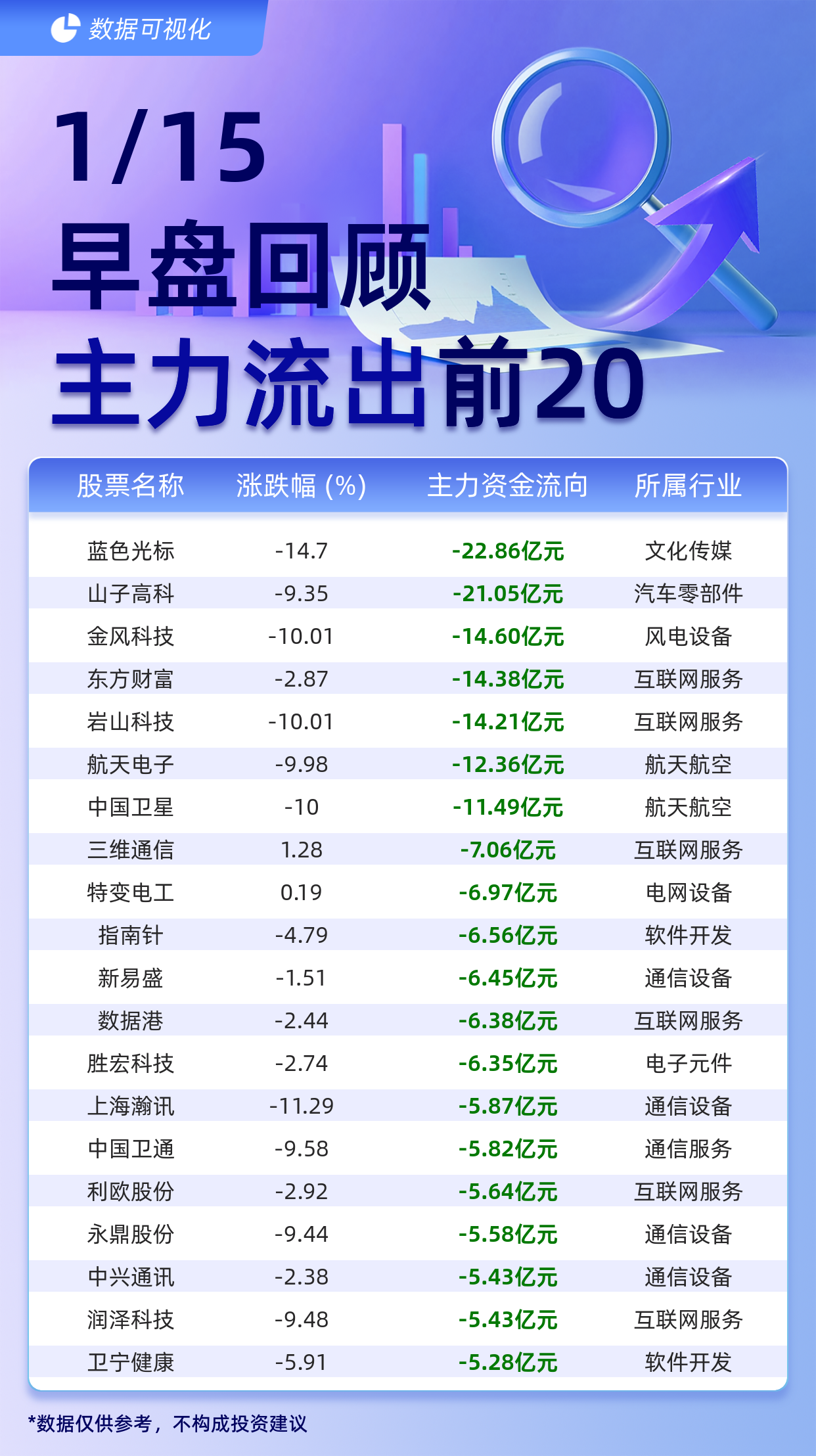
主力个股资金流出前20:蓝色光标流出22.86亿元、山子高科流出21.05亿元
Jin Rong Jie· 2026-01-15 03:50
Core Viewpoint - The data indicates significant outflows of main funds from various stocks, with notable declines in share prices across multiple sectors, particularly in cultural media, automotive parts, and wind power equipment [1][2][3] Group 1: Stock Performance and Fund Flow - Blue Cursor experienced a decline of 14.7% with a fund outflow of 2.286 billion [2] - Shanzi Gaoke saw a decrease of 9.35% with a fund outflow of 2.105 billion [2] - Goldwind Technology had a drop of 10.01% with a fund outflow of 1.460 billion [2] - Dongfang Fortune's stock fell by 2.87% with a fund outflow of 1.438 billion [2] - Yanshan Technology declined by 10.01% with a fund outflow of 1.421 billion [2] - Aerospace Electronics dropped by 9.98% with a fund outflow of 1.236 billion [2] - China Satellite's stock decreased by 10% with a fund outflow of 1.149 billion [2] - Sanwei Communication had a slight increase of 1.28% but still faced a fund outflow of 0.706 billion [2] - Tebian Electric experienced a minor increase of 0.19% with a fund outflow of 0.697 billion [2] - Compass saw a decline of 4.79% with a fund outflow of 0.656 billion [2] Group 2: Additional Stock Data - Xinyisheng's stock fell by 1.51% with a fund outflow of 0.645 billion [3] - Dataport experienced a decline of 2.44% with a fund outflow of 0.638 billion [3] - Shenghong Technology's stock decreased by 2.74% with a fund outflow of 0.635 billion [3] - Shanghai Huanxun saw a significant drop of 11.29% with a fund outflow of 0.587 billion [3] - China Satellite Communications experienced a decline of 9.58% with a fund outflow of 0.582 billion [3] - Leo Holdings' stock fell by 2.92% with a fund outflow of 0.564 billion [3] - Yongding's stock decreased by 9.44% with a fund outflow of 0.558 billion [3] - ZTE Corporation saw a decline of 2.38% with a fund outflow of 0.543 billion [3] - Runze Technology experienced a drop of 9.48% with a fund outflow of 0.543 billion [3] - Weining Health's stock fell by 5.91% with a fund outflow of 0.528 billion [3]


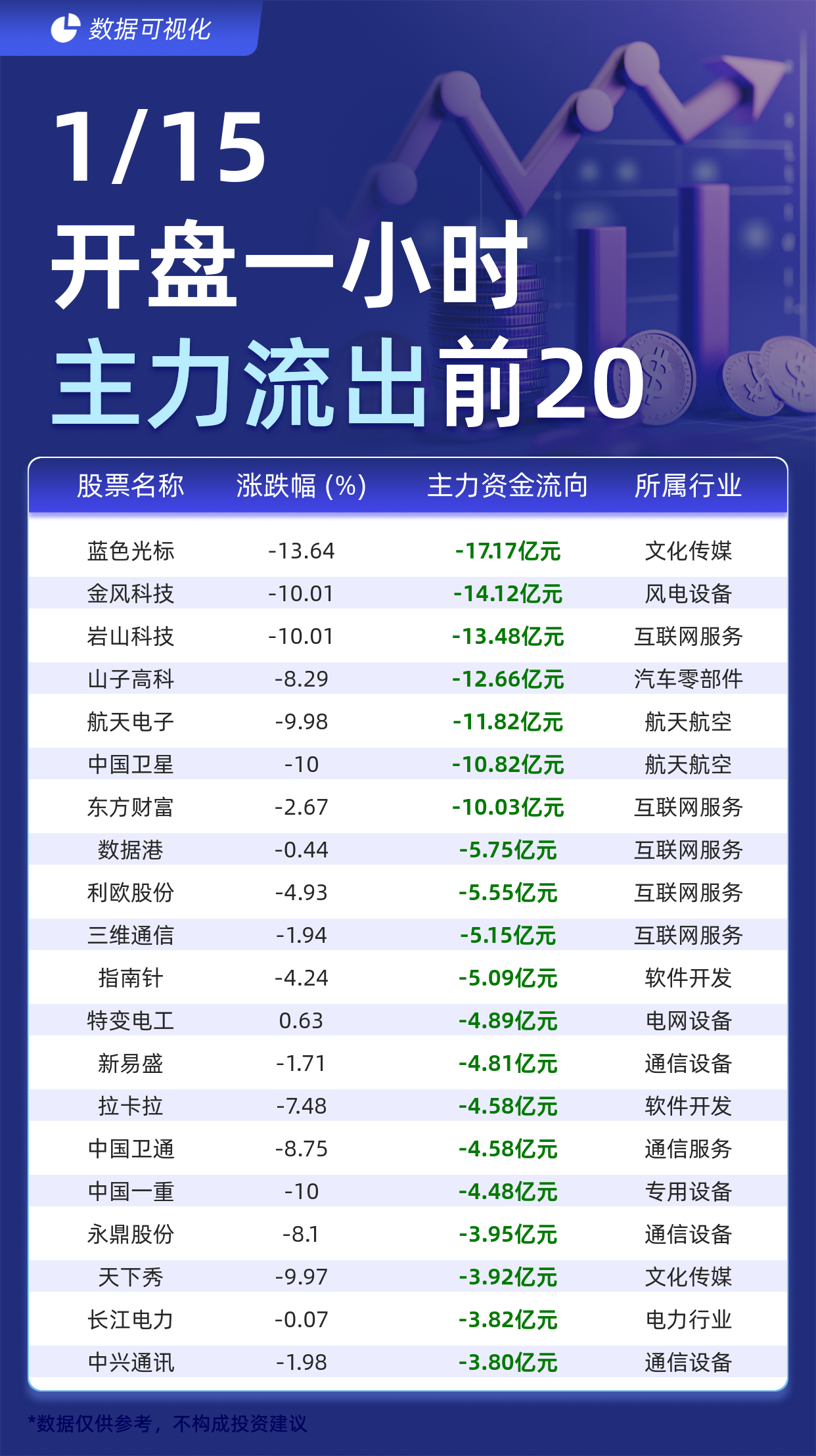
主力个股资金流出前20:蓝色光标流出17.17亿元、金风科技流出14.12亿元


Jin Rong Jie· 2026-01-15 02:47
Group 1 - The main stocks with significant capital outflows include BlueFocus (-1.717 billion), Goldwind (-1.412 billion), and Yanshan Technology (-1.348 billion) [1] - The sectors affected by the capital outflows include cultural transmission, wind power equipment, and internet services [2][3] - The largest percentage drop in stock prices was observed in BlueFocus (-13.64%) and Goldwind (-10.01%) [2] Group 2 - Other notable stocks with capital outflows include Aerospace Electronics (-1.182 billion), China Satellite (-1.082 billion), and Dongfang Fortune (-1.003 billion) [1] - The telecommunications sector also saw significant outflows, with companies like ZTE (-0.380 billion) and China Satcom (-0.458 billion) experiencing declines [3] - The overall trend indicates a bearish sentiment in the market, particularly affecting technology and aerospace sectors [2][3]
同泰新能源优选1年持有四季报“押注”可控核聚变新战场,基金经理陈宗超:能源革命爆发力远超想象
Xin Lang Cai Jing· 2026-01-14 10:06
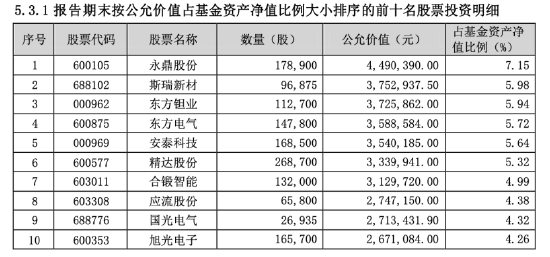
Core Insights - The article discusses the investment outlook for the 2025 fund reports, focusing on AI applications, commercial aerospace, and nuclear fusion as potential investment themes for 2026 [1] Group 1: Fund Performance - The fund managed by Chen Zongchao, Tongtai New Energy Preferred 1-Year Holding A, achieved a quarterly return of 26.28%, ranking first among its peers [3][11] - The fund's returns over the past month, three months, and six months were 16.38%, 25.96%, and 70.17%, respectively, with a one-year return of 96.53%, nearly doubling [3][11] Group 2: Investment Strategy - Chen Zongchao emphasizes a structural differentiation in the power equipment and new energy sector, advocating for a focus on cutting-edge and uncertain areas like controllable nuclear fusion [1][2] - The core logic is based on the advantages of controllable nuclear fusion, which is driven by advancements in high-temperature superconductors and the growth of artificial intelligence, positioning it as a key battleground for major powers [1][2] Group 3: Market Dynamics - 2025 is seen as a pivotal year for controllable nuclear fusion to transition from scientific ideal to industrial reality, supported by strong policy drivers and a diversified investment ecosystem involving state platforms, energy state-owned enterprises, local funds, and private capital [2][7] - The investment potential of controllable nuclear fusion is projected to exceed that of wind, solar, and lithium battery industries once the technology matures and achieves large-scale commercialization [2][7] Group 4: Portfolio Composition - The fund's top ten holdings differ significantly from traditional new energy funds, including companies like Yongding Co., Sry New Materials, and Antai Technology, which are closely linked to key aspects of the nuclear fusion industry chain [8][9]