SUMEC(600710)

Search documents
关税缓和,看好跨境电商
Orient Securities· 2025-11-06 15:25
Investment Rating - The industry investment rating is "Positive (Maintain)" [5] Core Viewpoints - The report emphasizes the long-term nature of overseas expansion, highlighting the increasing penetration rate of cross-border e-commerce in foreign trade and maintaining a positive outlook on leading companies with strong performance resilience and those with marginal performance improvements [3] - The report notes that the recent easing of tariffs and the ongoing strong growth trend in cross-border e-commerce are expected to enhance the ability of Chinese foreign trade enterprises to respond to external shocks and improve their global layout [7] Summary by Sections Cross-Border E-Commerce Performance - In the first three quarters of 2025, the cross-border e-commerce sector achieved revenue of 56.09 billion yuan, a year-on-year increase of 22.6%, with a three-year CAGR of 24.5%. The net profit attributable to shareholders was 3.59 billion yuan, up 20.2% year-on-year, with a three-year CAGR of 20.2% [7] - The revenue growth rate slightly slowed due to trade friction and increased competition, but the net profit growth rate showed significant improvement [7] - In Q3 2025, the sector's revenue grew by 14.3% year-on-year, and net profit increased by 29.6%, indicating operational resilience and improved cost management despite rising tariff costs [7] Market Outlook - The report anticipates strong performance during the upcoming Black Friday and Cyber Monday shopping events, with consumers showing early planning, trust, and value-seeking behaviors [7] - Online sales during the 2025 holiday shopping season in the U.S. are expected to reach $253.4 billion, a year-on-year increase of 5.3% [7] - The report highlights that cross-border e-commerce companies leverage China's efficient industrial clusters to export competitively priced products, with some transitioning from Amazon brands to multi-channel brands [7] Investment Recommendations - The report recommends focusing on resilient leading companies and those with improving performance in the cross-border e-commerce sector, with specific stock suggestions for both B2B and B2C segments [3]




贸易板块11月6日涨1.84%,中信金属领涨,主力资金净流入1.53亿元
Zheng Xing Xing Ye Ri Bao· 2025-11-06 08:51
Market Overview - The trade sector increased by 1.84% on November 6, with CITIC Metal leading the gains [1] - The Shanghai Composite Index closed at 4007.76, up 0.97%, while the Shenzhen Component Index closed at 13452.42, up 1.73% [1] Stock Performance - CITIC Metal (601061) closed at 15.04, rising by 8.59% with a trading volume of 925,600 shares and a turnover of 1.374 billion [1] - Wuhuan Development (600058) closed at 9.66, up 5.23%, with a trading volume of 390,800 shares and a turnover of 375 million [1] - Sumec (600710) closed at 12.15, increasing by 3.05%, with a trading volume of 263,600 shares and a turnover of 320 million [1] - Other notable stocks include Yiatong (002183) with a 1.54% increase and Jiangsu Guotai (002091) with a 0.87% increase [1] Capital Flow - The trade sector saw a net inflow of 153 million from institutional investors, while retail investors experienced a net outflow of 1.65 billion [2] - Major stocks like CITIC Metal and Wuhuan Development attracted significant net inflows from institutional investors, with 63.23 million and 62.05 million respectively [3] - Retail investors showed a negative net flow in several stocks, including CITIC Metal and Wuhuan Development, indicating a divergence in investment behavior [3]


苏美达涨2.88%,股价创历史新高
Zheng Quan Shi Bao Wang· 2025-11-06 02:39
Core Viewpoint - Su Mei Da's stock price reached a historical high, reflecting positive market sentiment and performance in the retail sector [2] Company Summary - As of 9:43, Su Mei Da's stock increased by 2.88%, reaching a price of 12.13 yuan, with a trading volume of 5.0088 million shares and a transaction amount of 59.9987 million yuan, resulting in a turnover rate of 0.38% [2] - The latest total market capitalization of Su Mei Da in A-shares is 15.851 billion yuan, with the same amount for circulating market capitalization [2] - The company's Q3 report indicates a total operating revenue of 87.423 billion yuan for the first three quarters, a year-on-year increase of 0.52%, and a net profit of 1.104 billion yuan, reflecting a year-on-year growth of 10.03% [2] - Basic earnings per share are reported at 0.8400 yuan, with a weighted average return on equity of 14.00% [2] Industry Summary - The overall decline in the retail trade industry is recorded at 0.62%, with 11 stocks experiencing price increases, including Su Mei Da, which ranks among the top gainers [2] - Other notable gainers in the industry include Zhongxin Metal and Ruoyu Chen, with respective increases of 6.64% and 1.70% [2] - Conversely, 83 stocks in the industry have seen declines, with Sanjiang Shopping, Guoguang Chain, and Zhongbai Group leading the losses at 7.97%, 4.52%, and 3.32% respectively [2] - As of November 5, the latest margin trading balance for Su Mei Da is 139 million yuan, with a financing balance of the same amount, showing a decrease of 11.9106 million yuan over the past 10 days, representing a 7.90% decline [2]
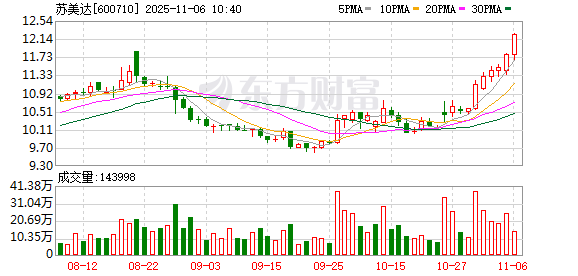
苏美达股价连续4天上涨累计涨幅8.85%,海富通基金旗下1只基金持3.18万股,浮盈赚取2.96万元
Xin Lang Cai Jing· 2025-11-03 07:19
Core Viewpoint - Su Mei Da's stock price has increased by 1.24% to 11.44 CNY per share, with a total market capitalization of 14.949 billion CNY, and has seen a cumulative increase of 8.85% over the past four days [1] Company Overview - Su Mei Da Co., Ltd. is located at 198 Changjiang Road, Nanjing, Jiangsu Province, established on June 24, 1996, and listed on July 1, 1996. The company operates in two main business segments: industrial chain and supply chain [2] - The industrial chain includes sectors such as consumer goods and environmental protection, with key products/services including textiles, home power products, environmental engineering, clean energy, and shipbuilding [2] - The supply chain segment focuses on integrated services for bulk commodity operations and import of mechanical and electrical equipment. Revenue composition shows supply chain contributing 71.59% and industrial chain 28.20% [2] Fund Holdings - Hai Fu Tong Fund has a significant holding in Su Mei Da, with its Hai Fu Tong An Yi Income Mixed A Fund (519050) holding 31,800 shares, representing 0.39% of the fund's net value, ranking as the ninth largest holding [3] - The fund has realized a floating profit of approximately 4,452 CNY today and 29,600 CNY during the four-day increase [3] Fund Manager Information - The fund managers of Hai Fu Tong An Yi Income Mixed A are Du Xiaohai and Tan Yunfei, with respective management tenures of 9 years and 137 days, and 11 years and 100 days [4] - Du Xiaohai's fund has a total asset size of 5.742 billion CNY, with the best return during his tenure being 117.69% [4] - Tan Yunfei manages a fund with a total asset size of 21.146 billion CNY, with the best return during his tenure being 66.59% [4]
2025航运业转型融资研究报告
Sou Hu Cai Jing· 2025-11-03 01:57
Core Insights - The global shipping industry is undergoing a significant green transformation, with green ships becoming a key driver for low-carbon transition. This is supported by policies such as the IMO's 2025 Net Zero Framework and China's Green Development Action Plan for Shipbuilding Industry (2024-2030) [1][2][14] Group 1: Industry Overview - The IMO's Net Zero Framework is a milestone document that combines mandatory emission limits with greenhouse gas pricing, requiring ocean-going vessels over 5,000 gross tons to gradually reduce their greenhouse gas fuel intensity [1][19] - China's shipbuilding industry has formed a globally leading industrial system, achieving significant progress in green technology research and development, ecological construction, and demonstration applications [2][15] - The technology landscape for green ships shows a "multi-pronged" approach, with clean energy technologies, such as LNG and methanol-powered vessels, leading the way [2][24][31] Group 2: Financial Support - The financial support for the green shipping industry is crucial, with an estimated investment need of approximately $1-1.9 trillion by 2050 to achieve net-zero emissions [16] - China is building a diversified financing system that includes debt, equity, and insurance, with various financial products being developed to support green ship construction [5][16] - Internationally, frameworks like the Poseidon Principles are pushing financial institutions to incorporate carbon performance into project evaluations, with tools like green bonds and sustainable development-linked loans being widely adopted [5][16] Group 3: Regional Development - Coastal provinces in China have formed distinctive industrial clusters, with Shanghai leading in high-end ship design and green port construction, while Jiangsu excels in LNG-powered shipbuilding [4][23] - Shandong focuses on hydrogen and LNG applications, while Fujian aims to develop electric vessels, and Liaoning is advancing its green methanol industry [4][23] Group 4: Challenges and Recommendations - The green shipping industry faces challenges such as insufficient market mechanisms and lagging supporting infrastructure [6][18] - Recommendations include enhancing policy and market synergy, diversifying financial products, and accelerating the construction of clean fuel refueling stations and shore power facilities [6][18]



中财大绿金院IIGF:航运业转型融资研究报告——立足绿色船舶视角
Sou Hu Cai Jing· 2025-11-01 07:13
Core Insights - The shipping industry is undergoing a green transformation, with green ships becoming a central focus. Global policies and technological innovations are advancing, particularly with the International Maritime Organization (IMO) set to implement the "IMO Net Zero Framework" in 2025, which will accelerate the decarbonization of maritime shipping by establishing greenhouse gas intensity requirements and a global carbon pricing mechanism [11][20][17]. Group 1: Overview of the Green Shipping Industry - Green ships are leading the shipping industry's transition towards sustainability, with significant progress in technology, industry chain ecology, and demonstration applications [12]. - The green shipping technology landscape includes clean energy technologies, energy efficiency improvements, and carbon capture technologies, each with varying maturity and application potential [21][22]. - China's green shipping industry has formed a globally leading industrial system, with key regions like Shanghai, Jiangsu, and Shandong developing distinctive paths for green ship development [43]. Group 2: Financial Support for Green Shipping - Financial support is crucial for the development of the green shipping industry, with diverse financing paths emerging, including medium to long-term loans, supply chain finance, and transformation loans [2][49]. - The domestic green financing landscape is evolving, with green bonds and leasing becoming increasingly important, while international frameworks like the Poseidon Principles guide financial institutions in investing in green shipping [13][50]. - Shanghai has emerged as a financial hub for green shipping, integrating shipping enterprises into local carbon markets and launching innovative financial tools to support the green shipping sector [14][49]. Group 3: Challenges and Recommendations - The green shipping sector faces challenges such as insufficient economic incentives for mandatory emissions reductions, comprehensive financing risks, and difficulties in ecological investment [15]. - Recommendations for advancing the green shipping industry include enhancing policy and market mechanisms, developing diversified financing solutions, and increasing investments in supporting infrastructure like clean fuel supply and carbon capture [15][49]. Group 4: Related Ecosystem - The development of green shipping is interconnected with port terminals, logistics services, and maritime services, forming a comprehensive ecosystem for sustainable shipping [38]. - Green ports are being developed in China, with significant achievements in reducing environmental impacts and enhancing operational efficiency [39]. - The logistics sector, while diverse, shows varying degrees of green transformation, with cargo shipping progressing faster than passenger shipping in adopting low-carbon technologies [41].

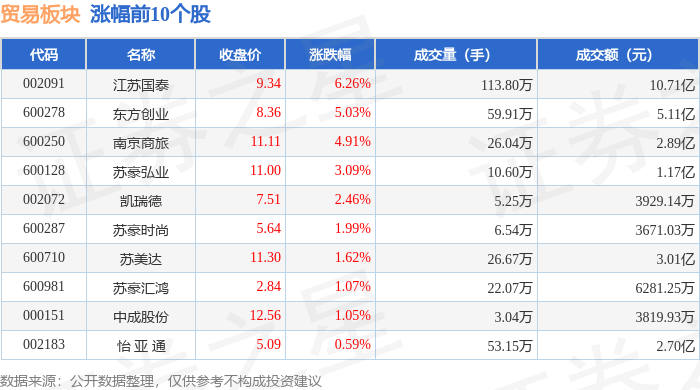
贸易板块10月31日涨2.01%,江苏国泰领涨,主力资金净流入2.31亿元
Zheng Xing Xing Ye Ri Bao· 2025-10-31 08:42
Core Insights - The trade sector experienced a rise of 2.01% on October 31, with Jiangsu Guotai leading the gains [1] - The Shanghai Composite Index closed at 3954.79, down 0.81%, while the Shenzhen Component Index closed at 13378.21, down 1.14% [1] Trade Sector Performance - Jiangsu Guotai (002091) closed at 9.34, up 6.26% with a trading volume of 1.138 million shares and a transaction value of 1.071 billion [1] - Other notable performers included: - Dongfang Chuangye (600278) at 8.36, up 5.03% [1] - Nanjing Shanglv (600250) at 11.11, up 4.91% [1] - Shisuo Hongye (600128) at 11.00, up 3.09% [1] Capital Flow Analysis - The trade sector saw a net inflow of 231 million in main funds, while retail funds experienced a net outflow of 118 million and 113 million respectively [2] - Key individual stock capital flows included: - Jiangsu Guotai with a net inflow of 103 million, but retail outflows of 64 million [3] - Dongfang Chuangye with a net inflow of 94 million from main funds, but retail outflows of 60 million [3] - Nanjing Shanglv with a net inflow of 62 million from main funds, but retail outflows of 41 million [3]


2025Q3交运行业基金重仓分析:推荐基本面改善但基金持仓处于较低水平的油运、造船、航空等板块
Shenwan Hongyuan Securities· 2025-10-30 13:20
Investment Rating - The report maintains a positive outlook on the shipping, shipbuilding, and aviation sectors, indicating a fundamental improvement despite low fund holdings [3]. Core Insights - The shipbuilding sector has seen a reversal of negative factors, with second-hand ship prices stabilizing and surpassing 2024 highs, suggesting potential for new ship price increases [3]. - The oil tanker market is experiencing strong demand due to OPEC's production increases and ongoing sanctions on Russian and Iranian oil supplies, leading to a significant rise in freight rates [3]. - Fund holdings in the transportation sector have decreased to a historical low, with notable increases in the market value of shipping, ports, airports, and cross-border logistics [3][4]. Summary by Sections 1. Changes in Fund Holdings in the Transportation Sector - As of Q3 2025, the total market value of funds in the transportation sector reached 18 billion yuan, a 30% decrease from the previous quarter, ranking 17th among 31 sectors [4][5]. - The transportation sector's market value accounts for 2.68% of total A-share market value, with an underweight of 1.59% [4]. 2. Changes in Fund Holdings by Sub-sectors - The proportion of fund holdings in aviation, shipping, ports, airports, raw material supply chain services, and cross-border logistics has increased, with aviation transportation holding the largest share at 37.62% [10]. - The market value changes for various sectors include significant increases in shipping and raw material supply chain services, while express delivery and highways saw declines [10]. 3. Top Ten Fund Holdings in the Transportation Sector - The top ten fund holdings include SF Holding, YTO Express, Huaxia Airlines, and China Merchants Energy, with notable increases in holdings for YTO Express and China Merchants Energy [15]. - Stocks with total holdings exceeding 300 million yuan and growth rates above 10% include YTO Express and China Merchants Energy, with growth rates of 110% and 227% respectively [15]. 4. Valuation of Key Companies in the Transportation Sector - Key companies such as China National Aviation and SF Holding have been evaluated with projected earnings per share (EPS) and price-to-earnings (PE) ratios indicating potential growth [19].

苏美达股价涨5.01%,嘉实基金旗下1只基金重仓,持有3.85万股浮盈赚取2.04万元
Xin Lang Cai Jing· 2025-10-30 05:52
Core Viewpoint - Su Mei Da's stock price increased by 5.01% to 11.11 CNY per share, with a trading volume of 299 million CNY and a turnover rate of 2.09%, resulting in a total market capitalization of 14.518 billion CNY [1] Company Overview - Su Mei Da Co., Ltd. is located at 198 Changjiang Road, Nanjing, Jiangsu Province, established on June 24, 1996, and listed on July 1, 1996. The company operates in two main business segments: industrial chain and supply chain [2] - The industrial chain includes sectors such as consumer goods and environmental protection, with key products/services including textiles, home power products (garden machinery, cleaning machinery, gasoline generators), environmental engineering (wastewater treatment, waste management, soil remediation, kitchen waste treatment, biodegradable plastic industrial engineering), clean energy (photovoltaic products, engineering, operation and maintenance), and shipbuilding and shipping [2] - The supply chain focuses on integrated services for bulk commodity operations and import of electromechanical equipment. The revenue composition is as follows: supply chain 71.59%, industrial chain 28.20%, with advanced manufacturing at 11.86% and consumer goods at 8.65% [2] Fund Holdings - According to data, one fund under Jia Shi Fund has a significant holding in Su Mei Da. The Jia Shi Zhong Zheng 1000 Index Enhanced Initiation A (016776) increased its holdings by 11,800 shares in the third quarter, totaling 38,500 shares, representing 0.93% of the fund's net value, ranking as the fifth-largest holding [3] - The fund has a current scale of 26.8915 million CNY and has achieved a year-to-date return of 36.35%, ranking 1449 out of 4216 in its category, with a one-year return of 37.45%, ranking 1266 out of 3885 [3]
2025年航运业转型融资研究报告
Sou Hu Cai Jing· 2025-10-28 03:19
Core Insights - The shipping industry is undergoing a significant transformation driven by the global carbon neutrality wave, with the implementation of the IMO's "Net Zero Framework" in 2025 marking a critical phase for emission reduction [13][18] - Green ships are becoming a strategic focus for capital investment, with various clean energy technologies such as LNG, methanol, ammonia, hydrogen, and fuel cells emerging as key players in this transition [12][14] Industry Overview - The shipping industry is expected to require an investment of approximately $1-1.9 trillion to achieve net-zero emissions by 2050, highlighting the urgent need for financial support [15] - China's green ship manufacturing sector has made significant progress, with a focus on high-end, autonomous, and international development [14][22] - The industry is characterized by a high concentration of major players in the midstream segment, while the downstream market remains fragmented [38][39] Technology Landscape - Clean energy technologies are categorized into three main types: clean energy technologies, energy efficiency improvement technologies, and carbon capture technologies, each with varying levels of maturity and application potential [24][33] - LNG technology is currently the mainstream choice for the transition period, while methanol is gaining traction due to its high energy density and ease of refueling [12][28] - Hydrogen and ammonia have zero-carbon potential but face challenges related to toxicity, storage costs, and technological maturity [12][29][32] Financial Support Mechanisms - Green finance is emerging as a core engine for driving technology implementation, with leading international shipping companies raising billions through green bonds and sustainable development-linked bonds [2][15] - Innovative financing models, such as "rent and carbon emissions linkage" and "energy-saving revenue sharing," are reshaping the financing logic within the industry [2][12] - China's financial support for green shipping includes long-term loans, supply chain finance, and transformation loans, with a focus on expanding the range of financial products available [54][56] Regional Development - Key regions in China, such as Shanghai, Jiangsu, Shandong, Fujian, and Liaoning, are developing distinctive paths for green ship development, supported by favorable policies and regional characteristics [51][52] - Shanghai is positioning itself as a global leader in green and intelligent shipbuilding, while Jiangsu focuses on LNG-powered ship design and construction [51][52]