Haitong Securities(600837)

Search documents
中国证券行业2025年十大新闻
证券时报· 2025-12-29 08:48
Core Viewpoint - 2025 is a pivotal year for the Chinese securities industry, focusing on deepening functional positioning and high-quality development, with an emphasis on mergers and acquisitions, international expansion, and technological innovation [2][4]. Group 1: Industry Development Strategy - The industry development strategy is projected in two dimensions: internally, to create a first-class investment bank through mergers and acquisitions; externally, to recommend the value of Chinese assets to global markets [2]. - High-quality development is the main theme, requiring securities firms to act as both market participants and builders, as well as to become "boosters" of technological innovation and "guardians" of residents' wealth [2]. Group 2: Mergers and Acquisitions - 2025 marks a critical year for mergers and acquisitions in the Chinese securities industry, with major firms merging and smaller institutions seeking transformation [4]. - Notable mergers include the formation of "Guotai Haitong Securities" from Guotai Junan and Haitong Securities, and the merger of Guolian Securities and Minsheng Securities, which has significantly improved their profitability rankings [4][5]. - The merger wave is reshaping the competitive landscape, with the top firms now dominating profit rankings [4]. Group 3: Classification Evaluation - The classification evaluation of securities firms is undergoing significant revisions in 2025, emphasizing the need for firms to enhance their functional roles and professional capabilities [6]. - New regulations remove the revenue bonus while increasing the emphasis on return on equity (ROE), guiding firms to focus on operational efficiency rather than mere scale [6][7]. Group 4: Margin Trading and Financing - The margin trading market is heating up, with a record balance of 2.54 trillion yuan, reflecting a 36.6% increase from the beginning of the year [9]. - Competition among firms has intensified, with some lowering financing rates below 4% to attract clients, indicating a shift towards long-term client retention strategies [9][10]. Group 5: Investment Banking and Technology - The securities industry is adapting to the "hard technology" era, with reforms aimed at providing more inclusive financing paths for tech companies [11]. - Firms are establishing research institutes focused on emerging industries and enhancing their service capabilities through collaboration and talent development [13]. Group 6: AI Integration - The adoption of AI technologies is rapidly transforming the securities industry, with firms implementing AI across various business functions, significantly improving efficiency [15]. - The shift towards AI-driven services is seen as a critical factor in maintaining competitive advantage, with some firms fully committing to AI integration [15]. Group 7: Internationalization - Chinese securities firms are deepening their internationalization efforts, expanding their service offerings beyond traditional roles to include cross-border wealth management and derivatives trading [17]. - The internationalization process is driven by both market demand and strategic goals, positioning firms as key players in the global market [17][18]. Group 8: Asset Management Transformation - The public offering process for asset management is reaching a turning point, with firms reassessing their roles in the broader asset management landscape [19]. - The transition of collective investment products is a priority, with many firms adapting to regulatory changes and focusing on private equity and other specialized products [20][21]. Group 9: Capital Space Optimization - Regulatory changes are encouraging firms to optimize capital management, with a focus on enhancing capital utilization efficiency [25]. - The average leverage ratio of listed securities firms is currently at 3.45 times, indicating room for improvement compared to other financial institutions [25]. Group 10: Name Changes Reflecting Strategic Shifts - A wave of name changes among securities firms signals strategic realignments and resource restructuring following mergers and acquisitions [26]. - The name changes often reflect deeper integration and new strategic directions, indicating a shift in focus and operational capabilities [26][28].




中国证券行业2025年十大新闻
券商中国· 2025-12-29 04:28
Core Viewpoint - 2025 is a pivotal year for the Chinese securities industry, focusing on deepening functional positioning and high-quality development, with an emphasis on mergers and acquisitions, international expansion, and technological innovation, particularly through AI applications [1][2]. Mergers and Acquisitions - The year marks a critical phase for mergers and acquisitions in the securities industry, with major firms like Guotai Junan and Haitong Securities merging to form Guotai Haitong Securities, and other significant consolidations such as Guolian Securities and Minsheng Securities [3][4]. - The competitive landscape is shifting, with Guotai Haitong leading in net profit, and Guolian Minsheng's ranking improving significantly from around 40th to the top 20 [3]. - New merger cases are emerging, such as CICC's plan to merge with Xinda Securities and Dongxing Securities, potentially creating a new entity with over 1 trillion yuan in total assets [3]. Industry Integration Logic - Two main integration strategies are evident: resource consolidation under the same actual controller and market-driven mergers aimed at enhancing national influence [4]. - Analysts suggest that resource integration may become the most important way for securities firms to quickly enhance scale and comprehensive strength [4]. Classification Evaluation Reform - A significant revision of the classification evaluation for securities firms is underway, emphasizing the need for firms to enhance their functional roles and professional capabilities [5][6]. - The new regulations aim to shift focus from revenue expansion to improving operational efficiency and professional skills, thereby enhancing overall industry competitiveness [5]. Margin Trading Market - The margin trading market is heating up, with a record balance of 2.54 trillion yuan, reflecting a 36.6% increase from the beginning of the year [7]. - Several firms have raised their margin trading limits, and a price war on interest rates has begun, with some firms offering rates below 4% [8][9]. Investment Banking and Technology - The securities industry is adapting to a new era of "hard technology," with reforms aimed at providing more inclusive financing paths for tech companies [10][11]. - Securities firms are establishing research institutes focused on emerging industries and enhancing their service capabilities through collaboration and talent development [11]. AI Integration - The adoption of AI technologies is rapidly transforming the industry, with applications expanding across various business functions, significantly improving efficiency [12][13]. - Firms are moving towards an "AI-native" model, enhancing client engagement and operational management through AI tools [12]. Internationalization of Securities Firms - The internationalization of Chinese securities firms is accelerating, with a focus on comprehensive service capabilities and participation in global market competition [14][15]. - This trend is driven by the growing demand for cross-border services and the strategic goal of building first-class investment banks [14]. Asset Management Transformation - The public offering process for asset management is at a turning point, with firms reassessing their positioning in the broader asset management landscape [16][17]. - The industry is witnessing a decline in the rush for public fund licenses, with many firms withdrawing applications, indicating a shift in focus towards existing business optimization [16]. Impact of Fund Fee Reforms - The implementation of public fund fee reforms is pushing securities firms to enhance their research and wealth management capabilities, with a notable decline in commission revenues [18]. - Firms are transitioning towards a buyer advisory model, focusing on asset management and providing comprehensive solutions rather than merely selling products [18]. Regulatory Environment - Regulatory signals indicate a potential easing of capital requirements for high-quality institutions, aimed at improving capital utilization efficiency [19]. - Analysts suggest that enhancing leverage and capital efficiency could drive growth in high-value capital-intensive businesses [19]. Name Changes Reflecting Strategic Shifts - A wave of name changes among securities firms signifies strategic realignments and resource restructuring following mergers and acquisitions [20][21]. - These changes reflect deeper integration and the influence of new stakeholders, indicating a shift in strategic focus and operational capabilities [20].

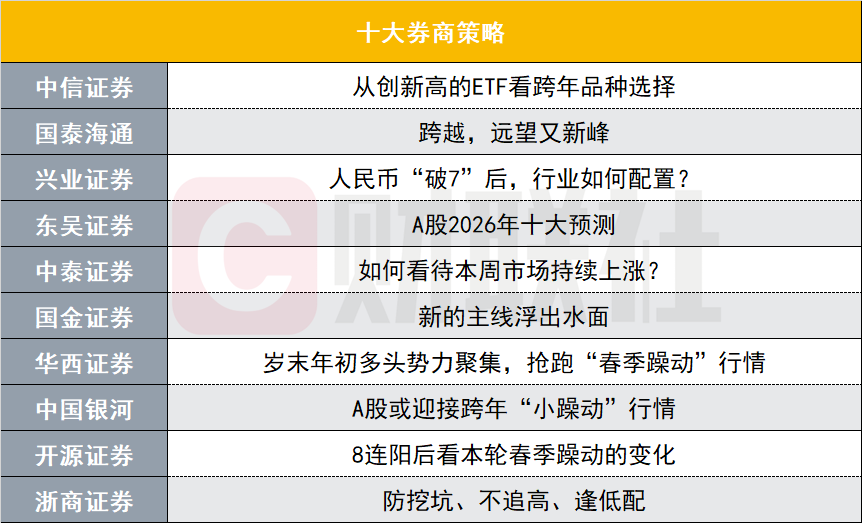
跨越2025 年终行情能否连涨收官?请看本周十大券商策略
智通财经网· 2025-12-28 23:37
Core Viewpoint - The Chinese stock market is experiencing a positive trend as it approaches the end of 2025, with significant movements in various sectors and a focus on potential investment opportunities for 2026 [1][30]. Group 1: Market Trends and Predictions - The Shanghai Composite Index has achieved an "eight consecutive days of gains" [1]. - The total scale of Chinese ETFs has surpassed 6 trillion, setting a new historical high [1]. - Major brokerages have provided insights on market trends, with predictions for 2026 focusing on sectors that may dominate [2][5][13]. Group 2: Sector Analysis - Citic Securities highlights that 39 out of 360 industry/theme ETFs reached new highs in December, with a focus on telecommunications, non-ferrous metals, and commercial aerospace as key sectors [3]. - Industry sectors such as chemicals, engineering machinery, and new energy are expected to see increased attention and potential growth due to their long-term return on equity (ROE) improvement [4]. - Guotai Junan emphasizes the importance of capital markets in driving social confidence and investment, marking a shift from traditional investment methods to more capital-intensive approaches [5]. Group 3: Currency and Economic Factors - The recent appreciation of the Renminbi is attributed to a weaker US dollar and seasonal capital inflows, which may support the Chinese stock market [9][30]. - The potential for a significant influx of capital back into China is anticipated, driven by the reversal of previous trends in currency valuation and investment sentiment [9][10]. - The structural transformation of the Chinese economy is expected to reduce uncertainty and enhance investment opportunities, particularly in technology and manufacturing sectors [7][24]. Group 4: Investment Strategies - Investment strategies are shifting towards sectors that benefit from the current economic environment, including AI hardware, renewable energy, and consumer services [19][31]. - Brokers suggest focusing on thematic trading opportunities in sectors like robotics, commercial aerospace, and healthcare, which are expected to gain traction in the upcoming year [19][31]. - The market is advised to adopt a cautious approach, emphasizing low-cost entry points and avoiding high-risk positions as the market stabilizes [35][36].



国泰海通|策略:跨越,远望又新峰
国泰海通证券研究· 2025-12-28 14:49
Group 1 - The core viewpoint is that the Chinese stock market is expected to break through and stabilize at important levels, with a "transformation bull market" anticipated to reach new heights by 2026, driven by emerging technologies and cyclical finance [2] - The Shanghai Composite Index reached 4000 points on October 28, marking a 10-year high, confirming the strategic judgment made by Guotai Junan for 2025 [2] - The article emphasizes that after a prolonged period of volatility, the Chinese stock market is poised for a significant upward movement, with emerging technologies as the main focus and cyclical finance as a potential dark horse [2][3] Group 2 - Since September 2024, macroeconomic policy shifts have alleviated internal concerns, while since April 2025, China has managed trade frictions more effectively, reflecting an increase in national strength and governance capabilities [3] - The article notes that the traditional investment model is shifting, with a focus on knowledge, technology, and capital-intensive industries driving new growth, as opposed to the previous reliance on traditional, extensive investments [3][4] - The breaking of the "guaranteed return" phenomenon in China has led to a systemic decline in risk-free returns, with long-term interest rates expected to fall below 2% in the second half of 2024, indicating a significant change in the investment landscape [4] Group 3 - The transformation of China's industrial structure is crucial, as it reduces uncertainty in economic and social development, providing clear investment signals [5] - The article highlights that the characteristics of the "transformation bull market" are intertwined with economic structural transformation and capital market reforms, encouraging confidence and patience in the stock market [5]
国泰海通|金工:量化择时和拥挤度预警周报(20251226)市场有望重回上行趋势
国泰海通证券研究· 2025-12-28 14:49
Core Viewpoint - The A-share market is expected to enter a new upward trend based on technical signals from sentiment models indicating a bullish signal [1][2]. Market Outlook - The market is anticipated to return to an upward trend, with liquidity shock indicators for the CSI 300 index at 0.34, lower than the previous week (0.41), indicating current market liquidity is 0.34 standard deviations above the average level over the past year [2]. - The PUT-CALL ratio for the SSE 50 ETF options increased to 0.88 from 0.83, reflecting a rise in investor caution regarding the short-term performance of the SSE 50 ETF [2]. - The five-day average turnover rates for the SSE Composite Index and Wind All A Index are 1.06% and 1.66%, respectively, indicating increased trading activity, positioned at the 69.45% and 75.13% percentiles since 2005 [2]. - The RMB exchange rate fluctuated last week, with onshore and offshore rates increasing by 0.46% and 0.42%, respectively [2]. - Historical data shows that the SSE Composite Index, CSI 300, CSI 500, and ChiNext Index have respective probabilities of rising in the second half of December at 50%, 55%, 45%, and 40%, with average gains of 1.2%, 1.08%, -0.11%, and -0.84% [2]. Technical Analysis - The Wind All A Index broke above the reversal indicator on December 1 according to the SAR indicator [2]. - The market score based on moving average strength is 212, placing it at the 77.2% percentile for 2023 [2]. - A sentiment model score of 3 out of 5 indicates a positive trend signal and a positive weighted model signal [2]. - The A-share market experienced a rebound last week, influenced by U.S. President Trump's strong expectations for a Federal Reserve rate cut and the rapid growth of new momentum industries such as equipment manufacturing and high-tech manufacturing in China [2]. Market Review - Last week, the SSE 50 Index rose by 1.37%, the CSI 300 Index increased by 1.95%, the CSI 500 Index grew by 4.03%, and the ChiNext Index climbed by 3.9% [3]. - The current overall market PE (TTM) stands at 22.3 times, which is at the 76.6% percentile since 2005 [3]. Factor Crowding Observation - The crowding degree for small-cap factors has decreased to 0.15, while the crowding degree for low valuation factors is at -0.61 [4]. - The crowding degree for high profitability factors is 0.14, and for high profitability growth factors, it is 0.46 [4]. - Industry crowding degrees are relatively high in telecommunications, non-ferrous metals, comprehensive, power equipment, and electronics, with defense and military industry and commercial retail showing significant increases [4].

国泰海通|机械:商业航天和机器人共构宏大叙事
国泰海通证券研究· 2025-12-28 14:49
Group 1 - The article emphasizes the importance of focusing on robot manufacturers and core component suppliers, including actuators and motors, reducers, screw types, screw equipment, bearings, sensors, and complete machines [1] - On December 26, the Shanghai Stock Exchange released guidelines for the IPO of commercial aerospace companies, supporting those in a critical phase of large-scale commercialization [1] - The Long March 8A rocket successfully completed its sixth launch, marking a high-density launch year with six successful missions in 2025 [1] Group 2 - The narrative of commercial aerospace and humanoid robots is highlighted, with Elon Musk announcing plans to launch a rocket to Mars by the end of 2026, carrying a Tesla Optimus humanoid robot for feasibility testing [2] - The acceleration of financing in the embodied intelligence sector is noted, indicating a growing interest and investment in this area [3]

2026为何重视券商投行拐点及科创板跟投?
Changjiang Securities· 2025-12-28 11:45
Investment Rating - The report maintains a "Positive" investment rating for the industry [13] Core Insights - The brokerage investment banking business has experienced a contraction from 2022 to 2024, but is expected to see a recovery starting in 2025, with significant improvements in both business volume and revenue [2][7] - The recovery is influenced by the resurgence of the Sci-Tech Innovation Board (STAR Market), which is anticipated to enhance the profitability of brokerage firms through underwriting and follow-on investments [2][10] - Leading brokerage firms such as Guotai Junan, CITIC Securities, and CICC are expected to leverage their resource and scale advantages to maintain competitive edges in the market [2][10] Summary by Sections Investment Banking Business Recovery - The brokerage investment banking sector is projected to recover in 2025 after three years of contraction, with a notable increase in business volume and revenue [7][21] - A-share IPO and refinancing volumes for 2025 are expected to reach CNY 1,253 billion and CNY 9,347 billion, respectively, representing year-on-year increases of 86.1% and 318.9% [21][28] Market Concentration - The concentration of A-share IPOs has significantly increased, with the top five firms (CR5) accounting for 71.5% of the total IPO volume in 2025, up 15.9 percentage points from 2024 [28] - The concentration in bond underwriting has also risen, with CR5 at 52.3% [28] Sci-Tech Innovation Board Follow-On Investment - The follow-on investment returns from the Sci-Tech Innovation Board have improved significantly, with total follow-on investment amounting to CNY 11.2 billion in 2025 and first-day returns reaching 261% [9][30] - Major firms like CITIC, Huatai, and Guotai Junan have reported substantial first-day follow-on investment returns, contributing significantly to their annual profit growth [9][30] 2026 Outlook - The report anticipates a robust project pipeline for the Sci-Tech Innovation Board in 2026, with a total planned issuance of CNY 675 billion from 40 companies [36] - Under optimistic scenarios, follow-on investment returns could drive profit growth for leading brokerage firms by up to 10% in 2026 [10][42]

剧变之年!券商首席经济学家“大换牌”,高善文、付鹏、何海峰纷纷隐退
券商中国· 2025-12-27 09:59
Core Viewpoint - The restructuring of chief economists in Chinese securities firms in 2025 reflects a significant talent shift driven by industry consolidation, re-evaluation of research value, and evolving competitive dynamics [1]. Group 1: Industry Consolidation - The primary driver of the recent changes in chief economists is the merger and restructuring within the industry, leading to a reshuffling of key research leadership positions [2]. - The merger of Guotai Junan and Haitong Securities has drawn attention to the personnel arrangements of their former chief economists, with notable departures and transitions impacting the new entity [3]. Group 2: Talent Acquisition by Smaller Firms - As major firms focus on consolidation, many smaller securities firms are actively recruiting top research talent to enhance their market influence and achieve competitive advantages [4]. - Notable movements include the return of Yan Xiang to Founder Securities and the recruitment of Sun Binbin and Song Xuetao from Tianfeng Securities to other firms, indicating a strategy to build strong research brands [4]. Group 3: Internal Promotions - Some firms are focusing on internal talent development, as seen with Yuan Chuang and Long Hongliang being promoted within their respective companies, reflecting a commitment to maintaining research continuity and culture [5]. Group 4: Departure of Iconic Figures - The departure of prominent figures like Gao Shanwen and Fu Peng from the securities industry highlights a trend of established economists exploring new career paths, prompting discussions on the value of traditional research models [6][7]. - Gao Rui Dong's transition from a chief economist role to managing a fund exemplifies the shift from sell-side research to buy-side management [7]. Group 5: Impact on Market Competitiveness - The role of chief economists is crucial for securities firms, serving as leaders in research and key figures in building research brands, which can significantly influence market competitiveness [9].
国泰海通研究所集中提拔:訾猛、刘欣琦拟任副所长,丁丹拟任产业研究院副院长
Xin Lang Cai Jing· 2025-12-27 05:31
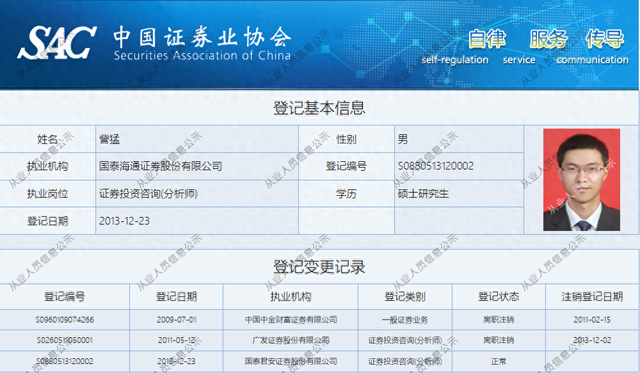
Core Viewpoint - Guotai Haitong Securities is promoting two deputy directors and one deputy dean in its research institute, indicating a strategic move to enhance its research capabilities and leadership [1]. Group 1: Promotions and Appointments - Zhi Meng and Liu Xinqi are being promoted to deputy directors of the research institute, while Ding Dan is set to become the deputy dean of the policy and industry research institute [1]. - Zhi Meng has a strong background in wholesale and retail trade, as well as food and beverage research, having led a team that was awarded the New Fortune Best Analyst for three consecutive years from 2016 to 2018 [1]. - Liu Xinqi focuses on non-bank financial research and has also led teams that received accolades as New Fortune Best Analysts in the non-bank financial sector [2][3]. Group 2: Background and Experience - Zhi Meng has been registered as a securities investment consultant since December 2009, with experience at various firms including China International Capital Corporation and Guotai Junan Securities [1][2]. - Liu Xinqi has been registered as a securities investment consultant since August 2014, with a career that includes positions at Ping An Securities and Founder Securities before joining Guotai Junan Securities [3][4]. - Ding Dan specializes in pharmaceutical research and has led teams recognized as New Fortune Best Analysts in the pharmaceutical and biotechnology sector for two consecutive years in 2011 and 2012 [4][5]. Group 3: Company Overview and Goals - Guotai Haitong Securities aims to become a leading securities research institution with international influence and local pricing power, continuously optimizing its research system [6][7]. - The research institute is structured into major research groups covering various fields, including macro, strategy, fixed income, industry, and company research, with over 40 sub-research areas [7]. - As of the third quarter of 2025, Guotai Haitong's total assets reached 2.01 trillion yuan, with operating income of 45.89 billion yuan, reflecting a year-on-year growth of 101.6%, and a net profit of 22.07 billion yuan, up 131.8% year-on-year [7].
喜报丨国泰海通获2025上证最佳分析师多项大奖
国泰海通证券研究· 2025-12-26 14:26
2025上证鹰·上证最佳分析师榜单正式出炉,国泰海通获10项大奖,详情如下: 扫码关注 星标不迷路 国泰海通证券研究所官方公众号 海量研报 | 热门活动 | 视听 内容 重要提醒 本订阅号所载内容仅面向国泰海通证券研究服务签约客户。因本资料暂时无法设置访问限制,根据《证 券期货投资者适当性管理办法》的要求,若您并非国泰海通证券研究服务签约客户,为保证服务质量、 控制投资风险,还请取消关注,请勿订阅、接收或使用本订阅号中的任何信息。我们对由此给您造成的 不便表示诚挚歉意,非常感谢您的理解与配合!如有任何疑问,敬请按照文末联系方式与我们联系。 法律声明 本公众订阅号(微信号: GTHT RESEARCH )为国泰海通证券股份有限公司(以下简称"国泰海通证券") 研究所依法设立、独立运营的唯一官方订阅号。其他机构或个人在微信平台上以国泰海通研究所名义注 册的,或含有"国泰海通研究",或含有与国泰海通证券研究所品牌名称相关信息的其他订阅号均不是国 泰海通证券研究所官方订阅号 本订阅号不是国泰海通证券研究报告发布平台 本订阅号所载内容均来 | 名 次 | 奖项 | 研究团队 | | --- | --- | --- | ...