CNOOC(600938)

Search documents
中国海油1月14日获融资买入1.93亿元,融资余额17.89亿元
Xin Lang Cai Jing· 2026-01-15 03:21
资料显示,中国海洋石油有限公司位于北京市东城区朝阳门北大街25号,香港花园道1号中银大厦65层, 成立日期1999年8月20日,上市日期2022年4月21日,公司主营业务涉及中国海洋石油有限公司是一家主 要从事原油和天然气的勘探、生产及销售的中国公司。该公司经营三个分部。勘探及生产分部从事常规 油气业务、页己油气业务、油砂业务和其他非常规油气业务。贸易业务分部从事原油转口贸易业务。公 司业务分部从事总部管理、资金管理以及研究开发等业务。该公司主要在中国、加拿大、美国、英国、 尼日利亚以及巴西等地开展业务。主营业务收入构成为:油气销售82.73%,贸易14.96%,其他(补 充)2.31%。 截至9月30日,中国海油股东户数21.65万,较上期减少7.02%;人均流通股13922股,较上期增加 7.62%。2025年1月-9月,中国海油实现营业收入3125.03亿元,同比减少4.15%;归母净利润1019.71亿 元,同比减少12.59%。 融资方面,中国海油当日融资买入1.93亿元。当前融资余额17.89亿元,占流通市值的2.02%,融资余额 超过近一年60%分位水平,处于较高位。 融券方面,中国海油1月14 ...

石油ETF鹏华(159697)盘中净申购1000万份,冲刺连续5天净流入
Sou Hu Cai Jing· 2026-01-15 02:29
Group 1 - The oil sector is experiencing a capital inflow despite market conditions, with the Penghua Oil ETF (159697) seeing a net subscription of 10 million units, marking five consecutive days of net inflow [1] - Political tensions in Venezuela and Iran are increasing, contributing to a rise in regional political risk premiums for oil prices, while OPEC+ has decided to temporarily halt its production growth plan for the first quarter of 2026 [1] - As of January 15, 2026, the National Securities Oil and Gas Index (399439) shows mixed performance among its constituent stocks, with Hengtong Co. leading at a 3.61% increase, while Jiufeng Energy is down 4.45% [1] Group 2 - As of December 31, 2025, the top ten weighted stocks in the National Securities Oil and Gas Index (399439) include major companies such as China National Petroleum, Sinopec, and CNOOC, collectively accounting for 67.11% of the index [2]




伊朗紧张局势或扰动部分能化品供应
HTSC· 2026-01-15 02:12
Investment Rating - The report maintains an "Overweight" rating for the oil and gas sector and the basic chemicals sector [5]. Core Insights - The ongoing tensions in Iran may disrupt the supply of energy and chemical products, leading to increased volatility in oil prices. As of January 13, WTI and Brent crude oil futures closed at $61.15 and $65.47 per barrel, reflecting increases of 6.5% and 7.6% respectively since the beginning of the month [1][2]. - Iran's domestic unrest could lead to a decline in its oil production and exports, which may create supply gap risks, particularly through the Strait of Hormuz, where Iran's oil shipping accounted for 34% of global maritime oil transport from January to May 2025 [2][3]. - The potential disruption in Iran's natural gas supply could lead to localized shortages in global urea and methanol markets, with significant price increases expected if unrest continues [3][4]. Summary by Sections Oil and Gas Sector - Iran's oil production increased from 1.93 million barrels per day in July 2020 to 3.22 million barrels per day by November 2025, with the country playing a crucial role in global oil supply through the Strait of Hormuz [2]. - The report anticipates that oil prices, which have returned to marginal cost levels, may gradually recover due to the ongoing conflict, despite the need to monitor the situation closely [2]. Chemical Sector - The unrest in Iran may impact its natural gas supply, which is critical for producing chemical feedstocks. Historical data shows that similar conflicts have led to significant price spikes in methanol and urea [3]. - In 2024, Iran's urea export volume is estimated at 4.5 million tons, accounting for 10% of global supply. The report highlights that if unrest persists, it could lead to increased methanol prices in China and a potential urea shortage during the spring planting season in the Northern Hemisphere [3]. Recommended Companies - The report recommends high-dividend energy companies and domestic producers with significant urea and methanol capacities, including China Petroleum (A/H), China National Offshore Oil Corporation (A/H), Huayi Group, and China National Chemical Corporation [1][4].

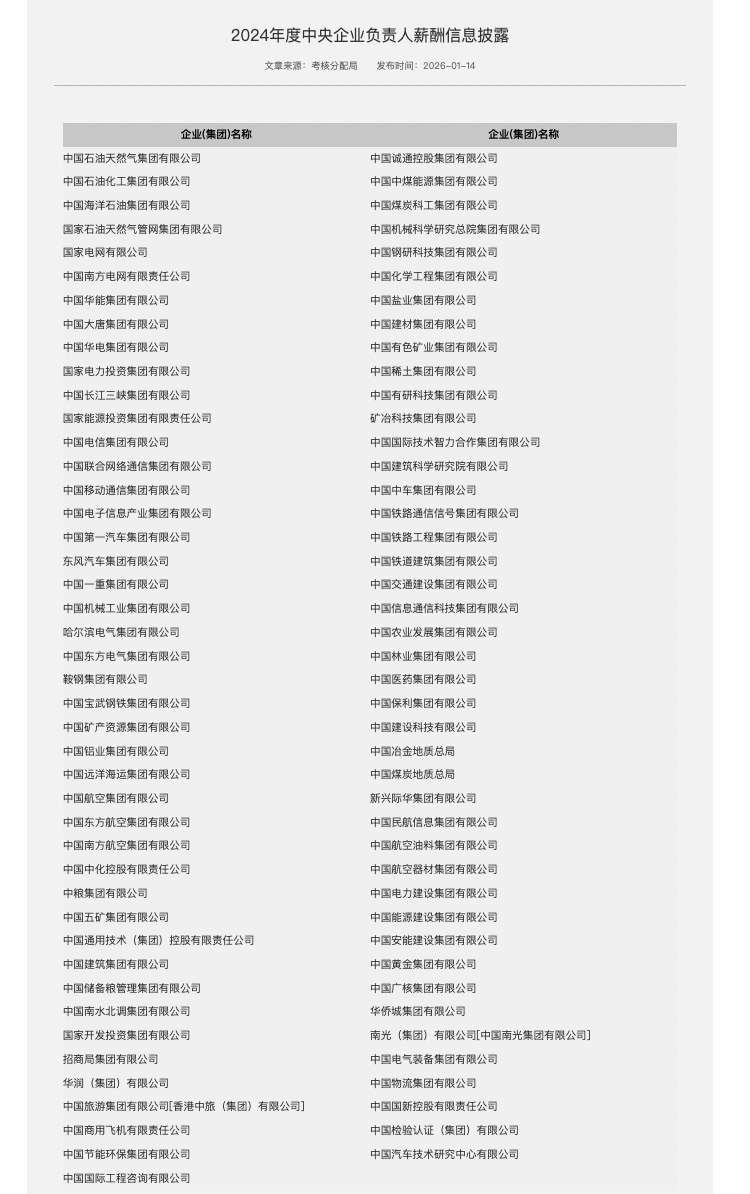
中石油、中石化、中国电信、中国联通等央企负责人年薪多少?国资委披露
Feng Huang Wang Cai Jing· 2026-01-15 00:54
Group 1 - The State-owned Assets Supervision and Administration Commission (SASAC) disclosed the salary information of over 80 central enterprise leaders for the year 2024, emphasizing the importance of transparency in key areas and responding to public concerns [1] - The disclosure includes a list of major central enterprises, such as China National Petroleum Corporation, China Petroleum and Chemical Corporation, and State Grid Corporation of China, among others [3][4] Group 2 - Notable salaries among central enterprise leaders include: - Dai Houliang, Chairman of China National Petroleum, with an annual salary of 978,500 yuan - Wang Dongjin, Chairman of China National Offshore Oil Corporation, with an annual salary of 966,900 yuan - Ma Yongsheng, Chairman of China Petroleum and Chemical Corporation, with an annual salary of 935,500 yuan - Ke Ruiwen, Chairman of China Telecom, with an annual salary of 953,500 yuan - Chen Zhongyue, Chairman of China Unicom, with an annual salary of 914,900 yuan [4]

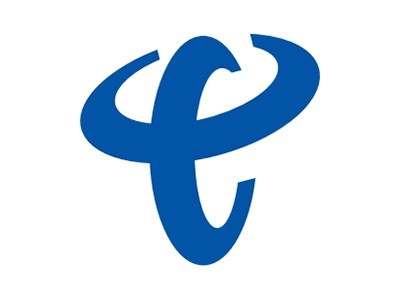

企图烧掉收受的部分现金
Xin Lang Cai Jing· 2026-01-14 18:39
Core Viewpoint - The article discusses the corruption case of Li Yong, former Deputy Secretary of the Party Committee and General Manager of China National Offshore Oil Corporation (CNOOC), highlighting his involvement in significant bribery and corruption activities, particularly in overseas projects [3][9]. Group 1: Corruption Details - Li Yong was involved in a long-term corruption scheme, utilizing his extensive knowledge of the international offshore oil sector to disguise bribery within seemingly legitimate project collaborations [3][4]. - A businessman named Ren Fengde acted as a "white glove" to collect bribes on behalf of Li Yong, facilitating the concealment of illicit funds overseas [4][5]. - Li Yong received millions of dollars in "thank you fees" from foreign agents, which were then funneled through complex offshore banking routes to obscure their origins [5][10]. Group 2: Investigation and Evidence - The investigation into Li Yong began after receiving tips about his suspicious activities, leading to a data-driven approach to uncover evidence of his corruption [4][10]. - The special investigation team analyzed extensive business records and engaged experts to understand the offshore oil business model, which helped identify irregularities in procurement projects linked to Li Yong [4][6]. - Evidence was gathered through international cooperation, leading to a comprehensive chain of evidence against Li Yong and his associates [5][10]. Group 3: Legal Consequences - In October 2023, Li Yong was placed under investigation and subsequently detained after attempting to destroy evidence of his corruption [9]. - He was sentenced to 14 years in prison for bribery and fined 3 million RMB, with all illicit funds recovered from overseas accounts [9][10].
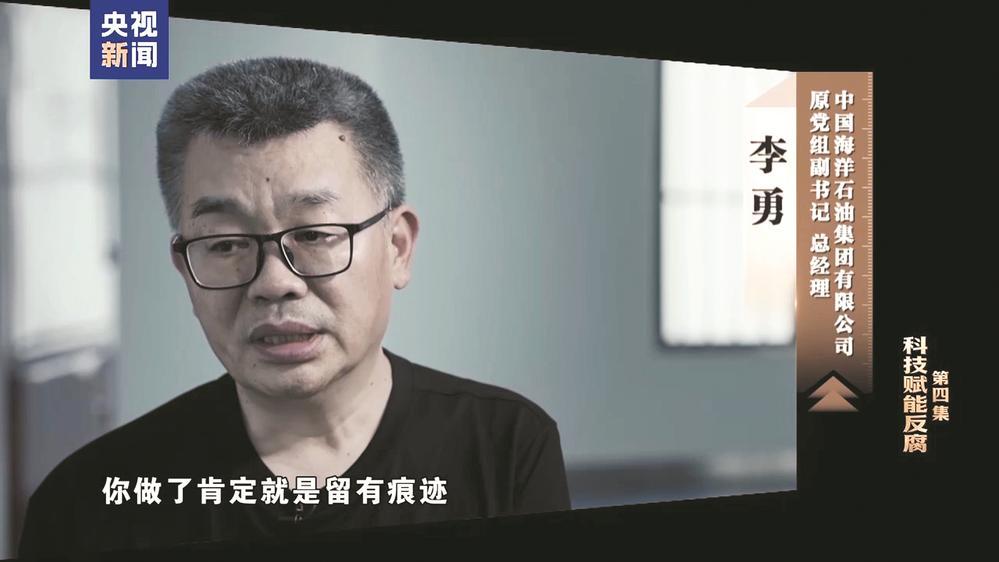
中纪委监委详解境外取证追赃思路:境外已不再是“避罪天堂”
Nan Fang Du Shi Bao· 2026-01-14 16:53
Core Viewpoint - The documentary highlights the increasing effectiveness of anti-corruption efforts in China, particularly in addressing cross-border corruption, showcasing a specific case involving Li Yong, a former executive of China National Offshore Oil Corporation (CNOOC) [1][10]. Group 1: Case Overview - Li Yong, former Deputy Secretary of the Party Committee and General Manager of CNOOC, is under investigation for severe corruption, with over 83% of the illicit funds originating from overseas [1][10]. - The case exemplifies the challenges of cross-border corruption, where corrupt officials believed they could evade scrutiny by transferring illicit gains abroad [1][4]. Group 2: Investigation Techniques - The investigation utilized big data and information technology to analyze Li Yong's extensive business dealings and relationships, leading to the identification of suspicious activities [4][9]. - A key figure in the investigation, businessman Ren Fengde, was found to have close ties with Li Yong, facilitating corrupt transactions through a network of offshore accounts [5][8]. Group 3: International Cooperation - The investigation involved collaboration with multiple countries to gather evidence, demonstrating the effectiveness of international legal cooperation in combating corruption [8][11]. - The successful retrieval of evidence and recovery of illicit funds from abroad underscores the importance of global partnerships in anti-corruption efforts [11]. Group 4: Outcomes and Implications - Li Yong was sentenced to 14 years in prison and fined 3 million RMB for his corrupt activities, highlighting the consequences of cross-border corruption [10]. - The case serves as a warning that no one is above the law, even in international contexts, reinforcing the message that overseas locations are not safe havens for corrupt officials [11].
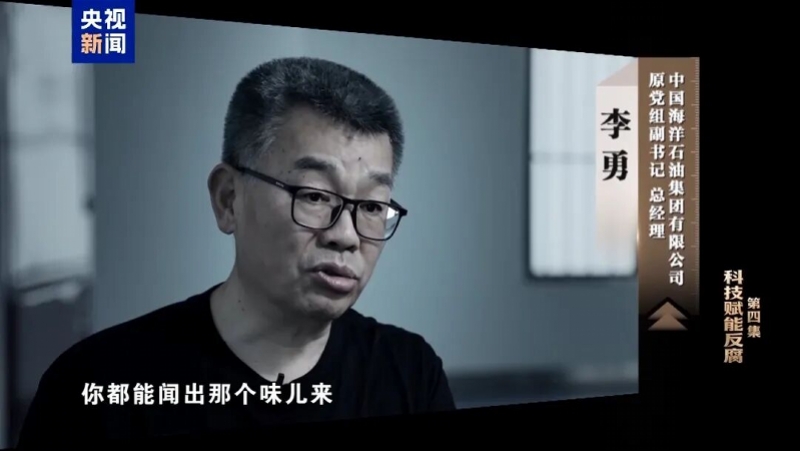
不法商人充当“白手套”,在境外代为收受、流转和存放赃款,中海油原总经理李勇:我就觉得在海外没有调查权,鞭长莫及
Xin Lang Cai Jing· 2026-01-14 16:32
Core Viewpoint - The case of Li Yong, former Deputy Secretary of the Party Committee and General Manager of China National Offshore Oil Corporation (CNOOC), exemplifies cross-border corruption in state-owned enterprises, with over 83% of the illicit funds originating from abroad [3][4]. Group 1: Case Background - Li Yong has worked in the oil sector for nearly 40 years, leveraging his deep understanding of international offshore oil business models to disguise corrupt practices within seemingly legitimate project collaborations [5]. - The investigation into Li Yong began after the Central Commission for Discipline Inspection received tips regarding his suspected serious corruption issues, leading to a comprehensive data-driven inquiry [7][20]. Group 2: Investigation Techniques - Advanced technological methods significantly enhanced the investigation's effectiveness, allowing for rapid identification of key bribery targets through data analysis [9]. - The investigative team utilized a big data platform to analyze Li Yong's business relationships and project documentation, uncovering suspicious activities linked to a businessman named Ren Fengde [10][20]. Group 3: Corruption Mechanisms - Li Yong and Ren Fengde, who had a long-standing personal and professional relationship, engaged in a scheme where Ren acted as a "middleman" to facilitate corrupt transactions while keeping Li Yong's involvement concealed [12][15]. - In a specific instance, Li Yong orchestrated a deal involving an offshore drilling platform, where he arranged for Ren Fengde to receive a commission disguised as a legitimate transaction, effectively masking the bribe [14][17]. Group 4: International Cooperation - The investigation benefited from international cooperation, with the team successfully obtaining critical evidence from multiple countries, thereby closing the evidence chain for the case [22].
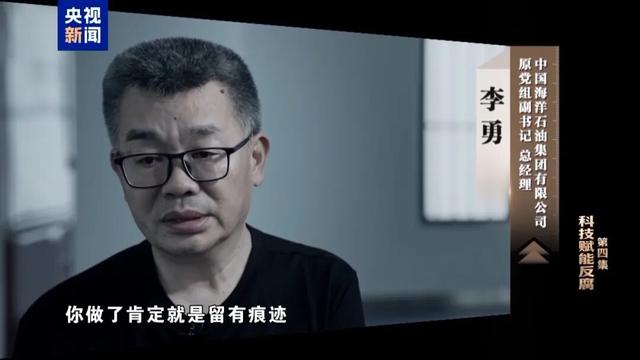
极度恐慌、情绪崩溃,李勇在阁楼烧现金企图脱罪
中国能源报· 2026-01-14 14:33
Core Viewpoint - The article discusses the case of Li Yong, former Deputy Secretary of the Party Committee and General Manager of China National Offshore Oil Corporation (CNOOC), highlighting the use of technology in anti-corruption efforts and the challenges of cross-border corruption investigations [1][6][8]. Group 1: Case Background - Li Yong was involved in significant overseas projects for CNOOC, with a prominent issue of cross-border corruption [6]. - Over 83% of the illicit funds in Li Yong's case originated from abroad, with investigations spanning 10 countries and regions [8]. - Li Yong believed that operating overseas would shield him from investigations, thinking that evidence would be hard to trace [12]. Group 2: Investigation Techniques - The disciplinary inspection and supervision authorities utilized big data and information technology to enhance the effectiveness of their investigations [1][17]. - A specialized task force analyzed extensive business records and employed data collision techniques to identify key suspects linked to Li Yong [15][17]. - The investigation revealed suspicious procurement projects linked to a businessman named Ren Fengde, who had close ties with Li Yong [18][22]. Group 3: Corruption Methods - Li Yong engaged in corrupt practices by disguising bribery within seemingly legitimate project collaborations, believing he could evade detection [10][26]. - He facilitated the receipt of bribes through intermediaries, such as Ren Fengde, who acted as a "white glove" to obscure the transactions [26][31]. - Li Yong's methods included creating offshore accounts to hide illicit funds, complicating the money trail across multiple jurisdictions [37][39]. Group 4: Consequences and Legal Actions - Following the investigation, Li Yong was placed under scrutiny and ultimately detained, leading to a conviction for bribery with a sentence of 14 years in prison and a fine of 3 million yuan [59][61]. - The case exemplifies the effectiveness of international cooperation in anti-corruption efforts, with successful evidence collection from foreign jurisdictions [39].
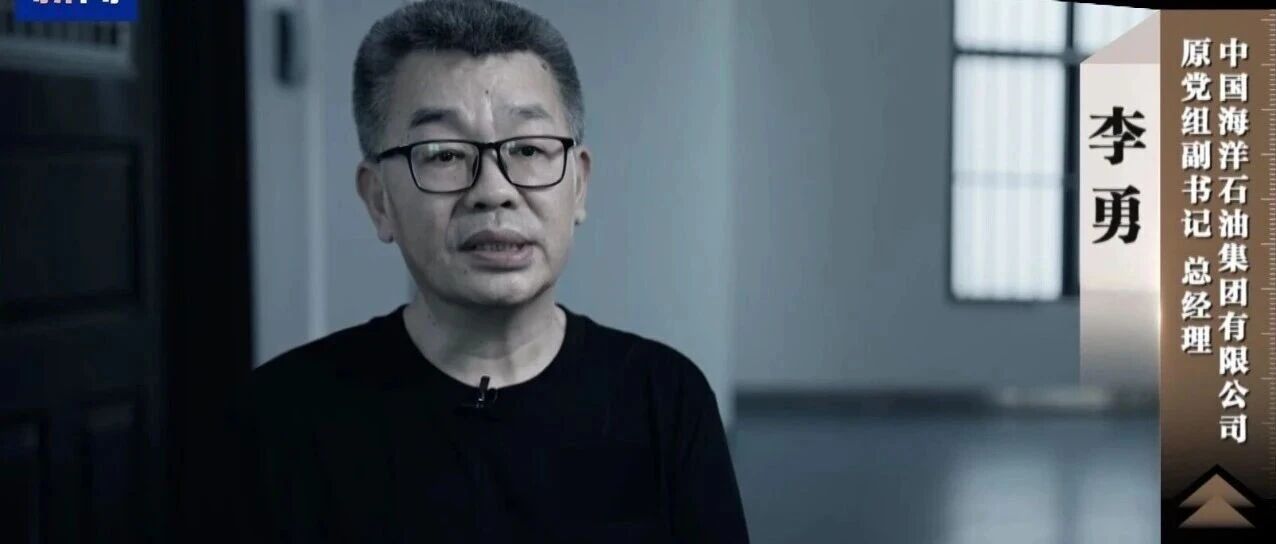
极度恐慌、情绪崩溃,落马官员李勇曾在阁楼烧现金企图脱罪
Xin Hua Wang· 2026-01-14 14:28
Core Viewpoint - The documentary highlights the increasing efforts of China's disciplinary inspection and supervision agencies in combating cross-border corruption, utilizing big data and information technology to uncover and investigate numerous cases, including that of Li Yong, a former executive at China National Offshore Oil Corporation (CNOOC) [1][12]. Group 1: Corruption Case of Li Yong - Li Yong, who worked in the oil sector for nearly 40 years, is suspected of serious corruption, with significant amounts of bribe money hidden overseas [3][5]. - The investigation into Li Yong was initiated after receiving tips about his activities, leading to a comprehensive analysis of his business dealings and the identification of suspicious transactions involving a businessman named Ren Fengde [3][7]. - Li Yong and Ren Fengde, who have a long-standing personal and professional relationship, engaged in a scheme where Ren acted as a "white glove" to facilitate bribe payments while obscuring Li's involvement [5][8]. Group 2: Investigation and Legal Consequences - The investigation revealed that Li Yong received millions of dollars in bribes, which were then funneled through complex offshore banking routes to evade detection [7][12]. - Li Yong was ultimately sentenced to 14 years in prison for bribery, with a fine of 3 million yuan, and all overseas illicit funds were successfully recovered [10][12]. - The case underscores the importance of international cooperation in anti-corruption efforts and the use of technology to track and recover illicit assets, marking a significant step in addressing cross-border corruption [12].
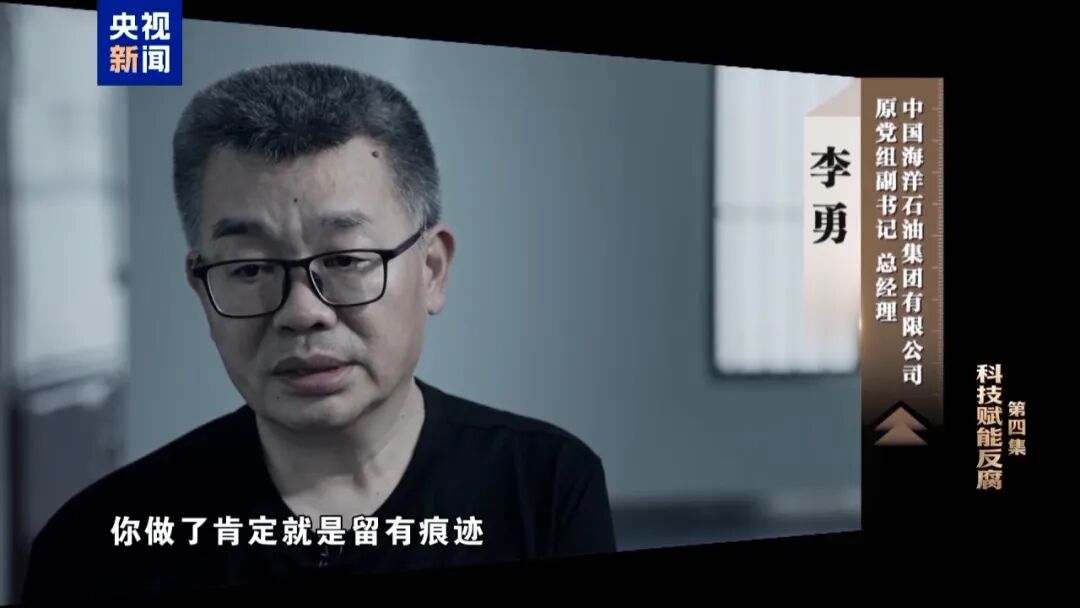
恐惧被查想在阁楼烧掉现金,中海油原总经理李勇贪腐细节披露
Zhong Guo Xin Wen Wang· 2026-01-14 13:55
Core Viewpoint - The case of Li Yong, former General Manager of China National Offshore Oil Corporation (CNOOC), highlights significant issues of cross-border corruption within state-owned enterprises, with over 83% of illicit funds originating from overseas [2][4]. Group 1: Corruption Details - Li Yong was involved in a long-term corruption scheme, managing numerous overseas projects and believing that funds hidden abroad would be difficult to trace [2][4]. - The investigation revealed that a significant portion of the illicit funds was funneled through complex international banking routes, involving multiple countries and offshore accounts [8]. - Li Yong's relationship with businessman Ren Fengde facilitated corrupt practices, including the use of a "middleman" to disguise bribes as legitimate business transactions [6][8]. Group 2: Methods of Corruption - Li Yong exploited high intermediary commissions in overseas projects, colluding with unscrupulous agents to ensure excessive fees, which he then shared [9][11]. - A specific incident involved Li Yong negotiating inflated transaction costs for a drilling platform, where he received millions in bribes disguised as "thank you" payments [6][9]. Group 3: Consequences and Legal Actions - Following a tip-off about Ren Fengde's detention, Li Yong attempted to destroy evidence of his corruption by burning cash, but ultimately realized the futility of this action [12]. - Li Yong was later detained and sentenced to 14 years in prison for accepting bribes, along with a fine of 3 million RMB [12].