NCI(601336)

Search documents
“开门红”效应初显,太保、新华最新保费公告实现稳健增长
Xin Lang Cai Jing· 2026-01-20 13:39
Core Insights - The insurance premium income in China continues to grow at a high rate, with China Pacific Insurance (CPIC) reporting a total original insurance premium income of RMB 461.68 billion for 2025, reflecting a steady growth trend [1][8] - CPIC's life insurance segment achieved a premium income of RMB 258.11 billion, a year-on-year increase of 8.1%, while the property insurance segment reported RMB 203.56 billion, with a modest growth of 0.2% [1][10] - New China Life Insurance also reported a premium income of RMB 195.90 billion for 2025, marking a 15% increase compared to the previous year, indicating a similar steady growth trend [1][10] - China Taiping announced a significant expected net profit growth of 215-225% for 2025, driven by improved net investment performance and a one-time impact from new tax policies [1][9] Life Insurance Performance - CPIC's life insurance premium income surpassed RMB 258 billion, growing 8.1% year-on-year, significantly outpacing the growth of property insurance and highlighting CPIC's competitive advantage in the life insurance sector [10] - The positive growth in CPIC's property insurance, despite market challenges, is noteworthy, as it maintained a stable scale amid intensified competition and regulatory changes in the auto insurance sector [10][12] Channel Structure - The distribution channels for CPIC's insurance premiums show a diverse performance, with the bancassurance channel achieving a remarkable growth of 42% year-on-year, generating RMB 56.53 billion [11][12] - New business in the bancassurance channel grew by 30.6%, while renewal business surged by 66.2%, indicating a significant improvement in customer retention [12] - The insurance agent channel reported a slight decline of 0.7% in premium income, totaling RMB 182.75 billion, while other distribution channels showed strong growth, particularly the group and government channels, which grew by 9% and 154.7% respectively [12] Business Structure Optimization - In the property insurance segment, CPIC reported a premium income of RMB 203.56 billion, with a minimal growth of 0.2%, demonstrating resilience in a challenging market environment [12] - The motor vehicle insurance segment generated RMB 110.51 billion, growing 3% and accounting for 54.3% of total property insurance premiums, serving as a stabilizing force [12] - Non-motor vehicle insurance faced challenges, with a premium income of RMB 93.05 billion, reflecting a 3% decline due to intense market competition [12][4] Scale Effect - The Chinese insurance market exhibits significant potential for growth while also demonstrating considerable scale effects, where larger insurance institutions can offer more comprehensive services and competitive pricing, thereby capturing greater market share [5][13]



保险板块1月20日涨0.86%,中国人寿领涨,主力资金净流入7.64亿元
Zheng Xing Xing Ye Ri Bao· 2026-01-20 08:56
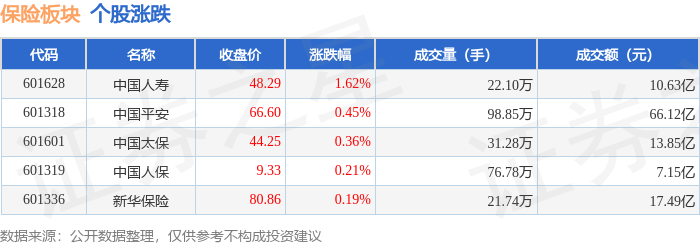
Group 1 - The insurance sector increased by 0.86% on January 20, with China Life leading the gains [1] - The Shanghai Composite Index closed at 4113.65, down 0.01%, while the Shenzhen Component Index closed at 14155.63, down 0.97% [1] - Key stock performances in the insurance sector included China Life at 48.29 with a rise of 1.62%, Ping An at 66.60 with a rise of 0.45%, and China Pacific Insurance at 44.25 with a rise of 0.36% [1] Group 2 - The net inflow of main funds in the insurance sector was 764 million yuan, while retail funds experienced a net outflow of 354 million yuan [1] - Major fund flows for key companies included Ping An with a net inflow of 332 million yuan, New China Life with 180 million yuan, and China Pacific Insurance with 124 million yuan [2] - Retail fund flows showed significant outflows for China Life and New China Life, with outflows of 132 million yuan and 1.22 billion yuan respectively [2]




净资产比率排行丨增速大幅减缓!46%险企下降,数量翻倍,形势严峻
Xin Lang Cai Jing· 2026-01-20 08:47
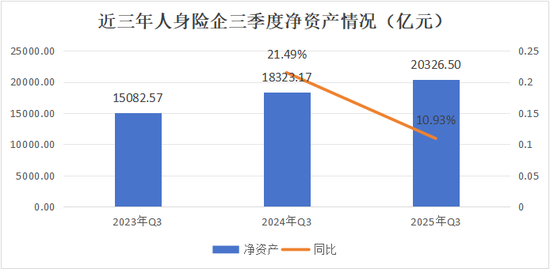
Core Insights - The net asset scale of the life insurance industry reached 2.03 trillion yuan in Q3 2025, an increase of approximately 200 billion yuan compared to the same period in 2024, reflecting a year-on-year growth of 10.93%, but the growth rate has significantly slowed down [1][36] - The increase in net assets is primarily driven by the stable growth of large and medium-sized insurance companies and the capital raising activities of smaller firms [2][36] - Among the 72 life insurance companies that reported their Q3 2025 net assets, 54% achieved positive growth, while 46% experienced a year-on-year decline, indicating a challenging industry environment [4][38] Net Asset Growth - The top 10 companies in terms of net asset growth are dominated by large and medium-sized insurers, with the top seven including China Life, Ping An, New China, Taiping, AIA, PICC Health, and China Post Life, collectively increasing their net assets by 206.17 billion yuan [1][36] - The number of companies experiencing a decline in net assets has doubled compared to the previous year, with 33 companies reporting a decrease in Q3 2025, up from 14 in Q3 2024 [4][40] - The proportion of companies with a net asset ratio exceeding 10% is only 28%, while 72% of companies fall below this threshold, indicating a significant disparity in financial health across the industry [23][36] Capital Raising Activities - A total of 12 life insurance companies have been approved for capital increases from October 1, 2024, to September 30, 2025, with several smaller firms showing significant growth due to capital injections [8][36] - The issuance of bonds for capital supplementation has also been a key strategy for many smaller insurers, with 16 companies issuing bonds during the same period [9][36] Net Asset Ratio Trends - The number of companies with an increasing net asset ratio has dropped sharply from 38 in Q3 2024 to only 20 in Q3 2025, while 72% of companies have seen their ratios decline [24][36] - The net asset ratio of the top 10 companies is predominantly above 20%, but five of these companies have experienced a decline in their ratios compared to the previous year [27][36] Performance of Major Insurers - The "big four" insurers (China Life, Ping An, Taiping, and Taikang) collectively hold 1.33 trillion yuan in net assets, accounting for 65.37% of the industry's total net assets [7][41] - Notable changes in rankings have occurred, with China Post Life entering the top 10 due to significant capital increases [40][41] Challenges and Future Outlook - The industry faces significant challenges, with many companies struggling to maintain positive growth amid changing accounting standards and market conditions [20][41] - The future landscape of the industry will likely be shaped by the resilience and internal capital generation capabilities of insurers as the effects of recent capital-raising activities and accounting changes stabilize [33][41]
菏泽监管分局同意新华保险 山东分公司成武营销服务部变更营业场所
Jin Tou Wang· 2026-01-20 05:49
二、新华人寿保险股份有限公司应按照有关规定及时办理变更及许可证换领事宜。 一、同意新华人寿保险股份有限公司山东分公司成武营销服务部变更营业场所为:山东省菏泽市成武县 永顺路与会文路交叉路口东北角启明商务中心1栋6-2(6层西南侧)。 2026年1月13日,国家金融监督管理总局菏泽监管分局发布批复称,《新华人寿保险股份有限公司菏泽 中心支公司关于新华人寿保险股份有限公司山东分公司成武营销服务部变更营业场所的请示》(新保菏 支发〔2025〕177号)收悉。经审核,现批复如下: ...
盘中,涨停!A股,突然异动!
Zhong Guo Ji Jin Bao· 2026-01-20 04:23
Market Overview - A-shares opened high but closed lower, with the Shanghai Composite Index down 0.3% at 4101.62 points, Shenzhen Component down 1.22%, and ChiNext Index down 1.83% [1] - The total trading volume in the Shanghai and Shenzhen markets reached 1.85 trillion yuan, an increase of 568 billion yuan compared to the previous trading day [2] Sector Performance - The communication equipment, aerospace military, electronic components, basic metals, and energy equipment sectors experienced significant declines [2] - The banking and insurance sectors saw a notable rise, with food and beverage, real estate, and semiconductor sectors also performing well [2] Banking and Insurance Sector - The banking and insurance sector showed resilience, with major insurance stocks like China Life and Ping An rising over 1% [3] - Key banking stocks such as CITIC Bank increased by over 2%, while other banks like China Construction Bank and Bank of China rose by over 1% [5] - A report from China Galaxy Securities indicated that structural monetary policy tools and a marginal improvement in RMB credit could support bank lending [5] Food and Beverage Sector - The food and beverage sector was active, with food processing stocks leading the gains, including Hongmian Co., Jingji Zhino, and Weizhi Xiang, all hitting the daily limit [6] - Notable performers included Hongmian Co. with a 10.13% increase and Jingji Zhino with a 10.01% increase [7] Real Estate Sector - The real estate sector showed a rebound, with stocks like Dayue City and Chengtou Holdings hitting the daily limit, and others like China Merchants Shekou and Binjiang Group rising over 5% [8] - Recent data from the National Bureau of Statistics indicated a slight decrease in new residential sales prices in first-tier cities, which may influence market sentiment [10] Aerospace and Military Sector - The aerospace and military sector faced significant declines, with stocks like Tongyu Communication and Aerospace Power hitting the daily limit down, and Aerospace Hongtu dropping 13% [11] - Other companies in the sector, such as China Satellite and China Aerospace, also saw declines exceeding 6% [12]







平顶山金融监管分局同意新华保险汝州支公司变更营业场所
Jin Tou Wang· 2026-01-20 03:39
二、新华人寿保险股份有限公司应按照有关规定及时办理变更及许可证换领事宜。 一、同意新华人寿保险股份有限公司汝州支公司将营业场所变更为:河南省平顶山市汝州市煤山街道六 团绿城水郡小区3号楼104、105商铺二层,105商铺一层。 2026年1月15日,平顶山金融监管分局发布批复称,《关于新华人寿保险股份有限公司汝州支公司变更 营业场所的请示》(新保平支字〔2025〕65号)收悉。经审核,现批复如下: ...
中国保险:2026 展望:寿险迎来历史性机遇;产险受益于持续监管红利-China Insurance-2026E Outlook Life Embarking on a Historic Opportunity; P&C Riding on Continued Regulatory Tailwinds
2026-01-20 03:19
Summary of Conference Call Notes Industry Overview - **Industry**: Life and Property & Casualty (P&C) Insurance in China - **Key Trends**: The life insurance sector is expected to experience significant growth opportunities due to a large volume of bank deposits maturing, estimated at over Rmb70 trillion, and a low-interest rate environment for reinvestment [22][2]. The P&C sector is projected to see a steady premium growth of 4% in 2026E, driven by auto insurance and personal P&C lines [3]. Core Insights Life Insurance Sector - **Growth Potential**: The life insurance industry is entering a "golden era" as retail investors seek higher returns from insurance products due to maturing bank deposits [2]. - **Margin Stability**: Margins are expected to remain stable, with pricing rate adjustments in September 2025 potentially offsetting margin erosion from a shift towards participating products [2][1]. - **Preferred Companies**: Industry leaders such as China Life and Ping An are favored due to anticipated K-shaped growth divergence between larger and smaller insurers amid regulatory tightening [2][1]. Property & Casualty (P&C) Insurance Sector - **Premium Growth**: The P&C industry is expected to achieve a 4% growth in premiums in 2026E, supported by regulatory tailwinds and expense rationalization [3]. - **Cost of Risk (CoR) Enhancement**: There is significant room for CoR improvement, driven by regulatory measures including expense management and adjustments in NEV insurance pricing [3]. - **Top Performers**: PICC P&C is expected to benefit the most from these trends, potentially delivering best-in-class results [3][1]. Financial Projections - **China Life Insurance**: Target price raised to HK$38 from HK$27.70, with EPS estimates for FY25E/FY26E/FY27E increased by 105%/48%/46% respectively, reflecting improved investment performance [7]. - **China Pacific Insurance**: Target price increased to HK$44.40 from HK$40.50, with FY25E/FY26E EPS estimates raised by 27%/14% [9]. - **Ping An Insurance**: Target price lifted to HK$79 from HK$68, with slight adjustments to EPS estimates [20]. Regulatory Environment - **Regulatory Changes**: New regulations are being implemented to strengthen supervision over insurers' asset liability management and expense management, focusing on quality-oriented metrics rather than volume [27][28]. - **Impact on Life Insurance**: Regulations will require life insurers to maintain specific liquidity and coverage ratios, which could affect their operational strategies [27]. - **P&C Insurance Regulations**: The P&C sector is seeing a shift towards more stringent expense management and compliance with quality metrics [27]. Additional Insights - **Market Dynamics**: The life insurance market is witnessing a shift towards bancassurance channels as consumers reallocate their wealth [44]. - **Product Mix Changes**: Insurers are increasingly shifting their product mix towards participating products, which may lower the cost of in-force books [41]. - **Investment Opportunities**: The anticipated interest rate hikes in China are expected to enhance investment returns for insurers, further supporting their growth [11][12]. This summary encapsulates the key points from the conference call, highlighting the growth potential and regulatory landscape of the life and P&C insurance sectors in China.
2025年度保险理赔报告密集出炉:“直付”服务打通壁垒,重疾出险年轻化、仍存较大保障缺口
Xin Lang Cai Jing· 2026-01-20 00:13
Core Insights - The insurance industry is witnessing a significant shift in claims and service models, with a focus on digitalization and direct payment services, enhancing the efficiency of claims processing [1][8] - Total claims paid by life insurance companies reached 1.18 trillion yuan, while property insurance companies paid 1.03 trillion yuan in 2025, both showing an increase compared to the previous year [1] - Medical insurance remains the dominant category in terms of claim numbers, while critical illness insurance accounts for a significant portion of claim amounts, highlighting a growing awareness of health risks among residents [5][6] Group 1: Claims Data Overview - Major insurance companies reported substantial increases in claims for 2025, with China Life processing over 62.24 million claims, a 7% increase year-on-year, and total claims amounting to over 100.4 billion yuan, a 10% increase [2] - China Pacific Life reported 4.24 million claims with a total payout of 20.1 billion yuan, while Ping An Life processed 4.96 million claims totaling 41.51 billion yuan [3] - China Property & Casualty Insurance processed over 200 million claims, with a total payout exceeding 380 billion yuan, marking a growth of over 10% [2] Group 2: Critical Illness and Medical Insurance Trends - Medical insurance claims accounted for over 90% of total claims in many companies, while critical illness insurance represented over 50% of the total payout amounts [5][6] - The trend of younger individuals being diagnosed with critical illnesses is rising, with significant claims from the 40-60 age group, and the 18-40 age group showing a high incidence rate [6][7] - Despite the increase in awareness and claims, the average payout for critical illness insurance remains insufficient to cover the high costs of treatment, with many claims below 100,000 yuan [7] Group 3: Digitalization and Service Improvements - The introduction of direct payment services has streamlined the claims process, allowing patients to avoid upfront costs, with China Life reporting 8.17 million direct payment claims totaling over 4.3 billion yuan [8][9] - The digital transformation in the insurance sector has led to over 90% of claims being processed online for several companies, significantly improving efficiency [8][9] - Companies are leveraging technology, including IoT and automated claims processing, to enhance service delivery and customer experience [9]
多家险企发布2025年度理赔报告 信息技术助力服务效率提升
Zhong Guo Zheng Quan Bao· 2026-01-19 23:17
Core Insights - The insurance industry has shown a stable claims scale for 2025, with major insurers enhancing their protection capabilities and many small to medium-sized insurers experiencing significant business growth [2][3] Claims Scale Stability - The total number of claims for China Life exceeded 62.24 million, a year-on-year increase of 7%, with total claims amounting to over 100.4 billion yuan, up 10% [2] - Ping An Life reported 4.958 million claims with a total payout of 41.51 billion yuan, while Xinhua Insurance had 5.01 million claims totaling 14.7 billion yuan [2] - Smaller insurers like Zhongyou Insurance saw customer service numbers exceed 2.49 million, a growth of over 370%, with claims amounting to 3.2 billion yuan, up over 90% [2] - The claims acceptance rates for several insurers remained high, with China Life, CITIC Prudential, and Ping An Life at 99.8%, 99.7%, and 99.2% respectively [2] High Payouts in Critical Illness Insurance - Critical illness claims accounted for a significant portion of total payouts, with Ping An Life reporting 261,000 claims totaling over 20.86 billion yuan, representing over 50% of total claims [3] - The average payout for critical illness and death claims was notably high, with Zhonghong Insurance reporting average payouts of 181,500 yuan and 184,500 yuan respectively [3] - There exists a substantial coverage gap between critical illness payouts and treatment costs, with Zhongyou Insurance indicating an average payout of 100,000 yuan against an average treatment cost of 400,000 yuan for malignant tumors [3] Growth Potential in Critical Illness Insurance - Analysts predict that the aging population and increasing demand for better medical resources will expand the potential customer base for critical illness insurance, leading to a sales growth period [4] - Medical claims accounted for the highest proportion of total claims for China Life at 60.6%, and over 65% for Cigna Life [4] Technological Empowerment in Claims Services - The integration of information technology has significantly accelerated claims processing times, with Xinhua Insurance reporting an average processing time of 0.5 days for small medical claims under 5,000 yuan [5] - Ping An Life's "111 Fast Claims" service has improved efficiency, with 93% of automated claims being processed within 60 seconds [5] - China Life has implemented a "one-day claim" service for critical illness claims, allowing for same-day processing for eligible cases [6] - The focus on IT in the insurance sector has shifted towards intelligent underwriting and claims systems, with major insurers adopting digital solutions to replace manual processes [6]
狂揽港股!险资一年41次举牌背后的资本盛宴
Xin Lang Cai Jing· 2026-01-19 12:23
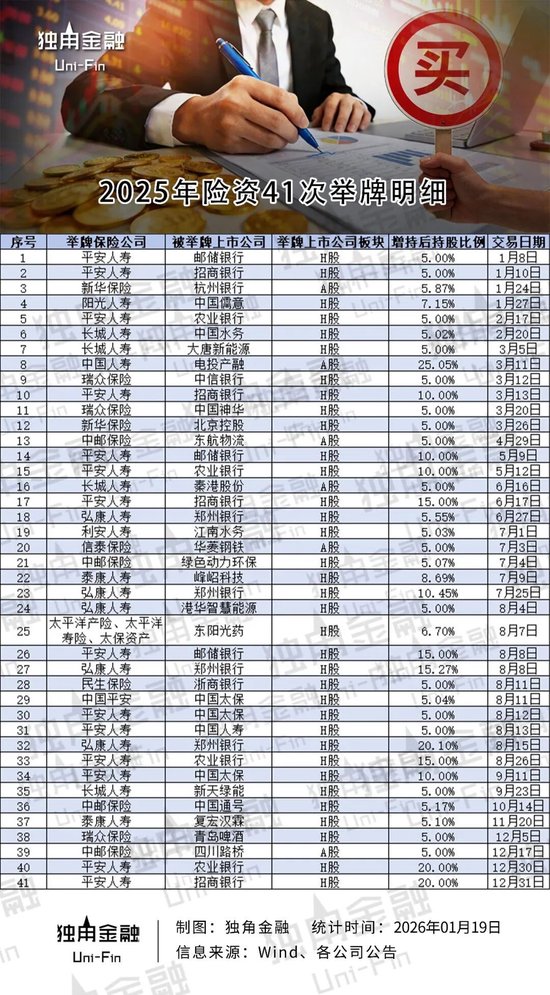
Core Viewpoint - Insurance capital is transitioning from a "barbarian at the gate" to a "strategist in the boardroom," with a focus on long-term investments rather than short-term financial gains, as evidenced by a record 41 public shareholding increases in 2025, the highest in nearly a decade [1][16][19] Group 1: Investment Trends - In 2025, insurance capital engaged in 41 public shareholding increases, more than double the average of recent years, indicating a significant shift in investment strategy [2][16] - The majority of these shareholding increases (over 85%) occurred in H-shares, driven by their substantial valuation discounts and smoother acquisition mechanisms [1][19] - Insurance companies are increasingly focusing on financial stocks, particularly banks, as they seek certainty, safety, and valuation flexibility in a complex market environment [1][9] Group 2: Regulatory Environment - Recent regulatory changes have opened up opportunities for insurance capital in equity investments, shifting from restrictions to encouragement of long-term investments [4][18] - The optimization of solvency regulatory standards has expanded the space for equity investments, allowing insurance companies to better match their long-term liabilities with asset returns [4][18] Group 3: Financial Performance - Insurance companies have reported significant increases in investment income, with 11 companies showing positive growth in 2025, including a remarkable 687.16% increase for New China Life [11][26] - The overall investment yield for major insurers has risen, with Ping An Life and China Life reporting increases exceeding 400% in investment income [12][26] Group 4: Strategic Focus - Insurance capital is not only focusing on traditional financial sectors but is also investing in high-tech fields such as renewable energy, advanced manufacturing, and biotechnology, reflecting a strategic alignment with national economic transformation [9][23] - The long-term nature of insurance capital aligns well with companies that have solid fundamentals and stable cash flows, allowing insurers to share in corporate growth and dividends [3][17]