NCI(601336)

Search documents
专属商业养老保险利率超存款 八成收益超3%
2 1 Shi Ji Jing Ji Bao Dao· 2026-01-19 10:34
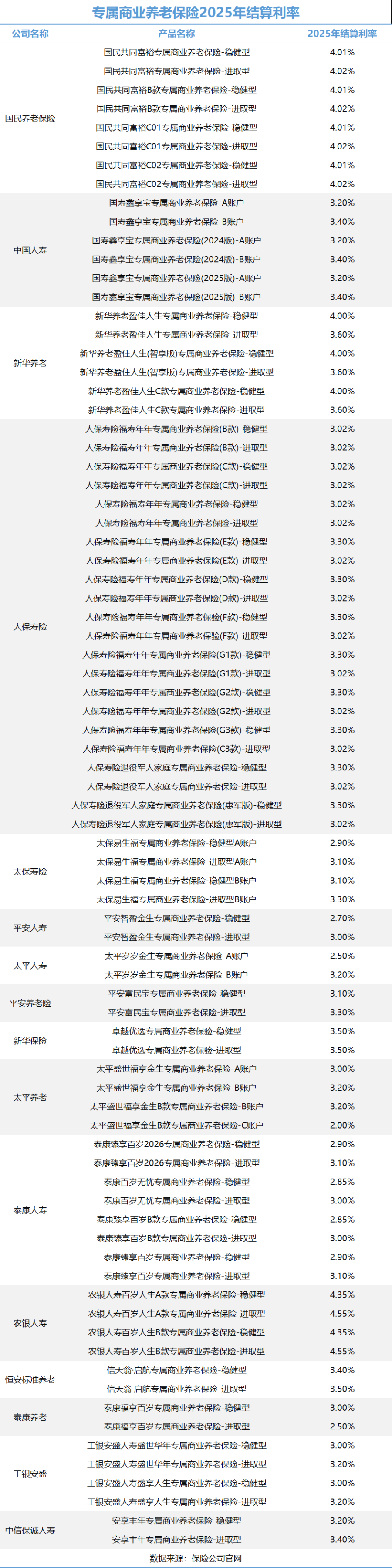
Core Viewpoint - The recent disclosure of 2025 settlement rates for exclusive commercial pension insurance products by multiple insurance institutions highlights a promising investment opportunity amidst declining bank deposit rates and fluctuating wealth management product values. The majority of these products offer competitive returns, with over 80% of them exceeding a 3.00% settlement rate for 2025 [1][2][8]. Summary by Category Insurance Product Performance - A total of 40 exclusive commercial pension insurance products have been reported, with settlement rates for stable accounts ranging from 2.00% to 4.35%, and for aggressive accounts from 2.50% to 4.55% [1][2]. - Among these products, 70 accounts (87.5%) have a settlement rate exceeding 3.00% [1][2]. - Notably, the products from Nongyin Life and Guomin Pension have all their settlement rates above 4.00%, with Nongyin Life's stable and aggressive accounts both at 4.35% and 4.55%, respectively [8]. Market Context - The backdrop of declining deposit rates has led to increased difficulty for investors seeking stable returns, prompting a shift towards pension insurance products as a viable alternative [2][8]. - The trend of "deposit special forces" among young investors reflects the growing demand for higher interest rates, which has become increasingly challenging to find in traditional banking products [2]. Product Structure and Design - Exclusive commercial pension insurance products are designed with both stable and aggressive accounts, allowing for a balance between guaranteed returns and potential higher yields [10][14]. - The unique structure of these products enables insurance companies to adopt long-term investment strategies, optimizing returns despite a low-interest environment [9][10]. - There is a notable phenomenon where some stable accounts are yielding higher returns than aggressive accounts, contrary to typical expectations [11]. Target Audience and Flexibility - These products cater to the needs of flexible employment groups, offering more adaptable payment options compared to traditional annuity insurance [12][14]. - The ability to choose between different account types and adjust contributions provides consumers with a tailored approach to retirement planning [13][14]. Regulatory Environment - The regulatory framework for exclusive commercial pension insurance includes mechanisms for monitoring settlement rates and ensuring financial stability, which enhances consumer confidence in these products [20].



保险公司为什么疯狂买股票?
Xin Lang Cai Jing· 2026-01-19 10:27
Core Viewpoint - In a declining interest rate environment, fixed-income assets like bonds are unable to match the long-duration liabilities of insurance companies, leading them to prefer high-dividend stocks as investment targets [1][10]. Group 1: Insurance Companies' Investment Activities - As of January 18, 2024, 81 insurance institutions conducted over 300 investigations into A-share listed companies, involving 80 companies [1]. - On January 9, 2024, Pacific Life announced a significant increase in its stake in Shanghai Airport, acquiring 72.424 million shares, bringing its total ownership to 4.9994% [1]. - The revival of insurance capital's stake acquisitions began in 2024, with approximately 40 acquisitions expected in 2025, marking a ten-year high [11][12]. Group 2: Premium Income Growth - In the first eleven months of 2025, insurance companies reported premium income of 5.76 trillion, a 7.56% increase compared to the same period in 2024 [3][14]. - Life insurance premiums reached 4.42 trillion, up 9.2% year-on-year, while property insurance premiums totaled 1.34 trillion, a 2.48% increase [3][14]. - China Life's premium income surpassed 700 billion in the first eleven months of 2025, with New China Life reporting a full-year premium income of 195.9 billion in the previous year, reflecting a 15% growth [3][14]. Group 3: Asset and Liability Management - The rapid growth of liabilities in insurance companies necessitates matching quality assets in the market [4][15]. - Unlike insurance companies, banks have shorter liability durations, with most deposits maturing within 1 to 3 years, allowing for quicker adjustments in a declining interest rate environment [4][15]. - By mid-2025, the average net investment return for listed insurance companies is projected to approach the cost of guaranteed liabilities, indicating a concerning downward trend [4][16]. Group 4: Stock Investment Trends - Low-valuation, high-dividend, and high-reliability companies are becoming preferred investment targets for insurance companies, as their dividend yields surpass bond returns [6][18]. - By mid-2025, the total stock investment of the five major listed insurance companies reached 1.85 trillion, accounting for 10.35% of total investment assets [6][18]. - China Life led with a stock investment of 620.1 billion, representing 11.83% of its total assets, followed by New China Life with 199.2 billion, or 11.63% [19]. Group 5: Future Projections - By the end of 2024, insurance companies are expected to have invested 2.43 trillion in stocks, with a projected increase to 5.2 trillion by the end of 2026 if stock investment ratios rise to 11.5% [20]. - If the stock investment ratio only increases to 10%, the total investment could still reach 4.5 trillion, reflecting an increase of 880 billion from the previous year [20]. - High-dividend stocks are anticipated to remain a primary investment direction for insurance capital in 2026, serving as a safety net for equity investments [10][20].




互联网保险概念下跌1.50%,主力资金净流出12股
Zheng Quan Shi Bao Wang· 2026-01-19 09:19
Market Performance - The internet insurance sector declined by 1.50%, ranking among the top losers in the concept sector, with major declines seen in companies like Focus Technology, iFlytek, and Weining Health [1] - Among the concept sectors, flexible DC transmission led with a gain of 5.14%, while WiFi 6 saw a decline of 1.79% [1] Fund Flow Analysis - The internet insurance sector experienced a net outflow of 2.237 billion yuan, with 12 stocks seeing net outflows, and 5 stocks exceeding 50 million yuan in outflows [1] - The largest net outflow was from Dongfang Caifu, totaling 1.168 billion yuan, followed by iFlytek, Weining Health, and New China Life with outflows of 716 million yuan, 215 million yuan, and 121 million yuan respectively [1] - Conversely, the stocks with the highest net inflows included China Ping An, China Life, and Tianli Technology, with inflows of 136 million yuan, 18.72 million yuan, and 13.16 million yuan respectively [1] Individual Stock Performance - Dongfang Caifu saw a decline of 1.63% with a turnover rate of 2.24% and a net outflow of approximately 1.168 billion yuan [2] - iFlytek dropped by 4.16% with a turnover rate of 6.81% and a net outflow of about 715 million yuan [2] - Weining Health decreased by 3.64% with a turnover rate of 9.46% and a net outflow of approximately 214 million yuan [2] - New China Life fell by 1.68% with a turnover rate of 1.15% and a net outflow of about 121 million yuan [2] - Seven Wolves increased by 1.76% with a net inflow of approximately 1.225 million yuan [3] - Tianli Technology rose by 0.97% with a net inflow of about 1.316 million yuan [3] - China Life remained stable at 0.00% with a net inflow of approximately 18.72 million yuan [3] - China Ping An slightly decreased by 0.05% with a significant net inflow of approximately 1.361 billion yuan [3]



保险板块1月19日跌0.14%,新华保险领跌,主力资金净流出2.9亿元
Zheng Xing Xing Ye Ri Bao· 2026-01-19 08:58
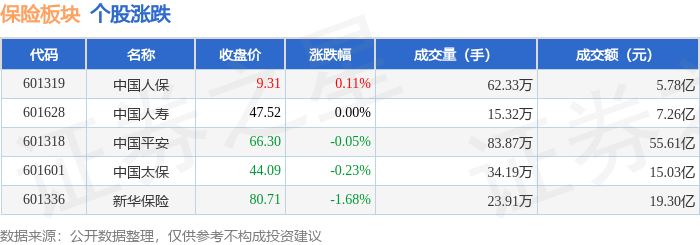
Core Viewpoint - The insurance sector experienced a slight decline of 0.14% on January 19, with New China Life Insurance leading the drop, while the overall market indices showed modest gains [1] Group 1: Market Performance - The Shanghai Composite Index closed at 4114.0, up by 0.29% [1] - The Shenzhen Component Index closed at 14294.05, up by 0.09% [1] Group 2: Individual Stock Performance - China Life Insurance (601628) closed at 47.52 with no change [1] - China Pacific Insurance (601601) closed at 44.09, down by 0.23% [1] - China Ping An (601318) closed at 66.30, down by 0.05% [1] - New China Life Insurance (601336) closed at 80.71, down by 1.68% [1] - China Reinsurance (601319) closed at 9.31, up by 0.11% [1] Group 3: Fund Flow Analysis - The insurance sector saw a net outflow of 290 million yuan from institutional investors, while retail investors had a net inflow of 340 million yuan [1] - The detailed fund flow for individual stocks indicates that China Life Insurance had a net inflow of 28.79 million yuan from institutional investors [2] - New China Life Insurance experienced a significant net outflow of 192 million yuan from institutional investors [2]
保险巨头盯上了50万亿到期存款
Xin Lang Cai Jing· 2026-01-19 07:37
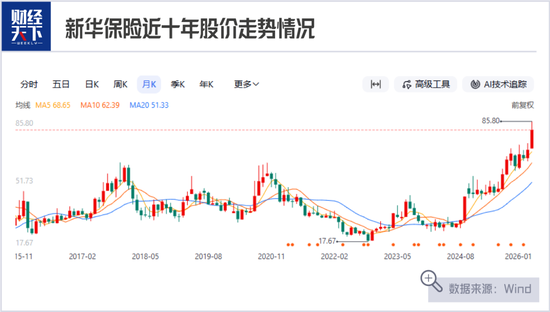
Core Viewpoint - The insurance sector is experiencing a significant rebound at the beginning of 2026, with insurance stocks rising sharply and sales of insurance products improving due to low deposit rates and favorable market conditions [1][19]. Group 1: Stock Performance - Insurance stocks have seen substantial gains, with New China Life leading with a 17.78% increase as of January 16, 2026. The top five listed insurance companies have all recorded double-digit growth over the past three months, with increases ranging from 10.32% to 23.83% [2][20]. - Historical data indicates that since 2014, there have been five notable bullish trends in the insurance sector, with stock market performance being a key catalyst for these trends [2][20]. Group 2: Sales Performance - The insurance industry is witnessing a resurgence in sales, with reports of significant premium collections, such as one company surpassing 3 billion yuan in first-year premium within four days after New Year [5][23]. - The total insurance premium income in China reached 5.76 trillion yuan by November 2025, marking an increase of 400 billion yuan from the previous year [5][23]. Group 3: Product Trends - The rise in sales is attributed to the popularity of participating insurance products, which combine protection and investment features. These products have become attractive due to their lower guaranteed rates and the current low-interest environment [6][24]. - Major insurance companies are focusing on participating insurance products, with new offerings featuring guaranteed rates around 1.75% and projected returns between 3.5% and 3.9% [7][25]. Group 4: Investment Performance - The total investment income of listed insurance companies reached 887.5 billion yuan in the first three quarters of 2025, reflecting a year-on-year increase of 35.64% [10][28]. - The investment strategies of insurance companies have shifted towards equities, with significant increases in stock and equity fund investments, particularly for companies like China Life and Ping An [12][30]. Group 5: Future Outlook - Analysts express optimism about the continued strength of insurance stocks in 2026, driven by robust premium growth and improved business quality, alongside favorable investment conditions [16][34]. - However, challenges remain, particularly regarding the long-term risks associated with interest rate spreads and the need for insurance companies to diversify their product offerings and improve customer satisfaction [16][35].
国际知名投行最新研判:保险股再迎“戴维斯双击”!
Xin Lang Cai Jing· 2026-01-19 06:29
Core Viewpoint - The insurance sector is poised for strategic investment opportunities due to the growth in net assets and investment returns, supported by shifts in resident savings towards insurance assets, alongside favorable policies [1][9]. Group 1: Performance Metrics - The insurance index is projected to rise by 31.31% in 2025, outperforming other financial sectors such as banking (12.04%) and brokerage (4.05%) [1]. - Individual stocks like New China Life, Ping An, China Pacific Insurance, China Life, and China Property & Casualty are expected to see significant increases in their stock prices, with respective gains of 46.03%, 35.87%, 26.6%, 21.21%, and 10.39% in 2025 [1]. - The A-share insurance sector is anticipated to maintain strong performance into 2026, with continued growth in the liability side and improved investment returns on the asset side [1]. Group 2: Liability Side Developments - The transformation of participating insurance products is enhancing competitiveness, attracting funds due to their "guaranteed + floating" return characteristics amid declining bank deposit rates [2][10]. - The ongoing shift in resident deposits and the reduction in large bank certificates of deposit are expected to further expand the growth of the insurance liability side [2][11]. - The demand for pension and health protection is driving the appeal of insurance products, which are expected to capture a larger share of resident savings and fixed-income investments [2][12]. Group 3: Asset Side Strategies - Insurers are increasing their allocation to equity assets due to pressure on interest margins and the challenges of bond yields not covering the costs of new premium inflows [5][14]. - The need for higher investment returns is pushing insurers to enhance their equity investment capabilities, especially as the industry transitions to a full-scale transformation of participating insurance by 2027 [5][15]. - The long-term trend indicates a significant increase in the proportion of equity investments within insurance portfolios, driven by the need for better returns [5][15]. Group 4: Policy Environment - Regulatory policies since September 2024 have encouraged insurance capital to enter the market, with expectations of substantial annual inflows into A-shares [7][16]. - The introduction of structural easing policies aims to optimize asset allocation and reduce capital requirements for insurance companies, supporting long-term market stability [7][16]. - The focus on nurturing patient capital and guiding long-term investments is expected to stabilize the capital market, with a particular emphasis on technology sectors for potential high returns [8][17].

非银金融行业周报:稳字当头,逆周期调节促健康发展
GOLDEN SUN SECURITIES· 2026-01-19 03:24
Investment Rating - The report maintains an "Accumulate" rating for the non-bank financial sector [4]. Core Insights - The report emphasizes a stable approach to prevent significant fluctuations in the market, with a focus on long-term investments and reforms to attract capital [2]. - The insurance sector is expected to benefit from an upward cycle in both liabilities and assets, driven by trends such as the migration of bank deposits and stable long-term interest rates [27]. - The securities sector is experiencing heightened market risk appetite and active trading, benefiting from favorable valuations and performance [27]. Summary by Sections 1. Industry Dynamics - The non-bank financial sector, including securities and insurance, showed positive movements with indices increasing by 1.34% and 1.00% respectively, while the insurance sector faced a decline of 2.63% [9]. - The China Securities Regulatory Commission (CSRC) is implementing measures to regulate the derivatives market and promote healthy development through counter-cyclical adjustments [1]. 2. Insurance - The insurance industry is entering an upward cycle, with a reported 14.89% year-on-year increase in premium income for New China Life, totaling CNY 195.9 billion [12]. - The Financial Regulatory Bureau's 2026 work meeting highlighted the importance of risk management and the need for non-bank institutions to focus on their core businesses [12]. 3. Securities - The report notes an increase in the financing margin ratio from 80% to 100%, aimed at reducing leverage and protecting investor rights [16]. - CITIC Securities reported a 28.75% increase in revenue for 2025, amounting to CNY 74.83 billion, with a net profit increase of 38.46% [18]. - The average daily trading volume for stock funds reached CNY 40,908.27 billion, reflecting a 21.22% week-on-week increase [19].

非银金融行业周报:行业周报稳字当头,逆周期调节促健康发展-20260119
GOLDEN SUN SECURITIES· 2026-01-19 02:59
Investment Rating - The report maintains an "Accumulate" rating for the non-bank financial sector [4]. Core Insights - The report emphasizes a focus on stability and counter-cyclical adjustments to promote healthy development in the non-bank financial sector. It highlights the need for regulatory measures in the derivatives market and the importance of risk management to support the real economy [1][2]. Summary by Sections 1. Industry Dynamics - The non-bank financial sector, including securities and insurance, showed varied performance with indices changing by +1.34% for non-bank financials and -2.63% for insurance during the week of January 12-16, 2026. The overall market indices, such as the Shanghai Composite Index, decreased by -0.57% [9][11]. 2. Insurance - The insurance sector is entering an upward cycle in both liabilities and assets. The long-term benefits from the trend of bank deposit migration and the stabilization of long-term interest rates are noted. The report remains optimistic about the insurance sector, particularly due to the "reporting and operation integration" strategy that enhances industry concentration [12][27]. 3. Securities - The securities sector is experiencing heightened market risk appetite and trading activity. The report indicates that securities firms and IT companies are benefiting from this environment, with a recommendation to focus on companies like China Ping An and Huatai Securities. Recent adjustments in financing margin requirements are aimed at stabilizing market leverage and protecting investor rights [16][19][27]. 4. Investment Recommendations - The report suggests a positive outlook for the insurance sector, driven by favorable trends in both the liability and asset sides. It also highlights the securities sector's potential for growth due to increased trading activity and market confidence. Specific companies to watch include China Ping An, China Life, and Guotai Junan [27].

新华保险2025年保费收入1959亿增15% 转型成效显现股价涨48%市值跃升700亿
Chang Jiang Shang Bao· 2026-01-18 23:46
Core Viewpoint - Xinhua Insurance has demonstrated robust growth in premium income and investment returns, driven by systematic reforms and strategic initiatives, positioning the company for high-quality development in the insurance sector [2][3]. Premium Income Growth - In 2025, Xinhua Insurance achieved a total original insurance premium income of CNY 195.9 billion, representing a 15% year-on-year increase [2][3]. - The company reported a significant increase in new business value by 50.8% in the first three quarters of 2025, with individual insurance channel productivity rising by 50% [2][4]. - The annual premium income growth of over 15% is notable compared to previous years, where growth rates were 15.5%, 2.5%, -0.2%, 1.7%, and 2.8% from 2020 to 2024 [3]. Business Structure and Performance - In the first three quarters of 2025, Xinhua Insurance's original insurance premium income reached CNY 172.7 billion, a year-on-year increase of 18.6% [4]. - The first-year premium income from long-term insurance was CNY 545.7 billion, up 59.8%, with first-year regular premium income growing by 41% [4]. - The company maintained a low surrender rate of 1.2%, down 0.1 percentage points from the previous year, indicating improved business quality [4]. Channel Performance - The individual insurance channel saw a 48.5% increase in first-year premium income, totaling CNY 184.4 billion [4]. - The bancassurance channel reported a 66.7% increase in first-year premium income, amounting to CNY 359.4 billion [5]. - The group insurance channel also experienced growth, with a 16.7% increase in premium income, reaching CNY 29.7 billion [6]. Investment Performance - Xinhua Insurance's investment income for the first three quarters of 2025 was CNY 40.4 billion, a staggering increase of 687.16% year-on-year [2][7]. - The company has increased its equity asset allocation significantly, with investment assets totaling CNY 1.77 trillion as of September 2025 [7]. - The annualized total investment return rate was 8.6%, contributing to a net profit of CNY 32.9 billion, up 58.88% [7]. Market Recognition - Xinhua Insurance's A-share price rose by 48.17% in 2025, increasing its market capitalization by nearly CNY 70 billion [2][8]. - As of January 16, 2026, the stock price continued to rise by 17.78%, with a total market capitalization exceeding CNY 229 billion [8].
非银金融周报:融资保证金比例上调,金监总局部署2026年监管工作-20260118
HUAXI Securities· 2026-01-18 14:52
Investment Rating - The industry rating is "Recommended" [5] Core Insights - The adjustment of the financing margin ratio from 80% to 100% aims to cool down excessive leverage and maintain market stability. This change will take effect on January 19, 2026, and applies only to new financing contracts [3][4][15][7] - As of January 14, 2026, the total market financing balance reached a historical high of 2.68 trillion yuan, with the margin balance accounting for 2.59% of the A-share market capitalization, indicating an increase from the average level of 2.40% in 2025 [4][15] - The non-bank financial sector index fell by 2.63%, underperforming the CSI 300 index by 2.06 percentage points, ranking 26th among all primary industries. The securities sector decreased by 2.21%, while the financial technology sector increased by 1.34% [2][13] Summary by Sections Market and Sector Performance - The average daily trading volume of A-shares for the week of January 11-17, 2026, was 34.651 billion yuan, a 21.5% increase week-on-week and a 189.4% increase year-on-year. The average trading volume for the first quarter of 2026 is 31.585 billion yuan, up 107.7% from the same period in 2025 [19] - In the same week, three new stocks were issued, raising 2.025 billion yuan, while two new stocks were listed, raising 1.484 billion yuan. Year-to-date, three A-share IPOs have raised 3.039 billion yuan [19] Financing Margin Ratio Adjustment - The financing margin ratio adjustment is a regulatory measure to prevent systemic risks and protect investors' rights. The increase in the minimum margin requirement is intended to curb market overheating and ensure a smooth market transition [4][7][15] Regulatory Developments - The National Financial Supervision Administration held a regulatory work meeting on January 15, 2026, outlining five key tasks for the year, including risk resolution for small and medium-sized financial institutions and enhancing regulatory quality. The focus for 2026 is on preventing systemic risks and ensuring high-quality industry development [8][16][17]