DZH(601519)

Search documents
1月1.84亿股民涌入炒股软件
2 1 Shi Ji Jing Ji Bao Dao· 2026-02-27 13:29
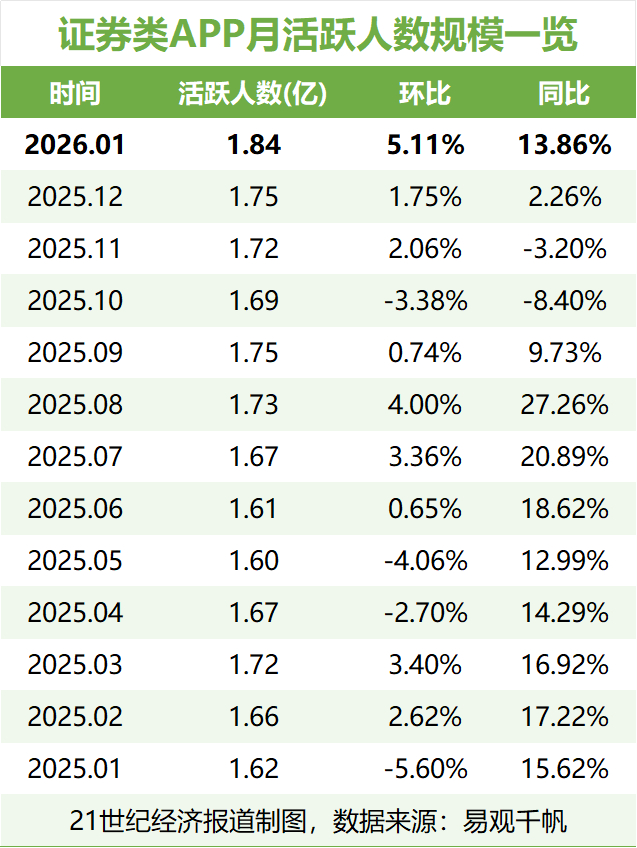
Core Insights - The A-share market is experiencing a "spring rally" in 2026, leading to increased trading activity and a surge in active users of stock trading apps, reaching 184 million in January 2026, a year-on-year increase of 13.86% and a month-on-month increase of 5.11% [1][2][3] User Activity Trends - The monthly active users of securities apps showed a fluctuating upward trend from January 2025 to January 2026, with a peak of 172 million in March 2025, followed by a decline to 160 million in May 2025, before rising again to 184 million in January 2026 [1][2] - The significant growth in January 2026 is attributed to the spring market conditions and a low base effect from the previous year's January due to fewer trading days caused by the Spring Festival [3] Leading Apps and Market Dynamics - Among the top 30 apps, "Tonghuashun" leads with 38.75 million active users in January 2026, followed by "Dongfang Caifu" and "Dazhihui" with 19.29 million and 13.76 million users, respectively [5][6] - The overall active user growth for securities apps is stable, with most apps experiencing a month-on-month growth rate between 5% and 7%, and year-on-year growth rates generally between 10% and 20% [5][6] Market Sentiment and New Accounts - The number of new accounts opened in January 2026 increased by 213% year-on-year, indicating strong investor interest in entering the market [7] - The balance of margin trading has reached historical highs, with new margin trading accounts totaling 190,500 in January, reflecting a month-on-month increase of 29.5% and a year-on-year increase of 157% [7] AI Integration in Securities Apps - The integration of AI tools into investment decision-making processes is enhancing user engagement, with over 30 securities firms deploying localized AI models for various services [9] - Major brokerages are utilizing AI for stock diagnosis, industry analysis, and asset allocation, transitioning from mere trading tools to comprehensive wealth management platforms [9][10] Future Trends in Securities Apps - The competition among securities apps is shifting from user scale to service value, with a focus on long-term client trust and the integration of AI capabilities into advisory services [10][11] - The industry is expected to see three key trends: deepening intelligent services, upgrading content ecosystems, and accelerating scenario integration to enhance user stickiness [11]






华为创始人任正非的一次内部演讲,诙谐幽默背后透露着大智慧!
Xin Lang Cai Jing· 2026-02-14 13:25
Group 1 - The core message of Huawei's founder Ren Zhengfei's internal speech reflects a blend of humor and profound wisdom, indicating a strategic mindset within the company [2] Group 2 - The speech emphasizes the importance of innovation and adaptability in the face of market challenges, showcasing Huawei's commitment to staying ahead in the technology sector [2] - Ren Zhengfei highlights the significance of teamwork and collaboration among employees to drive the company's success, reinforcing a strong corporate culture [2]
违法违规收集使用个人信息,国泰君安掌上期货、五矿期货等72款APP被通报
Xin Lang Cai Jing· 2026-02-10 04:14
Core Viewpoint - The National Cybersecurity Notification Center reported that 72 mobile applications are found to illegally collect and use personal information, with Guotai Junan Mobile Futures and Wumart Futures being highlighted for not clearly stating the purposes, methods, and scope of personal information collection [1][12]. Group 1: Violations in User Consent and Information Collection - 17 applications failed to provide clear prompts for users to read privacy policies upon first use, using default consent methods instead [2][13]. - 34 applications did not specify the purposes, methods, and scope of personal information collection in their privacy policies [3][14]. - 17 applications did not inform users about the recipients of their personal information, nor did they obtain separate consent for sharing [4][15]. Group 2: User Rights and Data Management - 5 applications began collecting personal information without user consent or continued to collect data despite user refusal [5][16]. - 9 applications did not provide effective means for users to correct, delete personal information, or cancel their accounts [6][17]. - 3 applications failed to process complaints and requests within promised timeframes [6][17]. Group 3: Withdrawal of Consent and Marketing Practices - 22 applications did not offer users a convenient way to withdraw consent for personal information collection [6][18]. - 2 applications used automated decision-making for marketing without providing options for users to refuse or opt-out [7][18]. - 4 applications processed sensitive personal information without obtaining separate consent from users [8][19]. Group 4: Security Measures and Compliance - 25 applications did not implement adequate security measures such as encryption or anonymization [9][19]. - 1 application continued to display ads after closing a page, disrupting user experience [10][20]. - 4 applications lacked a privacy policy altogether [11][21].

多款金融类App被通报
Nan Fang Du Shi Bao· 2026-02-05 23:13
Core Viewpoint - The National Cybersecurity Incident Response Center has identified 72 mobile applications that illegally collect and use personal information, including several financial apps, highlighting significant compliance issues in the industry [1][2]. Group 1: Overview of Violations - A total of 72 mobile applications were flagged for illegal collection and use of personal information between December 26, 2025, and January 20, 2026 [1]. - Among the flagged apps, several financial applications were noted, including Zhongshan Securities, Dazhihui, Guotai Junan Futures, and Wukuang Futures [1]. Group 2: Specific Violations in Financial Apps - Dazhihui was found to have the most violations, totaling six, including failure to clearly inform users about privacy policies and collection practices [2]. - Specific violations included not providing clear consent mechanisms, not listing the purposes and methods of data collection, and failing to inform users about third-party data sharing [2][3]. - Other issues included inadequate options for users to correct or delete their personal information and lack of mechanisms for withdrawing consent for data collection [3].
要有“舍小取大”的大智慧
Xin Hua Ri Bao· 2026-02-04 21:46
Core Insights - The article discusses the transformation of the traditional tourism model in the context of the Dangkou Ancient Town, emphasizing the shift from a ticketed "scenic area" to a free-access "street area" to revitalize cultural tourism [1][2][3] Group 1: Transformation of Tourism Model - The cancellation of entrance fees at Dangkou Ancient Town represents a fundamental shift in development strategy, moving from a passive approach of waiting for visitors to an active strategy of inviting them [1] - The reopening of Dangkou as a free-access area led to a significant increase in visitor numbers, demonstrating that charging fees can act as a barrier rather than a protective measure [1] - By 2025, revenue from cultural and handmade products in Dangkou is projected to grow by 50% year-on-year, indicating the effectiveness of transforming the tourism focus from mere sightseeing to immersive consumer experiences [1] Group 2: Evolving Visitor Expectations - Modern tourists seek immersive experiences rather than just superficial visits, with a preference for "slow travel" and genuine interactions [2] - The unique charm of ancient towns lies in their authentic local life and historical narratives, which should be preserved rather than artificially recreated [2] - Differentiation in the tourism market is crucial, with a focus on local culture, historical significance, and unique activities to meet the increasingly segmented demands of visitors [2] Group 3: Community Engagement and Economic Impact - The transformation from "scenic area" to "street area" fosters community involvement, with local residents becoming active participants in tourism development rather than being displaced [3] - Residents are investing in hospitality and retail businesses, contributing to the local economy and sharing in the benefits of tourism growth [3] - The implementation of a free-access policy enhances the sense of community and participation among locals, leading to a more sustainable and inclusive economic model [3]
涉个人信息使用违规,大智慧、中山证券等金融类App被通报
Nan Fang Du Shi Bao· 2026-02-03 13:18
Core Viewpoint - The National Cybersecurity Incident Response Center has identified 72 mobile applications that illegally collect and use personal information between December 26, 2025, and January 20, 2026 [1] Group 1: Financial Apps Involved - Several financial apps are among the 72 identified, including Zhongshan Securities, Dazhihui, Guotai Junan Futures, and Wenkang Futures [2][3] - Dazhihui has the highest number of violations, totaling six specific issues related to user consent and privacy policy transparency [4] Group 2: Specific Violations of Dazhihui - The app failed to clearly prompt users to read the privacy policy upon first use and used default consent mechanisms [4] - The privacy policy did not adequately detail the purposes, methods, and scope of personal information collection [4] - Dazhihui did not inform users about third parties receiving their personal information without explicit consent [4] - The app lacked effective features for users to correct, delete personal information, or cancel their accounts [5] - There was no easy way for users to withdraw consent for personal information collection [5] - The app did not have specific rules for handling personal information of minors and did not obtain parental consent [5] Group 3: Regulatory Attention on Financial Apps - Financial apps, particularly brokerage apps, have been under increasing regulatory scrutiny, with multiple apps being named for violations in 2025 [6] - The Shanghai Communications Administration reported several brokerage apps, including Shenwan Hongyuan and Dongfang Securities, for similar issues [6] - Legal experts emphasize the need for enhanced user identity verification and transaction monitoring to protect user rights in financial apps [6]
五矿期货、大智慧、中山证券等72款APP违法违规收集使用个人信息被通报
Xin Lang Cai Jing· 2026-02-03 05:48
Core Viewpoint - The National Cybersecurity Center has reported that 72 mobile applications are found to be in violation of personal information protection laws, highlighting significant issues in user consent and data handling practices. Group 1: User Consent Issues - 17 mobile applications failed to clearly inform users about privacy policies and data collection practices at the first run of the app, using default consent methods instead [1] - 34 mobile applications did not specify the purposes, methods, and scope of personal information collection in their privacy policies [2] - 17 mobile applications provided personal information to third parties without user consent or proper notification [3] Group 2: Data Collection Practices - 5 mobile applications began collecting personal information without obtaining user consent first, or continued to collect data despite user refusal [4] - 9 mobile applications did not provide effective means for users to correct, delete personal information, or cancel their accounts [5] - 3 mobile applications failed to process complaints and requests for personal rights in a timely manner [6] Group 3: User Rights and Security Measures - 22 mobile applications did not offer users a straightforward way to withdraw consent for data collection [7] - 25 mobile applications lacked adequate security measures such as encryption or anonymization of personal data [8] - 1 mobile application continued to display ads after the user closed the page, disrupting normal usage [9] Group 4: Sensitive Information Handling - 4 mobile applications processed sensitive personal information without obtaining separate user consent [6] - 6 mobile applications did not have specific rules for handling personal information of minors, failing to obtain parental consent [10] Group 5: Privacy Policy Compliance - 4 mobile applications were found to have no privacy policy at all [10] - 33 out of 71 previously reported applications still exhibited issues upon re-evaluation, leading to their removal from distribution platforms [10]
违法违规收集使用个人信息 72款移动应用被通报
Yang Shi Wang· 2026-02-03 03:54
Core Viewpoint - The National Cybersecurity Center has reported that 72 mobile applications are found to be in violation of personal information protection laws, highlighting significant issues in user consent and data handling practices. Group 1: User Consent Issues - 17 mobile applications failed to clearly inform users about privacy policies and data collection practices at the first run of the app [1] - 34 mobile applications did not specify the purposes, methods, and scope of personal information collection in their privacy policies [2] - 17 mobile applications provided personal information to third parties without user consent or proper notification [3] Group 2: Data Collection Practices - 5 mobile applications collected personal information without obtaining user consent or continued to collect data after users declined [4] - 9 mobile applications did not provide effective mechanisms for users to correct, delete personal information, or cancel their accounts [5] - 3 mobile applications failed to process complaints and requests for personal rights in a timely manner [6] Group 3: User Rights and Security Measures - 22 mobile applications did not offer users a straightforward way to withdraw consent for data collection [7] - 25 mobile applications lacked adequate security measures such as encryption or anonymization of personal data [8] - 1 mobile application continued to display ads after the user closed the page, disrupting normal usage [9] Group 4: Compliance with Regulations - 4 mobile applications were found to have no privacy policy at all [10] - 33 out of 71 previously reported applications still exhibited issues upon re-evaluation, leading to their removal from distribution platforms [10]
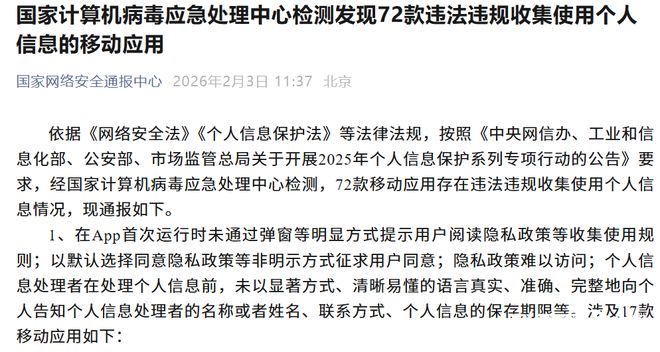
国家计算机病毒应急处理中心检测发现72款违法违规收集使用个人信息的移动应用
Xin Lang Cai Jing· 2026-02-03 03:51
Core Viewpoint - The National Cybersecurity Center has reported that 72 mobile applications are found to be in violation of personal information protection laws, highlighting significant issues in user consent and data handling practices. Group 1: User Consent and Information Collection - 17 mobile applications failed to clearly inform users about privacy policies and data collection practices at the first run, using default consent methods instead [1] - 34 mobile applications did not specify the purposes, methods, and scope of personal information collection in their privacy policies [2] - 17 mobile applications did not inform users about third-party data sharing, failing to obtain separate consent for such actions [3] - 5 mobile applications collected personal information without user consent or continued to collect data despite user refusal [4] Group 2: User Rights and Data Management - 9 mobile applications did not provide effective mechanisms for users to correct, delete personal information, or cancel their accounts [5] - 3 mobile applications failed to process complaints and requests within promised timeframes, lacking a convenient mechanism for users to exercise their rights [6] - 22 mobile applications did not offer users a straightforward way to withdraw consent for data collection [7] Group 3: Data Security and Sensitive Information - 25 mobile applications did not implement adequate security measures such as encryption or anonymization [8] - 4 mobile applications processed sensitive personal information without obtaining separate consent from users [9] - 6 mobile applications did not have specific rules for handling personal information of minors, failing to obtain parental consent [10] Group 4: Advertising and Marketing Practices - 2 mobile applications used automated decision-making for marketing without providing options for users to opt-out or reject targeted advertising [6] - 1 mobile application continued to display ads after the user closed the page, disrupting normal usage [9] Group 5: Privacy Policy Compliance - 4 mobile applications were found to have no privacy policy at all [10] - 33 out of 71 previously reported applications still exhibited issues upon re-evaluation, leading to their removal from distribution platforms [10]
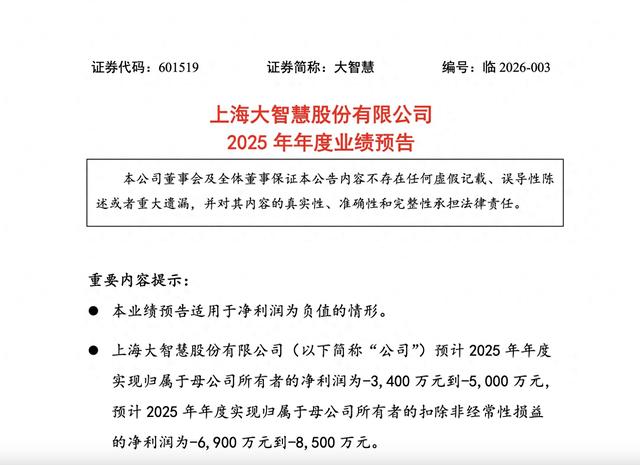
业绩冰火两重天,湘财股份并购重组考验“大智慧”
Guan Cha Zhe Wang· 2026-01-28 16:36
Core Viewpoint - The merger between Xiangcai Securities and Dazhihui represents a significant move in the brokerage and fintech sectors, with Xiangcai showing strong financial performance while Dazhihui continues to struggle with losses, raising questions about the merger's potential success and synergies [1][3][10]. Financial Performance - Xiangcai Securities reported a net profit of 553 million yuan for 2025, a year-on-year increase of over 157%, with total revenue exceeding 1.9 billion yuan, marking a growth of 28.8% from the previous year [4][7]. - The brokerage's net income from brokerage services reached 742 million yuan, up 39% year-on-year, contributing nearly 40% to total revenue [7]. - Investment income also grew to 384 million yuan, reflecting a 19% increase, while investment banking revenue fell to 60 million yuan, a decline of nearly 30% [7][8]. Merger and Acquisition Dynamics - The merger aims to leverage Xiangcai's brokerage license and Dazhihui's fintech capabilities, with a strategic vision of creating a "brokerage + fintech" ecosystem [10][11]. - The merger process has faced challenges, including legal disputes regarding the merger's compliance with regulations, which temporarily affected stock prices [11][12]. - The restructuring plan has been submitted for review by the Shanghai Stock Exchange, with uncertainties surrounding its approval and implementation timeline [12][13]. Industry Context - The merger reflects broader trends in the brokerage industry, where smaller firms face increasing pressure from larger competitors, necessitating strategic partnerships and diversification [9][13]. - Xiangcai's performance highlights the importance of adapting to market conditions, particularly in brokerage services, while also addressing weaknesses in investment banking [8][9].