EBSCN(601788)

Search documents
盛景微净利连降2年 2024年上市募9.6亿光大证券保荐

Zhong Guo Jing Ji Wang· 2026-01-20 07:48
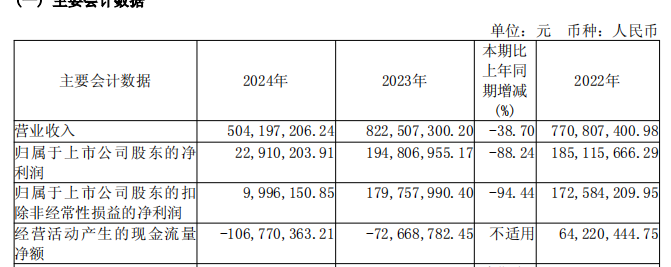
Core Viewpoint - Shengjing Micro (603375.SH) has disclosed its 2025 annual performance forecast, indicating a significant decline in net profit compared to the previous year, with expectations of a net profit attributable to shareholders ranging from 10 million to 15 million yuan, representing a decrease of 34.53% to 56.35% year-on-year [1] Financial Performance Summary - In 2024, the company reported a net profit attributable to shareholders of 22.91 million yuan, a decrease of 88.24% compared to 2023 [2] - The net profit excluding non-recurring gains and losses for 2024 was 999.62 thousand yuan, down 94.44% year-on-year [2] - The company's operating revenue for 2024 was 504.20 million yuan, reflecting a decline of 38.70% from 2023 [2] - The net cash flow from operating activities for 2024 was -106.77 million yuan, indicating a worsening cash flow situation compared to -72.67 million yuan in 2023 [2] Fundraising and IPO Details - Shengjing Micro raised a total of 960.86 million yuan through its public offering, with a net amount of 864.08 million yuan after deducting issuance costs, exceeding the original plan by 60.46 million yuan [3] - The funds raised are intended for projects including module research and development, construction of a research center, and to supplement working capital [3] - The company issued 25.17 million shares at a price of 38.18 yuan per share, representing 25% of the total share capital post-issuance [2][3]

光大证券晨会速递-20260120
EBSCN· 2026-01-20 01:48
Group 1: Macroeconomic Insights - The economic structure is shifting towards improvement, with expectations for a strong start in Q1 2026 due to preemptive investment policies, strong export and infrastructure indicators, and early disbursement of funds for "trade-in" programs [1] - Economic data is anticipated to rebound, contributing to a positive economic outlook for the beginning of 2026 [1] Group 2: Bond Market Analysis - As of the end of December 2025, the total bond custody amount reached 178.55 trillion yuan, with a net increase of 0.30 trillion yuan, although this was a decrease compared to the previous month [2] - The bond market shows a trend where commercial banks are increasing their holdings in interest rate bonds, while credit cooperatives are reducing their positions [2] - The economic characteristics of 2025 indicate a "high before low" pattern, with supply outpacing demand and external demand stronger than internal demand [3] - In December 2025, industrial production growth rates increased year-on-year and month-on-month, while fixed asset investment saw a larger decline [3] - The current liquidity in the bond market is relatively loose, and investors are becoming increasingly optimistic, with expectations for the 10Y government bond yield to stabilize around 1.75% in 2026 [3] Group 3: Real Estate Market Trends - As of January 18, 2026, the cumulative transaction volume for new homes in 20 cities was 23,000 units, reflecting a year-on-year decrease of 45.3% [4] - In major cities, Beijing saw 1,398 units sold (-25%), Shanghai 3,534 units (-35%), and Shenzhen 765 units (-75%) [4] - The second-hand housing market also experienced a decline, with a total of 44,000 units sold across 10 cities, down 17.8% year-on-year [4] - In Beijing, 7,033 second-hand homes were sold (-23%), in Shanghai 12,849 units (-8%), and in Shenzhen 2,844 units (-25%) [4]
光大证券:地缘政治不确定性为油价提供景气基础 关注26年供需边际变化
智通财经网· 2026-01-19 23:25
Core Viewpoint - The current geopolitical tensions in Iran are driving oil price volatility, with the geopolitical risk premium on oil prices increasing, leading to a rise in oil prices. OPEC+ has decided to pause production increases in Q1 2026, which is expected to alleviate concerns regarding oil supply [1][2][3]. Group 1: Geopolitical Impact on Oil Prices - The escalation of tensions in Iran has resulted in significant fluctuations in oil prices, providing a favorable backdrop for oil price increases due to geopolitical uncertainties [2]. - As of January 16, 2026, Brent and WTI crude oil futures closed at $64.20 and $59.22 per barrel, reflecting increases of 1.9% and 0.7% respectively from the previous week [2]. - The U.S. has opted for economic sanctions against Iranian officials rather than military action, which may lead to a potential end to the current oil price surge, although risks of escalation remain [2]. Group 2: OPEC+ Production Decisions - OPEC+ increased production by 2.21 million barrels per day in 2025, but has decided to adopt a cautious approach to production increases in 2026, which is expected to improve the balance of oil supply and demand [3]. - OPEC forecasts a demand growth of 1.38 million barrels per day for 2026, with a first-time prediction of 1.34 million barrels per day growth for 2027 [3]. Group 3: Demand and Supply Outlook - The IEA has revised its forecast for global oil demand growth in 2026 to 860,000 barrels per day, an increase of 90,000 barrels per day from previous estimates, driven by improvements in macroeconomic and trade conditions [4]. - The IEA expects that the demand for chemical feedstocks will dominate oil demand growth, with its share of the incremental demand rising from 40% in 2025 to 60% in 2026 [4]. - Global oil supply is projected to grow by 2.4 million barrels per day in 2026, with a downward adjustment of 20,000 barrels per day due to OPEC+ production pauses and intensified sanctions on Russian and Venezuelan oil [4]. Group 4: Resilience of Major Oil Companies - The "Big Three" Chinese oil companies have demonstrated resilience during the current oil price volatility, benefiting from increased production and effective cost control, with performance levels surpassing historical oil price periods [5]. - Looking ahead to 2026, these companies are expected to maintain high capital expenditures and continue expanding in the natural gas market, as well as accelerate the transformation of their downstream refining businesses, positioning them for long-term growth through oil price cycles [5].
【光大研究每日速递】20260120
光大证券研究· 2026-01-19 23:06
Economic Policy and Market Outlook - Recent economic policies, including structural interest rate cuts, are expected to support economic growth, potentially leading to a "good start" in the first quarter of 2026, although final performance will depend on forthcoming data [5] - The financial market policies have moderated previously overheated sectors, indicating that the market may not sustain its rapid upward trend and could transition into a more volatile phase [5] Fund Market Trends - The Hong Kong stock market saw an overall increase, while domestic equity markets experienced fluctuations; TMT-themed funds performed well, whereas defense and military-themed funds faced net value declines [5] - There was a notable reduction in passive fund holdings across various broad-based ETFs, with over 130 billion yuan flowing out of large-cap ETFs, while TMT and cyclical theme ETFs attracted over 60 billion yuan in net inflows [5] Economic Data Insights - The economic landscape in 2025 is characterized by a "high before low" trend, with supply outpacing demand and external demand exceeding internal demand [6] - In December 2025, industrial production growth rates increased year-on-year and month-on-month, while fixed asset investment saw a widening decline, and retail sales growth continued to decrease [6] Oil and Geopolitical Factors - Heightened geopolitical tensions in Iran have increased the geopolitical risk premium on oil, contributing to rising oil prices; as of January 16, 2026, Brent and WTI crude oil prices were reported at $64.20 and $59.22 per barrel, reflecting increases of 1.9% and 0.7% respectively [7] - The ongoing international instability is likely to provide a favorable foundation for oil price trends in the long term [7] Infrastructure Investment - The State Grid has announced a planned fixed asset investment of 4 trillion yuan during the 14th Five-Year Plan period, marking a 40% increase compared to the previous plan, focusing on power grid and energy storage sectors [8] - Key projects for 2026 will concentrate on ultra-high voltage and pumped storage, indicating potential opportunities in power infrastructure orders and renewable energy consumption [8] Power Consumption and Digitalization - In 2025, the total electricity consumption in society increased by 5.0% year-on-year [9] - The State Grid's investment in new power systems is expected to enhance capacity pricing, with projected capacity prices for 2026 estimated at 6.3 cents per kilowatt-hour, a 4-cent increase from the previous year [9] Pharmaceutical Sector Innovations - The pharmaceutical and biotechnology sectors are experiencing a surge driven by innovation, including overseas expansion, AI applications, and new technologies, alongside policy support and seasonal market dynamics [9] - Key focus areas include innovative drugs, CXO services, AI healthcare, brain-computer interfaces, and small nucleic acid drugs, with ongoing attention required on post-JPM conference collaborations and clinical data outcomes [9]
【固收】2025年经济前高后低特点显著——2025年四季度和12月经济数据点评兼债市观点(张旭/李枢川)
光大证券研究· 2026-01-19 23:06
Core Viewpoint - The economic data for Q4 2025 indicates a significant "high first, low later" trend, with supply outpacing demand and external demand stronger than internal demand [4][5]. Economic Data Summary - In Q4 2025, the GDP grew by 4.5% year-on-year, aligning with market expectations, while the annual growth rate for 2025 was 5% [4][5]. - The industrial added value for December 2025 increased by 5.2% year-on-year, up from 4.8% in November [4][5]. - Fixed asset investment for the entire year of 2025 saw a cumulative year-on-year decline of 3.8%, worsening from a previous decline of 2.6% [4][6]. - Retail sales of consumer goods in December 2025 grew by 0.9% year-on-year, down from 1.3% in November, marking a continuous decline over seven months [4][6]. Investment Market Insights - In the bond market, from August 2025 to the present, government bond yields have shown a clear divergence, with short-term yields stable and declining, while long-term yields, especially the 30-year yield, are on an upward trend [7]. - The current loose liquidity and diverging fundamentals suggest a gradually optimistic outlook for the bond market, with the 10-year government bond yield expected to stabilize around 1.75% in 2026 [7]. - In the convertible bond market, as of January 16, 2026, the China Securities Convertible Bond Index has risen by 5.6%, mirroring the 5.5% increase in the overall index, indicating a strong demand for convertible bonds amid a bullish equity market [7].

——2025年12月份债券托管量数据点评:商业银行持续增持利率债
EBSCN· 2026-01-19 09:27
1. Report Industry Investment Rating No relevant content provided. 2. Core Viewpoints of the Report - The total bond custody increased less on a month - on - month basis. In December 2025, the total bond custody of China Central Depository & Clearing Co., Ltd. (CCDC) and Shanghai Clearing House was 178.55 trillion yuan, with a net increase of 0.30 trillion yuan compared to the previous month, and 1.18 trillion yuan less than the month - on - month increase in November [1][11]. - In terms of the bond holder structure, among the allocation portfolios, except for credit cooperatives, all institutions increased their bond holdings; trading portfolios and overseas institutions decreased their bond holdings. Different institutions showed different trends in holding various types of bonds [2][26]. - The balance of bonds to be repurchased increased seasonally, and the bond market leverage ratio rose on a month - on - month basis. As of the end of December 2025, the estimated balance of repurchase - style repurchase of bonds to be repurchased was 11.91 trillion yuan, an increase of 859.04 billion yuan compared to the previous month. The leverage ratio was 107.14%, up 0.54 percentage points month - on - month and down 1.10 percentage points year - on - year [4][47]. 3. Summary by Related Catalogs 3.1 Bond Custody Total and Structure - The total bond custody increased less on a month - on - month basis. As of the end of December 2025, the total bond custody of CCDC and Shanghai Clearing House was 178.55 trillion yuan, with a net increase of 0.30 trillion yuan compared to the previous month, and 1.18 trillion yuan less than the month - on - month increase in November [1][11]. - By variety, interest - rate bonds, credit bonds, and financial bonds increased on a net basis month - on - month, while negotiable certificates of deposit (NCDs) decreased on a net basis. In December 2025, the custody of interest - rate bonds was 124.63 trillion yuan, accounting for 69.80% of the inter - bank bond market custody, with a net increase of 0.69 trillion yuan; the custody of credit bonds was 19.15 trillion yuan, accounting for 10.73%, with a net increase of 0.02 trillion yuan; the custody of non - policy financial bonds was 12.93 trillion yuan, accounting for 7.24%, with a net increase of 0.13 trillion yuan; the custody of NCDs was 19.69 trillion yuan, accounting for 11.03%, with a net decrease of 0.62 trillion yuan [1][11]. 3.2 Bond Holder Structure and Changes 3.2.1 Month - on - Month Changes in Custody by Institution - Among the allocation portfolios, except for credit cooperatives, all institutions increased their bond holdings; trading portfolios and overseas institutions decreased their bond holdings. Specifically, policy banks increased their holdings of interest - rate bonds, NCDs, and credit bonds across the board; commercial banks and securities companies increased their holdings of interest - rate bonds but decreased their holdings of NCDs and credit bonds; non - legal person products increased their holdings of interest - rate bonds and credit bonds but decreased their holdings of NCDs; credit cooperatives and overseas institutions decreased their holdings of interest - rate bonds, NCDs, and credit bonds across the board [2][26]. 3.2.2 Month - on - Month Changes in Custody by Bond Type - The custody of treasury bonds continued to increase on a month - on - month basis. Policy banks and commercial banks continued to increase their holdings, while non - legal person products continued to decrease their holdings. - The custody of local government bonds continued to increase on a month - on - month basis, and all major institutions in the bond market increased their holdings. - The custody of policy - based financial bonds continued to increase on a month - on - month basis. Commercial banks continued to increase their holdings, while policy banks changed to significantly decrease their holdings. - The custody of NCDs continued to decrease on a month - on - month basis. Policy banks changed to increase their holdings, while non - legal person products significantly decreased their holdings. - The custody of enterprise bonds continued to decrease on a month - on - month basis, and all major institutions in the bond market decreased their holdings. - The custody of medium - term notes continued to increase on a month - on - month basis. Commercial banks and non - legal person products were the main institutions increasing their holdings. - The custody of short - term financing bills and super - short - term financing bills continued to decrease on a month - on - month basis, and commercial banks were the main institutions decreasing their holdings. - The custody of privately - placed debt instruments changed to a decrease, and commercial banks were the main institutions decreasing their holdings [3][28]. 3.2.3 Holder Structure of Major Bond Types - As of the end of December 2025, the holder structure of treasury bonds: commercial banks accounted for 69.21%, overseas institutions 5.25%, policy banks 11.61%, non - legal person products 7.72%, securities companies 2.50%, insurance institutions 2.57%, and credit cooperatives 1.13% [33]. - The holder structure of policy - based financial bonds: commercial banks accounted for 56.73%, non - legal person products 31.54%, overseas institutions 2.82%, credit cooperatives 3.15%, insurance institutions 1.89%, securities companies 0.93%, and policy banks 2.94% [35]. - The holder structure of local government bonds: commercial banks accounted for 71.83%, non - legal person products 9.83%, policy banks 11.81%, insurance institutions 4.92%, securities companies 1.02%, credit cooperatives 0.57%, and overseas institutions 0.02% [37]. - The holder structure of enterprise bonds: non - legal person products accounted for 55.48%, commercial banks 31.29%, securities companies 9.09%, insurance institutions 3.23%, policy banks 0.54%, credit cooperatives 0.28%, and overseas institutions 0.08% [39]. - The holder structure of medium - term notes: non - legal person products accounted for 60.33%, commercial banks 24.90%, securities companies 4.56%, nominal holder accounts (domestic) 3.67%, policy banks 3.24%, insurance institutions 2.26%, overseas institutions 0.21%, other 0.57%, and credit cooperatives 0.25% [41]. - The holder structure of short - term financing bills and super - short - term financing bills: non - legal person products accounted for 66.21%, commercial banks 26.47%, nominal holder accounts (domestic) 2.97%, securities companies 1.01%, policy banks 2.73%, other 0.29%, insurance institutions 0.14%, credit cooperatives 0.02%, and overseas institutions 0.15% [46]. - The holder structure of NCDs: non - legal person products accounted for 63.66%, commercial banks 22.09%, policy banks 2.22%, credit cooperatives 1.90%, other 4.15%, nominal holder accounts (domestic) 2.09%, securities companies 0.81%, overseas institutions 2.92%, and insurance institutions 0.16% [45]. 3.3 Bond Market Leverage Ratio Observation - The balance of bonds to be repurchased increased seasonally, and the bond market leverage ratio rose on a month - on - month basis. As of the end of December 2025, the estimated balance of repurchase - style repurchase of bonds to be repurchased was 11.91 trillion yuan, an increase of 859.04 billion yuan compared to the previous month. The leverage ratio was 107.14%, up 0.54 percentage points month - on - month and down 1.10 percentage points year - on - year [4][47].
证券板块1月19日跌0.22%,华林证券领跌,主力资金净流出18.66亿元
Zheng Xing Xing Ye Ri Bao· 2026-01-19 08:58
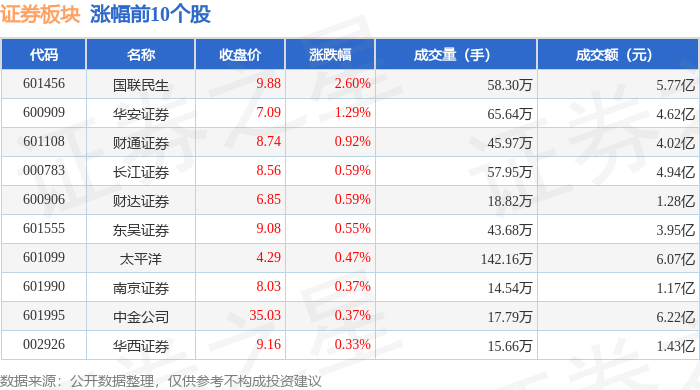
Market Overview - On January 19, the securities sector declined by 0.22%, with Huayin Securities leading the drop [1] - The Shanghai Composite Index closed at 4114.0, up 0.29%, while the Shenzhen Component Index closed at 14294.05, up 0.09% [1] Individual Stock Performance - Guolian Minsheng (601456) closed at 9.88, up 2.60% with a trading volume of 583,000 shares and a turnover of 577 million yuan [1] - Huayin Securities (002945) closed at 17.47, down 1.74% with a trading volume of 339,700 shares and a turnover of 594 million yuan [2] - Dongfang Caifu (300059) closed at 23.50, down 1.63% with a trading volume of 2,997,400 shares and a turnover of 7.065 billion yuan [2] Capital Flow Analysis - The securities sector experienced a net outflow of 1.866 billion yuan from institutional investors, while retail investors saw a net inflow of 1.136 billion yuan [2] - Major stocks like Guotai Junan (601211) had a net inflow of 118 million yuan from institutional investors, while retail investors had a net outflow of 66.72 million yuan [3] - The overall trend indicates a mixed sentiment among different investor types, with institutional investors pulling back while retail investors are more active [2][3]






光大证券:重视各国战略金属收储带来投资机会 全面看好战略金属价值重估
智通财经网· 2026-01-19 01:52
Core Viewpoint - The report from Everbright Securities highlights the increasing importance of strategic metals (copper, aluminum, cobalt, nickel, tin, antimony, tungsten, rare earths) due to supply disruptions and the limitations in production capacity in China and abroad [1][2]. Group 1: Strategic Metal Storage Initiatives - Australia announced a strategic reserve plan for critical minerals worth AUD 1.2 billion, with AUD 185 million allocated for necessary mineral reserves, prioritizing antimony, gallium, and rare earths [2] - The European Commission approved a resource revival action plan to raise EUR 3 billion for supply chain strategies, establishing a platform to support critical material reserves [2] - The U.S. Defense Logistics Agency (DLA) plans to procure USD 500 million in cobalt, USD 245 million in antimony, USD 100 million in tantalum, and USD 45 million in scandium [2] Group 2: Investment Opportunities in Strategic Metals - The focus on strategic metal storage in the U.S. and Australia presents significant investment opportunities, particularly in metals with concentrated supply chains and security risks, such as cobalt from the Democratic Republic of Congo and lithium from South America [3] - The rapid development of AI and energy transition is expected to drive demand for copper, aluminum, and tin, although supply constraints exist for these metals [4] - Military-related metals like tungsten, antimony, and rare earths are facing tightening supply, with production declines attributed to lower resource grades and regulatory controls [5] Group 3: Supply Concentration and Constraints - Copper, lithium, cobalt, and nickel supply is highly concentrated in South America, the Democratic Republic of Congo, and Indonesia, with Chile and Peru accounting for 35% of global copper production and the Democratic Republic of Congo producing 76% of global cobalt [4] - The rapid growth of AI is expected to significantly increase demand for copper, aluminum, and tin, but supply for these metals is constrained [4] - Tungsten, antimony, and rare earths are critical for military applications, but their production has decreased due to resource management practices and regulatory measures [5] Group 4: Investment Recommendations - For copper, recommended companies include Zijin Mining, Luoyang Molybdenum, and Western Mining [5] - For aluminum, Yunnan Aluminum is recommended, with China Aluminum as a focus [5] - For cobalt and nickel, Huayou Cobalt is recommended, with attention to Liqin Resources and Shengtun Mining [5] - For tungsten, focus on China Tungsten High-tech [5] - For tin, Xiyang Tin Industry is recommended, with interest in Xingye Silver Tin [5] - For antimony, Huaxi Nonferrous is highlighted, and for rare earths, Northern Rare Earth is recommended with a focus on China Rare Earth [5]


十大券商:轮动加快,聚焦这些板块!
天天基金网· 2026-01-19 01:00
Group 1 - The core viewpoint emphasizes a shift from narrative-driven trends to performance-based evaluations as the market enters the earnings forecast period, with a focus on sectors like chemicals, non-ferrous metals, and power equipment [2][5] - The adjustment of financing margin ratios is seen as a measure to stabilize the market and guide rational investment, indicating a potential shift towards a more balanced market environment [7][10] - The article highlights the acceleration of thematic rotation in the market, particularly focusing on domestic semiconductor and power sectors, driven by regulatory actions and strong demand [3][4] Group 2 - The market is expected to experience short-term fluctuations due to increased financing margin ratios and the cooling of previously hot themes, with a focus on sectors that show strong demand and industrial catalysts [4][8] - There is a recommendation for investors to adopt a cautious approach, focusing on sectors that benefit from structural changes and performance improvements, such as new energy and consumer goods [6][12] - The AI industry chain is identified as a key area for investment, with a consensus forming around its growth potential, despite some volatility in related sectors [13]


回归业绩!主题轮动加快,聚集这些板块
Zheng Quan Shi Bao Wang· 2026-01-19 00:45
Group 1 - The market is expected to experience a shift from a one-sided trend driven by narratives and capital to a more performance-focused environment as annual report forecasts approach [2][4] - The adjustment of financing margin ratios is seen as a signal to guide rational investment and maintain market stability, with a focus on sectors like traditional manufacturing and resource pricing [2][5] - The recent regulatory measures aim to prevent excessive speculation and market manipulation, leading to a more rational return of market sentiment [3][4] Group 2 - The focus is shifting towards sectors with strong demand support and industrial catalysts, particularly in low-position technology areas such as domestic computing power and new energy [3][4] - The upcoming earnings disclosures are expected to heighten the competitive sentiment around performance, with attention on sectors that may exceed expectations [4][9] - The market is likely to transition into a consolidation phase after reaching previous highs, with a recommendation for investors to adopt a stable allocation strategy [5][7] Group 3 - The "spring market" is facing short-term pressures due to various factors, including complex overseas macro environments and domestic regulatory intentions [6][8] - Despite recent market weaknesses, there is potential for continued upward movement in the AI application sector, driven by strong fundamentals [6][11] - The overall market valuation remains reasonable, supported by macro policies and a gradual recovery in corporate earnings [9][10]