Bank Of Guiyang(601997)

Search documents
城商行板块1月16日跌1.27%,江苏银行领跌,主力资金净流出2.29亿元
Zheng Xing Xing Ye Ri Bao· 2026-01-16 08:56
Core Viewpoint - The city commercial bank sector experienced a decline of 1.27% on January 16, with Jiangsu Bank leading the drop. The Shanghai Composite Index closed at 4101.91, down 0.26%, while the Shenzhen Component Index closed at 14281.08, down 0.18% [1]. Group 1: Stock Performance - Ningbo Bank closed at 29.30, up 1.70% with a trading volume of 589,500 shares and a transaction value of 1.723 billion [1]. - Xiamen Bank closed at 7.20, up 0.70% with a trading volume of 128,700 shares and a transaction value of 92.3661 million [1]. - Jiangsu Bank closed at 9.76, down 2.69% with a trading volume of 2,061,300 shares and a transaction value of 2.033 billion [2]. - Shanghai Bank closed at 9.64, down 2.43% with a trading volume of 961,200 shares and a transaction value of 933.3 million [2]. Group 2: Capital Flow - The city commercial bank sector saw a net outflow of 229 million from main funds, while speculative funds had a net inflow of 716 million, and retail investors experienced a net outflow of 487 million [2]. - Hangzhou Bank had a main fund net inflow of 153 million, while retail investors saw a net outflow of 113 million [3]. - Nanjing Bank recorded a main fund net inflow of 70.5 million and a retail net outflow of 131 million [3].




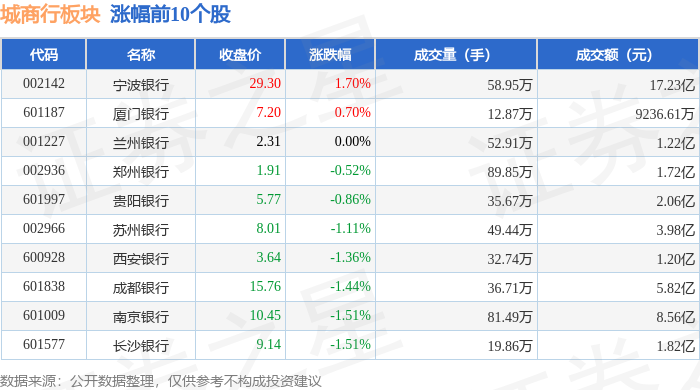
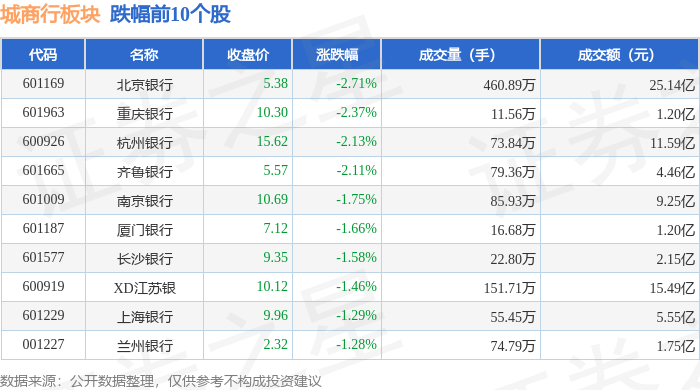
城商行板块1月14日跌2.11%,北京银行领跌,主力资金净流出7.29亿元
Zheng Xing Xing Ye Ri Bao· 2026-01-14 08:58
Core Viewpoint - The city commercial bank sector experienced a decline of 2.11% on January 14, with Beijing Bank leading the drop, while the overall market showed mixed results with the Shanghai Composite Index down 0.31% and the Shenzhen Component Index up 0.56% [1] Group 1: Market Performance - The closing price of Beijing Bank was 5.38, down 2.71%, with a trading volume of 4.6089 million shares and a transaction value of 2.514 billion [1] - Other notable declines included Chongqing Bank at 10.30 (-2.37%), Hangzhou Bank at 15.62 (-2.13%), and Qilu Bank at 5.57 (-2.11%) [1] - The city commercial bank sector saw a net outflow of 729 million in main funds, while retail investors contributed a net inflow of 53.1975 million [1] Group 2: Fund Flow Analysis - Hangzhou Bank had a main fund net inflow of 1.20 billion, but a net outflow from retail investors of 92.9469 million [2] - Suzhou Bank recorded a net inflow of 52.503 million from main funds, while retail investors had a net outflow of 54.0558 million [2] - Shanghai Bank experienced a main fund net inflow of 45.3249 million, with a retail net outflow of 46.6735 million [2]

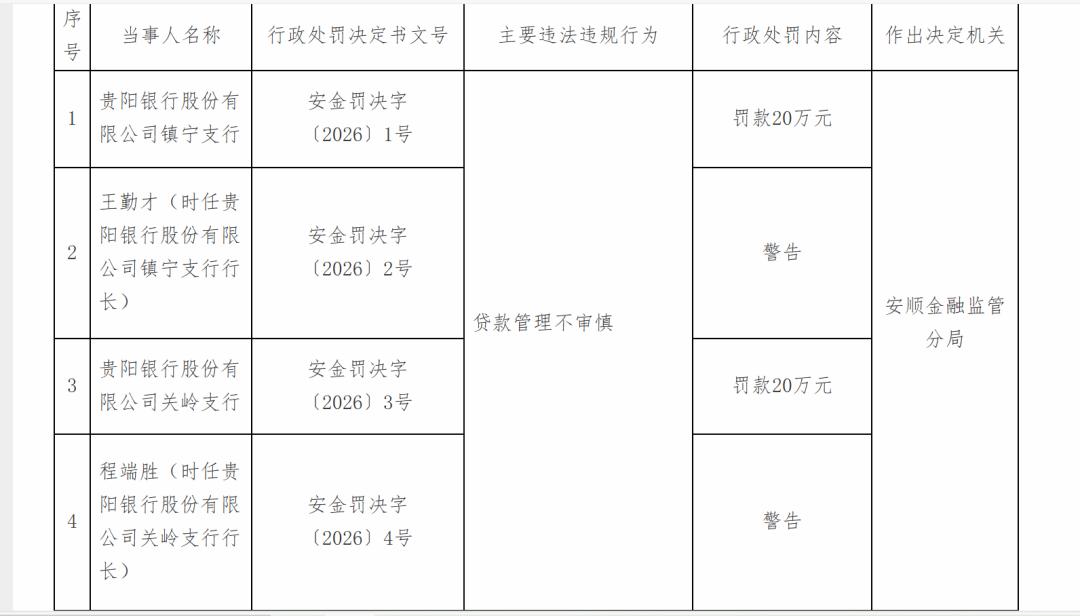
贵阳银行两家支行同日被罚 支行行长均被警告
Xi Niu Cai Jing· 2026-01-13 09:04
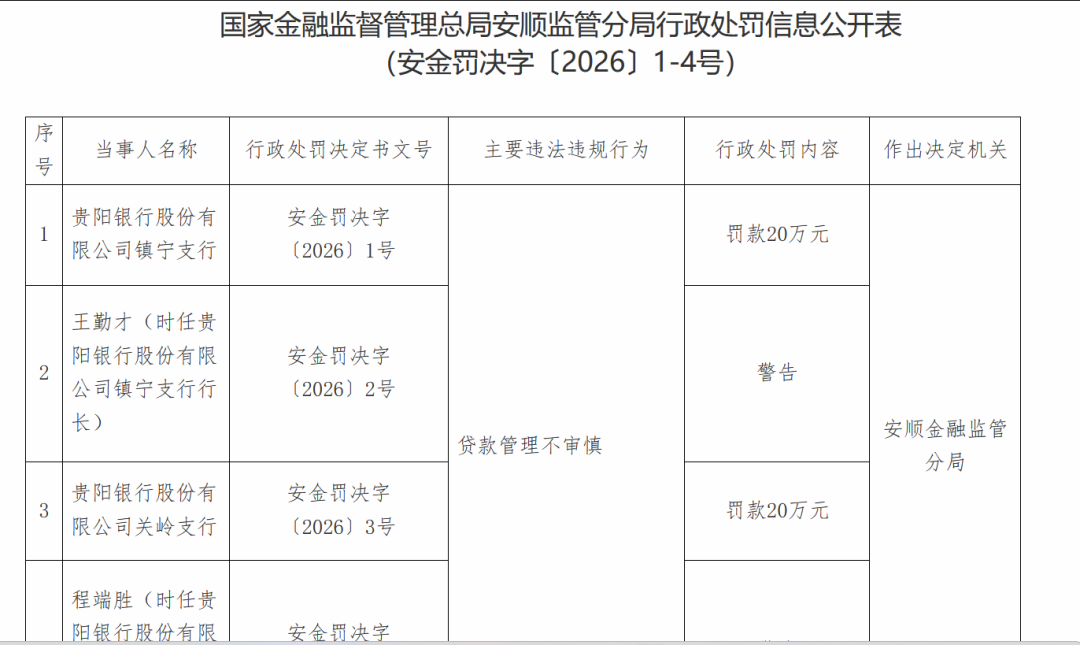
此前不久,贵阳银行旗下多家支行被罚。2025年12月23日,国家金融监督管理总局遵义监管分局发布的行政处罚信息公开表显示,贵阳银行习水支行因"违 规收取小微企业贷款承诺费"被罚款20万元;时任贵阳银行习水支行行长李伟被警告。贵阳银行正安支行因"贷款项目资本金未真实入账"被罚款30万元;时 任贵阳银行正安支行行长冯在稳同样因此被警告。 2025年11月25日,国家金融监督管理总局黔西南监管分局披露的行政处罚信息公开表显示,因"贷款三查不到位",贵阳银行黔西南分行被罚款60万元,时任 贵阳银行黔西南分行行长助理易麒麟被警告并罚款5万元,时任贵阳银行兴仁支行行长杨春被警告。 业绩方面,2025年前三季度,贵阳银行实现营业收入94.35亿元,同比下降13.73%;实现归母净利润39.15亿元,同比下降1.39%。截至2025年9月末,贵阳银 行不良贷款率为1.63%。其房地产贷款不良率由2024年末的1.05%攀升至1.75%,余额达527.63亿元。 2026年1月8日,贵阳银行接连收到两张"罚单"。 国家金融监督管理总局安顺监管分局披露的行政处罚信息公开表显示,贵阳银行镇宁支行、关岭支行因贷款管理不审慎,分别被罚 ...

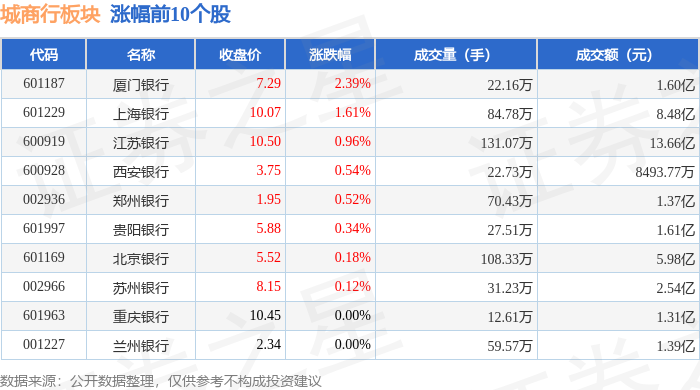
城商行板块1月12日涨0.25%,厦门银行领涨,主力资金净流出6140.56万元
Zheng Xing Xing Ye Ri Bao· 2026-01-12 09:10
Market Performance - The city commercial bank sector increased by 0.25% compared to the previous trading day, with Xiamen Bank leading the gains [1] - The Shanghai Composite Index closed at 4165.29, up 1.09%, while the Shenzhen Component Index closed at 14366.91, up 1.75% [1] Individual Bank Performance - Xiamen Bank (601187) closed at 7.29, up 2.39% with a trading volume of 221,600 shares and a transaction value of 160 million yuan [1] - Shanghai Bank (601229) closed at 10.07, up 1.61% with a trading volume of 847,800 shares and a transaction value of 848 million yuan [1] - Jiangsu Bank (616009) closed at 10.50, up 0.96% with a trading volume of 1,310,700 shares and a transaction value of 1.366 billion yuan [1] - Other banks such as Xi'an Bank, Zhengzhou Bank, and Beijing Bank also showed minor increases in their stock prices [1] Capital Flow Analysis - The city commercial bank sector experienced a net outflow of 61.41 million yuan from institutional investors, while retail investors saw a net inflow of 66.54 million yuan [2] - The individual capital flow for Jiangsu Bank showed a net inflow of 47.88 million yuan from institutional investors, while retail investors had a net outflow of 51.39 million yuan [3] - Xiamen Bank had a net inflow of 17.18 million yuan from institutional investors, but retail investors experienced a net outflow of 8.30 million yuan [3]
罚没26亿元,超100人被禁业,2025年6565张罚单背后:银行监管转向精准重罚
3 6 Ke· 2026-01-09 05:53
Core Viewpoint - The banking sector is facing intensified regulatory scrutiny in 2026, with multiple banks receiving fines for various violations, reflecting a shift towards more precise and severe penalties aimed at addressing systemic risks [2][3][13]. Regulatory Environment - In early 2026, several banks have already been penalized, indicating a continuation of strict regulatory measures from 2025 [1][4]. - The regulatory actions cover a range of issues, including inadequate loan management and insufficient internal controls [2][7]. Penalty Statistics - In 2025, a total of 6,565 fines were issued to banks, with over 1,000 banks penalized, marking an increase in the number of institutions facing penalties [9][10]. - The total amount of fines in 2025 reached 2.647 billion, a significant increase of 45.28% compared to the previous year, driven by a rise in the number of large fines exceeding one million [10][12]. Specific Cases - Guiyang Bank faced multiple fines in 2025, totaling 19, with the largest fine being 600,000 for inadequate loan management practices [6][7]. - The penalties imposed on Guiyang Bank included fines of 200,000 for two branches due to imprudent loan management, with responsible personnel receiving warnings [5][6]. Trends in Penalties - The trend of issuing large fines is expected to continue, with predictions indicating that the number of fines may remain stable while the amounts could increase, particularly for medium-sized banks [13]. - The focus of regulatory scrutiny is shifting towards high-risk areas, including compliance in financial technology and consumer protection [13]. Employee Accountability - The "double penalty system" has been implemented, linking compliance responsibilities directly to specific individuals, resulting in lifetime bans for over 100 bank employees in 2025 [3][8][12].
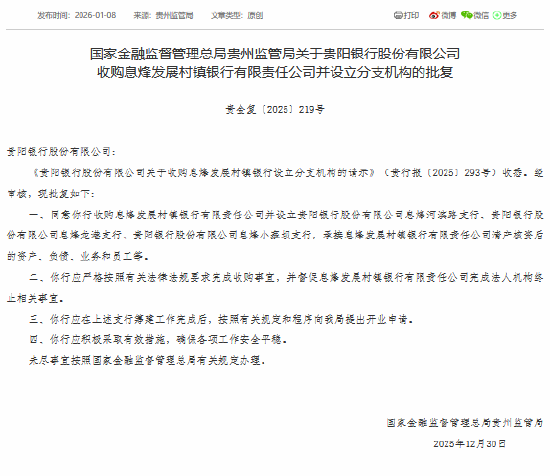
贵阳银行获批收购息烽发展村镇银行并设立分支机构
Xin Lang Cai Jing· 2026-01-08 10:16
Core Viewpoint - Guizhou Regulatory Bureau of the National Financial Supervision Administration has approved Guiyang Bank's acquisition of Xifeng Development Village Bank and the establishment of three new branches [1][2][3] Group 1: Acquisition Details - Guiyang Bank will acquire Xifeng Development Village Bank and establish three branches: Xifeng Riverside Road Branch, Xifeng Longgang Branch, and Xifeng Xiaozhaiba Branch [1][2][3] - The acquisition includes the transfer of assets, liabilities, business, and employees after the completion of asset verification [1][2][3] Group 2: Regulatory Requirements - Guiyang Bank is required to strictly adhere to relevant laws and regulations during the acquisition process [1][2][3] - The regulatory bureau will oversee the termination of the legal entity of Xifeng Development Village Bank [1][2][3] - Guiyang Bank must submit an application for opening the new branches after their establishment [3]
城商行板块1月8日跌0.89%,重庆银行领跌,主力资金净流入673.97万元
Zheng Xing Xing Ye Ri Bao· 2026-01-08 08:56
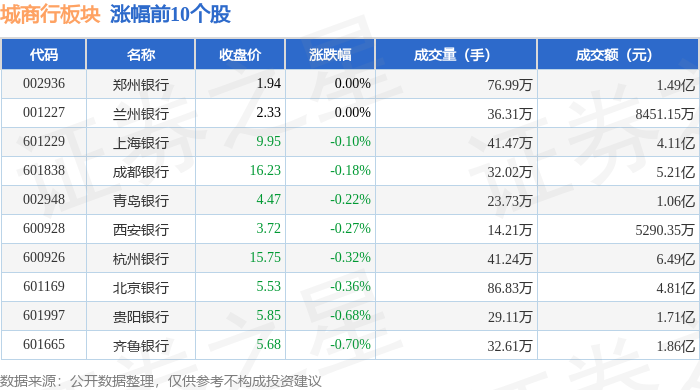
Market Overview - The city commercial bank sector experienced a decline of 0.89% on January 8, with Chongqing Bank leading the drop [1] - The Shanghai Composite Index closed at 4082.98, down 0.07%, while the Shenzhen Component Index closed at 13959.48, down 0.51% [1] Individual Stock Performance - Zhengzhou Bank closed at 1.94 with no change, while Lanzhou Bank also remained unchanged at 2.33 [1] - Shanghai Bank closed at 9.95, down 0.10%, and Chengdu Bank closed at 16.23, down 0.18% [1] - Chongqing Bank saw a significant decline of 2.70%, closing at 10.45, with a trading volume of 99,000 shares [2] Trading Volume and Turnover - The trading volume for Zhengzhou Bank was 769,900 shares with a turnover of 149 million yuan, while Lanzhou Bank had a trading volume of 363,100 shares and a turnover of 84.51 million yuan [1] - The highest turnover was recorded for Nanjing Bank at 1.342 billion yuan with a trading volume of 1,217,000 shares [2] Capital Flow Analysis - The city commercial bank sector saw a net inflow of 6.7397 million yuan from institutional investors, while retail investors experienced a net outflow of 70.5351 million yuan [2] - Chengdu Bank had a net inflow of 87.0825 million yuan from institutional investors, but a net outflow of 46.0321 million yuan from retail investors [3] Summary of Capital Flows - Institutional investors showed a positive net flow for several banks, including Hangzhou Bank with 77.8301 million yuan and Qingdao Bank with 8.4480 million yuan [3] - Conversely, Chongqing Bank had a negative net flow of 535,600 yuan from institutional investors, indicating a lack of confidence [3]
贵阳银行开年就收两张罚单!业绩承压
Shen Zhen Shang Bao· 2026-01-08 04:05
Group 1 - The core point of the news is that Guiyang Bank has faced multiple regulatory penalties due to imprudent loan management, with a total of 10 penalties amounting to 2.4 million RMB since 2025 [1][3][4] - Guiyang Bank's branches, specifically the Zhenning and Guanling branches, were fined 200,000 RMB each for their loan management practices, and responsible individuals received warnings [1][3] - The bank's financial performance has been under pressure, with a 13.73% year-on-year decline in operating income to 9.435 billion RMB and a 1.39% decline in net profit to 3.915 billion RMB for the first three quarters of 2025 [4] Group 2 - Guiyang Bank has experienced a continuous decline in both revenue and net profit for three consecutive years since 2023 [4] - The asset quality of Guiyang Bank is deteriorating, with a non-performing loan (NPL) ratio reaching 1.70% as of June 2025, the highest since its listing, and a slight decrease to 1.63% by September 2025, still the second-highest level [4] - The NPL ratio for real estate loans increased from 1.05% at the end of 2024 to 1.75%, with a balance of 52.763 billion RMB, accounting for 15.36% of total loans, indicating concentrated risk exposure [4]
城商行板块1月7日涨0%,杭州银行领涨,主力资金净流出1.7亿元
Zheng Xing Xing Ye Ri Bao· 2026-01-07 08:58
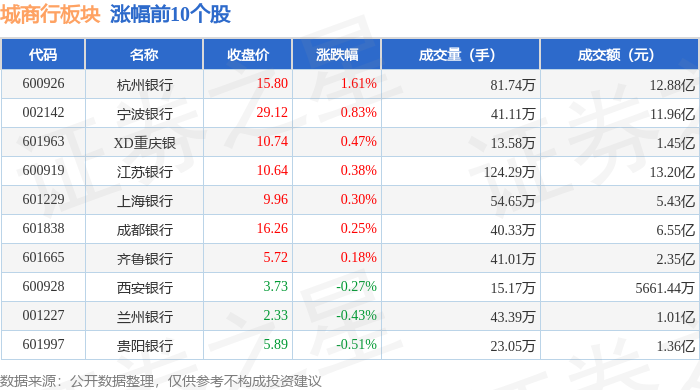
Market Performance - The city commercial bank sector experienced a slight increase of 0.0% on January 7, with Hangzhou Bank leading the gains [1] - The Shanghai Composite Index closed at 4085.77, up 0.05%, while the Shenzhen Component Index closed at 14030.56, up 0.06% [1] Individual Stock Performance - Hangzhou Bank (600926) closed at 15.80, with a rise of 1.61% and a trading volume of 817,400 shares [1] - Ningbo Bank (002142) closed at 29.12, up 0.83%, with a trading volume of 411,100 shares [1] - Other notable performances include Jiangsu Bank (601963) at 10.64 (+0.38%) and Shanghai Bank (601229) at 9.96 (+0.30%) [1] Capital Flow Analysis - The city commercial bank sector saw a net outflow of 170 million yuan from institutional investors, while retail investors contributed a net inflow of 188 million yuan [2] - The overall capital flow indicates a mixed sentiment, with institutional investors withdrawing funds while retail investors increased their positions [2] Detailed Capital Flow by Bank - Jiangsu Bank had a net inflow of 123 million yuan from institutional investors, while retail investors saw a net outflow of 27 million yuan [3] - Hangzhou Bank experienced a net inflow of 84 million yuan from institutional investors, but retail investors had a significant outflow of 132 million yuan [3] - Chengdu Bank recorded a net inflow of 55 million yuan from institutional investors, with retail investors also experiencing a net outflow [3]
城商行板块1月5日涨0.26%,杭州银行领涨,主力资金净流入3.8亿元
Zheng Xing Xing Ye Ri Bao· 2026-01-05 09:09
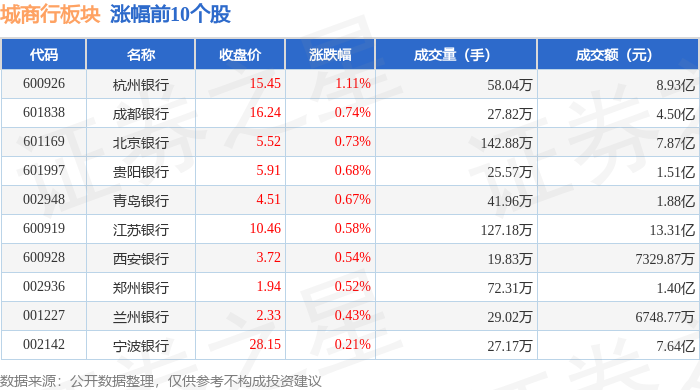
Market Overview - The city commercial bank sector increased by 0.26% on January 5, with Hangzhou Bank leading the gains [1] - The Shanghai Composite Index closed at 4023.42, up by 1.38%, while the Shenzhen Component Index closed at 13828.63, up by 2.24% [1] Individual Bank Performance - Hangzhou Bank (600926) closed at 15.45, with a rise of 1.11% and a trading volume of 580,400 shares, amounting to a transaction value of 893 million yuan [1] - Chengdu Bank (601838) closed at 16.24, up by 0.74%, with a trading volume of 278,200 shares and a transaction value of 450 million yuan [1] - Beijing Bank (601169) closed at 5.52, increasing by 0.73%, with a trading volume of 1,428,800 shares and a transaction value of 787 million yuan [1] - Guizhou Bank (601997) closed at 5.91, up by 0.68%, with a trading volume of 255,700 shares and a transaction value of 151 million yuan [1] - Qindao Bank (002948) closed at 4.51, increasing by 0.67%, with a trading volume of 419,600 shares and a transaction value of 188 million yuan [1] - Jiangsu Bank (616009) closed at 10.46, up by 0.58%, with a trading volume of 1,271,800 shares and a transaction value of 1.331 billion yuan [1] - Xian Bank (600928) closed at 3.72, increasing by 0.54%, with a trading volume of 198,300 shares and a transaction value of 73.3 million yuan [1] - Zhengzhou Bank (002936) closed at 1.94, up by 0.52%, with a trading volume of 723,100 shares and a transaction value of 140 million yuan [1] - Lanzhou Bank (001227) closed at 2.33, increasing by 0.43%, with a trading volume of 290,200 shares and a transaction value of 67.5 million yuan [1] - Ningbo Bank (002142) closed at 28.15, up by 0.21%, with a trading volume of 271,700 shares and a transaction value of 764 million yuan [1] Capital Flow Analysis - The city commercial bank sector saw a net inflow of 380 million yuan from main funds, while retail funds experienced a net outflow of 134 million yuan [2] - The main funds' net inflow and outflow for individual banks include: - Jiangsu Bank (600919) had a net inflow of 10.4 million yuan, with a 7.78% share of main funds [3] - Shanghai Bank (601229) had a net inflow of 87.04 million yuan, with a 13.64% share of main funds [3] - Hangzhou Bank (600926) had a net inflow of 79.04 million yuan, with an 8.86% share of main funds [3] - Nanjing Bank (600000) had a net inflow of 67.86 million yuan, with a 9.68% share of main funds [3] - Ningbo Bank (002142) had a net inflow of 58.14 million yuan, with a 7.61% share of main funds [3] - Qilu Bank (601665) had a net inflow of 57.72 million yuan, with a 14.60% share of main funds [3] - Qingdao Bank (002948) had a net inflow of 22.18 million yuan, with an 11.82% share of main funds [3] - Suzhou Bank (002966) had a net inflow of 6.29 million yuan, with a 2.71% share of main funds [3] - Xiamen Bank (601187) had a net inflow of 520,450 yuan, with a 5.25% share of main funds [3] - Xian Bank (600928) had a net inflow of 287,550 yuan, with a 3.92% share of main funds [3]