Biwin Storage Technology (688525)

Search documents
“订单排期到了明年” 存储超级周期下的众生相:谁在兑现 谁在挣扎
Zhong Guo Ji Jin Bao· 2026-01-31 23:42
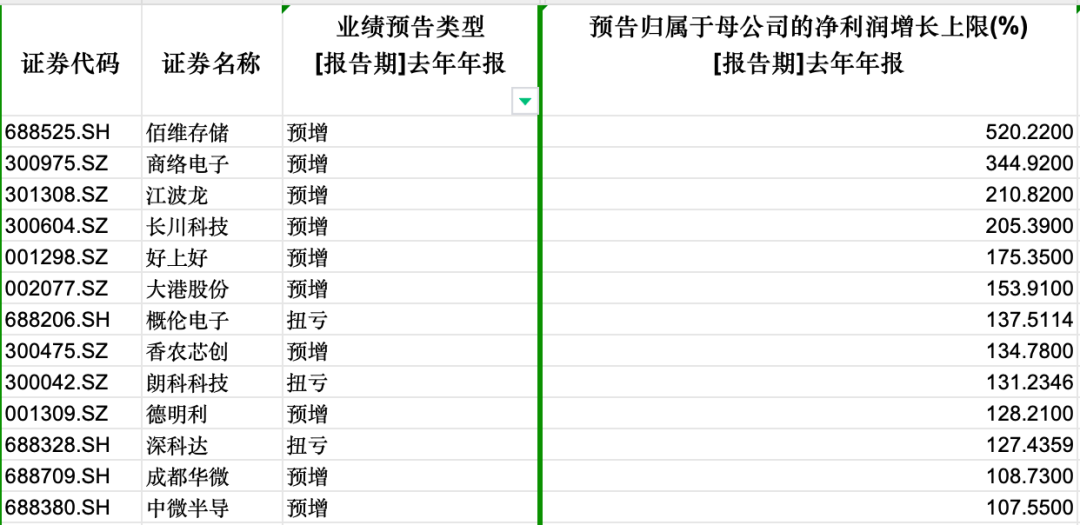
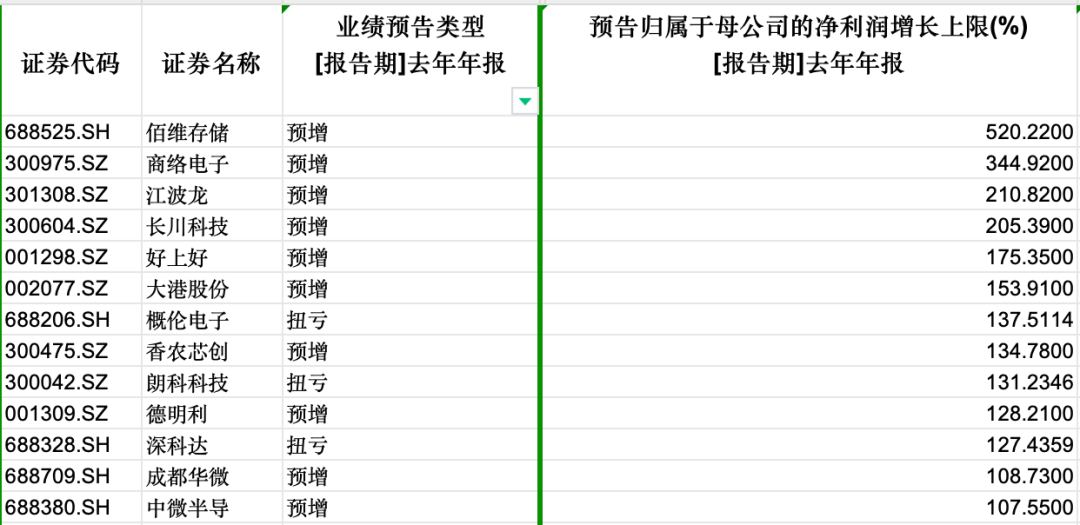
Core Viewpoint - The storage chip market is experiencing a "super cycle" driven by AI, leading to significant price increases and improved profitability for storage companies, while terminal manufacturers face pressure to raise prices or reduce specifications [1][3][7]. Group 1: Market Dynamics - The storage market is emerging from a low point, with many companies reporting substantial profit increases due to stabilizing prices driven by AI demand [1][2]. - As of January 29, 2026, 52 storage-related companies in the A-share market have issued performance forecasts for 2025, with 25 companies expecting profit increases, and 31 companies reporting year-on-year net profit growth [1][2]. - Notable profit increases include Bawei Storage with a projected growth of 520.22%, Shangluo Electronics at 344.92%, and Jiangbolong at 210.82% [2]. Group 2: Price Trends - Market research indicates that storage prices are expected to rise by 40% to 50% in Q1 2026 and by approximately 20% in Q2 2026, surpassing historical highs [3][4]. - Companies like Jiangbolong attribute their recovery to the stabilization of storage prices and increased demand from AI servers, leading to a supply-demand imbalance [2][5]. Group 3: Competitive Positioning - Storage manufacturers are shifting focus from consumer markets to enterprise-level markets, such as data centers and AI servers, where profit margins are higher due to lower price sensitivity [5][6]. - Companies are investing in technology and production capabilities to enhance their competitive edge, with Jiangbolong planning to raise 3.7 billion yuan for technology development and production expansion [6]. Group 4: Impact on Terminal Manufacturers - Terminal manufacturers are facing significant cost pressures due to rising component prices, leading to a projected 14.8% decrease in global laptop shipments in Q1 2026 [7][8]. - Major brands like Lenovo and Dell have begun raising prices on their products, with Lenovo increasing prices by 500 to 1500 yuan on mid-to-high-end models [8][9]. - The rising costs of memory components are impacting the profitability of smartphone manufacturers, with companies like Transsion Holdings reporting a 54.11% decline in net profit due to increased supply chain costs [9].


“产线的机器已经开足了马力,订单排期到了明年,连客户要货的电话都不敢接了,怕得罪人 ”存储超级周期下的众生相:谁在兑现,谁在挣扎
Zhong Guo Ji Jin Bao· 2026-01-31 12:57
Core Viewpoint - The storage chip market is experiencing a "super cycle" driven by AI, leading to significant price increases and improved profitability for storage companies, while terminal manufacturers face pressure to raise prices or reduce specifications [1][3]. Group 1: Market Dynamics - The storage market is emerging from a low point, with many companies reporting substantial profit increases due to stabilizing prices driven by AI demand [1]. - As of January 29, 2026, 52 storage-related companies in the A-share market have issued performance forecasts for 2025, with 25 companies expecting profit increases, and 31 companies reporting year-on-year net profit growth [1]. - Notably, 13 companies have projected net profit growth exceeding 100% [1]. Group 2: Company Performance - Companies like Bawei Storage and Jiangbolong are forecasting significant profit increases, with Bawei Storage projecting a net profit growth of 520.22% and Jiangbolong 210.82% [2]. - Jiangbolong attributes its turnaround to the recovery of storage prices and increased demand from AI servers, leading to a shift in supply dynamics [2]. - The storage price surge is expected to continue, with predictions of a 40% to 50% increase in Q1 2026 and an additional 20% in Q2 2026 [3]. Group 3: Competitive Positioning - Storage manufacturers are shifting focus from consumer markets to enterprise-level markets, such as data centers and AI servers, which offer higher profit margins due to lower price sensitivity [5]. - Companies are investing in technology and product development to enhance their competitive edge, with Jiangbolong planning to raise 3.7 billion yuan for technology development and production expansion [6]. - The urgency to secure market position is emphasized, as delays in strategic actions could result in missed opportunities during this lucrative period [7]. Group 4: Impact on Terminal Manufacturers - Terminal manufacturers are facing significant cost pressures due to rising prices of storage components, leading to a projected 14.8% decrease in global laptop shipments in Q1 2026 [8]. - Major brands like Lenovo and Dell have begun to raise prices on various product lines, with Lenovo increasing prices by 500 to 1500 yuan for mid-to-high-end models [8][9]. - The rising costs are impacting profit margins, with companies like Transsion Holdings reporting a 54.11% decline in net profit due to increased supply chain costs [9].

900亿AI存储龙头又要IPO了
投中网· 2026-01-31 07:05
Core Viewpoint - The article discusses the significant surge in demand and prices for storage chips driven by AI, highlighting the emergence of domestic companies like Baiwei Storage as key players in this evolving market [4][10]. Group 1: Market Dynamics - The price of DDR5 memory has skyrocketed by over 300%, and enterprise SSDs are in short supply, with HBM (High Bandwidth Memory) orders extending to 2027 [4]. - The price of HBM3E chips has increased by 50%, reaching over $500, while the total cost for a complete HBM3E memory module ranges from $2,800 to $3,100 [7]. - The overall DRAM contract prices are expected to rise by 55% to 60% in Q1 2026, with NAND Flash products also seeing price increases of 33% to 38% [17]. Group 2: Company Performance - Baiwei Storage (688525.SH) anticipates a 4-5 times increase in annual performance, with projected net profits for 2025 reaching between 850 million to 1 billion yuan, marking a year-on-year growth of 427% to 520% [4][7]. - The company's stock price has surged from around 110 yuan to a peak of 199.38 yuan, reflecting an 81% increase and a market valuation nearing 900 billion yuan [12]. Group 3: Strategic Initiatives - Baiwei Storage has submitted a prospectus to the Hong Kong Stock Exchange to capitalize on the AI wave, focusing on advanced packaging and testing capabilities, as well as CXL memory pooling technology [5][9]. - The company plans to use funds from its IPO to enhance R&D and production capabilities for high-end DRAM modules and enterprise SSDs, while expanding its global sales and service network [9]. Group 4: Competitive Landscape - Major players like Samsung and SK Hynix are increasing prices and extending delivery times, indicating a tight supply chain for high-end memory products [8]. - Baiwei Storage has successfully integrated into the supply chains of top global tech companies, including Meta and Google, providing embedded storage solutions for AI devices [15]. Group 5: Future Outlook - The ongoing price increases and demand for storage chips are expected to continue until at least mid-2026, with a potential supply-demand imbalance lasting until 2028 [18]. - The surge in IPO activities among storage chip companies reflects a broader trend of value reassessment in the industry, driven by AI computing needs and domestic market dynamics [20].

佰维存储公布国际专利申请:“固态硬盘数据纠错方法、装置、设备及可读存储介质”
Sou Hu Cai Jing· 2026-01-30 22:54
证券之星消息,根据企查查数据显示佰维存储(688525)公布了一项国际专利申请,专利名为"固态硬 盘数据纠错方法、装置、设备及可读存储介质",专利申请号为PCT/CN2025/101817,国际公布日为 2026年1月29日。 数据来源:企查查 专利详情如下: 以上内容为证券之星据公开信息整理,由AI算法生成(网信算备310104345710301240019号),不构成 投资建议。 图片来源:世界知识产权组织(WIPO) 今年以来佰维存储已公布的国际专利申请2个。结合公司2025年中报财务数据,2025上半年公司在研发 方面投入了2.73亿元,同比增29.77%。 ...

存储公司业绩普遍预增 机构预计短缺和涨价会持续
Zhong Guo Jin Rong Xin Xi Wang· 2026-01-30 15:06
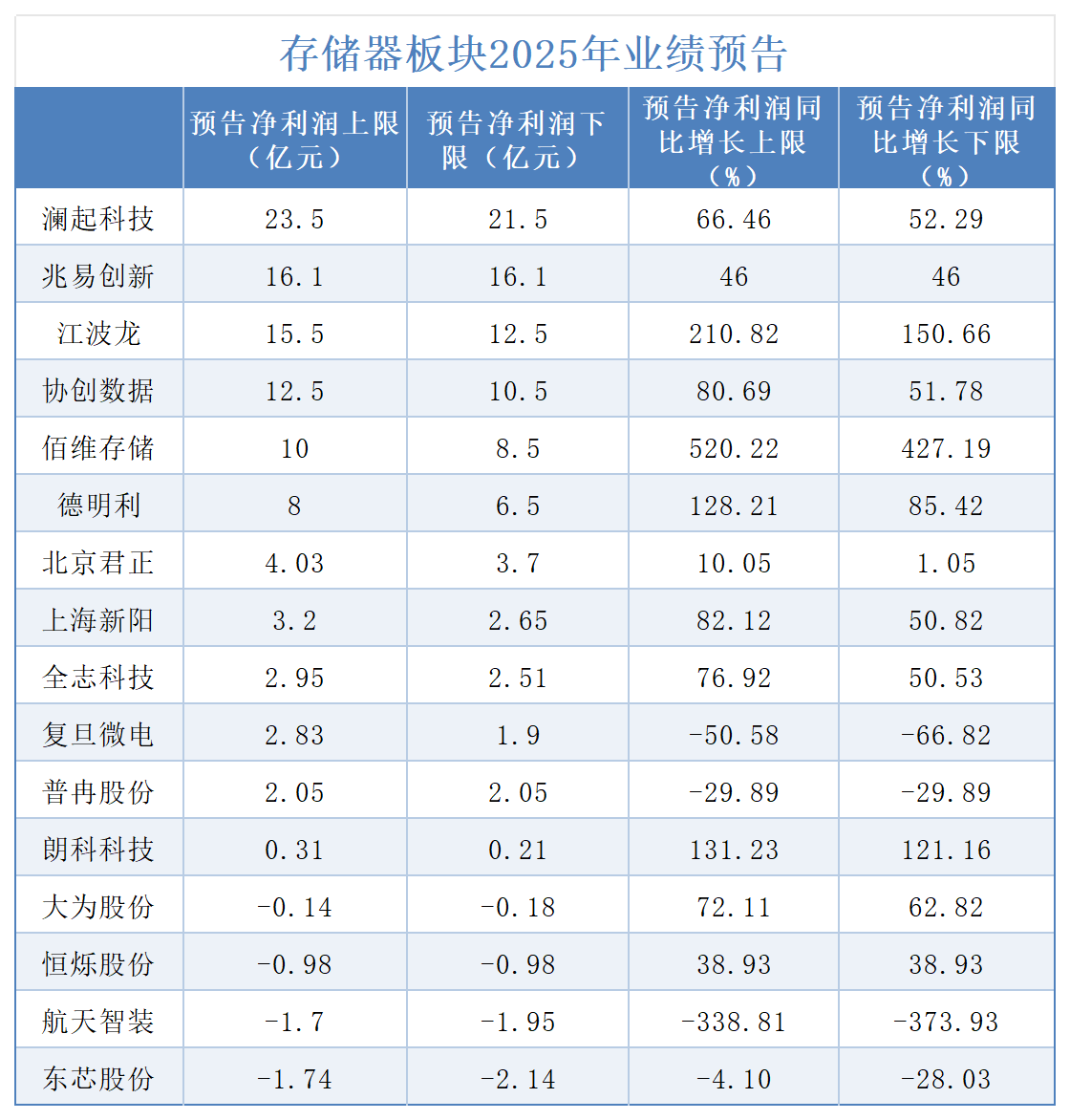
Core Viewpoint - The storage industry is experiencing a significant increase in profitability, driven by the growth of AI and computing power, leading to a high prosperity cycle and rising product prices [1][7]. Group 1: Company Performance Forecasts - Baiwei Storage is expected to achieve a net profit of 8.5 billion to 10 billion yuan in 2025, representing a year-on-year growth of 427.19% to 520.22% [2][3]. - Jiangbolong forecasts a net profit of 12.5 billion to 15.5 billion yuan, with a year-on-year increase of 150.66% to 210.82% [4][3]. - Demingli anticipates a revenue of 103 billion to 113 billion yuan, with a year-on-year growth of 115.82% to 136.77%, and a net profit of 6.5 billion to 8 billion yuan, reflecting an increase of 85.42% to 128.21% [6][3]. Group 2: Industry Trends and Drivers - The growth in the storage sector is primarily attributed to the booming AI and computing power industries, which have led to a high demand and rising prices for storage products [7][8]. - The global storage industry is expected to maintain high prosperity through 2026, with price increases anticipated to continue throughout the year, particularly driven by AI demand [7][8]. - The current cycle of price increases is influenced by structural supply-demand mismatches, with AI server demand significantly outpacing other segments [8][7]. Group 3: Market Dynamics and Future Outlook - The storage market is projected to expand due to increasing data and AI proliferation, with a notable rise in demand for storage technology across various sectors [8][7]. - The price of storage products has already seen substantial increases in 2025, with further rises expected in 2026, driven by both AI servers and general server demands [8][7]. - Companies are actively expanding production capacities in response to the favorable market conditions, with domestic manufacturers like Baiwei Storage and Jiangbolong leading the charge [7][8].


900亿AI存储龙头又要IPO了
3 6 Ke· 2026-01-30 02:00
Core Viewpoint - The surge in demand for storage chips driven by AI has created unprecedented opportunities for Chinese companies, particularly for Bawei Storage, which is experiencing significant growth and plans to go public in Hong Kong to capitalize on this trend [1][4]. Group 1: Market Dynamics - Prices for high-end memory components, such as HBM3E chips, have skyrocketed, with current prices exceeding $500, a 50% increase from previous levels [2]. - The total cost for HBM3E memory modules in AI training servers can reach $4,000 to $8,000, with data centers requiring significant investments, often exceeding $1 million [2]. - The overall DRAM contract prices are expected to increase by 55% to 60% in Q1 2026, while NAND Flash prices are projected to rise by 33% to 38% [8]. Group 2: Company Performance - Bawei Storage anticipates a 4-5 times increase in annual performance, with net profit projections for 2025 reaching between 850 million to 1 billion yuan, marking a year-on-year growth of 427% to 520% [1][2]. - The fourth quarter of 2025 is expected to be a significant growth period, contributing nearly 90% of the annual profit, with quarterly net profit soaring by 1225% to 1450% [2]. Group 3: Strategic Initiatives - Bawei Storage plans to use funds from its IPO to enhance R&D and production capabilities for high-end DRAM modules and enterprise SSDs, expand its global sales and service network, and explore strategic investments in upstream chip design and advanced packaging companies [4]. - The company is focusing on advanced packaging and testing capabilities, particularly in HBM mid-end processes and CXL memory pooling technology, to strengthen its position in the AI storage market [3]. Group 4: Leadership and Growth - Under the leadership of CEO Sun Chengsi, Bawei Storage has transformed from a low-margin OEM to a high-end storage solution provider, significantly increasing its market value from 5.33 billion yuan at its 2022 IPO to nearly 100 billion yuan [5][6]. - The company has successfully integrated into the supply chains of major global tech firms, including Meta and Google, and has established partnerships with leading automotive and cloud computing companies [7]. Group 5: Industry Trends - The ongoing price increases and supply constraints in the storage chip market indicate a super cycle driven by AI demand, with companies like Bawei Storage positioned to benefit from this trend [3][8]. - Multiple storage chip companies are accelerating their IPO processes, reflecting a broader industry shift towards capitalizing on the AI-driven demand and the restructuring of global supply chains [9].
受涨价潮影响,多家存储企业业绩预增
3 6 Ke· 2026-01-30 00:20
Core Viewpoint - Several storage companies have reported significant profit increases for 2025, driven by a price surge in the industry [1] Group 1: Company Performance - Jiangbolong announced an earnings forecast for 2025, expecting a net profit attributable to shareholders of 1.25 billion to 1.55 billion yuan, representing a year-on-year growth of 150.66% to 210.82% [1] - Other storage companies, including Baiwei Storage, Zhaoyi Innovation, Demingli, and Langke Technology, are also expected to report profit increases due to the same price surge [1]

携手英特尔等巨头 佰维以Mini SSD生态破局AI终端存储
Ju Chao Zi Xun· 2026-01-29 07:01
Core Insights - The storage industry faces significant challenges with traditional devices like M.2 SSDs and eMMC, which hinder innovation in AI terminals. The introduction of the Mini SSD by Baiwei Storage represents a breakthrough with its compact size and high performance [1][3][4] Product Innovation - The Mini SSD features a unique LGA packaging design that allows for easy installation similar to changing a SIM card, significantly lowering design barriers for terminal manufacturers [3] - It achieves a reading speed of 3700MB/s and a storage capacity of up to 2TB, with a 4TB version in development, showcasing a perfect balance of small size and large capacity [3][4] - The product is designed to withstand high temperatures and ensure reliability, featuring IP68 dust and water resistance, and a lifespan of 12,000 insertions [4] Market Performance - The Mini SSD has been well-received in the market, adapting to various smart PCs and gaming handhelds, and has garnered over 100 million views globally in related articles and videos [1] - It has won the "Best Invention of the Year" award from TIME and is a finalist for the Edison Awards, indicating strong industry recognition [1] Ecosystem Collaboration - Baiwei Storage aims to build an industry alliance for Mini SSD, focusing on fair pricing and stable supply, to standardize technology and explore the AI storage market [2][5] - Collaboration with partners like Intel and Hynix is crucial for the success of the Mini SSD, enhancing flexibility and innovation in development and production [5] Application Expansion - The company is implementing a dual-driven system for B2B and B2C applications, providing modular solutions for terminal manufacturers and enhancing AI model deployment efficiency [6][7] - The Mini SSD strategy targets five core areas: ultrabooks, gaming handhelds, external storage, mobile workstations, and AI applications, with plans to expand into robotics and professional imaging devices [7] Strategic Development - Baiwei Storage's success is rooted in its integrated R&D and manufacturing strategy, establishing a comprehensive technological barrier in AI storage solutions [8] - The company plans to launch innovative Mini SSD products in 2024, with a focus on expanding its application ecosystem and solidifying its market position in high-growth sectors [8]
利基存储紧缺持续,AI需求打开增量空间
Orient Securities· 2026-01-29 01:45
Investment Rating - The report maintains a "Positive" investment rating for the electronic industry [5] Core Insights - The ongoing shortage of niche storage is expected to continue, with AI demand opening up incremental growth opportunities [2][8] - AI demand is anticipated to drive the need for niche storage, particularly in applications such as automotive, industrial, and security [7] - Domestic manufacturers are positioned competitively in the niche storage market and are likely to benefit from the supply constraints caused by international suppliers exiting this segment [7] Summary by Sections Investment Recommendations and Targets - Key investment targets include domestic storage chip design companies such as Zhaoyi Innovation, Puran, Jucheng, Dongxin, Beijing Junzheng, and Hengshuo [3][8] - Other relevant companies include domestic storage module manufacturers like Jiangbolong, Demingli, and Baiwei Storage, as well as semiconductor equipment firms such as Zhongwei, Jingzhida, and Beifang Huachuang [3][8] - Companies benefiting from storage technology iterations include Lanke Technology, Lianyun Technology, and Aojie Technology [3][8] Market Dynamics - The supply of niche storage products is being significantly reduced as major international suppliers focus on mainstream storage products, leading to a substantial contraction in supply [7] - For instance, the global MLC NAND Flash capacity is projected to decrease by 41.7% in 2026 due to supply shrinkage, which is expected to drive prices significantly higher [7] - Domestic firms are gaining market share in niche storage, with Zhaoyi Innovation holding approximately 18.5% of the NOR Flash market in 2024, ranking second globally [7]



公募顶流四季报揭秘:科技冲锋与价值深蹲下的业绩分野
2 1 Shi Ji Jing Ji Bao Dao· 2026-01-28 12:31
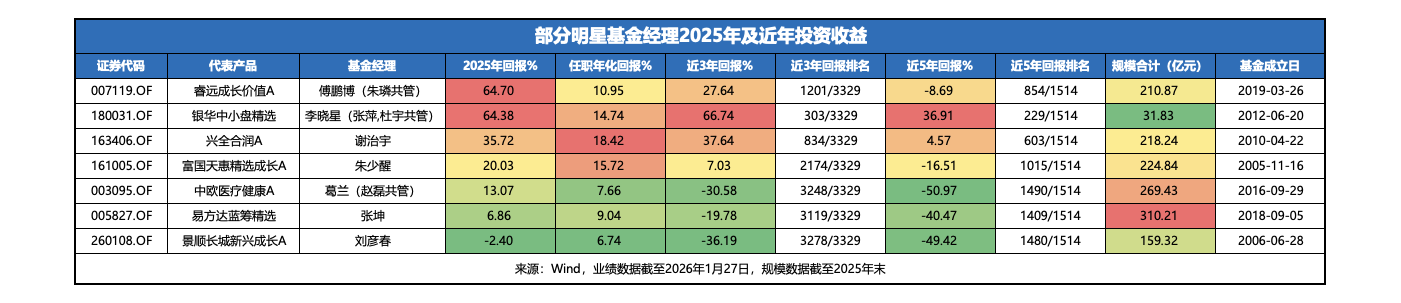
Core Viewpoint - The market experienced increased volatility in Q4 2025, with A-shares and Hong Kong stocks showing mixed performance, while sectors like AI computing and semiconductors thrived, contrasting with weaker performances in real estate and pharmaceuticals [1] Group 1: Market Performance - The Shanghai Composite Index rose by 2.22% in Q4 2025, while the Hang Seng Index fell by 4.56% [1] - The technology growth sector, particularly AI computing and semiconductors, showed significant gains, while industries such as real estate and pharmaceuticals faced challenges [1] Group 2: Fund Manager Performance - Star fund managers like Fu Pengbo and Li Xiaoxing achieved over 60% returns in 2025, focusing on AI computing and semiconductors [2] - Balanced allocation funds, such as Zhu Shaoxing's, demonstrated stability with a 20% annual return, benefiting from diversified investments across various sectors [3][14] Group 3: Investment Strategies - Fu Pengbo's fund increased its allocation to data center cooling and computing-related companies, with a top ten stock concentration of 70.38% [5] - Li Xiaoxing emphasized AI hardware innovation and semiconductor investments, with a focus on domestic advancements in the semiconductor industry [6] Group 4: Traditional Value Investments - Fund managers like Zhang Kun and Liu Yanhun maintained positions in traditional sectors like consumer goods and pharmaceuticals, despite facing net value pressures [8][12] - Liu Yanhun's fund experienced a 5.85% decline in Q4, reflecting the challenges faced by traditional value sectors [12] Group 5: Policy and Market Outlook - Fund managers noted the impact of "anti-involution" policies on corporate fundamentals, suggesting a shift towards supply-side optimization [17] - Despite market rebounds, equity assets are still viewed as attractive, with a focus on high-quality listed companies as scarce income-generating assets [18]