Shenzhen Techwinsemi Technology Company Limited(001309)

Search documents
“订单排期到了明年” 存储超级周期下的众生相:谁在兑现 谁在挣扎
Zhong Guo Ji Jin Bao· 2026-01-31 23:42
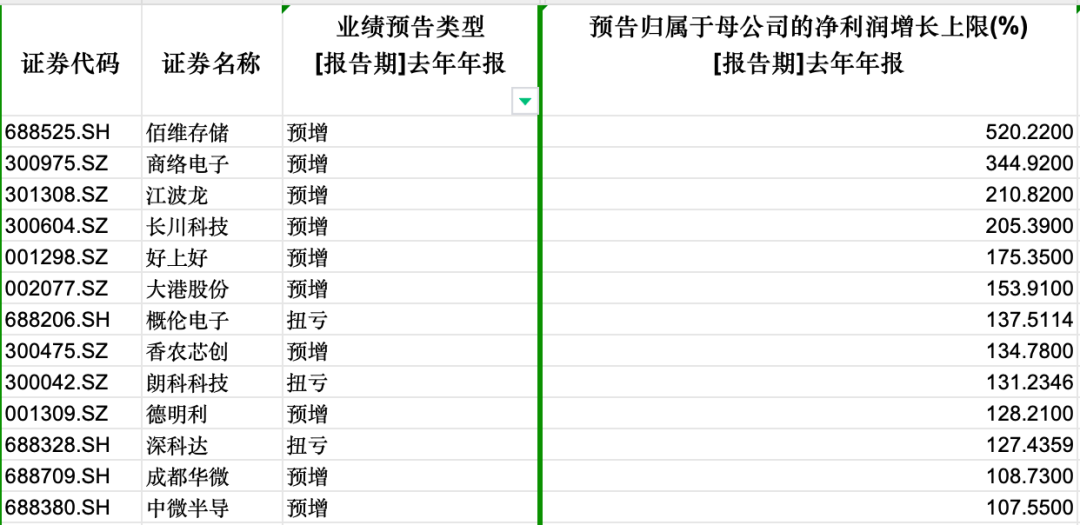
Core Viewpoint - The storage chip market is experiencing a "super cycle" driven by AI, leading to significant price increases and improved profitability for storage companies, while terminal manufacturers face pressure to raise prices or reduce specifications [1][3][7]. Group 1: Market Dynamics - The storage market is emerging from a low point, with many companies reporting substantial profit increases due to stabilizing prices driven by AI demand [1][2]. - As of January 29, 2026, 52 storage-related companies in the A-share market have issued performance forecasts for 2025, with 25 companies expecting profit increases, and 31 companies reporting year-on-year net profit growth [1][2]. - Notable profit increases include Bawei Storage with a projected growth of 520.22%, Shangluo Electronics at 344.92%, and Jiangbolong at 210.82% [2]. Group 2: Price Trends - Market research indicates that storage prices are expected to rise by 40% to 50% in Q1 2026 and by approximately 20% in Q2 2026, surpassing historical highs [3][4]. - Companies like Jiangbolong attribute their recovery to the stabilization of storage prices and increased demand from AI servers, leading to a supply-demand imbalance [2][5]. Group 3: Competitive Positioning - Storage manufacturers are shifting focus from consumer markets to enterprise-level markets, such as data centers and AI servers, where profit margins are higher due to lower price sensitivity [5][6]. - Companies are investing in technology and production capabilities to enhance their competitive edge, with Jiangbolong planning to raise 3.7 billion yuan for technology development and production expansion [6]. Group 4: Impact on Terminal Manufacturers - Terminal manufacturers are facing significant cost pressures due to rising component prices, leading to a projected 14.8% decrease in global laptop shipments in Q1 2026 [7][8]. - Major brands like Lenovo and Dell have begun raising prices on their products, with Lenovo increasing prices by 500 to 1500 yuan on mid-to-high-end models [8][9]. - The rising costs of memory components are impacting the profitability of smartphone manufacturers, with companies like Transsion Holdings reporting a 54.11% decline in net profit due to increased supply chain costs [9].


存储公司业绩普遍预增 机构预计短缺和涨价会持续
Zhong Guo Jin Rong Xin Xi Wang· 2026-01-30 15:06
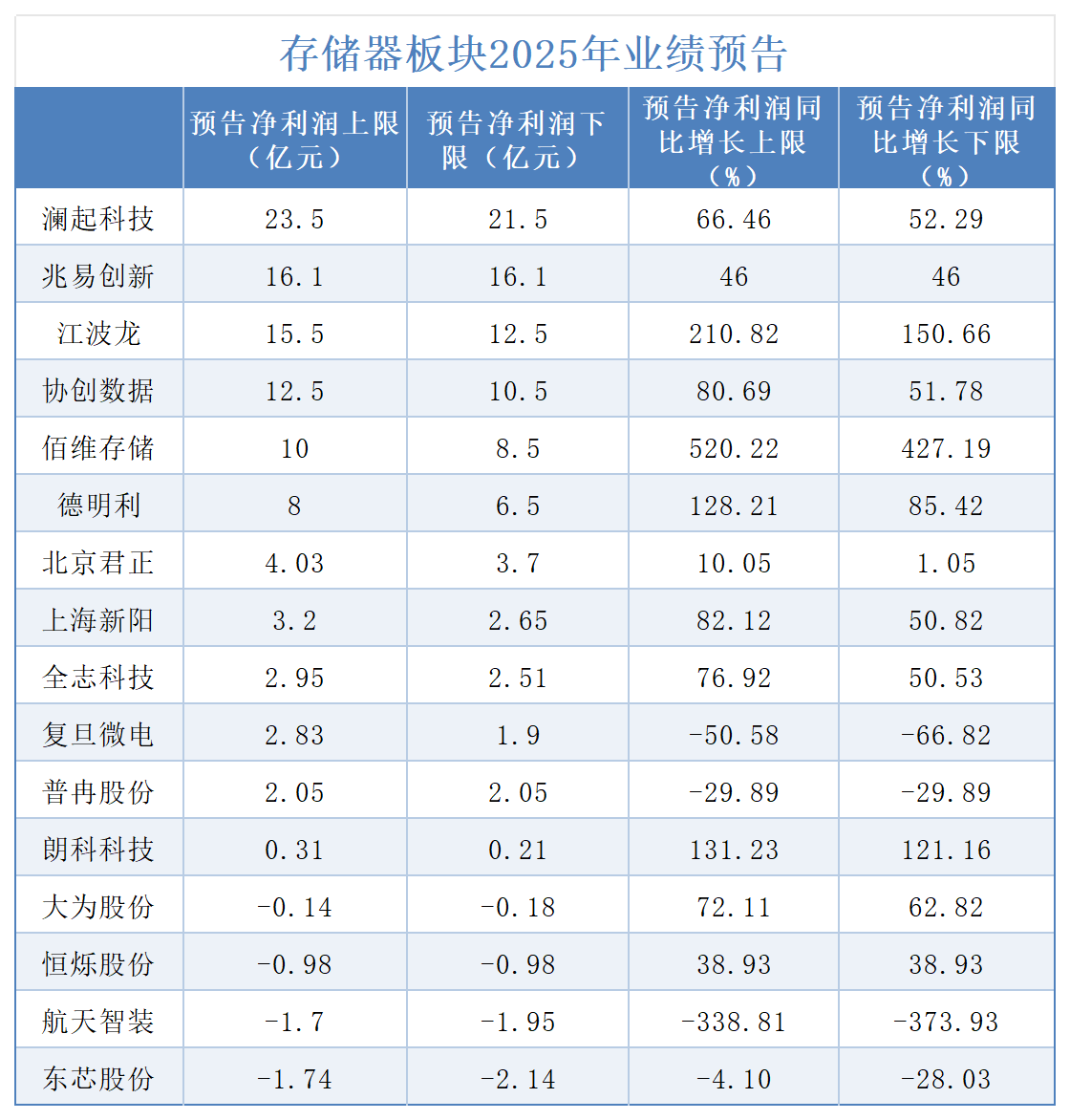
Core Viewpoint - The storage industry is experiencing a significant increase in profitability, driven by the growth of AI and computing power, leading to a high prosperity cycle and rising product prices [1][7]. Group 1: Company Performance Forecasts - Baiwei Storage is expected to achieve a net profit of 8.5 billion to 10 billion yuan in 2025, representing a year-on-year growth of 427.19% to 520.22% [2][3]. - Jiangbolong forecasts a net profit of 12.5 billion to 15.5 billion yuan, with a year-on-year increase of 150.66% to 210.82% [4][3]. - Demingli anticipates a revenue of 103 billion to 113 billion yuan, with a year-on-year growth of 115.82% to 136.77%, and a net profit of 6.5 billion to 8 billion yuan, reflecting an increase of 85.42% to 128.21% [6][3]. Group 2: Industry Trends and Drivers - The growth in the storage sector is primarily attributed to the booming AI and computing power industries, which have led to a high demand and rising prices for storage products [7][8]. - The global storage industry is expected to maintain high prosperity through 2026, with price increases anticipated to continue throughout the year, particularly driven by AI demand [7][8]. - The current cycle of price increases is influenced by structural supply-demand mismatches, with AI server demand significantly outpacing other segments [8][7]. Group 3: Market Dynamics and Future Outlook - The storage market is projected to expand due to increasing data and AI proliferation, with a notable rise in demand for storage technology across various sectors [8][7]. - The price of storage products has already seen substantial increases in 2025, with further rises expected in 2026, driven by both AI servers and general server demands [8][7]. - Companies are actively expanding production capacities in response to the favorable market conditions, with domestic manufacturers like Baiwei Storage and Jiangbolong leading the charge [7][8].


德明利:公司业绩表现受行业景气度、业务开拓、研发创新等多重因素综合影响
Zheng Quan Ri Bao Zhi Sheng· 2026-01-30 11:12
证券日报网讯 1月30日,德明利在互动平台回答投资者提问时表示,公司业绩表现受行业景气度、业务 开拓、研发创新等多重因素综合影响。公司深耕存储行业多年,具备应对行业周期变化做好供应链管控 与库存管理的核心运营能力。公司未来将进一步把握行业发展机遇,依托在存储领域的技术、供应链及 市场布局等核心优势努力提升经营效益,具体业绩情况请以公司披露的定期报告为准。 (编辑 袁冠琳) ...
受涨价潮影响,多家存储企业业绩预增
3 6 Ke· 2026-01-30 00:20
Core Viewpoint - Several storage companies have reported significant profit increases for 2025, driven by a price surge in the industry [1] Group 1: Company Performance - Jiangbolong announced an earnings forecast for 2025, expecting a net profit attributable to shareholders of 1.25 billion to 1.55 billion yuan, representing a year-on-year growth of 150.66% to 210.82% [1] - Other storage companies, including Baiwei Storage, Zhaoyi Innovation, Demingli, and Langke Technology, are also expected to report profit increases due to the same price surge [1]

利基存储紧缺持续,AI需求打开增量空间
Orient Securities· 2026-01-29 01:45
Investment Rating - The report maintains a "Positive" investment rating for the electronic industry [5] Core Insights - The ongoing shortage of niche storage is expected to continue, with AI demand opening up incremental growth opportunities [2][8] - AI demand is anticipated to drive the need for niche storage, particularly in applications such as automotive, industrial, and security [7] - Domestic manufacturers are positioned competitively in the niche storage market and are likely to benefit from the supply constraints caused by international suppliers exiting this segment [7] Summary by Sections Investment Recommendations and Targets - Key investment targets include domestic storage chip design companies such as Zhaoyi Innovation, Puran, Jucheng, Dongxin, Beijing Junzheng, and Hengshuo [3][8] - Other relevant companies include domestic storage module manufacturers like Jiangbolong, Demingli, and Baiwei Storage, as well as semiconductor equipment firms such as Zhongwei, Jingzhida, and Beifang Huachuang [3][8] - Companies benefiting from storage technology iterations include Lanke Technology, Lianyun Technology, and Aojie Technology [3][8] Market Dynamics - The supply of niche storage products is being significantly reduced as major international suppliers focus on mainstream storage products, leading to a substantial contraction in supply [7] - For instance, the global MLC NAND Flash capacity is projected to decrease by 41.7% in 2026 due to supply shrinkage, which is expected to drive prices significantly higher [7] - Domestic firms are gaining market share in niche storage, with Zhaoyi Innovation holding approximately 18.5% of the NOR Flash market in 2024, ranking second globally [7]



电子行业周报:缺货涨价从结构性到全面性,AI 算力+存力持续高景气
Guoxin Securities· 2026-01-28 00:45
Investment Rating - The report maintains an "Outperform" rating for the electronics industry [1][10]. Core Insights - The report highlights a transition from structural shortages to widespread price increases in the electronics sector, driven by sustained high demand for AI computing and storage capabilities. This inflationary trend is expected to enhance the earnings outlook for related companies [1]. - The report expresses optimism for 2026, predicting it to be a year of significant growth for domestic hard technology, driven by innovations in AI smartphones, AI glasses, and foldable screens [1]. - The report recommends focusing on companies involved in self-controllable manufacturing (foundry and equipment) and those in the overseas storage and computing supply chain [1]. Summary by Sections Market Trends - The Shanghai Composite Index rose by 0.84%, while the electronics sector increased by 1.39%. Sub-sectors such as optical optoelectronics saw a rise of 3.21%, whereas consumer electronics declined by 0.69% [1][13]. - Global AI computing and storage demand continues to drive resource competition within the electronics supply chain, leading to price increases across various components [1]. Semiconductor and Storage - The report notes a significant increase in storage prices, with NAND Flash prices rising by 18% and DRAM prices by 33% over the past month. This has led to increased cost proportions for PC manufacturers [3]. - Companies like 德明利 (Demingli) and 江波龙 (Jiangbolong) are expected to see substantial profit growth due to the ongoing storage cycle [3]. PCB Industry - The report indicates that rising raw material prices and demand growth are positively impacting the performance of PCB upstream manufacturers. Companies in this sector are expected to exceed market expectations [4]. - Recommendations include companies like 生益科技 (Shengyi Technology) and 芯碁微装 (Xinqi Micro) [4]. Key Company Recommendations - The report recommends several companies for investment, including 蓝特光学 (Lante Optics), 翱捷科技 (Aojie Technology), and 中芯国际 (SMIC), among others, based on their potential in the current market environment [1][9].
产品涨价驱动 存储芯片公司业绩亮眼
Shang Hai Zheng Quan Bao· 2026-01-28 00:09
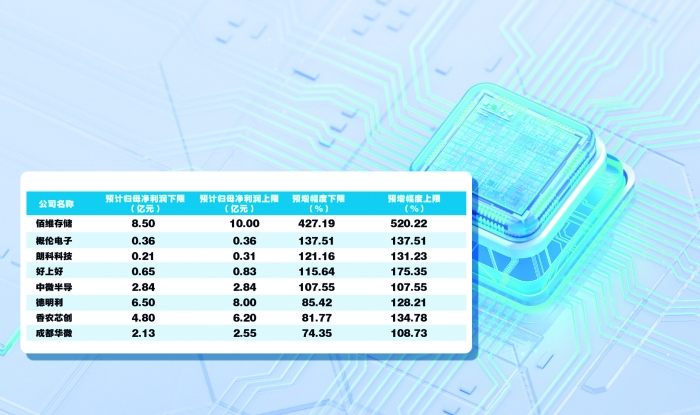
Core Insights - The storage chip industry is experiencing significant growth driven by rising product prices and increased demand from AI and computing sectors, with expectations of continued high prosperity through 2026 [1][4][5] - Major companies in the storage sector, including both global leaders and domestic firms, are actively expanding production capacities to capitalize on this favorable market cycle [1][6] Group 1: Industry Performance - As of January 27, 2025, 34 storage-related companies in the A-share market have released earnings forecasts, with 19 companies reporting profitability, and 17 showing year-on-year profit growth, indicating a robust performance across the sector [2] - Notably, Bawei Storage is projected to achieve a revenue of 10 billion to 12 billion yuan, representing a year-on-year increase of 49.36% to 79.23%, and a net profit of 850 million to 1 billion yuan, reflecting a staggering growth of 427.19% to 520.22% [2] - Demingli, another leading company, anticipates revenues between 10.3 billion to 11.3 billion yuan, with a year-on-year growth of 115.82% to 136.77%, and a net profit of 650 million to 800 million yuan, marking an increase of 85.42% to 128.21% [2] Group 2: Price Dynamics - The primary driver of the high growth in the storage chip industry is the entry into a prosperous cycle and the increase in product prices, particularly influenced by AI demand and supply constraints [4] - Starting from the second quarter of 2025, the global storage industry began to rebound, with major companies like SanDisk initiating price increases, prompting others such as Samsung and Micron to follow suit [4] Group 3: Future Outlook - Industry experts predict that the core cycle of rising storage prices will last until the end of 2026, with high prosperity expected to continue at least until 2027, and the HBM segment may not see a price turning point until early 2028 [5] - A recent example includes Kioxia, which reported that its NAND flash memory capacity for 2026 is fully sold out, indicating a tight supply situation expected to persist until at least 2027 [5] Group 4: Expansion Strategies - In response to the ongoing high demand, both international and domestic manufacturers are ramping up production, focusing on HBM and high-end NAND sectors, with capacity expansions planned for 2026 to 2028 [6] - Companies like Kioxia and Micron are making significant investments to enhance their production capabilities, with Kioxia planning to double its NAND capacity over the next five years and Micron investing $24 billion to expand its Singapore facility [6][7] - Domestic firms such as Yangtze Memory Technologies and Changxin Memory Technologies are also advancing their production capabilities, while companies like Bawei Storage and Demingli are pursuing capital increases to fund expansion projects [6][7]
存储芯片公司业绩亮眼 行业高景气2026年仍将持续
Shang Hai Zheng Quan Bao· 2026-01-27 22:31
Core Viewpoint - The profitability growth of storage chip companies is driven by the booming AI and computing industries, leading to a high prosperity cycle and continuous price increases in products [1] Group 1: Industry Performance - As of January 27, 2025, 34 storage concept companies in A-shares have released performance forecasts, with 19 companies achieving profitability, and 17 companies showing year-on-year profit growth, representing a 50% success rate [2] - Notably, 8 companies have projected profit growth exceeding 100%, with Baiwei Storage leading the growth [2] - Baiwei Storage expects revenue of 10 billion to 12 billion yuan, a year-on-year increase of 49.36% to 79.23%, and net profit of 850 million to 1 billion yuan, a year-on-year increase of 427.19% to 520.22% [2] Group 2: Price Increases - The primary reason for the high growth in the storage chip industry is the entry into a high prosperity cycle and product price increases [4] - Baiwei Storage indicated that from Q2 2025, as storage prices stabilize and rise, the company's sales revenue and gross margin will gradually improve [4] - The global storage industry began to rebound from Q2 2025, with major manufacturers like SanDisk initiating price increases, followed by others like Samsung and Micron [4] Group 3: Future Trends - The core factors behind the current price increases in storage chips are the explosive demand from AI and supply contractions, leading to structural supply-demand mismatches [5] - Industry experts predict that the core cycle of rising storage prices will last until the end of 2026, with high prosperity expected to continue at least until 2027 [5] Group 4: Expansion Strategies - Companies are actively expanding production to seize opportunities during the high prosperity cycle [6] - International manufacturers are focusing on expanding HBM and high-end NAND production capacities, with plans to gradually release these capacities from 2026 to 2028 [6] - Domestic manufacturers like Yangtze Memory and Changxin Technology are also accelerating their production expansion and technological upgrades [6] Group 5: Specific Company Actions - De Ming Li plans to raise no more than 3.2 billion yuan for SSD and DRAM expansion projects and to support its smart storage management and R&D headquarters [7] - Pu Ran Co. is enhancing its core competitiveness in the storage chip field through the acquisition of Noah Chang Tian, which allows it to take over SK Hynix's 2D NAND-related business [7]
产品涨价驱动 存储芯片公司业绩亮眼 行业高景气2026年仍将持续 全球厂商扩产忙
Shang Hai Zheng Quan Bao· 2026-01-27 18:38
Core Insights - The storage chip industry is experiencing significant profitability growth driven by the demand from AI and computing sectors, leading to a high prosperity cycle and continuous product price increases [1] - The high prosperity in the storage chip industry is expected to persist into 2026, with price increases anticipated throughout the year, particularly in the HBM segment, which may remain robust until 2028 [1] Group 1: Company Performance - As of January 27, 2025, 34 storage concept companies in the A-share market have released performance forecasts, with 19 companies reporting profitability, and 17 companies showing year-on-year profit growth, indicating a 50% success rate [2] - Among these, Bawei Storage is leading with an expected revenue of 10 billion to 12 billion yuan, representing a year-on-year growth of 49.36% to 79.23%, and a projected net profit of 850 million to 1 billion yuan, reflecting a staggering growth of 427.19% to 520.22% [2] - Leading companies like Demingli and Zhaoyi Innovation are also reporting strong performance, with Demingli forecasting revenues of 10.3 billion to 11.3 billion yuan, a year-on-year increase of 115.82% to 136.77%, and net profits of 650 million to 800 million yuan, up by 85.42% to 128.21% [2] Group 2: Industry Trends - The primary driver of the high growth in the storage chip industry is the entry into a high prosperity cycle and product price increases, with companies like Bawei Storage and Demingli reporting improvements in sales revenue and gross margins due to stabilizing storage prices [4] - The global storage industry began to rebound from the second quarter of 2025, with major manufacturers like SanDisk initiating price increases, followed by others such as Samsung and Micron [4] - The current price increase cycle is attributed to a structural supply-demand mismatch caused by an explosion in AI demand and supply constraints, with expectations that the price increase cycle will last until the end of 2026 and high prosperity until at least 2027 [5] Group 3: Expansion Strategies - In response to the ongoing high prosperity and rising product prices, storage companies are announcing expansion plans to capitalize on the industry cycle [6] - International manufacturers are focusing on expanding HBM and high-end NAND production capacities, with companies like Kioxia planning to double its NAND capacity over the next five years to meet growing AI data center demands [6] - Domestic companies such as Yangtze Memory Technologies and Changxin Memory Technologies are also ramping up production, with Bawei Storage and Demingli pursuing capital increases for expansion projects [7]
产品涨价驱动 存储芯片公司业绩亮眼 行业高景气2026年仍将持续,全球厂商扩产忙
Shang Hai Zheng Quan Bao· 2026-01-27 18:36
Core Viewpoint - The storage chip industry is experiencing significant growth driven by AI demand and rising product prices, leading to a high profitability forecast for various companies in the sector [1][5][6]. Group 1: Company Performance Forecasts - Baiwei Storage expects a net profit of 8.5 billion to 10 billion, representing a growth of 427.19% to 520.22% [1][3]. - Demingli anticipates a net profit of 6.5 billion to 8 billion, with a growth rate of 85.42% to 128.21% [3][4]. - 34 storage concept companies have released 2025 performance forecasts, with 19 companies showing profit growth, indicating a 50% success rate [3]. Group 2: Industry Trends and Drivers - The storage chip industry is projected to maintain high profitability through 2026, particularly in the HBM segment, driven by AI demand [2][6]. - The price increase in storage products is attributed to a high demand from AI applications and a supply contraction, leading to a structural supply-demand mismatch [6][7]. - Major companies like Samsung and Micron are expanding production capacities to meet the growing demand, with specific plans to increase DRAM and NAND production [7][8]. Group 3: Expansion and Investment Strategies - Domestic companies such as Changjiang Storage and Changxin Technology are ramping up capital expenditures and production capacity to capitalize on the industry's growth [2][7]. - Baiwei Storage and Demingli are actively pursuing expansion through fundraising and mergers to enhance their core competencies in the storage chip market [8].