Sinoma Science & Technology (002080)

Search documents
玻璃玻纤板块1月26日跌0.56%,再升科技领跌,主力资金净流出5.51亿元
Zheng Xing Xing Ye Ri Bao· 2026-01-26 09:34
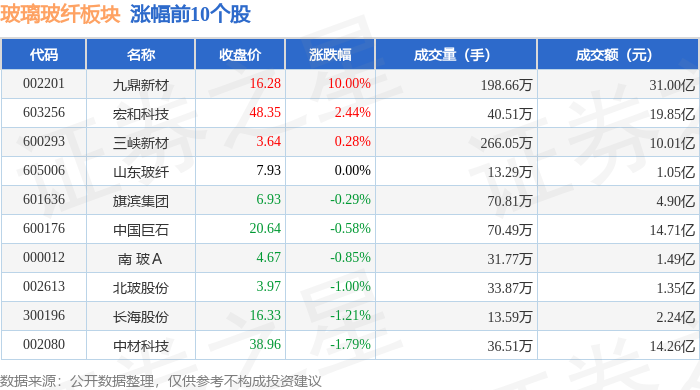
Market Overview - The glass and fiberglass sector experienced a decline of 0.56% on January 26, with Zaiseng Technology leading the drop [1] - The Shanghai Composite Index closed at 4132.61, down 0.09%, while the Shenzhen Component Index closed at 14316.64, down 0.85% [1] Stock Performance - Jiuding New Materials (002201) saw a significant increase of 10.00%, closing at 16.28 with a trading volume of 1.9866 million shares and a transaction value of 3.1 billion [1] - Honghe Technology (603256) increased by 2.44%, closing at 48.35 with a trading volume of 405,100 shares [1] - Other notable performances include: - Sanxia New Materials (600293) up 0.28% at 3.64 - Shandong Fiberglass (605006) remained unchanged at 7.93 - Qibin Group (601636) down 0.29% at 6.93 - China Jushi (600176) down 0.58% at 20.64 [1] Capital Flow - The glass and fiberglass sector saw a net outflow of 551 million in main funds, while retail investors contributed a net inflow of 536 million [2] - The sector's capital flow indicates that retail investors are more active compared to institutional investors [2] Individual Stock Capital Flow - China Jushi (600176) had a main fund net inflow of 84.17 million, but retail investors showed a net outflow of 54.68 million [3] - Honghe Technology (603256) experienced a main fund net inflow of 143.88 million, while retail investors had a net inflow of 81.73 million [3] - Other stocks like Jiuding New Materials (002201) and Shandong Fiberglass (605006) also showed mixed capital flows, with significant retail participation [3]


中材科技跌2.04%,成交额9.55亿元,主力资金净流出5019.56万元
Xin Lang Cai Jing· 2026-01-26 05:37
Core Viewpoint - Zhongcai Technology's stock has experienced fluctuations, with a recent decline of 2.04% and a total market capitalization of 65.21 billion yuan, while the company shows a year-to-date stock price increase of 6.93% [1] Group 1: Financial Performance - For the period from January to September 2025, Zhongcai Technology achieved operating revenue of 21.701 billion yuan, representing a year-on-year growth of 29.09% [2] - The net profit attributable to shareholders for the same period was 1.48 billion yuan, reflecting a significant year-on-year increase of 143.24% [2] Group 2: Shareholder Information - As of September 30, 2025, Zhongcai Technology had 63,000 shareholders, a decrease of 2.56% from the previous period, with an average of 26,621 circulating shares per shareholder, which is an increase of 2.63% [2] - The company has distributed a total of 5.712 billion yuan in dividends since its A-share listing, with 2.425 billion yuan distributed in the last three years [3] Group 3: Stock Trading Activity - On January 26, Zhongcai Technology's stock price was reported at 38.86 yuan per share, with a trading volume of 9.55 billion yuan and a turnover rate of 1.45% [1] - The net outflow of main funds was 50.20 million yuan, with significant buying and selling activity from large orders [1]

建筑材料行业周报:新一轮城市更新开启,关注消费建材底部向上的弹性-20260125
East Money Securities· 2026-01-25 14:49
Investment Rating - The report maintains an "Outperform" rating for the construction materials sector, indicating a positive outlook compared to the broader market [2] Core Views - A new round of urban renewal is beginning, which is expected to provide significant opportunities in the consumer building materials sector, effectively countering the decline in new housing market demand [8] - The report highlights that after a prolonged downturn in the real estate sector, profitability in various segments of the construction supply chain is starting to recover, particularly for leading companies that have undergone strategic adjustments [8] - The report emphasizes the potential for price increases in certain segments, such as waterproofing and coatings, as companies respond to improved market conditions [8] Summary by Sections Cement - The cement market is entering a seasonal downturn, with demand expected to decline. The average shipment rate for major regions has dropped to 29%, a decrease of approximately 10 percentage points [27][34] - The national average price for cement remains stable at around 353 RMB per ton, with minor fluctuations observed in specific regions [28][34] - The report suggests that after the Spring Festival, demand may recover as new key projects are expected to commence, potentially stabilizing prices [34] Glass - The glass market is also experiencing a decline in demand, with production capacity decreasing to approximately 14.95 million tons, the lowest in recent years [53] - The average price for float glass has increased slightly to 1,139 RMB per ton, with inventory levels decreasing [38] - The report indicates that the glass industry is facing profitability challenges, leading to accelerated production line cold repairs, which may help stabilize the market [53] Fiberglass - The fiberglass market is seeing stable pricing for both roving and electronic fabrics, with the price of 7628 electronic fabric currently at approximately 4.4-4.85 RMB per meter [55] - The report anticipates continued high demand for electronic fabrics, supported by structural adjustments and a shortage of high-end products [55] - Key recommendations include focusing on leading companies like China Jushi, with additional attention on International Composite Materials and Zhongcai Technology [55] Carbon Fiber - Carbon fiber prices are expected to remain stable in the short term, with the rapid development of commercial aerospace potentially driving new demand [55] - The report notes that the current price stability is a necessary step for increased market penetration, with significant growth expected in the aerospace sector [55] Consumer Building Materials - The report highlights the resilience of consumer building materials, with leading companies like Sanke Tree and Rabbit Baby showing strong growth potential as they emerge from profitability challenges [8] - The urban renewal initiative is expected to create substantial market opportunities, particularly for high-quality consumer building materials [8]


长江新能源产业混合型A:2025年第四季度利润1224.32万元 净值增长率10.18%
Sou Hu Cai Jing· 2026-01-24 08:44
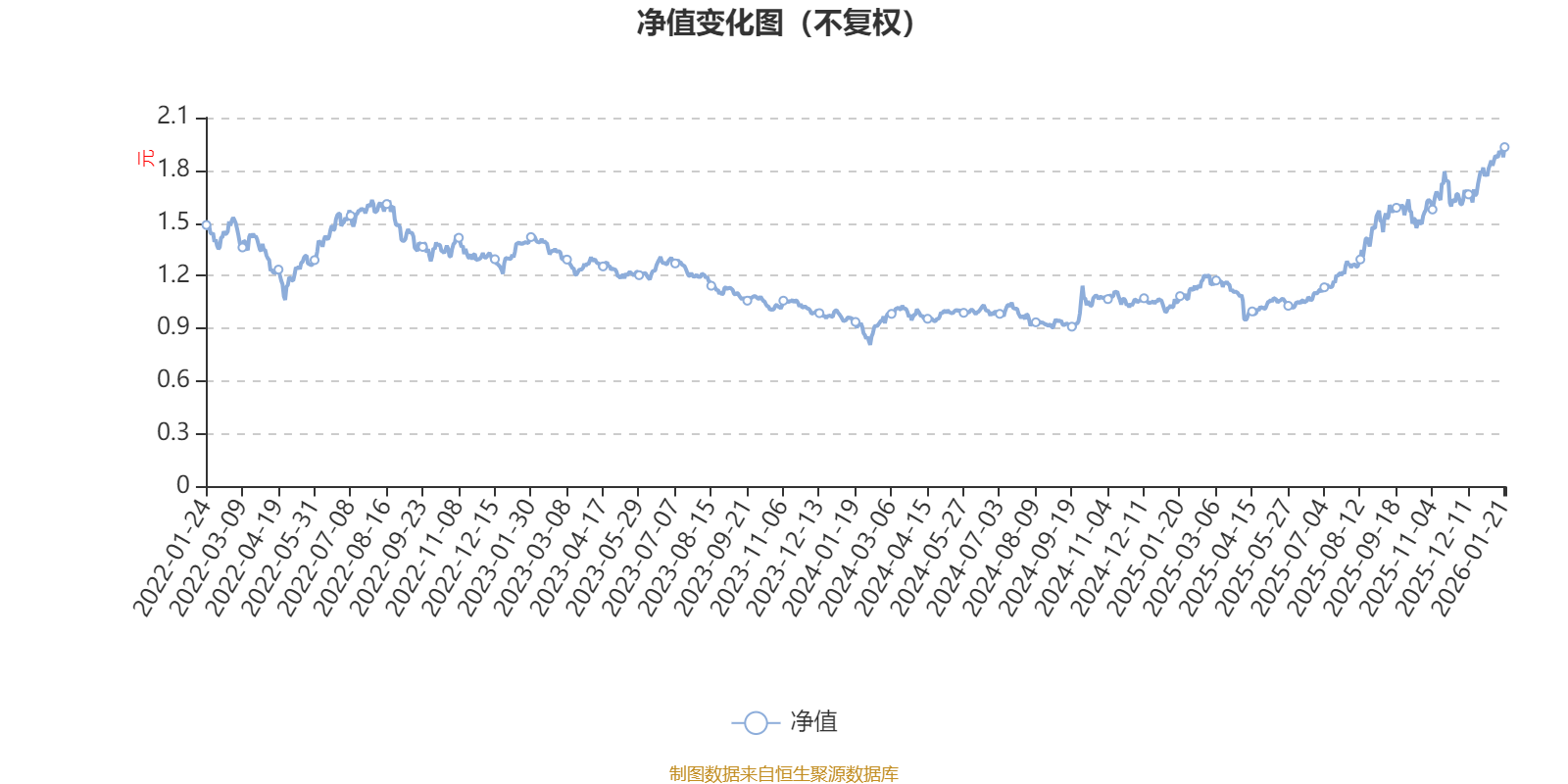
Core Insights - The AI Fund Changjiang New Energy Industry Mixed A (011446) reported a profit of 12.24 million yuan for Q4 2025, with a weighted average profit per fund share of 0.1594 yuan. The fund's net value growth rate for the reporting period was 10.18%, and the fund size reached 123 million yuan by the end of Q4 2025 [2][13]. Fund Performance - As of January 21, the fund's unit net value was 1.932 yuan. Over the past year, the fund achieved a cumulative growth rate of 76.8%, outperforming its peers [2]. - The fund's performance over different time frames includes a 27.27% growth rate over the past three months, ranking 7 out of 621 comparable funds, and a 59.78% growth rate over the past six months, ranking 27 out of 621 [3]. Investment Strategy - The fund focuses on the new energy industry and its upstream and downstream sectors, seeking opportunities in supply-demand reversals and technological advancements within the industry. The management plans to continue tracking and identifying investment opportunities in these areas [2]. Risk Metrics - The fund's Sharpe ratio over the past three years is 0.6629, ranking 173 out of 526 comparable funds [7]. - The maximum drawdown over the past three years was 43.48%, with the largest single-quarter drawdown occurring in Q2 2022 at 21.13% [9]. Portfolio Composition - As of December 31, the fund's average stock position over the past three years was 78.37%, compared to the industry average of 85.83%. The fund reached its highest stock position of 86.26% at the end of 2021 and its lowest of 72.55% by the end of Q3 2024 [12]. - The top ten holdings of the fund include Tianqi Lithium, Huayou Cobalt, CATL, Tianhua New Energy, Yongxing Materials, China National Materials, Liyuanheng, Guoci Materials, Sifang Co., and Keda Technology [16].





AI驱动高端产品规模量产 PCB公司2025年业绩强势预增
Shang Hai Zheng Quan Bao· 2026-01-23 18:12
Core Viewpoint - The PCB industry is experiencing significant growth driven by the demand for high-end products, particularly due to advancements in AI data centers and related technologies, leading to a positive outlook for 2025 earnings across various companies in the sector [1][2]. Group 1: Company Performance - Approximately 80% of the 20 PCB companies that have released earnings forecasts for 2025 expect profit growth, with companies like Jin'an Guoji and Shenghong Technology projecting net profit increases exceeding 250% [1]. - Shenghong Technology anticipates a net profit of 4.16 billion to 4.56 billion yuan for 2025, representing a year-on-year growth of 260.35% to 295.00% [3]. - Founder Technology expects a net profit of 430 million to 510 million yuan for 2025, an increase of 67.06% to 98.14% compared to the previous year [3]. - Benchuan Intelligent forecasts a net profit of 30.4 million to 45.6 million yuan for 2025, reflecting a growth of 28.06% to 92.08% year-on-year [4]. Group 2: Market Trends - The demand for high-end PCB products, such as multilayer boards and HDI boards, is increasing due to the rising requirements for signal transmission rates and data loss in AI and high-performance computing [2]. - China is expected to maintain its position as the largest PCB production region, accounting for over 50% of global output in the coming years [2]. Group 3: Material and Equipment Upgrades - The continuous production of high-end products is driving the upstream materials and equipment sectors towards high-end upgrades, creating a robust market demand for high-end supporting products [5]. - Jin'an Guoji projects a net profit of 280 million to 360 million yuan for 2025, with a growth of 655.53% to 871.40% year-on-year, driven by improved market conditions for copper-clad laminates [6]. - Dafu Technology expects a net profit of 97 million to 125 million yuan for 2025, recovering from a loss of 245 million yuan in the previous year [6]. - The demand for high-end manufacturing equipment is surging, with companies like Dazhu CNC projecting a net profit of 785 million to 885 million yuan for 2025, an increase of 160.64% to 193.84% year-on-year [7]. Group 4: Emerging Technologies - Companies are expanding their focus on emerging markets such as AI power servers and robotics, with Benchuan Intelligent actively pursuing these opportunities [4]. - The demand for precision tools and polishing materials is also rising, with Ding Tai Gao Ke expecting a net profit of 410 million to 460 million yuan for 2025, reflecting a year-on-year growth of 80.72% to 102.76% [8].



如何看待电子布提价持续性-如何看待消费建材投资机会
2026-01-23 15:35
Summary of Conference Call Records Industry Overview - The conference call discusses the construction materials industry, particularly focusing on the demand for consumer building materials and the electronic cloth sector. The demand structure is shifting, with significant growth in the renovation of second-hand homes, indicating potential stability in the industry. The expected transaction area for second-hand homes in 2025 is projected to reach 600-700 million square meters, nearing the scale of the new housing market, suggesting substantial potential in the existing market [1][2]. Key Insights and Arguments - **Supply-Side Dynamics**: The construction materials industry has experienced a supply-side contraction, with most categories seeing a cumulative decline in production and sales of about 30% since 2021, while prices have only dropped by 15%. Leading companies like Oriental Yuhong have consolidated their market positions through economies of scale [1][4]. - **Performance of Leading Companies**: Companies such as Oriental Yuhong, Sankeshu, and others have shown strong performance, emerging from operational lows and demonstrating clear growth inflection points. For instance, Oriental Yuhong is expected to see significant cash flow improvement starting in 2024, with a projected revenue turnaround in Q3 2025 and an anticipated growth of over 30% in 2026 [5][6]. - **Electronic Cloth Market**: The electronic cloth segment is highlighted as having the highest probability of price increases within the fiberglass sector. The year 2026 is anticipated to be a pivotal year for Q cloth applications, with large-scale applications of second-generation cloth expected. Companies like China National Materials possess comprehensive technology that will enhance their performance amid industry upgrades [10][14]. - **Profitability Trends in Fiberglass Industry**: The fiberglass industry is currently at a historical low in unit profitability, with leading companies still profitable while smaller firms struggle. Demand growth is expected to be around 4-5% in 2026, with supply growth below 4%, indicating a potential upward trend in raw sand prices [9]. Additional Important Points - **Investment Opportunities**: The call emphasizes the importance of focusing on companies that have emerged from operational lows and show clear growth potential, particularly in the waterproof materials segment, which is expected to yield better investment returns [7]. - **Market Supply Constraints**: The supply of weaving machines is limited, with the only global supplier, Toyota, experiencing a significant reduction in production efficiency for thin cloth. This constraint is expected to impact the ordinary electronic cloth market, leading to a sustained price increase trend [12][13]. - **Future Projections**: The ordinary electronic cloth market is projected to experience a supply-demand gap in 2026, with inventory levels dropping significantly, indicating a potential for continued price increases. The PCB market is also expected to see slight growth, further supporting price increases in ordinary electronic cloth [11]. - **Recommended Companies**: The call suggests focusing on companies like China National Materials, China Jushi, and International Composites, which are positioned well to benefit from the anticipated market dynamics and price increases [14].


玻璃玻纤板块1月23日跌0.56%,国际复材领跌,主力资金净流出10.27亿元
Zheng Xing Xing Ye Ri Bao· 2026-01-23 09:04
Market Overview - The glass and fiberglass sector experienced a decline of 0.56% on January 23, with International Composite Materials leading the drop [1] - The Shanghai Composite Index closed at 4136.16, up 0.33%, while the Shenzhen Component Index closed at 14439.66, up 0.79% [1] Stock Performance - Notable gainers in the glass and fiberglass sector included: - Jinjing Technology (600586) with a closing price of 6.68, up 10.05% and a trading volume of 2.0262 million shares, totaling 1.331 billion yuan [1] - Sanxia New Materials (600293) closed at 3.63, up 10.00% with a trading volume of 1.4648 million shares, totaling 523 million yuan [1] - Jiuding New Materials (002201) closed at 14.80, up 6.78% with a trading volume of 2.2046 million shares, totaling 3.213 billion yuan [1] Fund Flow Analysis - The glass and fiberglass sector saw a net outflow of 1.027 billion yuan from institutional investors, while retail investors contributed a net inflow of 691 million yuan [2] - The main fund flow for key stocks included: - Jinjing Technology had a net inflow of 1.821 billion yuan from institutional investors, but a net outflow of 940.533 million yuan from speculative funds [3] - Sanxia New Materials experienced a net inflow of 880.962 million yuan from institutional investors, with a net outflow of 278.971 million yuan from speculative funds [3] - Flag Group (601636) had a net inflow of 434.656 million yuan from institutional investors, while speculative funds saw a net outflow of 325.892 million yuan [3]



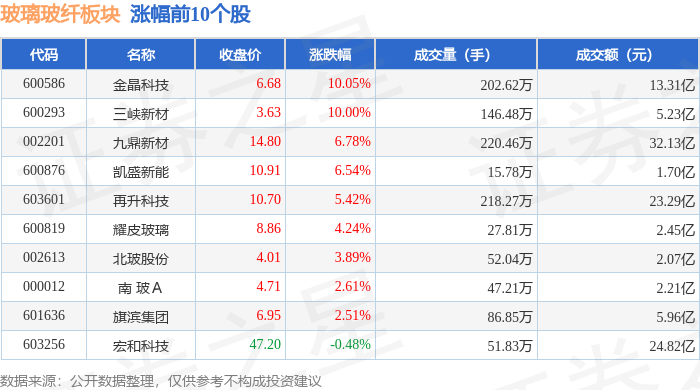
玻璃玻纤板块1月22日涨5.42%,九鼎新材领涨,主力资金净流入9.52亿元
Zheng Xing Xing Ye Ri Bao· 2026-01-22 09:01
证券之星消息,1月22日玻璃玻纤板块较上一交易日上涨5.42%,九鼎新材领涨。当日上证指数报收于 4122.58,上涨0.14%。深证成指报收于14327.05,上涨0.5%。玻璃玻纤板块个股涨跌见下表: | 代码 | 名称 | 收盘价 | 涨跌幅 | 成交量(手) | 成交额(元) | | --- | --- | --- | --- | --- | --- | | 002201 | 九鼎新材 | 13.86 | 10.00% | 86.00万 | 11.59亿 | | 603256 | 宏和科技 | 47.43 | 10.00% | 46.37万 | 21.29亿 | | 603601 | 再升科技 | 10.15 | 9.97% | 156.28万 | 15.36亿 | | 301526 | 国际复材 | 8.69 | 7.02% | 272.53万 | 22.66亿 | | 600586 | 金晶科技 | 6.07 | 5.20% | 57.42万 | 3.43 Z | | 002080 | 中材科技 | 41.14 | 4.76% | 82.43万 | 33.22亿 | | 601636 | | 6. ...

超600家上市公司预告2025年业绩
Shang Hai Zheng Quan Bao· 2026-01-21 18:12
Group 1: Chemical and Metal Industries - Several chemical companies, including Xinong Co. and Dayang Bio, are showing continuous improvement in their operations [1] - The non-ferrous metal sector benefits from high prices and capacity release, with Zijin Mining expected to achieve a net profit of 51 billion to 52 billion yuan in 2025, a year-on-year increase of 59% to 62% [1] - Zijin Mining's growth is driven by increased production and higher sales prices of gold, copper, and silver [1] - The high-end manufacturing sector shows resilience, with Okoyi's net profit projected to grow by 67.53% to 91.96% in 2025, despite rising raw material costs [1] - The new materials industry is also performing well, with China National Materials Technology expected to achieve a net profit of 1.55 billion to 1.95 billion yuan in 2025, a year-on-year increase of 73.79% to 118.64% [1] Group 2: International Market Growth - The overseas market is becoming a new growth engine for many listed companies [2] - Siyuan Electric is expected to achieve total revenue of 21.205 billion yuan in 2025, a year-on-year increase of 37.18%, and a net profit of 3.163 billion yuan, up 54.35% [2] - Absen, a leading global LED display provider, anticipates a net profit of 240 million to 290 million yuan in 2025, representing a year-on-year growth of 105.32% to 148.09% [2] - Absen's overseas revenue reached approximately 3.193 billion yuan, a year-on-year increase of about 8.94% [2] Group 3: Company-Specific Developments - Chutian Technology expects a net profit of 235 million to 300 million yuan in 2025, marking a turnaround to profitability driven by strong international market breakthroughs [3] - The company has made significant progress in Southeast Asia, the Middle East, and the Americas, with overseas sales revenue steadily increasing [3] - Hangcha Group is also expanding into emerging markets while consolidating its traditional markets, indicating the effectiveness of its globalization strategy [3]




高速覆铜板CCL:四大核心材料机遇与挑战(附报告)
材料汇· 2026-01-21 15:30
Core Viewpoint - The article emphasizes the AIPCB wave and highlights the investment opportunities arising from the upgrade of M9 materials, focusing on four main lines of development [1]. Group 1: Low Dielectric Electronic Fabrics - The transition from LDK to second-generation fabrics is underway, with M9 paired with Q fabrics evolving towards third-generation products [17]. - The market for low dielectric electronic fabrics is expected to grow rapidly, driven by AI server demand, with a projected compound annual growth rate of 23.8% from 2024 to 2033 [20][23]. Group 2: Electronic Resins - The use of hydrocarbon resins in M9 is expected to increase significantly, with a ratio of hydrocarbon resins to PPO rising to 2:1, enhancing the value of materials [31][34]. - New types of resins are becoming mainstream, with hydrocarbon resins being the preferred choice for next-generation high-frequency CCLs [31][39]. Group 3: Fillers - The proportion of spherical silica micro-powder in M9 is expected to increase significantly, with high-performance spherical silica micro-powder filling ratios expanding to over 40% [36][40]. - Liquid-phase preparation methods for silica are becoming the industry standard, meeting the requirements for M7 and above [40]. Group 4: Other Upstream PCB Materials - Attention is drawn to electronic-grade fluorinated copper powder and PCB-specific electronic chemicals, which are essential for the upgrade trends in high-end PCBs [3][43]. - The supply of high-end materials, including Low Dk electronic fabrics and HVLP copper foil, is facing shortages, with major manufacturers accelerating production to meet demand [7][29]. Group 5: Market Performance - The demand for high-end CCL driven by AI is accelerating the upgrade of upstream materials, with significant performance improvements observed in various AIPCB sub-sectors since mid-2025 [5][8]. - The average increase in AIPCB sub-sector indices from May to August 2025 shows substantial growth, particularly in electronic fabrics and copper foil [6]. Group 6: Investment Recommendations - Companies to watch include: 1. Low dielectric electronic fabrics: Honghe Technology, Feilihua, Zhongcai Technology [4]. 2. HVLP networks: Gangguan Copper Foil, Rongfu Technology, Longyang Electronics [4]. 3. Electronic resins: Dongcai Technology, Shengnong Group, Hongchang Electronics, Tongzi New Materials [4]. 4. Other upstream materials: Jiangnan New Materials for electronic-grade oxidized copper powder, Tiancheng Technology for PCB-specific electronic chemicals [4].