
BANK OF QINGDAO(002948)

Search documents
银行业2025年四季度监管数据总结:利润增速回正,息差连续两季度企稳
GF SECURITIES· 2026-02-26 14:05
Investment Rating - The industry investment rating is "Buy" [2] Core Viewpoints - The banking industry has shown a recovery in profit growth, with net profit for commercial banks increasing by 2.33% year-on-year in 2025, reflecting a quarter-on-quarter improvement of 2.35 percentage points [13][14] - The overall asset growth of commercial banks continued, with total assets increasing by 9.01% year-on-year as of Q4 2025, while loan growth slightly decreased to 7.26% year-on-year [29][30] - Net interest margin stabilized for two consecutive quarters at 1.42%, with expectations for a gradual recovery in 2026 [54] Summary by Sections Performance - The net profit of commercial banks increased by 2.33% year-on-year in 2025, with state-owned banks, joint-stock banks, city commercial banks, and rural commercial banks showing growth rates of 2.25%, -2.84%, 12.87%, and 4.57% respectively [13][14] - The return on equity (ROE) and return on assets (ROA) for commercial banks were 7.78% and 0.60%, reflecting a year-on-year decline of 0.33 percentage points and 0.03 percentage points respectively [13] Scale - Total assets of commercial banks grew by 9.01% year-on-year as of Q4 2025, with state-owned banks showing a growth rate of 10.78% [29][30] - Loan growth for commercial banks was 7.26% year-on-year, with city commercial banks experiencing a counter-cyclical increase in loan growth [29][30] Interest Margin - The net interest margin for commercial banks was stable at 1.42%, with a year-on-year decline of 10.50 basis points [54] - Expectations for 2026 indicate potential downward pressure on net interest margins in Q1, but a gradual recovery is anticipated thereafter [54] Asset Quality - The non-performing loan ratio for commercial banks was 1.50%, showing a quarter-on-quarter decrease of 2.00 basis points, while the provision coverage ratio was 205.21% [54] Capital - The core Tier 1 capital adequacy ratio for commercial banks was 10.92%, reflecting a quarter-on-quarter increase of 0.05 percentage points [54]




202601信贷收支表:大型银行短贷显著增加,中小银行信贷增长放缓
GUOTAI HAITONG SECURITIES· 2026-02-25 09:23
Investment Rating - The report assigns an "Accumulate" rating for the banking sector [5]. Core Insights - The report highlights that the Lunar New Year misalignment has disrupted the deposit growth rhythm, with a continued trend of personal fixed deposits migrating from small to large banks [2][4]. - On the asset side, credit growth continues to slow down, with a significant increase in short-term loans, particularly among large banks [4]. Summary by Sections Liabilities - The Lunar New Year misalignment has caused disturbances in deposit growth [3]. - Total deposits increased by CNY 3.5 trillion year-on-year, with demand deposits and fixed deposits increasing by CNY 2.5 trillion and decreasing by CNY 912 billion, respectively [5]. Assets - Total loans decreased by CNY 489.3 billion year-on-year, with large banks and small banks seeing decreases of CNY 213 billion and CNY 276.3 billion, respectively [4]. - Short-term loans increased by CNY 347.8 billion year-on-year, while medium and long-term loans decreased by CNY 377.2 billion [4]. - Large banks saw a year-on-year increase of CNY 419.7 billion in short-term loans, while small banks experienced a decrease of CNY 718 million [4]. Investment Recommendations - The report suggests focusing on three main lines for investment in the banking sector: 1. Identifying targets with expected performance growth, recommending banks like Ningbo Bank, China Merchants Bank, and Nanjing Bank [6]. 2. Emphasizing banks with convertible bond expectations, recommending Chongqing Bank and Changshu Bank [6]. 3. Continuing dividend strategies, recommending banks such as Bank of Communications and Jiangsu Bank [6].



银行经营周期如何定价各类资产?
GF SECURITIES· 2026-02-24 12:04
Investment Rating - The report assigns a "Buy" rating for the banking sector, indicating an expectation of stock performance exceeding the market by more than 10% over the next 12 months [58]. Core Insights - In 2025, the banking sector's asset growth is projected to be 8.01%, an increase from 6.52% in 2024, driven by factors such as fiscal stimulus, cross-border capital inflows, and the activation of maturing deposits [5][13]. - The report identifies two key cycles affecting asset pricing in banking: the bank expansion cycle and the interest margin cycle, suggesting a comprehensive analysis of these cycles [5][13]. - The debt cycle is characterized as a fundamental aspect of the bank expansion cycle, with a model proposed by Dalio outlining seven stages of a typical debt cycle, which can be influenced by external debt reliance [16][19]. - The report anticipates limited upward space for the debt cycle in 2026, with government leverage expected to increase by 5.89%, lower than the 7.6% projected for 2025 [35][36]. - The banking interest margin cycle is expected to stabilize in 2025, following two complete cycles since 2010, with a correlation observed between bank interest margins and the 30Y-10Y government bond spread [41][45]. Summary by Sections Bank Expansion Cycle - The asset growth rates for different types of banks in 2025 are projected as follows: state-owned banks at 11%, joint-stock banks at 4.74%, city commercial banks at 9.68%, and rural commercial banks at 5.17%, all exceeding the average growth rate [5][13]. - The report emphasizes the importance of understanding the relationship between bank assets and liabilities, highlighting that credit and debt expansion are cyclical and self-reinforcing [15][16]. Debt Cycle Analysis - The report outlines that the current debt cycle, which began in 2022, has lasted 16 quarters, surpassing previous cycles, and indicates a shift in leverage dynamics among enterprises, government, and households [35][36]. - The analysis includes a comparison of deflationary and inflationary debt cycles, noting that the U.S. faces greater inflationary pressures due to higher external debt reliance compared to China [21][19]. Interest Margin Cycle - The report notes that the banking interest margin has experienced significant fluctuations since 2010, with a stabilization phase expected to begin in 2025 [41][45]. - It highlights the impact of loan repricing cycles on interest margins, with a notable decline in loan rates observed in recent years [49][50].

银行股马年开局遇冷,机构调研透露几大隐忧
Di Yi Cai Jing· 2026-02-24 12:01
银行股马年首个交易日跌多涨少 2月24日,A股市场实现开门红,截至收盘,沪指涨0.87%报4117.41点,深证成指涨1.36%,创业板指涨 0.99%。当天,沪深两市合计成交约2.2万亿元,较上一个交易日放量近2200亿元。 调研热情不及往年。 马年第一个交易日A股迎来开门红,银行股在市场火热情绪中继续被"冷落",成为当天为数不多的飘绿 板块之一。 从消息面来看,当天最新LPR(贷款市场报价利率)出炉,1年期及5年期两个期限品种均连续9个月"按 兵不动"。央行节前披露的金融数据显示,尽管社融实现"开门红",但信贷投放在1月罕见出现同比少 增。在此背景下,市场一方面更多关注信贷质量,另一方面也更加关注春节后开工节奏。 从机构对银行的调研情况来看,相较于往年同期,今年以来调研热情也有所回落,分化依然明显。第一 财经梳理发现,机构调研过程中的关注点主要集中在信贷投放尤其对公信贷景气度、息差压力下的负债 量价趋势和中收拓展能力,以及盈利压力下的资本补充计划等。 从板块表现来看,市场热点快速轮动,全市场超4000只个股上涨、百余只个股涨停。截至收盘,31个申 万一级行业中,仅传媒、计算机、商贸零售等7个板块飘绿。其中 ...




存款利率1.8%,银行股息冲上4.4%!闭眼买银行股的时代回来了?
Sou Hu Cai Jing· 2026-02-24 04:25
当下投资银行股的机会成本仍然不高。数据显示,目前10年期国债收益率1.80%,仍处在历 史地位;银行股股息接近4.4%,较10年期国债收益率有2.6个百分点的溢价 商业银行的净利润正在较大范围地回暖,这体现在近期公布的10余家银行业绩快报中。 截至2026年2月12日,已有12家上市银行公布了2025年业绩快报,除华夏银行,其他各家净利润均实现 正增长:青岛银行的归母净利润同比增幅超过20%,齐鲁银行、杭州银行、浦发银行的归母净利润增幅 同比也在10%以上。而华夏银行归母净利润则比2024年末下降1.72%。 相比之下,2025年前三季度,商业银行累计实现净利润1.87万亿元,同比下降0.02%。其中,国有大 行、城商行、民营银行的净利润增速分别是2.27%、1.73%和7.09%;全国性股份制银行、农商行和外资 行净利润则同比下降,降幅分别为2.1%、7.36%和19.34%。 整体来看,商业银行的净利润正在迎来回暖。数据显示,2025年商业银行累计实现净利润为2.4万亿 元,较2024年末的2.3万亿元有所上升。2025年前三季度,商业银行累计实现净利润1.87万亿元,同比下 降0.02%,降幅较上半年有 ...



银行业周度追踪2026年第6周:商业银行四季度利润增速回升-20260224
Changjiang Securities· 2026-02-23 23:30
Investment Rating - The industry investment rating is "Positive" and maintained [11] Core Insights - The banking index fell by 1.3% this week, underperforming the CSI 300 and ChiNext indices by 1.6% and 2.5% respectively, indicating a short-term style switch in the market [6][19] - H-shares of banks led the gains, while most A-shares declined, with notable performances from Huaxia Bank and Shanghai Bank due to improved earnings and strong expectations for convertible bond conversions [6][19] - The price-to-book (PB) ratio and return on equity (ROE) of bank stocks remain undervalued, with a continued recommendation for high-quality city commercial banks in Zhejiang, Jiangsu, and Shandong provinces, including Hangzhou Bank, Ningbo Bank, Jiangsu Bank, Nanjing Bank, Qingdao Bank, Qilu Bank, and Suzhou Bank [6][19] - The report also suggests focusing on low-valuation, high-dividend, and convertible bond opportunities, particularly in Industrial Bank [6][19] Summary by Sections Market Performance - The banking sector's trading activity has decreased, with turnover rates falling, although the transaction volume share for state-owned and rural commercial banks has rebounded [8][39] - The average dividend yield for the six major state-owned banks in A-shares is 4.28%, with a spread of 249 basis points over the 10-year government bond yield, while H-shares yield 5.21% [7][29] Profit Growth and Net Interest Margin - The overall asset growth rate for commercial banks reached 9.0% year-on-year by the end of Q4 2025, with major state-owned banks seeing a growth rate of 10.8% [9][44] - The net profit growth for commercial banks was 2.3% year-on-year, indicating a positive trend, particularly among city and rural commercial banks [9][44] - The net interest margin for 2025 is projected at 1.42%, with a marginal stabilization observed, and a further narrowing of the decline expected in 2026 [9][46] Asset Quality - The non-performing loan (NPL) ratios across various banks are stable or improving, attributed to increased write-off efforts, while the provision coverage ratio continues to decline [10][49] - Capital adequacy ratios remain stable, with attention on the potential impact of the second round of fiscal injections for state-owned banks and refinancing for smaller banks in 2026 [10][49]


11家银行年报抢先看!浦发、中信规模突破10万亿,青岛银行增速领跑
Xin Lang Cai Jing· 2026-02-23 02:11
Core Insights - 11 A-share banks reported their 2025 performance, showing an average total asset growth rate of 11.32%, with city commercial banks significantly outperforming joint-stock banks in profitability [1][12]. Group 1: Performance Overview - The average growth rate of total assets for the 11 banks was 11.32%, while the average growth rate for operating income was 3.30%, and the average growth rate for net profit attributable to shareholders was 7.83% [1][12]. - Analyst Zheng Qingming from Shenwan Hongyuan Securities predicts that listed banks will exhibit stable revenue with gradually improving profit growth, expecting a 0.9% year-on-year revenue growth and a 1.9% recovery in net profit growth for 2025 [1][13]. Group 2: Joint-Stock Banks Performance - Four joint-stock banks (Shanghai Pudong Development Bank, CITIC Bank, China Merchants Bank, and Industrial Bank) reported total assets exceeding 10 trillion yuan, with Shanghai Pudong Development Bank's total assets reaching 100,817.46 billion yuan, a 6.55% increase from 2024 [2][15]. - Shanghai Pudong Development Bank achieved the fastest net profit growth among joint-stock banks, with a net profit of 500.17 billion yuan, an increase of 10.52% year-on-year [2][15]. Group 3: City Commercial Banks Performance - City commercial banks outperformed joint-stock banks in several metrics, with an average total asset growth rate of 15.1%, operating income growth of 5.73%, and net profit growth of 11% [5][19]. - Qingdao Bank emerged as the fastest-growing bank, with total assets growing by 18.12% to 8149.60 billion yuan and net profit increasing by 21.66% [5][19]. Group 4: Asset Quality and Income - Shanghai Pudong Development Bank reported a decrease in non-performing loans and a decline in the non-performing loan ratio, indicating improved asset quality [3][16]. - Several banks, including Ningbo Bank and Nanjing Bank, reported significant increases in net interest income, with Ningbo Bank achieving a 10.77% increase to 531.61 billion yuan [10][25].



青岛银行6宗违规被罚116.1万 违反账户管理规定等
Zhong Guo Jing Ji Wang· 2026-02-17 08:06
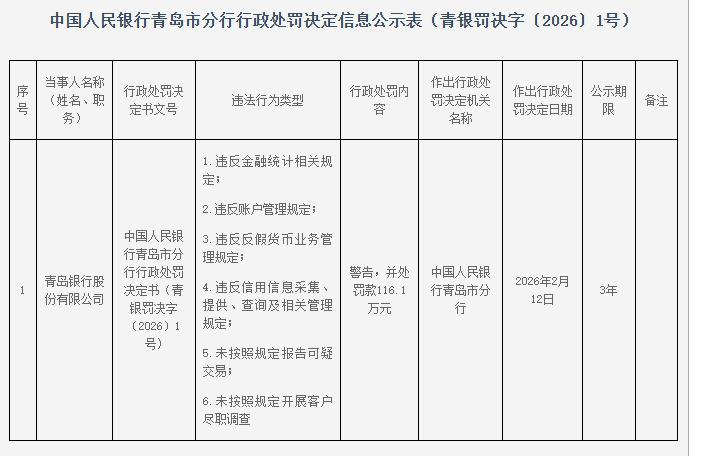
中国经济网北京2月17日讯 中国人民银行青岛市分行网站近日公布的行政处罚决定信息公示表(青 银罚决字〔2026〕1号)显示,青岛银行股份有限公司存在以下违法行为类型:1.违反金融统计相关规 定;2.违反账户管理规定;3.违反反假货币业务管理规定;4.违反信用信息采集、提供、查询及相关管 理规定;5.未按照规定报告可疑交易;6.未按照规定开展客户尽职调查。 | 店号 | 当事人名称 | 行政处罚决 | | 行政处罚内 | 作出行政处 | 作出行政处 | 公示期 | 备注 | | --- | --- | --- | --- | --- | --- | --- | --- | --- | | | (姓名、职 务) | 定书文号 | 违法行为类型 1. 违反金融统计相关规 | kin | 罚决定机关 名称 | 罚決定日期 | Re | | | | | | 定; 2. 违反账户管理规定; | | | | | | | | | 中国人民银 | 3. 违反反假货币业务管 | | | | | | | | | 行青岛市分 | 理规定; | | | | | | | 1 | 青岛银行股 | 行行政处罚 | 4. 违反信用信息采集、 ...
青岛银行被罚116.1万元:违反金融统计相关规定等
Xin Lang Cai Jing· 2026-02-14 13:56
Core Viewpoint - The Qingdao Bank Co., Ltd. has been penalized by the People's Bank of China, Qingdao Branch, for multiple regulatory violations, resulting in a warning and a fine of 1.161 million yuan [1]. Summary by Categories Regulatory Violations - The bank violated financial statistical regulations [2][3] - The bank breached account management regulations [2][3] - The bank did not comply with anti-counterfeit currency business management regulations [2][3] - The bank failed to adhere to regulations regarding the collection, provision, and inquiry of credit information [2][3] - The bank did not report suspicious transactions as required [2][3] - The bank did not conduct customer due diligence as mandated [2][3] Penalties - The bank received a warning and was fined 1.161 million yuan [1] - The penalty decision was made public on February 12, 2026 [1]
2026年1月金融数据点评:存款搬家加速,M1、M2增速大幅回升
GF SECURITIES· 2026-02-14 05:23
Investment Rating - The industry rating is "Buy" [6] Core Insights - The overall social financing growth slightly declined to 8.2% in January, while M1 and M2 growth rates significantly rebounded, with M1 growing by 4.9% and M2 by 9.0% [6][16] - Government net financing increased significantly by 2,831 billion yuan year-on-year, contributing to the overall social financing growth [6][17] - The report indicates a shift in deposit structure due to accelerated deposit migration, impacting M1 negatively while having limited effect on M2 [6][16] Summary by Sections Overall Situation - Social financing growth decreased slightly to 8.2%, while M1 and M2 growth rates increased significantly [15][16] - M1 and M2 growth rates rose by 1.1 percentage points and 0.5 percentage points respectively compared to the previous month [6][16] Government Sector - Fiscal strength showed a year-on-year decline, impacting overall financing dynamics [39] Household Sector - Demand remained stable year-on-year, with short-term loan demand increasing [39] Corporate Sector - Short-term loan demand increased year-on-year, while bill financing saw a significant reduction [39] Non-Bank Sector - The acceleration of deposit migration was noted, with non-bank deposits increasing by 1.45 trillion yuan year-on-year [6][39]