
Kunlun(300418)

Search documents
2025年中国混合专家模型(MoE)行业市场现状及未来趋势研判:稀疏激活技术突破成本瓶颈,驱动万亿参数模型规模化商业落地[图]
Chan Ye Xin Xi Wang· 2026-01-01 03:22
Core Insights - The hybrid expert model (MoE) is recognized as a "structural revolution" in artificial intelligence, enabling the construction of ultra-large-scale and high-efficiency models through its sparse activation design [1][7] - The market size for China's MoE industry is projected to reach approximately 148 million yuan in 2024, reflecting a year-on-year growth of 43.69% [1][7] - The sparse activation mechanism allows models to scale to trillions of parameters at a significantly lower computational cost compared to traditional dense models, achieving a revolutionary balance between performance, efficiency, and cost [1][7] Industry Overview - MoE is a neural network architecture that enhances performance and efficiency by dynamically integrating multiple specialized sub-models (experts), focusing on a "divide-and-conquer strategy + conditional computation" [2][3] - The core characteristics of MoE include high parameter capacity and low computational cost, activating only a small portion of total parameters to expand model size [2][3] - MoE faces technical challenges such as load balancing, communication overhead among experts, and high memory requirements, while offering advantages like task specificity, flexibility, and efficiency [2][3] Industry Development History - The MoE concept originated from the "adaptive mixture of local experts" theory proposed by Michael Jordan and Geoffrey Hinton in 1991, focusing on efficient collaboration through a gating network [3][4] - Significant advancements occurred in 2017 when Google introduced sparse gating mechanisms in LSTM networks, leading to substantial reductions in computational costs and performance breakthroughs in NLP tasks [3][4] - The MoE technology has rapidly evolved alongside deep learning and big data trends, with notable models like Mistral AI's Mixtral 8x7B and DeepSeek-MoE series pushing the boundaries of performance and efficiency [3][4] Industry Value Chain - The upstream of the MoE industry includes chips, storage media, network devices, and software tools for instruction sets and communication libraries [6] - The midstream focuses on the development and optimization of MoE models, while the downstream applications span natural language processing, computer vision, multimodal large models, and embodied intelligence [6] - The natural language processing market in China is expected to reach approximately 12.6 billion yuan in 2024, growing by 14.55% year-on-year, driven by technological breakthroughs and increasing demand across various sectors [6] Market Size - The MoE industry in China is projected to reach a market size of about 148 million yuan in 2024, with a year-on-year growth rate of 43.69% [1][7] - The technology's advantages are attracting significant investments from research institutions, large tech companies, and AI startups, facilitating the transition from technical prototypes to scalable commercial applications [1][7] Key Company Performance - The MoE industry in China is characterized by a competitive landscape involving "open-source pioneers, large enterprises, and vertical deep-divers," with market concentration undergoing dynamic reshaping [8][9] - Leading companies like Kunlun Wanwei and Tencent are leveraging technological innovation and product advantages to establish a strong market position [8][9] - Kunlun Wanwei launched the first domestic open-source model based on MoE architecture in February 2024, achieving a threefold increase in inference efficiency compared to dense models [9] Industry Development Trends - The demand for multimodal data is driving the integration of MoE architecture with technologies like computer vision and speech recognition, making multimodal MoE models mainstream [10] - Breakthroughs in sparse activation and expert load balancing technologies are enhancing the stability and inference efficiency of large-scale MoE models [11] - The construction of ecosystems around open-source frameworks and domestic computing power is accelerating the large-scale implementation of MoE in various fields [12]




AI语料概念上涨2.00%,6股主力资金净流入超亿元
Zheng Quan Shi Bao Wang· 2025-12-31 09:42
Group 1 - The AI corpus concept rose by 2.00%, ranking 7th among concept sectors, with 39 stocks increasing in value, including DeSheng Technology and Zhangyue Technology hitting the daily limit up [1] - Notable gainers in the AI corpus sector included FuShi Holdings, ZhiDeMai, and Century Tianhong, which increased by 10.68%, 6.98%, and 5.54% respectively [1] - The sector saw a net inflow of 1.927 billion yuan from main funds, with 33 stocks receiving net inflows, and 6 stocks exceeding 100 million yuan in net inflow [2] Group 2 - The top net inflow stock was Kunlun Wanwei, with a net inflow of 394 million yuan, followed by Zhangyue Technology, Keda Xunfei, and DeSheng Technology with net inflows of 295 million yuan, 265 million yuan, and 150 million yuan respectively [2] - The net inflow ratios for DeSheng Technology, Zhangyue Technology, and Hanwang Technology were 35.28%, 25.56%, and 16.69% respectively, indicating strong investor interest [3] - The AI corpus sector's performance was contrasted with other sectors, such as the silicon energy sector, which saw a decline of 1.03% [2]


游戏板块12月31日跌0.13%,世纪华通领跌,主力资金净流入3.75亿元
Zheng Xing Xing Ye Ri Bao· 2025-12-31 09:07
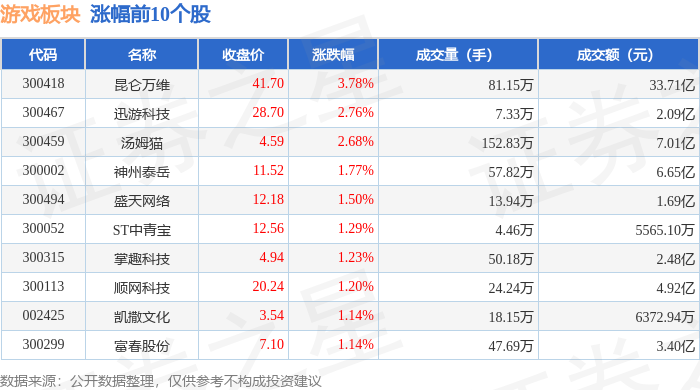
Market Overview - The gaming sector experienced a slight decline of 0.13% on December 31, with Century Huatong leading the drop [1] - The Shanghai Composite Index closed at 3968.84, up 0.09%, while the Shenzhen Component Index closed at 13525.02, down 0.58% [1] Individual Stock Performance - Kunlun Wanwei (300418) saw a closing price of 41.70, with an increase of 3.78% and a trading volume of 811,500 shares, amounting to a transaction value of 3.371 billion [1] - Xunyou Technology (300467) closed at 28.70, up 2.76%, with a trading volume of 73,300 shares [1] - Tom Cat (300459) closed at 4.59, up 2.68%, with a trading volume of 1,528,300 shares [1] - Other notable performers include Shenzhou Taiyue (300002) with a 1.77% increase and a closing price of 11.52, and Sheng Tian Network (300494) with a 1.50% increase and a closing price of 12.18 [1] Fund Flow Analysis - The gaming sector saw a net inflow of 375 million from institutional investors, while retail investors experienced a net outflow of 145 million [2] - Major stocks like Kunlun Wanwei had a net inflow of 413 million from institutional investors, while retail investors had a net outflow of 254 million [3] - Shenzhou Taiyue also reported a net inflow of 87.39 million from institutional investors, with retail investors seeing a net outflow of 52.79 million [3] ETF Performance - The Gaming ETF (product code: 159869) tracked the China Animation and Gaming Index, with a slight decline of 0.06% over the past five days and a price-to-earnings ratio of 37.03 [5] - The latest share count for the Gaming ETF is 8.77 billion, with an increase of 65 million shares and a net subscription of 930.77 million [5]




北京AI企业瞄准内容服务出海,深耕垂直过程数据
Xin Jing Bao· 2025-12-31 06:21
Core Insights - The CEO of Kunlun Wanwei, Fang Han, highlighted the rapid growth potential of AIGC products, which provide content services like video, music, and images to end-users at lower costs and barriers [2] - Kunlun Wanwei, established in 2008, began its AI initiatives in 2022, launching several models including the 13B Chinese pre-trained model and the Tiangong 1.0 model [2] - The company is focusing on commercializing AI applications across various sectors, including AI assistants, video, social media, and music [2] Financial Performance - In Q3, Kunlun Wanwei reported revenue of 2.072 billion yuan, a year-on-year increase of 56.16%, and a net profit attributable to shareholders of 190 million yuan, up 180.13% [3] - Despite the positive quarterly results, the company faced a cumulative loss of approximately 666 million yuan from the beginning of the year to the end of the reporting period, representing a year-on-year decline of 6.19% [3] - The company anticipates achieving profitability in the next one to two years [3] Market Strategy - Fang Han emphasized the opportunity for medium-sized model companies to excel in niche markets by focusing on industry-specific process data, which can be effectively trained using open-source models [2] - Kunlun Wanwei has received support from local government initiatives aimed at promoting cultural exports and AI talent acquisition, enhancing its competitive edge in the AI talent market [3] - The company has a workforce of approximately 1,800 employees in Beijing and around 1,200 overseas, with R&D centers established in locations like Poland [3]
AI泡沫后只剩这两类公司杀出重围!昆仑万维CEO方汉:明年唯一技术赛点在Agent
AI前线· 2025-12-31 03:20
Core Insights - The article emphasizes three key terms for the tech industry in 2025: AI bubble, verifiable product value, and process-oriented ecosystem [4] - The AI bubble is seen as a necessary phase that consolidates capital, computing power, and engineering talent, ultimately leading to viable products [4] - The industry is experiencing a structural mismatch where technology outpaces product development, resulting in a lack of compelling consumer applications [5] Group 1: Industry Trends - Companies that have succeeded this year are those that address high-frequency demand scenarios, such as AI social media and music, which are conducive to scalable model applications [7] - AI has significantly restructured content production and office processes, reducing time from days to minutes, shifting focus from model strength to verifiable processes and reusable results [7] - The core pressures faced by tech companies include converting technical advantages into sustainable cash flow and advancing AI deployment within regulatory frameworks [8] Group 2: Future Outlook - The only technological battleground identified for 2026 is whether Agents can automate verifiable processes on a large scale [11] - The focus will be on general AI assistants, companies that only develop models without products, and traditional software companies that lag in adopting AI-driven processes [11][12] - The next two years will determine success based on the ability to transform processes into assets rather than the intelligence of models [14]

传媒ETF(159805)涨超2.2%,教育部计划出台AI赋能教育相关政策
Xin Lang Cai Jing· 2025-12-31 02:43
Group 1 - The core viewpoint of the news is the strong performance of the media sector, particularly driven by the announcement from the Ministry of Education regarding the introduction of AI in education policies, which is expected to boost the commercial potential of AI in education [1][2] - The China Securities Media Index (399971) rose by 2.07%, with notable increases in constituent stocks such as BlueFocus (300058) up 15.73%, Liou Co. (002131) up 9.94%, and Yidian Tianxia (301171) up 7.51% [1] - The Media ETF (159805) also saw an increase of 2.20%, with the latest price reported at 1.39 yuan [1] Group 2 - The China Securities Media Index comprises 50 large-cap listed companies from sectors such as marketing and advertising, cultural entertainment, and digital media, reflecting the overall performance of representative companies in the media field [2] - As of November 28, 2025, the top ten weighted stocks in the China Securities Media Index include companies like Focus Media (002027) and Giant Network (002558), which together account for 50.98% of the index [2] - The report highlights the strong user willingness to pay for AI+ education solutions, with a projected global market size exceeding $30 billion by 2025 and a compound annual growth rate of over 40% [1]


Meta收购Manus引爆“硅谷震撼”,盘点中国六大AI Agent概念股
Xin Lang Cai Jing· 2025-12-30 11:09
Core Insights - Meta's acquisition of AI Agent startup Manus signifies a pivotal shift in the AI industry, moving from mere conversational capabilities to autonomous actions, marking a new phase in AI evolution [1][9] - The news has triggered a surge in the Chinese capital market, with investors actively seeking companies that demonstrate real "Agent implementation capabilities" [1][9] Group 1: Key Companies in AI Agent Space - **Pioneer in Vertical Implementation: Maifushi (02556.HK)** Maifushi's stock surged over 11% following the news, as it recently launched its Agentforce 3.0, a significant upgrade that automates complex business processes from perception to execution. It ranks among the top in the "2025 Enterprise AI Agent Applications TOP 50" alongside major players like Baidu and Alibaba [2][10] - **Foundation Stone of Infrastructure: Baidu Group (09888.HK)** Baidu serves as the backbone of China's AI Agent ecosystem, providing the Wenxin large model and the AgentBuilder development tool, enabling developers to create agents with low barriers. Its foundational technology positions it as a critical player in the AI Agent market [3][11][12] - **Central Hub for Office Scenarios: Kingsoft Office (688111.SH)** Kingsoft is transforming traditional document processing software into intelligent agents through WPS AI, focusing on enhancing personal productivity. It stands as a solid counterpart to Microsoft's Copilot in the domestic market [4][13] - **Hardware Giant: Lenovo Group (00992.HK)** Lenovo is promoting "AI PCs" that integrate localized large models and agents, representing a new category of edge intelligence. This positions Lenovo as a key hardware provider for AI agents, ensuring user accessibility [5][14] - **Entertainment and Social Player: Kunlun Wanwei (300418.SZ)** Kunlun is aggressively pursuing the C-end entertainment sector with its "All in AGI" strategy, which includes the Tiangong large model and ventures into AI gaming and social agents, aiming to create interactive companions in virtual environments [6][15] - **Leader in Visual Perception: SenseTime-W (00020.HK)** SenseTime excels in visual AI, focusing on physical world perception, particularly in autonomous driving and robotics. Its "Riri New" system aims to develop agents capable of understanding and responding to physical environments, representing a high-tech frontier in the agent space [7][16] Conclusion - Meta's acquisition of Manus serves as a clarion call for the AI industry, indicating a shift from mere conversational AI to functional agents. The next phase for China's AI agents will prioritize product capabilities over mere concepts [8][17]



AI泡沫后只剩这两类公司杀出重围!昆仑万维CEO方汉:明年唯一技术赛点在Agent
Xin Lang Cai Jing· 2025-12-30 11:04
Group 1 - The core keywords for the technology sector in 2025 are AI bubble, verifiable product value, and process-oriented ecology, indicating a shift from mere technological advancement to practical application and monetization [2][10] - The AI bubble is seen as a necessary phase that concentrates capital, computing power, and engineering talent to filter out viable products, with a focus on real-world high-frequency scenarios that can generate sustainable revenue [2][10] - Companies that have emerged successfully this year are those that address high-frequency demand scenarios, such as AI social media and music, which are conducive to scalable model applications and user retention [3][11] Group 2 - AI has significantly restructured content production and research analysis, reducing the marginal cost of content or services by 1-2 orders of magnitude, thus altering industry pricing logic [3][11] - Companies lagging behind include general-purpose AI assistants lacking vertical data and result closure, and those that focus solely on models without product development, leading to long-term commercialization stagnation [4][13] - The industry is transitioning from an "algorithm-driven" approach to a balanced focus on both algorithms and products, with product leaders gaining influence comparable to algorithm leaders [12][14] Group 3 - The unique technological battleground for 2026 is whether Agents can automate verifiable processes on a large scale, emphasizing the industrialization of structured decision-making [6][15] - The Chinese AI sector has made significant strides in application layers, particularly in AIGC and AI social media, leveraging data density and scene complexity for rapid iteration, although gaps remain in top-tier closed model capabilities compared to Silicon Valley [6][15] - Future innovations are expected to emerge as AI mobile devices and edge computing become prevalent, with a focus on transforming processes into assets rather than merely enhancing model intelligence [6][15][16]
Meta宣布重大收购,AI智能体概念爆发,高增长潜力股出炉
Xin Lang Cai Jing· 2025-12-30 05:13
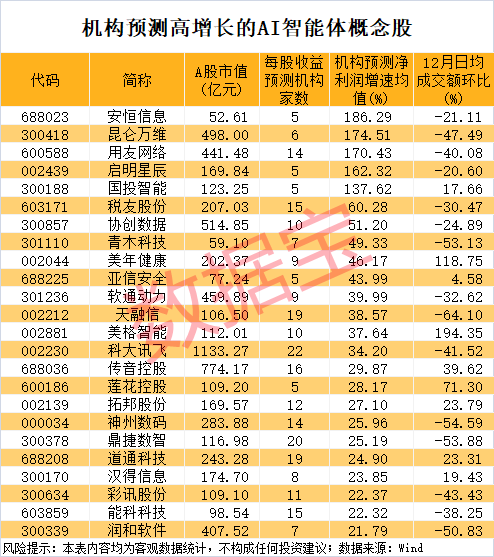
Group 1 - Meta announced the acquisition of AI agent company Manus to accelerate AI innovation, with specific transaction terms undisclosed [1][2] - AI agent stocks saw a strong performance, with Kute Intelligent reaching a 20% limit up in early trading [1][2] - A total of 17 AI agent concept stocks have been investigated by institutions more than 10 times this year, including Zhongkong Technology, Guangdian Yuntong, Shunwang Technology, Yuxin Technology, and Bangyan Technology [3] Group 2 - According to predictions from more than five institutions, 26 AI agent concept stocks are expected to have a net profit growth rate exceeding 20% in 2026 and 2027 [3][4] - Five stocks are forecasted to have an average net profit growth rate exceeding 100%, including Kunlun Wanwei, Yonyou Network, Guotou Intelligent, Qiming Star, and Anheng Information [3][4] - The table lists various AI agent concept stocks along with their market capitalization, earnings per share, and predicted net profit growth rates, highlighting significant growth potential in the sector [4]



短剧游戏指数盘中涨超2%,成分股普涨
Mei Ri Jing Ji Xin Wen· 2025-12-30 03:21
Group 1 - The short drama game index rose over 2% during the trading session, indicating a positive market trend in this sector [1] - Component stocks showed a widespread increase, with notable performances from companies such as Baina Qiancheng, which hit the daily limit, and others like Happiness Blue Ocean, Hengdian Film, 37 Interactive Entertainment, and Kunlun Wanwei showing significant gains [1]


