BABA(BABA)

Search documents
阿里AI春节“封神”:1.3亿人涌入千问,日活追平豆包,B端模型价格仅谷歌1/18
Sou Hu Cai Jing· 2026-02-17 17:24
Core Insights - The AI industry in China experienced unprecedented activity during the Spring Festival, with major companies like Alibaba, ByteDance, and Tencent launching aggressive initiatives to capture market share [2] - Alibaba's Qwen 3.5-Plus model, which was released on New Year's Eve, showcases significant advancements in performance and cost efficiency, positioning it as a strong competitor against Google's Gemini 3 Pro [4] - The shift in AI value focus is moving from chat-based interactions to task-oriented agents, with Alibaba leveraging its comprehensive capabilities to address industry challenges [2][10] B-end Cost Reduction - Alibaba's Qwen 3.5-Plus model features a sparse mixture of experts architecture, boasting 3.97 trillion parameters but activating only 170 billion, resulting in a 19-fold increase in inference throughput and a 60% reduction in memory usage [4] - The API pricing for Qwen 3.5-Plus is set at 0.8 yuan per million tokens, which is only 1/18th of the cost of Google's equivalent model, aiming to enhance enterprise AI penetration [4] C-end User Engagement - During the Spring Festival, over 1.3 billion commands were issued to the Qwen app, with 130 million users experiencing AI shopping for the first time, establishing it as a national-level AI assistant [7] - The daily active users (DAU) of Qwen reached approximately 73.5 million, nearly matching ByteDance's three-year accumulation in just three months, indicating strong market penetration [8] Technological Integration - Alibaba's "Tongyun Ge" strategy integrates its model development, cloud infrastructure, and chip technology, enabling it to support both B-end pricing strategies and C-end user engagement effectively [10] - The unified architecture allows Alibaba to maximize computational efficiency, reducing training costs and increasing training speed by 10% [10] Market Dynamics - The Spring Festival results indicate a significant shift in user behavior towards practical AI applications, with Alibaba's approach focusing on creating agents that can perform tasks rather than just engage in conversation [10] - The company is building a robust ecosystem by integrating its core assets like Taobao and Alipay with the Qwen model, enhancing its competitive edge against Silicon Valley giants [8][10]


Amazon vs. Alibaba: Which E-Commerce Titan Has an Edge Right Now?
ZACKS· 2026-02-17 17:00
Core Insights - Amazon and Alibaba are the two largest players in e-commerce and cloud computing, both investing heavily in AI and cloud infrastructure, making a comparison relevant for investors [1] Group 1: Amazon (AMZN) Overview - Amazon's Q4 2025 results showed net sales of $213.4 billion, a 14% year-over-year increase, driven by strong performance in North America, International, and AWS [2] - AWS reported a 24% revenue growth, its fastest in 13 quarters, with an annualized run rate of approximately $142 billion and a backlog of $244 billion, indicating strong demand [3] - Amazon's capital expenditures for 2026 are projected at $200 billion, primarily for AWS and AI infrastructure, reflecting confidence in long-term returns [4] Group 2: Alibaba (BABA) Overview - Alibaba's Q2 fiscal 2026 revenues reached RMB 247.8 billion, a modest 5% year-over-year increase, while non-GAAP diluted earnings fell 71% due to heavy investments [5] - The Cloud Intelligence Group achieved 34% revenue growth, with AI-related products showing triple-digit gains for nine consecutive quarters, but faces challenges from U.S. chip export restrictions [6] - Alibaba's quick commerce business grew revenues by 60%, but incurred significant losses, leading to a RMB 21.8 billion free cash flow outflow [8] Group 3: Valuation and Performance Comparison - Alibaba's stock increased by 28.3% over the last six months, outperforming Amazon's 14.1% decline, but this is attributed to recovery rather than fundamental strength [10] - Alibaba's price-to-sales ratio is 2.29x, significantly lower than Amazon's 2.61x, reflecting Amazon's superior market position and predictable cash flows [14] - Amazon's premium valuation is justified by its stronger growth prospects, lower regulatory risks, and better forward guidance compared to Alibaba [17]


Alibaba Stock Rises 28% in 6 Months: Hold Tight or Time to Let Go?
ZACKS· 2026-02-17 17:00
Key Takeaways Alibaba shares rose 28% in six months despite a 71% drop in non-GAAP EPS and 78% EBITDA plunge.BABA's AI push lifted cloud revenues 34%, but costs and subsidies crushed margins and profits.BABA trades at 2.29X forward sales vs. 1.84X industry as profits slide and competition intensifies.Alibaba (BABA) shares have surged 28% in the past six-month period, outperforming the Zacks Internet – Commerce industry and the Zacks Retail-Wholesale sector. While the rally has rewarded shareholders, a close ...
刚刚,全球最大对冲基金最新持仓来了
Sou Hu Cai Jing· 2026-02-17 16:52
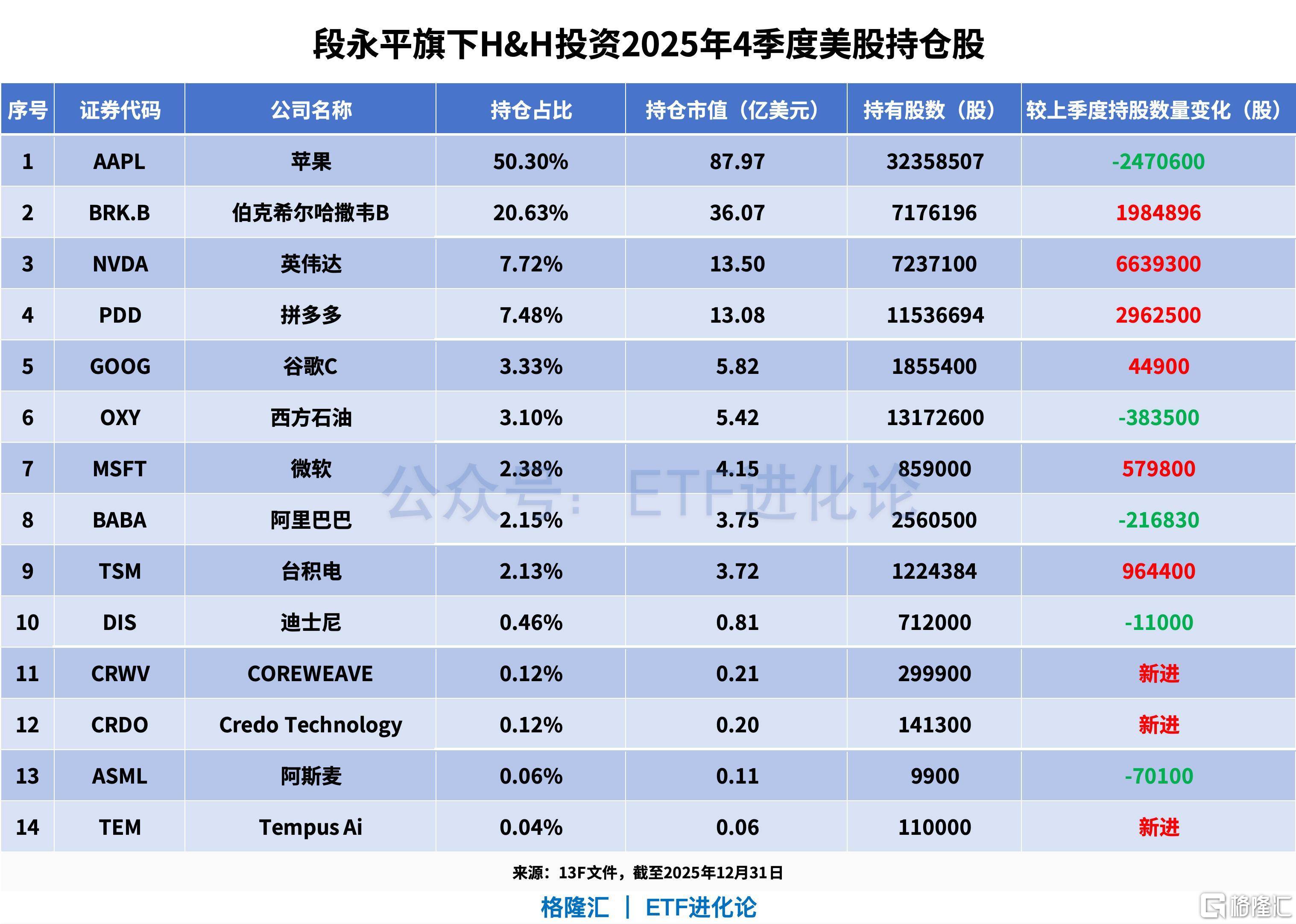
Core Insights - The article discusses the latest investment moves of prominent investor Duan Yongping, particularly through his investment account "H&H," which holds a portfolio valued at $17.489 billion as of Q4 2025 [2]. Investment Portfolio Summary - As of Q4 2025, H&H's portfolio consists of 14 U.S. stocks, with a total market value of $17.489 billion, approximately 120.8 billion RMB [2]. - Duan has recently invested in three AI-related companies: CoreWeave, Credo Technology, and Tempus AI, with respective portfolio weights of 0.12%, 0.12%, and 0.04% [2]. - Major increases in holdings include Berkshire Hathaway, NVIDIA, Pinduoduo, Google C, and Microsoft, while reductions were made in Apple, Occidental Petroleum, Alibaba, Disney, and ASML [2]. Key Holdings - The top holdings in H&H's portfolio include: - Apple: $8.797 billion (50.3% of the portfolio) - Berkshire Hathaway B: $3.607 billion (20.63% of the portfolio) [2][4]. AI-Related Investments - CoreWeave focuses on providing AI computing power through high-performance GPU clusters, which are essential for AI model training [5]. - Credo Technology specializes in high-speed interconnect chips and optical modules for data centers, crucial for efficient data transmission in AI servers [6]. - Tempus AI applies AI in precision medicine, particularly in oncology, by integrating genetic and clinical data for personalized treatment plans, although it faces long commercialization cycles and regulatory challenges [6]. Investor Sentiment on AI - Duan Yongping has expressed a strong interest in AI, emphasizing its potential to significantly enhance efficiency and transform industries [8]. - He acknowledges the risks associated with the AI sector, suggesting that many companies may not survive, but those that do could become the next major players like Google or Amazon [8][9].


阿里AI春节“封神”:1.3亿人涌入千问 日活追平豆包 B端模型价格仅谷歌1/18
Guo Ji Jin Rong Bao· 2026-02-17 15:51
Core Insights - The AI industry in China experienced unprecedented competition during the Spring Festival, with major players like Alibaba, ByteDance, and Tencent launching aggressive initiatives [2] - Alibaba's Qwen 3.5-Plus model, released on New Year's Eve, showcases a significant advancement in AI capabilities, offering performance comparable to Google's Gemini 3 Pro at a fraction of the cost [3] - The shift in AI value focus is moving from chat-based interactions to task-oriented agents, with Alibaba aiming to address key industry challenges [2][9] B-end Cost Reduction - Alibaba's Qwen 3.5-Plus features a novel sparse mixture of experts (MoE) architecture with 3.97 trillion parameters, activating only 170 billion, leading to a 19-fold increase in inference throughput and a 60% reduction in memory usage [3] - The API pricing for Qwen 3.5-Plus is set at 0.8 yuan per million tokens, which is 1/18th the cost of Google's equivalent, aiming to enhance enterprise AI penetration [3] C-end User Engagement - During the Spring Festival, over 1.3 billion users interacted with the Qwen app, generating 5 billion "Qwen help me" commands, establishing it as a national-level AI assistant [6] - The app's daily active users (DAU) reached approximately 73.5 million within three months, nearly matching ByteDance's three-year growth [7] Strategic Integration - Alibaba's "Tongyun Ge" strategy, integrating its model, cloud infrastructure, and chip development, enables it to support both B-end pricing strategies and C-end user engagement effectively [8] - The unified architecture allows Alibaba to maximize computational efficiency, reducing training costs and increasing training speed by 10% [8] Market Narrative Shift - The recent developments indicate a shift in Alibaba's market narrative, moving from concerns about lacking a ChatGPT-like entry point to establishing a robust ecosystem that emphasizes practical AI applications [9][10] - The company is demonstrating its potential in the AI era by leveraging its pricing power and execution capabilities [10] Market Penetration - AI order volumes from lower-tier cities surged by 782 times, with nearly half of all AI orders originating from county-level areas [11] - Approximately 4 million users aged 60 and above engaged with AI shopping, highlighting the technology's role in bridging the digital divide [11]
摩尔线程:完成对Qwen3.5模型全面适配
Xin Lang Cai Jing· 2026-02-17 14:43
Core Insights - Moore Threads has successfully adapted its flagship AI training and inference GPU MTT S5000 to Alibaba's latest large model Qwen3.5, showcasing the maturity and completeness of the MUSA ecosystem [1] Group 1: MUSA Ecosystem - The adaptation demonstrates two core capabilities of the MUSA ecosystem: native MUSA C support allows developers to directly use MUSA C for kernel development, significantly lowering the migration barrier from the CUDA ecosystem [1] - Deep compatibility with Triton-MUSA enables developers to write high-performance operators using familiar Triton syntax, which can seamlessly run on Moore Threads' full-featured GPUs through the Triton-MUSA backend [1]
These 3 International Stocks Could Be the Best-Performing Stocks In 2026
247Wallst· 2026-02-17 14:42
Core Insights - International stocks outperformed U.S. stocks in 2025 after a decade of U.S. dominance, driven by currency fluctuations and a changing geopolitical environment [1] - Three international stocks are highlighted as potential strong performers in 2026: Restaurant Brands, Alibaba, and MercadoLibre [1] Group 1: Restaurant Brands (QSR) - Restaurant Brands was formed from a merger between Tim Horton's and Burger King, and has since acquired Popeye's and Firehouse Subs [1] - The company has shown slight weakness in recent quarters but is expected to benefit from a trade-down trend in dining due to inflation, potentially increasing foot traffic and margins [1] - The stock is considered a defensive growth option, currently trading at a discount to historical levels despite year-over-year revenue and earnings growth [1] Group 2: Alibaba (BABA) - Alibaba is a leading global growth stock with significant potential, driven by its core e-commerce business and artificial intelligence initiatives [1] - The company reported an 8% year-over-year revenue growth, with over 20% growth in its international e-commerce segment, which is a high-margin area [1] - Free cash flow margins reached 20% due to cost discipline, indicating strong financial health and future growth prospects [1] Group 3: MercadoLibre (MELI) - MercadoLibre is a major e-commerce and fintech player in Latin and South America, providing exposure to approximately $1 trillion in GDP [1] - The company achieved 35% year-over-year growth in its e-commerce business, supported by a 40% growth in its Mercado Pago segment [1] - With around $5 billion in annual free cash flow and world-class margins of about 12%, MercadoLibre is viewed as a strong investment opportunity [1]



MercadoLibre vs Alibaba: Which E-Commerce Giant Is the Better Buy in 2026?
247Wallst· 2026-02-17 13:45
Core Insights - MercadoLibre is focusing on logistics and fintech in Latin America, achieving a 39% revenue growth and generating $2.2 billion in free cash flow, while Alibaba is investing heavily in AI and cloud infrastructure, resulting in a 5% revenue growth but a significant net income drop of 53% [1] Financial Performance - MercadoLibre reported Q3 2025 revenue of $7.41 billion, a 39% year-over-year increase, with total payment volume reaching $71.2 billion, up 41% [1] - Alibaba's Q2 2026 revenue was $34.81 billion, only a 5% increase, with a net income decline of 53% and free cash flow turning negative at $3.1 billion [1] Strategic Focus - MercadoLibre is expanding its logistics network and investing in free shipping and social commerce initiatives, while maintaining positive cash flow [1] - Alibaba is prioritizing AI infrastructure and quick commerce, framing its current profitability challenges as investments for future growth [1] Market Positioning - MercadoLibre holds a trailing price-to-earnings ratio of 48.5 and a forward multiple of 29.6, indicating strong investor confidence in its market share growth potential [1] - Alibaba trades at 20.5x trailing earnings and 17.2x forward earnings, which appears cheap but is overshadowed by a 51.8% year-over-year earnings decline [1] Risk-Reward Profiles - MercadoLibre's strategy is seen as less risky due to its positive cash flow and growth potential in a less penetrated e-commerce market [1] - Alibaba's investment thesis hinges on the stabilization of China's regulatory environment and the success of its AI investments, presenting a higher risk profile [1]

1.3亿人春节首次体验AI购物
Zhong Guo Ji Jin Bao· 2026-02-17 12:32
Core Insights - Over 130 million people in China experienced AI shopping for the first time during the Spring Festival, with "Qianwen help me" becoming a national-level AI assistant [1][2][3] Group 1: User Engagement and Growth - During the Spring Festival, AI ticket purchasing orders surged, with a 22-fold increase for event tickets and over 7-fold for flight tickets [3] - Movie ticket orders via AI skyrocketed by 372 times, particularly in third and fourth-tier cities, where orders increased by 782 times [3] - Nearly 400,000 users aged 60 and above engaged in AI shopping, indicating a broad demographic reach [3] Group 2: Ecosystem Integration - Qianwen integrates with Alibaba's ecosystem, including Taobao, Alipay, and other platforms, to enhance user service [3] - Future functionalities will include AI ride-hailing, mobile top-ups, and group buying [3] Group 3: Model Development and Performance - Alibaba launched the Qianwen 3.5 model, which is considered the strongest open-source model globally, achieving a significant leap from text-only to multimodal capabilities [5] - Qianwen 3.5 outperformed competitors in various benchmarks, scoring 87.8 in MMLU-Pro and 88.4 in GPQA, surpassing GPT-5.2 and Claude 4.5 respectively [5] - The model's performance in instruction-following and general agent evaluations also exceeded that of Gemini 3 Pro and GPT-5.2 [5]
过完这个春节,中国AI只剩下阿里和字节
Xin Lang Cai Jing· 2026-02-17 12:13
文 | 慢放 2026年除夕夜后,中国AI的版图被彻底重塑。 如果AI竞争是一场长跑,阿里千问则在春节上演了一场"时间折叠"。字节豆包跑了1000天的DAU流量高地,被千问用82天便闪电追平。这一战,宣告中国 AI正式告别群雄混战,进入阿里、字节"双雄争霸"新纪元。 除夕夜大战更是精彩刺激。一边,阿里开源Qwen3.5-Plus,性能直取Gemini 3 Pro,登顶全球最强开源,以底层架构革新捅破技术天花板,同时用50亿次"千 问帮我"开启AI生活元年。另一边,豆包亮相春晚引导国民互动;此前发布的Seedance 2.0则瞄准"生产工具",要帮普通人圆一个导演梦。 今年春节,阿里字节,一个"办事"一个"造梦"。千问大免单请客让无数普通人第一次体验了AI生活,而豆包试图在对话框里连接创意。一边用AI让柴米油盐 变得更便捷,另一边用AI帮普通人「圆导演梦」。这场双雄争霸的背后,是两种关于「AI该如何融入人类生活」的回答。 01「生活方式」 vs 「生产工具」 这和阿里的商业基因有关。过去20年,阿里干的就是「连接」的生意——连接买家和卖家,连接商家和消费者,连接线上和线下。现在,AI成了新的连接 器。千问要做的 ...