
BABA(BABA)

Search documents
两个春节,一年时间:战火烧红整条AI产业链 | 海斌访谈
Di Yi Cai Jing· 2026-02-18 09:41
Core Viewpoint - The competition among major tech companies for national-level traffic entry points during the Spring Festival is intense, with no clear winner emerging from this year's events [1][3][6]. Group 1: Competition Overview - Major players in the competition include Alibaba, ByteDance, Tencent, and Baidu, each deploying significant financial resources to attract AI users [3][5]. - Alibaba's Qianwen launched a 30 billion yuan "Spring Festival invitation plan," while Tencent offered 1 billion yuan in cash red envelopes through its Yuanbao app [3][4]. - ByteDance's Doubao and Baidu's Wenxin Assistant also participated, with Doubao reporting 1.9 billion AI interactions on New Year's Eve [4][13]. Group 2: Company Strategies - Alibaba leverages its extensive ecosystem and open-source models to compete effectively in both domestic and international markets [3][5]. - ByteDance's Doubao has gained a first-mover advantage with a higher daily active user count compared to its competitors [3][5]. - Tencent's model capabilities are perceived as weaker, but the company remains confident in its ability to compete in the AI space [5][6]. Group 3: Market Dynamics - The competition has raised the entry barrier for other companies, requiring substantial investment to compete for national-level traffic [5][6]. - The rapid iteration of large models in China has narrowed the gap with U.S. counterparts, with the difference in capabilities reduced to about three months [13][14]. - Chinese companies are increasingly efficient in their AI investments, achieving competitive intelligence levels with lower costs compared to U.S. firms [15]. Group 4: Future Trends - The emergence of intelligent agents, such as LobsterAI, indicates a shift towards more specialized applications of AI technology [8][9]. - The evolution of intelligent agents is expected to progress through various stages, from single-app functionalities to cross-platform interactions [10][11]. - The competitive landscape suggests that smaller companies may find opportunities by leveraging multiple AI models rather than being tied to a single one [9].




Alibaba Q3 Is Critical - But Not A Catalyst
Seeking Alpha· 2026-02-18 09:26
Core Insights - Q3 FY2026 is anticipated to be a pivotal moment for Alibaba Group Holding (BABA) as it may confirm the recovery of earnings during a phase characterized by significant investment [1] Group 1: Earnings Recovery - The upcoming earnings report is deemed highly important, although it is not expected to serve as an immediate catalyst for stock price changes [1] Group 2: Analyst Background - The analysis is conducted by a seasoned stock analyst with over 20 years of experience in quantitative research, financial modeling, and risk management, focusing on equity valuation and market trends [1] - The analyst has a background as a former Vice President at Barclays, leading teams in model validation and stress testing, which contributes to a deep expertise in both fundamental and technical analysis [1] - The research is co-authored with a partner, combining strengths to deliver high-quality, data-driven insights with a focus on macroeconomic trends and corporate earnings [1]
中国AI巨头新年发红包抢滩市场
Xin Lang Cai Jing· 2026-02-18 09:01
Group 1 - The traditional practice of giving red envelopes during the Lunar New Year in China has evolved, with tech giants leveraging it to attract users to their AI chatbots [1][3] - Major companies like Baidu, Tencent, Alibaba, and ByteDance have initiated electronic red envelope campaigns, distributing approximately 4.5 billion RMB nationwide [3] - Baidu launched a red envelope campaign worth nearly 61 million euros (about 500 million RMB) on January 25 to promote its Wenxin Yiyan chatbot [3] Group 2 - Tencent followed suit with a Spring Festival red envelope activity, where users needed to interact with the chatbot or share the app to qualify for a lottery [3] - Alibaba announced a "30 billion RMB free order" campaign on its Qianwen platform, offering 3 euros (25 RMB) coupons for each tea order, leading to a surge in orders [3] - ByteDance participated by distributing red envelopes and offering 100,000 prizes during the CCTV Spring Festival Gala, including robots and drones [3] Group 3 - The effectiveness of these campaigns is evident, with Alibaba's Qianwen app reaching the top of the free app download chart in China just one day after the campaign launch [3] - Despite the initial success, media commentary suggests that user retention will be the true challenge beyond the red envelope promotions [3]
人形机器人首次开口演小品,Seedance2.0惊艳亮相春晚,豆包千问元宝争相用红包“炸开”用户手机,这场投入巨大的春节推广值得吗?
Mei Ri Jing Ji Xin Wen· 2026-02-18 08:41
Core Insights - The 2026 Spring Festival Gala showcased the evolution of AI technology, with ByteDance's Seedance 2.0 model creating stunning visual effects that captivated the audience [1][4] - AI has been deeply integrated into the entire process of program creation, stage presentation, and live broadcasting, marking a significant shift in its role from a supporting tool to a core content producer [2][4][5] Group 1: AI in Content Creation - The Seedance 2.0 model was used for visual content generation in several performances, demonstrating its capability in producing complex imagery [4] - AI models, including voice recognition and real-time subtitle generation, enhanced audience engagement and accessibility during the live broadcast [2][8] Group 2: AI in User Engagement - Major tech companies engaged in a "red envelope war" during the Spring Festival, using cash giveaways to attract users to their AI applications [9][10] - The competition among apps like Doubao, Qianwen, and Tencent Yuanbao highlighted the strategic importance of AI as a new traffic entry point for user acquisition [18][20] Group 3: Market Dynamics and Future Implications - The significant investment in AI infrastructure necessitates effective monetization strategies to avoid market skepticism [19][21] - The success of AI applications during the Spring Festival could determine long-term competitive advantages based on financial strength, technological capabilities, and product relevance [22]


“懂你需要”的AI来了!人民日报评阿里千问民生服务能力
Zhong Guo Jing Ji Wang· 2026-02-18 07:45
Core Insights - The article highlights the transition of AI assistants, exemplified by Alibaba's Qianwen, from "recommendation-based services" to "proactive understanding" in daily life, impacting ticket booking, food ordering, government services, and educational support [1][2][4] Group 1: AI Integration in Daily Life - Qianwen's AI capabilities allow users to make complex requests, such as booking flights, with simple commands, significantly reducing the time spent on planning [2][3] - On February 6, Qianwen processed 10 million orders in just 9 hours, showcasing the efficiency of AI in handling consumer transactions [2] - The AI assistant can provide step-by-step explanations for educational purposes and assist in various administrative tasks, such as visa inquiries and document processing [3][4] Group 2: Growth and User Engagement - By the end of 2025, the user base for generative AI in China is projected to reach 602 million, a 141.7% increase from the end of 2024 [4] - Qianwen has over 100 million monthly active users, making it one of the fastest-growing AI-native applications globally [4] - The continuous investment in research and development by Alibaba has led to the creation of over 200,000 derivative models of Qianwen, with downloads exceeding 1 billion [4] Group 3: Future Prospects and Competitive Advantage - The article emphasizes that companies with strong industrial foundations and rich fulfillment ecosystems will hold competitive advantages in the global AI model landscape [4] - The integration of advanced AI technologies into everyday life is seen as a key driver for the digital and intelligent transformation of the economy and society [4]
“AI交易”成亮点!段永平Q4美股持仓:英伟达持仓激增,建仓CoreWeave、Credo及Tempus AI,减持苹果
Zhi Tong Cai Jing· 2026-02-18 07:07
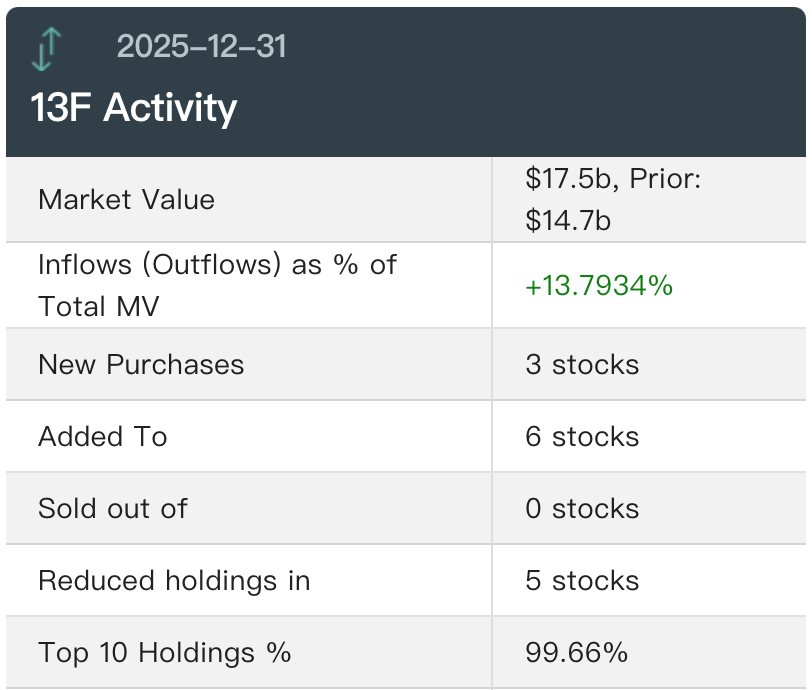
Core Insights - H&H International Investment reported a total market value of $17.5 billion for its U.S. stock holdings as of December 31, 2025, an increase from $14.7 billion in the previous quarter, reflecting a growth of approximately 13.79% [1][2]. Holdings Summary - The portfolio included 3 new stock purchases, increased holdings in 6 stocks, reduced holdings in 5 stocks, and did not completely sell out of any positions [1][2]. - The top ten holdings accounted for 99.66% of the total market value, indicating a concentrated investment strategy [1][2]. Top Holdings - Apple (AAPL.US) remains the largest holding with approximately 32.36 million shares valued at about $8.8 billion, making up 50.30% of the portfolio, although the number of shares decreased by 7.09% from the previous quarter [2][3]. - Berkshire Hathaway (BRK.B.US) is the second-largest holding with around 7.18 million shares valued at approximately $3.6 billion, increasing its share count by 38.24% [2][3]. - Nvidia (NVDA.US) ranks third with about 7.24 million shares valued at approximately $1.3 billion, showing a significant increase of 1110.62% in share count [3]. - Pinduoduo (PDD.US) is fourth with around 11.56 million shares valued at approximately $1.3 billion, with a 34.55% increase in shares [3]. - Google (GOOG.US) is fifth with about 1.86 million shares valued at approximately $600 million, with a 2.48% increase in shares [3]. Significant Changes - H&H significantly increased its holdings in Microsoft (MSFT.US) and Taiwan Semiconductor Manufacturing Company (TSM.US), with share counts rising by 207.66% and 370.95%, respectively [3]. - The firm notably reduced its position in ASML (ASML.US), decreasing its share count by 87.62% [3]. - New positions were established in CoreWeave (CRWV.US), Credo Technology (CRDO.US), and Tempus AI (TEM.US), focusing on AI and data center solutions [3]. Buying and Selling Trends - The top five stocks purchased based on percentage change were Nvidia, Berkshire Hathaway, Taiwan Semiconductor, Microsoft, and Google [4]. - The top five stocks sold based on percentage change included Apple, Occidental Petroleum (OXY.US), Alibaba (BABA.US), ASML, and Disney (DIS.US) [5].





中国AI有多强?有事它是真上啊!
Sou Hu Cai Jing· 2026-02-18 06:33
Core Insights - The Chinese AI landscape reached a historic turning point during the 2026 Spring Festival, marked by Alibaba's launch of the Qwen 3.5-Plus model, which transitioned from a pure text model to a native multimodal model [1][6] - The Qwen app became the world's first AI assistant capable of performing tasks, with over 130 million users experiencing AI shopping for the first time during the festival [1][2] Group 1: Model and Application Development - Alibaba's Qwen model has achieved a significant leap in capabilities, focusing on task execution rather than just text generation and image creation [2] - Since its public testing in November 2025, Qwen has integrated with various Alibaba services, offering over 400 task execution functions, allowing users to complete complex tasks with simple natural language commands [2][3] - The app's daily active users (DAU) reached 73.52 million, nearing the 78.71 million of a competing service, with a notable increase in orders from rural areas and older demographics [2][3] Group 2: Technological and Ecological Advantages - Alibaba's dual advantage of a strong model and a robust ecosystem has positioned it uniquely in the AI landscape, enabling the Qwen app to serve as a national AI assistant [3][4] - The "Tongyun Ge" strategy, which includes self-developed chips and a comprehensive cloud service, has laid a solid technical foundation for the AI assistant [3] - Alibaba's extensive consumer ecosystem, built over 20 years, provides a natural testing ground for AI applications, integrating various services to meet complex user needs [3][4] Group 3: Broader Implications for AI in Daily Life - The transition from AI as a conversational tool to a practical assistant signifies a paradigm shift in AI's value proposition, emphasizing real-world applications [2][6] - The success of the Qwen app illustrates a unique Chinese approach to AI, focusing on integrating technology into everyday life rather than merely showcasing capabilities [5][6] - The 2026 Spring Festival may mark the beginning of a new era in AI-driven consumer habits and lifestyles, as evidenced by the widespread adoption of AI for everyday tasks [6]

又又又一次快速行动:摩尔线程MTT S5000完成对阿里大模型Qwen3.5适配
Guang Zhou Ri Bao· 2026-02-18 03:08
Group 1 - The core achievement of Moore Threads is the full adaptation of Alibaba's latest large model Qwen3.5 on its flagship AI training and inference GPU MTT S5000, enabling efficient model deployment and optimization through MUSA C programming language and Triton-MUSA toolchain [2] - The adaptation process validated two core capabilities of the MUSA ecosystem: native MUSA C support allows developers to directly use MUSA C for kernel development, significantly lowering the migration barrier from CUDA; deep compatibility with Triton-MUSA enables developers to write high-performance operators using familiar Triton syntax, seamlessly running on Moore Threads' full-featured GPU [2] - Moore Threads achieved native optimization for the hybrid attention mechanism used in the Qwen3.5 multimodal model, providing efficient support for long sequence processing based on the muDNN computing library and MATE open-source operator library, successfully realizing high-performance inference of the model on the MTT S5000 [2] Group 2 - In a week, Moore Threads rapidly followed up and adapted to top domestic large models such as GLM-5, MiniMax M2.5, and Qwen3.5, indicating a normalized agile response mechanism [3] - This agile response is attributed to the seamless compatibility of the MUSA architecture with mainstream AI ecosystems and the continuous optimization of the toolchain, marking the establishment of a full-link support capability from model adaptation to efficient deployment for domestic computing power [3] - A new ecological model combining domestic computing power and domestic large models is gradually taking shape [3]
人工智能,从“猜你喜欢”到“懂你需要”
Xin Lang Cai Jing· 2026-02-18 02:53
智能应用向深向实的背后,是中国人工智能发展底座的不断夯实。以阿里巴巴为例,其过去10年持续加 大科研投入。目前,千问模型的衍生模型数量突破20万个,下载量超过10亿次。 让人工智能具备"向实扎根、向上生长"的潜力,将前沿技术嵌入充满"烟火气"的生活日常。千问人工智 能助手产品负责人郑嗣寿表示,产品将进一步发挥模型与生态优势,连接真实世界,深入日常生活,服 务广大用户。 来源:人民日报 春节前夕,以"一句话点奶茶"为代表的人工智能下单方式吸引了不少消费者踊跃尝试。2月6日,仅9个 小时,千问就接到了1000万张订单。这些订单全部由消费者通过一句话下指令实现。而后,由人工智能 帮助完成从消费决策、交易支付到履约服务的全过程。 "在技术支持下,现在的平台不再是简单的'猜你喜欢',而是'懂你需要'。"淘天集团研究中心主任徐飞 说。在学习、工作、民生服务等场景中,新一代人工智能助手也在大显身手。它可以像老师一样分步讲 解知识点,学生可以随时打断、追问;它能准确识别近百张格式不一的电子发票,提取关键信息,生成 结构清晰的表格。浙江杭州的林先生最近在千问上解锁了新体验,"我问'杭州户口怎么办护照',它就 告诉我需要准备什么 ...
高瓴四季度持仓曝光:加仓拼多多、阿里,组合集中度再升
Hua Er Jie Jian Wen· 2026-02-18 00:32
13F报告显示,高瓴旗下专注二级市场投资的基金管理平台HHLR Advisors四季度继续重仓中概股,核心仓位仍集中在拼多多、阿里巴巴等互联网与生物医 药公司。 根据最新披露文件,截至2025年12月31日,HHLR美股持仓总市值约31.04亿美元,较三季度末的40.91亿美元明显下降,持仓数量仍为33只,显示出在整体 仓位上有所收缩,同时继续向少数核心标的集中。 从结构来看,拼多多依然稳居第一大重仓股,阿里巴巴维持第二大重仓地位,百济神州(BeOne Medicines)和富途控股等仍位居前列,组合集中度进一步 提升。核心重仓继续集中,拼多多与阿里巴巴权重上升 四季度最核心的变化仍然发生在电商龙头上。 数据显示,HHLR继续增持拼多多,持股由三季度的859万股增至1072万股,持仓市值由11.36亿美元升至12.16亿美元,占投资组合比例由28%升至39%,第 一大重仓股地位进一步巩固。 与此同时,阿里巴巴也获得明显加仓。持股由328.9万股增至543万股,持仓市值由5.88亿美元升至7.96亿美元,占组合比例升至26%,继续位居第二大重仓 股。 此外,三季度仍位列前十大持仓的网易,以及三季度新建仓的百度、 ...
