Morgan Stanley(MS)

Search documents
大摩上调2026年美国GDP增长预期至2.6%
Xin Lang Cai Jing· 2026-02-14 10:19
Group 1 - Morgan Stanley raised its forecast for U.S. economic growth in 2026 to 2.6%, attributing this to stronger capital expenditure assumptions [1] - The firm noted that business investments related to spending growth from large cloud computing companies are more stable [1] - However, Morgan Stanley warned that the biggest risk to the U.S. economy is no longer trade protectionism, but rather the risk of an AI bubble [1]

本周,“AI颠覆一切”的狼终于来了
Hua Er Jie Jian Wen· 2026-02-14 09:07
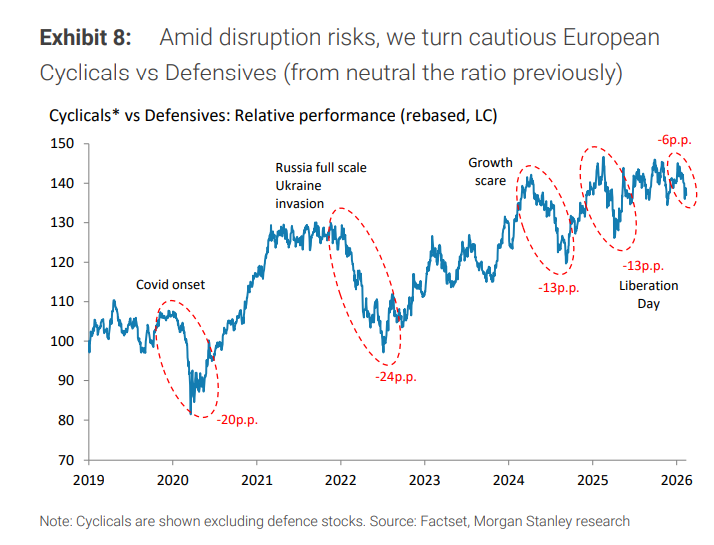
Core Insights - The market is increasingly recognizing the imminent threat of AI disruption, with the perceived risk in the MSCI Europe index rising from 4% to 24% in just over a month, including the banking sector [1][9] - Morgan Stanley has shifted its stance from neutral to cautious regarding cyclical stocks versus defensive stocks, highlighting opportunities in the European credit market for downside protection [1][15] AI Capability Advancements - The latest AI model, GPT-5.2, has achieved human expert-level performance in 71% of professional tasks, marking a significant leap in AI capabilities [5][8] - The speed of AI advancements is accelerating, with predictions that upcoming models in 2026 will far exceed current capabilities due to increased computational power [8] Market Disruption Dynamics - Initial concerns about AI's impact on the software industry have rapidly expanded to broader economic disruption risks, reminiscent of market reactions during the early COVID-19 pandemic [9][10] - Approximately 10% of the MSCI Europe index (excluding banks) is now viewed as facing substantial AI disruption risks, with this figure rising to 24% when including banks [9][10] Valuation Trends - The valuation of "disruption stocks" has decreased from a peak P/E ratio of 24x to 16.4x, with further downward potential indicated by comparisons to "uncontested disruption stocks" [10] Resilience Assessment Framework - Morgan Stanley proposes a framework to evaluate sectors and stocks based on five dimensions of risk exposure, identifying utilities, semiconductors, defense, and tobacco as the most resilient sectors [11] - Sectors such as software, commercial services, and banking are identified as facing the highest disruption risk [11] Non-AI Replicable Assets - The report emphasizes the rising value of assets that cannot be replicated by AI, including physical assets, regulatory barriers, and unique human experiences [4][12][14] Credit Market Insights - Despite AI disruption concerns affecting some credit markets, European investment-grade spreads remain low, presenting opportunities for investors to hedge against potential downturns [15] Computing Power Demand - There is a significant and growing demand for computing power, with projections indicating that the growth rate of demand will outpace current supply forecasts [16][21] - The intensity of computing requirements for AI queries is increasing rapidly, with predictions that companies may need to double their computing power every six months [19][21]



中概股全线走低、美股全线大跌,有色金属、半导体芯片、苹果重挫
Sou Hu Cai Jing· 2026-02-14 04:30
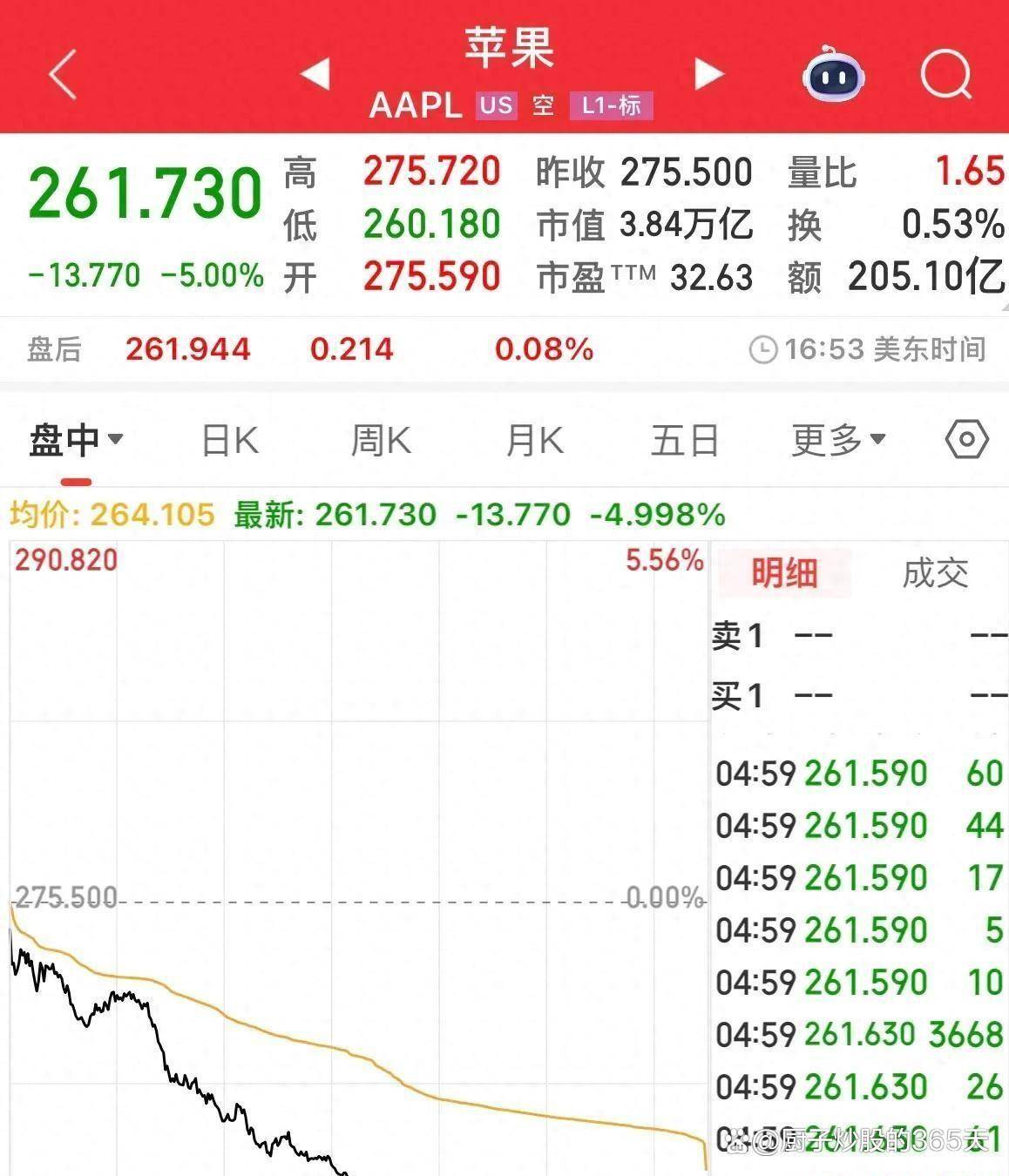
Market Overview - The US stock market experienced a significant decline, with the Dow Jones Industrial Average dropping 669.42 points (1.34%) to close at 49,451.98 points, the Nasdaq Composite falling 469.32 points (2.03%) to 22,597.15 points, and the S&P 500 decreasing by 108.71 points (1.57%) to 6,832.76 points [1][2][3] Market Sentiment - Over 4,100 stocks declined, indicating widespread market panic as investors rushed to sell assets, particularly in the tech and growth sectors. The VIX index surged, reflecting heightened risk aversion [2][3] Sector Performance - The sell-off affected nearly all sectors, with notable declines in precious metals and semiconductor stocks. The precious metals sector saw significant drops, with gold futures down 3.08% and silver futures plummeting 10.62% [4][5][6][8] - The Philadelphia Semiconductor Index fell by 2.5%, with individual stocks like AEHR Test Systems down 17.58% and Intel down over 3% [8][10] Major Companies - Apple Inc. experienced a substantial drop of 5.00%, resulting in a market cap loss of over $120 billion, attributed partly to regulatory concerns [12] - Other major tech companies also faced declines, with Tesla down 1.62%, Amazon down 2.20%, and Meta Platforms down nearly 3% [12] Financial Sector - Bank stocks fell across the board, with JPMorgan Chase down over 2%, Goldman Sachs down over 4%, and Citigroup down over 5%, driven by concerns over AI disrupting traditional wealth management [13][14] Economic Indicators - Recent economic data, including a drop in initial jobless claims and lower-than-expected existing home sales, contributed to market anxiety about potential economic overheating and prolonged high interest rates [24][25][26] Global Market Impact - The sell-off in the US markets had a ripple effect on global markets, with European indices also closing lower after initially opening higher, indicating a widespread sentiment of fear [18][19][20] AI Concerns - The market's decline was exacerbated by fears regarding the disruptive impact of AI technologies on various industries, leading to significant stock price drops in sectors perceived to be at risk [21][22][30] Storage Chip Sector - In contrast to the overall market trend, storage chip stocks saw gains, with companies like SanDisk and Seagate Technology rising significantly, reflecting a belief that AI's growth will increase demand for data storage [29]


美股三大指数周线齐跌
财联社· 2026-02-14 00:39
Market Overview - The three major indices showed mixed performance, with the Dow Jones up 0.10% to 49,500.93 points, the S&P 500 up 0.05% to 6,836.17 points, and the Nasdaq down 0.22% to 22,546.67 points [3] - All three indices recorded weekly declines, with the S&P 500 down 1.4%, the Dow down 1.2%, and the Nasdaq down 2.1% [3] Economic Indicators - The U.S. Bureau of Labor Statistics reported that the January CPI rose 2.4% year-over-year and 0.2% month-over-month, both below market expectations [3] - The core CPI, excluding volatile food and energy prices, increased by 2.5% year-over-year and 0.3% month-over-month, aligning with market expectations [3] - Phil Blancato, Chief Market Strategist at Osaic, indicated that this data could pave the way for interest rate cuts and inflation control if the trend continues [3] Sector Performance - Concerns over AI disruption led to market sell-offs, affecting various sectors including software, real estate, trucking, and financial services [6] - Financial stocks such as Charles Schwab and Morgan Stanley fell by 10.8% and 4.9%, respectively, while software company Workday dropped 11% and commercial real estate firm CBRE fell 16% [6] - The media sector was also impacted, with Disney down approximately 3% and Netflix down 6% [7] Technology Stocks - Major tech stocks mostly declined, with Nvidia down 2.21%, Apple down 2.27%, Microsoft down 0.13%, Google down 1.06%, and Amazon down 0.41% [7] - Tesla saw a slight increase of 0.09%, while Oracle rose by 2.34% and Netflix increased by 1.33% [7] Chinese Stocks - The Nasdaq Golden Dragon China Index fell by 0.10%, with Alibaba down 1.89%, JD.com down 1.38%, and Pinduoduo up 0.06% [7] - NIO remained flat, while Xpeng rose by 1.36% and Li Auto fell by 1.81% [7]



Figure Technology Solutions Announces Launch of Secondary Offering of Blockchain-Native Common Stock
Globenewswire· 2026-02-13 15:26
Core Viewpoint - Figure Technology Solutions, Inc. has announced a proposed secondary public offering of up to 4,230,000 shares of its Series A Blockchain Common Stock, aiming to enhance its capital structure and market presence [1] Group 1: Offering Details - The proposed offering includes a share repurchase plan where Figure intends to buy back up to $30 million of its Class A common stock from underwriters at the same price per share as the offering [2] - Goldman Sachs & Co. LLC, Morgan Stanley, and Cantor Fitzgerald will serve as lead joint book-running managers and sales agents for the offering [3] Group 2: Company Overview - Figure Technology Solutions operates as a blockchain-native capital marketplace, facilitating origination, funding, and trading of tokenized assets, with over 200 partners and more than $22 billion in home equity originated [6] - The company’s ecosystem includes Figure Connect, a consumer credit marketplace, and Democratized Prime, an on-chain lend-borrow marketplace, along with DART for asset custody and $YLDS, a yield-bearing stablecoin [6]

Leading bank flags AI disruption risk now affecting 24% of European equities as model capabilities surge
Yahoo Finance· 2026-02-13 15:15
Core Insights - The perception of artificial intelligence disruption risk in the market has surged from 4% to 24% of the MSCI Europe index in a month, reflecting a rapid broadening of concerns similar to the early Covid pandemic sell-off [1][10] Group 1: Market Dynamics - Investors are facing a dramatic repricing as they contend with non-linear advancements in AI capabilities, with expectations for new US large language models in 2026 that will significantly outperform current systems [2] - The affected portion of the MSCI Europe index has increased from 10% to 24% with the inclusion of European banks, which are now part of the "adopter to disrupted debate" [4] Group 2: Sector Resilience - Utilities, semiconductors, defense, tobacco, and household products are identified as the most resilient sectors against broadening disruption risks due to their defensive characteristics and regulatory protections [5] Group 3: Valuation Trends - Stocks in software and business services classified as "market-debated disrupted" have seen a decline in valuation from 24 times forward earnings to 16.4 times, with further potential declines noted for "undebated" disrupted stocks trading at 11.1 times earnings [6] Group 4: Defensive Positioning - The company has shifted its stance from neutral to cautious on European cyclicals versus defensives, while maintaining an overweight rating on European banks despite the ongoing risks from AI disruption [8] Group 5: Market Sentiment - Material disruption concerns are now ascribed to at least 10% of the MSCI Europe index excluding banks, with this percentage more than doubling in just one week [7]
Musk’s bankers are discussing a plan to wrangle xAI debt after SpaceX merger
Yahoo Finance· 2026-02-13 14:44
Core Viewpoint - Elon Musk's bankers are exploring a financing plan following the merger of SpaceX and xAI to alleviate the significant interest costs incurred by Musk in recent years [1][2]. Group 1: Debt and Financing - Musk has accumulated nearly $18 billion in debt from the Twitter buyout and the establishment of xAI, with a financing deal expected to help reduce this debt burden ahead of a potential IPO later this year [2]. - Morgan Stanley, which facilitated Musk's Twitter acquisition and xAI's debt raising, is anticipated to play a key role in the financing plan, alongside other banks like Goldman Sachs, Bank of America, and JPMorgan [3]. - Musk's acquisition of Twitter was supported by a $12.5 billion financing package, which has resulted in substantial monthly interest payments [4]. Group 2: Debt Management and Market Response - Initially, banks holding Twitter's debt faced challenges due to concerns over Musk's content moderation approach, which affected ad revenue, leading to a delay in offloading the debt [5]. - In April, banks successfully sold the last portion of Twitter's buyout debt, amounting to $1.23 billion, at a fixed rate of 9.5% and a discounted price of 98 cents on the dollar [5]. - Following the merger with xAI, the social network was valued at $45 billion, including debt, and xAI subsequently took on an additional $5 billion in debt, with creditors expressing concerns about profitability and cash flow [6].

Morgan Stanley said to consider $500 million India fund, shifts some assets
The Economic Times· 2026-02-13 13:19
Group 1 - Morgan Stanley Investment Management plans to move eight healthcare-focused investments into a continuation vehicle and is seeking to raise $500 million for this new India fund strategy [1][5] - The assets involved include Omega Hospitals and RG Scientific Enterprises Pvt., with Morgan Stanley having invested in Omega in 2024 with a minority stake and acquiring a controlling stake in RG Scientific in the same year [2][5] - The continuation fundraising initiative reflects a broader trend among investment firms seeking exit routes beyond initial public offerings and mergers, with the global secondary market increasing by 48% to $240 billion in 2025 compared to the previous year [5]


综述|人工智能技术冲击引发担忧 纽约股市大幅下跌
Xin Hua Wang· 2026-02-13 07:32
另外,美国住宅销量大幅下降、联邦政府批评苹果手机推送系统偏好左派等因素也冲击相关公司股价。 (文章来源:新华网) 今年以来,随着越来越多的人工智能工具投入应用,软件、物流、金融服务、商业地产等行业受到影 响。投资者担心,人工智能可能以更低成本、更高效率重新塑造相关产业的运营方式,冲击这些领域传 统企业的业绩表现。近来,这些担忧逐步开始反映在上市公司股价波动上。 由于投资者担心人工智能将优化物流流程,压缩传统企业利润率,罗宾逊全球物流公司股价12日跌超 14%。投资者担忧人工智能工具使用率提高会削弱办公空间需求,部分商业地产企业股票遭遇抛售。因 为新技术可能颠覆财富管理业务模式,以摩根士丹利公司为代表的金融服务类企业股价也受到冲击。 美国自由资本市场公司金融分析师杰伊·伍兹表示,人工智能技术不久前曾推动相关产业股指飙升至极 端水平,如今却成为压制相关企业股价的因素。 新华社纽约2月12日电综述|人工智能技术冲击引发担忧纽约股市大幅下跌 由于投资者担忧人工智能技术大规模应用颠覆相关产业传统运营方式,美国纽约股市12日高开后大幅下 挫,跌幅在尾盘进一步放大。收盘时,纽约股市三大股指均显著下跌,其中物流和商业地产企业 ...
Will Crypto ETFs Have Lasting Appeal? (BTC-USD)
Seeking Alpha· 2026-02-13 04:10
Core Insights - Bitcoin's price decline has not deterred the launch of new ETFs aimed at capitalizing on a potential rebound in the cryptocurrency market [2] - Regulatory changes, including the SEC's new generic listings standards (GLS) and the upcoming CLARITY Act, are expected to enhance investor interest in crypto ETFs, which raised $47.2 billion last year despite $5 billion in withdrawals in Q4 [3][4] Regulatory Developments - The GLS simplifies the listing process for crypto ETFs, allowing exchanges to list qualifying assets within five days without SEC approval, significantly reducing previous delays [8] - Under GLS, a crypto asset must be traded as a futures asset for at least six months, have a 12-month average liquidity of $700 million, and be part of the Intermarket Surveillance Group to gain approval [9] - The CLARITY Act, currently in Congress, aims to classify digital assets as "Digital Commodities," easing regulatory burdens for banks and encouraging institutional investment in crypto ETFs [15][16] Institutional Adoption - Major U.S. banks and asset managers are increasingly advising clients to include crypto in diversified portfolios, with Bank of America allowing its advisors to recommend spot Bitcoin ETFs [12] - Morgan Stanley has launched a Solana ETF with staking rewards, reflecting a trend where ETF issuers are incorporating proof-of-stake rewards to enhance fund attractiveness [13] - Analysts predict that ETF inflows could double by 2026 as more institutions enter the crypto space [4][19] Market Trends - The derivatives market is also showing growth, with CME Group expanding its crypto derivatives offerings, indicating a robust interest in crypto products [5] - Despite a reported bear market for Bitcoin, with significant holdings reductions in Q4 2025, some analysts remain optimistic about institutional interest and potential price recovery [20][21][22]