
动力煤

Search documents
春节后A股将会怎么走?以史为鉴这三大板块上涨概率更高
Feng Huang Wang· 2026-02-23 00:40
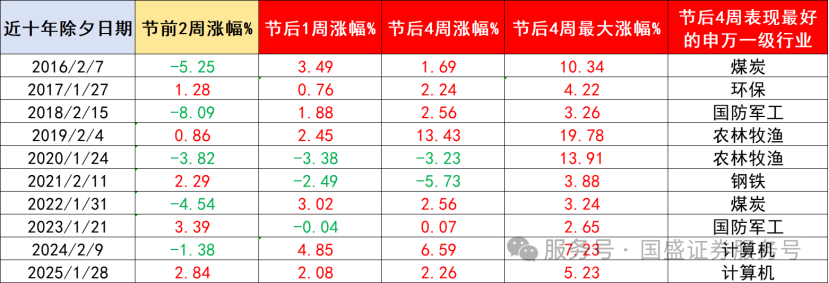
Group 1: Market Trends Post-Spring Festival - The Shanghai Composite Index shows a significant upward trend after the Spring Festival, with probabilities of increases over 5, 10, 20, and 30 days being 75%, 70%, 80%, and 60% respectively, and median gains of 1.64%, 1.32%, 9.45%, and 3.88% [1] - Over the past decade, the coal, agriculture, forestry, animal husbandry, and defense industries have performed well in the month following the Spring Festival, with the computer industry leading in the last two years [1] Group 2: Industry Performance Data - Historical data shows varying performance across industries during the Spring Festival period, with coal, environmental protection, and agriculture showing notable gains in specific years, such as coal in 2016 with a maximum gain of 10.34% and agriculture in 2019 with a maximum gain of 19.78% [2] - The report indicates that the coal industry is expected to see a significant increase in production capacity in 2026, with an anticipated rise of 0.7 billion tons, while also highlighting a potential reduction in capacity by 1.5 billion tons due to policy changes [2] Group 3: Agricultural Sector Insights - The agricultural sector is projected to experience a gradual recovery in pig prices by 2026, driven by a reduction in breeding sow capacity, which is expected to improve profitability for leading pig farming companies [3] - The report emphasizes opportunities in the poultry sector, particularly for leading chicken farming companies, and highlights the growth potential in the pet market [3] Group 4: Defense Industry Outlook - The defense industry is poised for growth in 2026, driven by geopolitical factors and advancements in military technology, with a focus on precision-guided munitions, unmanned systems, and networked battlefield capabilities [4] - Key recommendations include investments in missile weaponry, new aviation equipment, unmanned systems, and commercial aerospace sectors, with specific companies highlighted for their strategic positions within these industries [5]

黑色建材日报:库存持续累积,矿价震荡下行-20260206
Hua Tai Qi Huo· 2026-02-06 05:08
1. Report Industry Investment Ratings - No industry investment ratings are provided in the report 2. Core Views - The overall contradiction of steel products in the off - season is limited, but the inventory continues to accumulate, and the supply - demand pressure increases slightly. Iron ore inventory accumulates, and the price fluctuates downward. Coking coal and coke are in a weak supply - demand balance, with prices fluctuating. The supply and demand of thermal coal weaken during the Spring Festival holiday, and the price fluctuates [2][4][5][8] 3. Summary by Related Catalogs Steel Market Analysis - The futures market of steel products fluctuates downward. The main contract of rebar futures closes at 3101 yuan/ton, and the main contract of hot - rolled coil closes at 3263 yuan/ton. The actual national building materials output decreases by 81500 tons compared with last week, the total inventory increases by 440400 tons, and the apparent demand decreases by 287600 tons. The total inventory of hot - rolled coils increases by 112900 tons, and the apparent demand decreases by 58700 tons [1] Supply - Demand and Logic - In the off - season, the demand for building materials slows down, and the procurement sentiment is weak, which significantly suppresses the demand for rebar. The demand for plates is relatively stable, but the downstream manufacturing procurement sentiment is also cautious. The steel inventory accumulates before the festival, and the supply - demand pressure increases slightly. Attention should be paid to winter storage replenishment and raw material price changes [2] Strategy - The unilateral strategy is to expect the price to fluctuate. There are no strategies for inter - period, inter - variety, spot - futures, and options [3] Iron Ore Market Analysis - The price of iron ore decreases slightly. The prices of mainstream imported iron ore varieties at Tangshan Port are weakly declining. Traders' quotation enthusiasm is average, and steel mills' procurement is mainly for rigid demand. The total transaction volume of iron ore at major domestic ports today is 986000 tons, a 4.64% decrease from the previous day [4] Supply - Demand and Logic - The global shipping volume increases slightly, the shipping volume from Australia decreases, and the shipping volume from Brazil increases significantly. The arrival volume of imported iron ore is stable but at a historical high. Although the resumption of production of steel mills is slow, the molten iron output is at a medium - high level. The port inventory and steel mills' inventory continue to increase. The end - demand support weakens as the winter storage replenishment of steel mills is nearing the end. Attention should be paid to the subsequent negotiation progress of iron ore and the steel mills' replenishment [5] Strategy - The unilateral strategy is to short on rallies. There are no strategies for inter - period, inter - variety, spot - futures, and options [6] Coking Coal and Coke Market Analysis - The main contract of coking coal futures closes at 1172 yuan/ton, and the main contract of coke closes at 1738 yuan/ton. The price of coking coal stabilizes, and individual coal varieties decline slightly. Coking plants mainly produce normally, with good coke shipping enthusiasm and low inventory. Steel mills' procurement is for rigid demand, and the speculative demand is weak. Most steel mills have completed winter storage replenishment, and the coke inventory is at a high level. The price of Mongolian No. 5 raw coal is in the range of 1030 - 1050 yuan/ton [8] Supply - Demand and Logic - For coke, the supply is stable, the demand is suppressed by the weakening of steel products, and steel mills purchase as needed. The market contradiction is limited, and it is expected to fluctuate in the short term, following cost fluctuations. For coking coal, the domestic supply tightens marginally due to holidays, the demand replenishment is nearing the end, and the trading is light. Before the Spring Festival, the coal price is expected to be stable with a narrow adjustment. The total inventory is accumulating but still low, and the fundamental contradiction is not large. Attention should be paid to overseas demand and post - festival supply recovery [8] Strategy - Both coking coal and coke are expected to fluctuate. There are no strategies for inter - period, inter - variety, spot - futures, and options [9] Thermal Coal Market Analysis - In the producing areas, the coal price fluctuates. Before the Spring Festival, the long - term agreement shipment is stable, and some terminals make small - scale preparations. However, as more downstream factories are on holiday, the overall demand declines, some coal mines have poor sales, and the price is under pressure. At the northern ports, the market trading is light, and the quotation is basically stable. The import market is stable and slightly strong recently. Due to policy disturbances in Indonesia, the quantity of foreign ore reported for shipment decreases, and the future import volume is expected to shrink, with strong short - term support for the price of imported coal from Indonesia [10] Supply - Demand and Logic - Before the Spring Festival, both supply and demand weaken, and the coal price fluctuates. In the long - term, the supply is in a loose pattern. Attention should be paid to the consumption and replenishment of non - power coal [10] Strategy - No strategy is provided [11]
红马奔腾策略系列 1:从老红利到新红马之投资范式
Changjiang Securities· 2026-01-30 11:11
市场策略丨深度报告 [Table_Title] 红马奔腾策略系列 1:从老红利到新红马之投资 范式 %% %% %% %% research.95579.com 1 丨证券研究报告丨 报告要点 [Table_Summary] 目前部分机构资产回报率承压,核心原因在于负债端久期长、成本刚性,而低利率环境下,固 收类资产收益率下行,权益类的传统红利投资股息下降,较难覆盖负债端成本。投资思路:预 期回报率高(3%~5%以上)、安全边际高(行业格局和估值企稳)的方向值得关注。1)寻找 未来股息率高的方向:通过分红率的提高来提供较高的股息水平,直接增厚股息回报;2)同时 估值不应大幅下滑:具有安全边际,避免因资本利得大幅损失(如股价下跌)抵消股息收益, 重点关注供给收缩/行业出清到尾声的细分行业。 分析师及联系人 [Table_Author] 戴清 SAC:S0490524010002 SFC:BTR264 请阅读最后评级说明和重要声明 2 / 28 %% %% %% %% 关注自由现金流和稳住 ROE 是分红潜力的关键。一是从理论出发,稳定的自由现金流是保障 潜在股息率提升的重要基础,其通过影响利润与估值,提供持续的 ...
山西证券研究早观点-20260114
Shanxi Securities· 2026-01-14 01:11
Market Overview - The domestic market indices showed a decline, with the Shanghai Composite Index closing at 4,138.76, down 0.64% [4] - The CSI 300 Index experienced a decrease of 0.60%, closing at 4,761.03 [4] Agricultural Sector Insights - The agricultural sector reported a weekly performance with the CSI 300 Index increasing by 2.79% and the agriculture sector rising by 0.98%, ranking 28th among sectors [6] - Pig prices increased week-on-week, with average prices for external three yuan pigs in Sichuan, Guangdong, and Henan at 13.10, 12.86, and 12.93 CNY/kg respectively, showing a mixed trend [6] - The average pork price was 17.97 CNY/kg, up 1.18% from the previous week, while the average wholesale price for piglets rose by 6.45% to 16.50 CNY/kg [6] - The self-breeding and self-raising profit margin was -11.54 CNY per head, a reduction of approximately 23.05 CNY per head from the previous week [6] - The report suggests focusing on Hai Da Group due to favorable conditions in the feed industry and its competitive advantages in the market [6] Livestock Industry Trends - The pig farming industry has entered a loss phase, prompting a new round of capacity reduction driven by market forces and policy adjustments [6] - The number of breeding sows is expected to decrease rapidly, indicating a trend towards capacity reduction in the first half of the year [6] - Companies such as Wen's Foodstuffs, Shennong Group, and New Hope are recommended for investment due to their potential recovery in fundamentals and valuations [6] Poultry Sector Developments - Shengnong Development's breeding chicken business is progressing steadily, with cost control measures leading to reduced production costs [6] - The company is enhancing its revenue structure by increasing its presence in high-value channels [6] Pet Food Market Outlook - The pet food sector is anticipated to continue growing, with increasing penetration rates in pet ownership [6] - The competition is shifting from marketing to research and supply chain efficiency, suggesting a focus on brands that prioritize R&D [6] Coal Industry Analysis - The coal market is maintaining normal production levels, with a gradual recovery in supply as coal mines resume operations [8] - The demand from downstream sectors remains limited, leading to a stable but weak market outlook [8] - Investment recommendations include companies like Yanzhou Coal Mining, Shaanxi Coal and Chemical Industry, and China Shenhua Energy, with a focus on potential recovery in Q4 performance [8]
淮河能源跌2.25%,成交额1.57亿元,主力资金净流入464.07万元
Xin Lang Cai Jing· 2025-12-29 05:37
Group 1 - The core viewpoint of the news is that Huaihe Energy's stock has experienced a decline in price and trading volume, with a notable drop of 12.34% year-to-date and a recent decrease of 3.33% over the last five and twenty trading days [1][2] - As of December 29, Huaihe Energy's stock price was reported at 3.48 yuan per share, with a total market capitalization of 24.94 billion yuan [1] - The company has seen a net inflow of main funds amounting to 4.64 million yuan, with significant buying and selling activity from large orders [1] Group 2 - Huaihe Energy, established on November 29, 2000, and listed on March 28, 2003, operates in sectors including railway transportation, coal trading, thermal power generation, and electricity sales [2] - The company's revenue composition is as follows: logistics trade 68.73%, electricity 22.26%, coal sales 5.75%, railway transportation 2.61%, and others 0.65% [2] - For the period from January to September 2025, Huaihe Energy reported a revenue of 21.30 billion yuan, a year-on-year decrease of 9.71%, and a net profit attributable to shareholders of 752 million yuan, down 10.69% year-on-year [2] Group 3 - Since its A-share listing, Huaihe Energy has distributed a total of 1.10 billion yuan in dividends, with 466 million yuan distributed over the past three years [3] - As of September 30, 2025, the top ten circulating shareholders include Hong Kong Central Clearing Limited and Southern CSI 1000 ETF, with changes in their holdings noted [3]

黑色建材日报:环保限产扰动,钢价震荡运行-20251217
Hua Tai Qi Huo· 2025-12-17 02:39
1. Report Industry Investment Rating - The report does not explicitly provide an overall industry investment rating. However, for each product, the strategies suggest a "sideways" movement: - Steel: Sideways [1] - Iron ore: Sideways [2][3] - Coking coal and coke: Sideways [3][4] - Thermal coal: The report does not provide a clear strategy but indicates a weak price trend [4] 2. Core View of the Report - The overall market of black building materials is affected by multiple factors such as environmental protection production restrictions, seasonal production cuts, and changes in supply - demand relationships. Each product shows different supply - demand characteristics and price trends, and most products are in a state of price fluctuations. 3. Summary by Product Steel - **Market Analysis**: Yesterday, the main contract of rebar futures closed at 3,081 yuan/ton, and the main contract of hot - rolled coil closed at 3,246 yuan/ton. The spot trading volume of steel was average. The low - price transactions in the morning were good, but there were few transactions after price increases, and the basis shrank. The national building materials trading volume was 99,186 [1]. - **Supply - Demand and Logic**: For building materials, there is no significant production pressure currently, and inventory is continuously decreasing. For plates, high inventory continues to suppress prices, but demand resilience remains. In the short term, the supply side is affected by environmental protection and seasonal production cuts, and raw material support may weaken [1]. - **Strategy**: Sideways for single - side trading; no strategies for inter - period, inter - variety, spot - futures, and options trading [1] Iron Ore - **Market Analysis**: Yesterday, iron ore futures prices fluctuated. The iron ore 2605 contract closed at 761 yuan, up 0.92%. Spot prices rose slightly, but trading volume was low. Traders' enthusiasm for quoting was average, and steel mills maintained on - demand restocking, with purchase prices mostly following the market [2]. - **Supply - Demand and Logic**: The demand side of iron ore is currently weak. The steel product market has weak supply and demand, and steel mills' production enthusiasm is not high under the state of small profits, resulting in a continuous decline in hot metal production. Although the demand is weak, the iron ore price remains high due to the tight supply of some varieties at ports and weak liquidity, temporarily covering up the supply - demand contradiction. In the future, as steel mills start seasonal production cuts and are affected by environmental protection production restrictions, hot metal production is expected to further decline. If the port resource liquidity improves, combined with the fundamental supply - demand contradiction, the iron ore price will face significant downward pressure [2]. - **Strategy**: Sideways for single - side trading; no strategies for inter - period, inter - variety, spot - futures, and options trading [2][3] Coking Coal and Coke - **Market Analysis**: Yesterday, coking coal and coke futures continued the previous pattern of sideways and slightly stronger, and continued to rebound slightly. For imported Mongolian coal, the customs clearance volume remained high, port inventory continued to accumulate, prices fluctuated with the market, and downstream market procurement was cautious, with limited overall trading activity [3]. - **Supply - Demand and Logic**: Coking coal currently shows a pattern of weak supply and demand. Coal mines are mainly operating with low supply, and supply has slightly shrunk. Downstream coke has the expectation of further price cuts, and enterprises' enthusiasm for restocking is average, mostly for on - demand procurement. Coke also faces pressure on both supply and demand. Supply has slightly declined, and on the demand side, some steel mills are undergoing maintenance and production cuts, and the winter storage restocking plan has not yet been launched, with a relatively light trading atmosphere in the market [4]. - **Strategy**: Sideways for both coking coal and coke in single - side trading; no strategies for inter - period, inter - variety, spot - futures, and options trading [3][4] Thermal Coal - **Market Analysis**: In the producing areas, the coal prices in the main producing areas continued to run weakly. Downstream demand was mainly for on - demand hauling, and speculative demand was weak. Most coal mines sold at reduced prices, but sales did not improve, and mine inventory accumulated. At ports, affected by the continuous weakness in the producing areas, port quotes continued to decline. Some traders were extremely pessimistic about the future market, and the phenomenon of selling at a loss intensified. Currently, port inventory is high, the number of anchored ships is small, and the turnover rate has not increased. Traders at ports generally have a pessimistic attitude, believing that the current decline is large and there is still an expectation of further decline in the future. In terms of imports, affected by domestic coal prices, the tender price of imported coal continued to decline, and the market trading atmosphere was cold [4]. - **Supply - Demand and Logic**: Recently, coal prices have continued to run weakly, with downstream consumption falling short of expectations and relatively high inventory. Some coal mines have completed their annual tasks, so it is difficult to have significant improvement in supply in the later period. In the medium and long term, attention should be paid to changes in the supply pattern, as well as coal consumption and restocking [5]. - **Strategy**: The report does not provide a clear trading strategy but mentions factors such as coal mine safety supervision dynamics, port inventory accumulation changes, daily consumption of thermal coal and chemical coal, and other unexpected accidents that need to be concerned [5]
黑色建材日报:市场成交转弱,钢价震荡下行-20251212
Hua Tai Qi Huo· 2025-12-12 03:52
Group 1: Report Industry Investment Ratings - There is no information provided regarding the report industry investment ratings in the given content. Group 2: Report Core Views - The steel market's trading volume has weakened, and steel prices are fluctuating downward. The fundamentals of building materials are improving, while those of plates are not improving enough. The arrival of the off - season for building materials demand should be monitored [1]. - Iron ore prices have slightly declined due to a drop in hot metal production. The supply - demand contradiction is accumulating, and the release of inventory in the future may put pressure on prices. Attention should be paid to the progress of iron ore negotiations [3]. - A new round of price cuts for coking coal and coke has begun, and their prices are fluctuating downward. The bearish sentiment for coke is strong, and the price of coking coal is still under pressure [4][5]. - The price of thermal coal at ports and in production areas has been continuously falling. In the long - term, the supply remains loose, and attention should be paid to non - power coal consumption and restocking [6]. Group 3: Summary by Related Catalogs Steel - **Market Analysis**: The main contract of rebar futures closed at 3069 yuan/ton, and the main contract of hot - rolled coil futures closed at 3238 yuan/ton. The production, inventory, and demand of the five major steel products have all decreased. The spot trading of steel was weak, and prices in mainstream areas followed the decline of the futures market [1]. - **Supply - Demand and Logic**: The supply - demand fundamentals of building materials are improving, with both consumption and production declining, and inventory pressure easing. The fundamentals of plates are not improving enough, and high inventory is suppressing prices, requiring appropriate production cuts. The impact of off - season demand on the fundamentals should be monitored [1]. - **Strategy**: The strategy for steel is a unilateral oscillation, with no strategies for inter - period, inter - variety, spot - futures, or options [2]. Iron Ore - **Market Analysis**: Iron ore futures prices fluctuated weakly. The prices of mainstream imported iron ore varieties at Tangshan ports were weak. The trading volume at major ports was 99.1 million tons, a 38.60% increase from the previous period. The average daily hot metal production of 247 steel mills was 229.20 million tons, a decrease of 3.10 million tons from the previous period [3]. - **Supply - Demand and Logic**: Iron ore shipments increased slightly this period, and the average daily hot metal production continued to decline. The supply - demand contradiction is still accumulating, and inventory is rising. If external factors are removed, inventory release may put pressure on prices. Attention should be paid to the progress of iron ore negotiations [3]. - **Strategy**: The strategy for iron ore is a unilateral oscillation, with no strategies for inter - period, inter - variety, spot - futures, or options [3]. Coking Coal and Coke (Double - Coking) - **Market Analysis**: The main contracts of coking coal and coke futures fluctuated downward. Some steel mills initiated a new round of price cuts for coke, with a reduction of 50 - 55 yuan/ton. The price of coking coal in the main production areas continued to decline, and the price of imported Mongolian coal also decreased [4]. - **Supply - Demand and Logic**: The bearish sentiment for coke is strong, the support for raw material demand is weak, and the demand for coke is weakening due to the decline in hot metal production. Attention should be paid to the price of raw coal and changes in hot metal production. The sentiment for coking coal is still weak, downstream demand is limited, and coal prices are still under pressure [4][5]. - **Strategy**: The strategy for coking coal and coke is an oscillation, with no strategies for inter - period, inter - variety, spot - futures, or options [5]. Thermal Coal - **Market Analysis**: The price of coal in the main production areas continued to decline, and there was a wait - and - see sentiment in the market. The supply in the production areas was slightly tightened due to the maintenance of some coal mines. The price at ports continued to fall, demand was weak, and trading was cold. The price of imported coal also fell rapidly and maintained a cost - performance advantage [6]. - **Demand and Logic**: Pessimistic sentiment has spread in the market recently, and coal prices are fluctuating. In the long - term, the supply remains loose, and attention should be paid to non - power coal consumption and restocking [6]. - **Strategy**: There is no strategy provided for thermal coal [7].
安监限产叠加冬需,动力煤价格高位承压:能源周报(20251117-20251123)-20251124
Huachuang Securities· 2025-11-24 08:43
Investment Strategy - The oil and gas capital expenditure trend is declining, leading to a slowdown in supply growth. Since the signing of the Paris Agreement in 2015, global capital expenditure in the oil and gas upstream sector has significantly decreased, with a notable drop of nearly 22% from the 2014 peak to $351 billion in 2021. This trend is expected to continue as major energy companies face pressure to decarbonize and shift focus towards energy transition and renewable projects [9][25][27] - The current active drilling rig count in the US remains low, with new well costs closely aligned with current oil prices, limiting profit margins. The growth rate of US oil production is anticipated to slow down, with evidence emerging from the first half of 2025 [9][25][27] Oil Market - Brent crude oil spot price is currently at $63.54 per barrel, reflecting a week-on-week increase of 0.63%, while WTI crude oil is at $59.43 per barrel, down 0.43% [10][28] - The geopolitical situation, particularly the easing of tensions in the Russia-Ukraine conflict, is contributing to a volatile oil price environment. The expectation of a breakthrough in diplomatic negotiations has led to fluctuations in oil prices [10][28] Coal Market - The average market price for Qinhuangdao port thermal coal (Q5500) is reported at 820 RMB per ton, with a week-on-week increase of 0.35%. However, the market is experiencing a stalemate as downstream demand remains cautious towards high prices [11][12] - The total inventory at nine ports in the Bohai Rim is reported at 23.93 million tons, up 6.74% week-on-week, while southern ports report a decrease of 1.48% to 603.8 million tons [11][12] Coking Coal Market - Coking coal prices are experiencing a high-level consolidation, with the price of coking coal at the Jingtang port reported at 1,780 RMB per ton, down 4.30% week-on-week. The price of coking coal is less regulated compared to thermal coal, allowing producers to benefit from price increases [13][14] - The average daily iron output from 247 steel mills is reported at 2.3621 million tons, reflecting a slight decrease of 0.30% week-on-week, indicating a weak demand environment for steel products [13][14] Natural Gas Market - Russian LNG is entering the Chinese market at prices 20-30% lower than market rates, despite US pressure on Japan and Europe to halt imports of Russian LNG. This influx is contributing to a stable supply environment [14][15] - The average price of natural gas in the US is reported at $4.44 per million British thermal units, down 1.4% week-on-week, while European gas prices are on the rise [14][15] Oilfield Services - The oilfield services sector is expected to maintain its growth due to government policies aimed at ensuring energy security. The capital expenditure of major oil companies is projected to remain high, supporting the oilfield services industry's outlook [16][17] - The global active rig count is reported at 1,800, with a slight decrease in the Middle East and Asia-Pacific regions, while the US shows a week-on-week increase of 5 rigs [16][17]






行业比较与配置系列(2025年12月):12月行业配置关注:产能出清与景气改善的线索
CMS· 2025-11-24 06:01
Group 1 - The report highlights a focus on sectors with "inventory stabilization at low levels, capacity structure optimization, and continuous improvement in prosperity" for December [1][5] - The market experienced significant fluctuations due to multiple factors, including the cooling of Federal Reserve interest rate cut expectations and ongoing inflation concerns, with cyclical sectors and defensive industries performing relatively well [1][5] - Recommended sectors for investment include non-bank financials, power equipment (batteries, inverters, wind power equipment), defense and military, coal, basic chemicals, and steel [1][5] Group 2 - Economic data from January to October indicates a continuous slowdown, influenced by high bases, anti-involution policies, and reduced local investment [5] - The report notes that the supply side has seen significant capacity clearance, with some industries beginning to see improvements in capacity utilization rates as demand recovers [5][9] - The report emphasizes that the third quarter saw an unexpected improvement in A-share earnings, particularly in consumer services, resource products, and midstream manufacturing [5][9] Group 3 - The report identifies specific sectors for attention, including non-bank financials, where leading brokerages are accelerating consolidation, and insurance companies are expected to see high growth in profitability [6] - In the power equipment sector, the supply-demand landscape is improving, with prices in the new energy and photovoltaic supply chain continuing to rise [6] - The defense and military sector is expected to benefit from increased global military spending and demand for military trade, driven by geopolitical tensions [6] Group 4 - The coal industry is experiencing a tightening supply due to stricter safety regulations, with winter heating supporting stable demand for thermal coal [6] - Basic chemicals are seeing a structural improvement in demand, particularly in the pesticide sector, which is benefiting from reduced internal competition [6] - The steel industry is expected to see structural opportunities driven by high-end manufacturing demand, particularly from emerging industries like new energy vehicles and humanoid robots [6]
黑色建材日报:库存压力仍在,钢价震荡运行-20251121
Hua Tai Qi Huo· 2025-11-21 01:54
Report Industry Investment Ratings - The investment ratings for steel, iron ore, coking coal, coke, and thermal coal are all "oscillating" [1][3][5][7] Core Views - The steel market has inventory pressure, and steel prices will oscillate. The iron ore market has high supply and inventory pressure, and ore prices will likely oscillate. The coking coal and coke markets are pessimistic, with prices running weakly. The thermal coal market has limited supply recovery and high prices, with short - term prices oscillating strongly [1][3][5][7] Summary by Related Catalogs Steel - **Market Analysis**: Yesterday, steel futures prices oscillated weakly, and spot prices followed suit. National building materials trading volume was 84,500 tons, a decrease of 8.15% from the previous day. Rebar production increased, inventory decreased, and apparent demand was better than expected. Hot - rolled coil production increased slightly, inventory decreased, and consumption increased month - on - month [1] - **Supply - Demand and Logic**: Building materials have supply pressure, but inventory reduction is significant, and apparent consumption is good. However, the consumption off - season is approaching, and consumption sustainability needs to be observed. The supply - demand pattern of strip steel has improved, but supply pressure remains, and inventory reduction pressure is still large. Short - term steel prices will oscillate, and future winter storage games and raw material support need to be observed [1] - **Strategy**: Unilateral trading is oscillating, and there are no strategies for inter - period, inter - variety, spot - futures, or options trading [2] Iron Ore - **Market Analysis**: Yesterday, iron ore futures oscillated. Spot prices were generally weak and stable, and trading was dull. The cumulative trading volume of main ports in the country was 918,000 tons, an increase of 27.32% from the previous day. This week, the average daily hot metal output decreased slightly, port inventory decreased slightly, and the number of stranded ships increased [3] - **Supply - Demand and Logic**: Iron ore supply remains high, and inventory pressure persists. With steel mills' losses and production cuts, hot metal output has decreased month - on - month. Port inventory reduction and a decline in arrivals support prices, so the callback space for ore prices is limited, and they will likely oscillate within a range. Future hot metal output and downstream inventory changes need to be observed [3] - **Strategy**: Unilateral trading is oscillating, and there are no strategies for inter - period, inter - variety, spot - futures, or options trading [4] Coking Coal and Coke - **Market Analysis**: Yesterday, the prices of black - sector commodities generally fell, and the prices of coking coal and coke futures continued to decline. Imported Mongolian coal prices weakened due to the decline in futures prices, trading was cold, and trading volume further declined. This week, coking coal production continued to increase, downstream coking plants and ports reduced inventory significantly, coke production decreased slightly, and overall inventory increased slightly [5] - **Supply - Demand and Logic**: For coking coal, domestic mines are gradually resuming production, Mongolian coal customs clearance remains high, and seaborne coal imports have also increased. Short - term coking coal supply has recovered month - on - month, and downstream demand is mainly for rigid needs, with insufficient speculative demand. The market focus is on the value of warehouse receipts. For coke, production restrictions in some areas have ended, supply has improved, hot metal output has decreased slightly, speculative demand has weakened, and coke supply and demand are in a weak balance [6] - **Strategy**: Coking coal and coke trading are both oscillating, and there are no strategies for inter - period, inter - variety, spot - futures, or options trading [6] Thermal Coal - **Market Analysis**: In the production area, coal prices have been slightly adjusted, and supply has tightened in some mines due to environmental protection and other factors, leading to a slight increase in prices. At present, coal prices are relatively high, and downstream buyers only purchase on demand, with speculative demand slowing down. At ports, inventory has accumulated due to navigation bans, market coal trading is sluggish, and downstream buyers are mainly waiting and watching. For imported coal, supply from Indonesia is low, and foreign mine quotes remain high due to existing profits [7] - **Supply - Demand and Logic**: Current supply recovery in the production area is limited, and downstream purchasing is more cautious. However, the consumption peak season has arrived, port inventory accumulation is lower than expected, and non - power demand downstream is strong. Short - term prices will oscillate strongly, and future overall consumption and inventory replenishment need to be observed [7]