
CMBC(600016)

Search documents
观察|去年深圳8家银行密集“换将”,新行长们的角色之变
Nan Fang Du Shi Bao· 2026-01-21 06:03
Core Viewpoint - Shenzhen's "15th Five-Year Plan" aims to establish itself as a global "industrial financial center," raising expectations for local financial institutions, particularly banks, in their roles and responsibilities [22][23]. Group 1: Leadership Changes in Shenzhen Banks - Over the past year, at least eight commercial banks in Shenzhen have changed their leadership, including major state-owned banks and leading joint-stock banks [2]. - The appointment of Xiong Tao as the head of the Industrial and Commercial Bank of China (ICBC) Shenzhen branch reflects a strategic move to enhance the bank's focus on technology and innovation [2][4]. - Similarly, Ma Mingjun has been appointed as the head of the Bank of China Shenzhen branch, indicating a strengthened commitment to the Guangdong-Hong Kong-Macao Greater Bay Area [4][7]. Group 2: Key Appointments and Their Implications - Wang Xinghai, a veteran of China Merchants Bank, has taken over as the head of the Shenzhen branch, showcasing the bank's internal talent development strategy [9]. - Ping An Bank has also seen significant leadership changes, with Zhang Chaohui becoming the head of the Shenzhen branch, emphasizing the importance of this branch within the bank's overall strategy [11]. - New leaders at various banks, such as Shang Wencheng of China Everbright Bank and Yuan Rui of Shanghai Pudong Development Bank, are focusing on technology finance and innovative service models to meet the needs of Shenzhen's tech-driven economy [12][15]. Group 3: Strategic Focus on Technology Finance - The new leaders are expected to align their banks' strategies with Shenzhen's identity as a technology innovation hub, emphasizing the importance of "investment-loan linkage" services [12][23]. - The financial institutions are being urged to develop comprehensive service models that support the entire lifecycle of technology enterprises, particularly in critical sectors like semiconductors and advanced manufacturing [12][15]. - The shift towards a more integrated financial service approach reflects a broader trend in which banks are expected to act as "deep partners" and "comprehensive service providers" rather than just capital providers [23]. Group 4: Challenges and Future Directions - The banks in Shenzhen face challenges in transitioning from traditional financing to more complex service models, requiring enhanced risk management and understanding of emerging technologies [23]. - There is a growing need for collaboration with venture capital, insurance, and other financial institutions to meet the comprehensive needs of enterprises [23]. - The emphasis on long-term investment strategies and the establishment of a long-term assessment mechanism are critical for supporting sustainable growth in the technology sector [23].






中小微企业贷款贴息、民间投资专项担保……财政部连发五项重要政策
Sou Hu Cai Jing· 2026-01-21 03:12
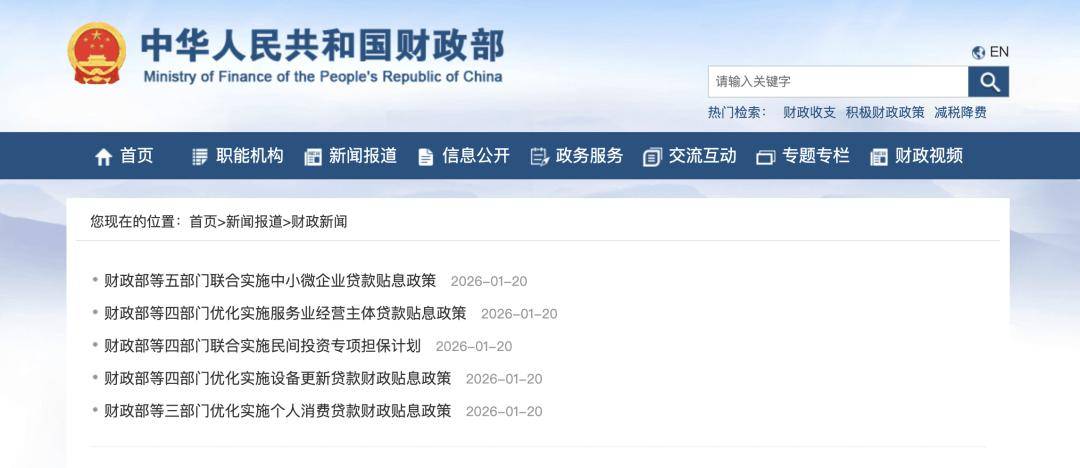
Group 1 - The Ministry of Finance and other departments have released five policy documents aimed at optimizing financial support for personal consumption loans, equipment updates, private investment guarantees, service industry loans, and small and micro enterprise loans [1][9][29] - The personal consumption loan subsidy policy has been extended until December 31, 2026, with adjustments to the subsidy standards and an expanded range of supported financial institutions [4][5][6] - The equipment update loan subsidy policy includes a 1.5% subsidy on fixed asset loans for equipment updates, applicable for up to two years, and has been expanded to include various sectors such as construction, aviation, and digital technology [10][11][12] Group 2 - The private investment guarantee plan has a total quota of 500 billion yuan, to be implemented over two years, focusing on supporting small and micro enterprises in various sectors including technology upgrades and service industry enhancements [17][18] - The plan includes a risk-sharing mechanism where banks will bear at least 20% of the loan risk, while the government guarantee fund will cover up to 80% [19] - The government will also reduce guarantee fees and increase the compensation limit for the guarantee fund to enhance support for private investments [20] Group 3 - The service industry loan subsidy policy has been extended to December 31, 2026, with an increased subsidy cap of 10 million yuan per loan and a 1% annual subsidy rate [23][24] - The policy now includes additional sectors such as digital, green, and retail industries, expanding the scope of financial support [24][25] - The implementation of these policies will involve streamlined processes for fund allocation and enhanced collaboration among financial institutions and regulatory bodies [26][28]




A股银行年度盘点:2025告别普涨,2026拥抱分化
3 6 Ke· 2026-01-21 00:59
Core Insights - In 2025, A-share listed banks in China experienced a significant shift in development logic, moving from scale competition to value creation, focusing on core business and providing precise financial services to support high-quality economic development [1][2] Group 1: Market Performance - The A-share banking sector showed notable structural differentiation in 2025, with the Shanghai Composite Index and Shenzhen Component Index rising by 18.41% and 29.87% respectively, while the banking sector index increased by 12.04% [1] - By the end of 2025, the total market capitalization of A-share banks reached 14.65 trillion yuan, with 35 out of 42 listed banks seeing their stock prices rise, and 19 banks experiencing gains exceeding 10% [1] - In contrast to the broad market rally in 2024, where the banking sector index rose by 43.56%, 2025 marked a transition to a more selective investment environment [1] Group 2: Performance of Major Banks - Agricultural Bank of China led the sector with a stock price increase of 52.66% in 2025, while other major banks like Industrial Bank, China Construction Bank, and Bank of China saw increases of 21.54%, 12.87%, and 10.75% respectively [4] - The total market capitalization of the four major state-owned banks remains dominant, with Industrial Bank at 2.63 trillion yuan and Agricultural Bank at 2.61 trillion yuan [4] - The performance of other major banks was hindered by large capital increases, as several banks announced plans to raise a total of 520 billion yuan through stock issuance [4][5] Group 3: Performance of Joint-Stock Banks - Joint-stock banks exhibited further performance differentiation in 2025, with Shanghai Pudong Development Bank leading with a 24.56% increase, while banks like Huaxia Bank, Everbright Bank, and Minsheng Bank saw declines of 9.82%, 5.59%, and 3.09% respectively [6][7] - The decline in stock prices for these banks can be attributed to poor operating performance, with Huaxia Bank and Everbright Bank reporting revenue and profit declines [8] - Regulatory penalties also impacted these banks, with Huaxia Bank facing over 120 million yuan in fines, indicating ongoing compliance pressures [10][12] Group 4: Regional and Cooperative Banks - City and rural commercial banks showed mixed performance, with Xiamen Bank rising by 35.78%, while others like Zhengzhou Bank and Beijing Bank experienced declines [11] - Regulatory penalties for city commercial banks were significant, with Shanghai Bank and Beijing Bank facing fines exceeding 3.8 million yuan and 3.6 million yuan respectively [12] Group 5: Investment Outlook for 2026 - The investment logic for bank stocks is expected to evolve towards value reassessment, with a focus on performance growth and compliance levels becoming critical for individual stock performance [19] - The banking sector is anticipated to transition from a "growth weak cycle" to a "reform deep water zone," suggesting a dual strategy of holding stable, high-dividend large banks while selectively investing in high-potential regional banks [18][19] - The average price-to-book ratio for the banking sector was approximately 0.73, indicating a structural recovery, with Agricultural Bank exceeding 1.0, while others remained below this threshold [13]




财政部连发多份重要文件,事关贷款贴息、民间投资贷款担保等 一揽子政策全文公布
Sou Hu Cai Jing· 2026-01-20 09:03
Group 1 - The core viewpoint of the news is the implementation of a financial subsidy policy for equipment renewal loans to support businesses in reducing financing costs and promoting effective investment [3][4][5] - The policy includes a 1.5% interest subsidy on fixed asset loans for equipment renewal projects, applicable for a maximum of two years, and is effective until December 31, 2026 [3][4] - The scope of support has been expanded to include various sectors such as construction, aviation, digital technology, and green energy, emphasizing high-end, intelligent, and digital equipment updates [4][6] Group 2 - A total of 26 banks are designated as eligible for processing the interest subsidy loans, including major national banks and several regional banks [4][5] - The subsidy process has been optimized to include a "pre-allocation + settlement" method, streamlining the application and approval process for banks and provincial financial departments [5][6] - The policy aims to enhance the experience of businesses by ensuring timely communication regarding subsidy payments through modern technology [6][7] Group 3 - The policy for small and micro enterprises includes a 1.5% interest subsidy on fixed asset loans, with a maximum loan amount of 50 million yuan, effective from January 1, 2026 [8][9] - The targeted sectors for this subsidy include new energy vehicles, medical equipment, and various service industries, aiming to stimulate investment and production [9][10] - The operational mechanism involves a "total-to-total" model for coordination between financial institutions and fiscal departments to ensure efficient processing of subsidy funds [11][12] Group 4 - The service industry loan subsidy policy has been extended until December 31, 2026, with an increased maximum loan amount of 10 million yuan and a 1% interest subsidy for one year [16][17] - New sectors such as digital, green, and retail have been added to the support scope, enhancing the policy's relevance to current economic trends [17][18] - The funding allocation process has been refined to improve efficiency and reduce redundancy in the approval process [18][19] Group 5 - A special guarantee plan for private investment has been introduced with a total quota of 500 billion yuan over two years, aimed at supporting small and micro enterprises [22][24] - The plan includes risk-sharing mechanisms where banks bear at least 20% of the loan risk, while the government guarantee fund covers up to 80% [24][25] - The initiative encourages innovative financing models and aims to enhance the capital strength of the government guarantee fund to support private investments effectively [26][27]
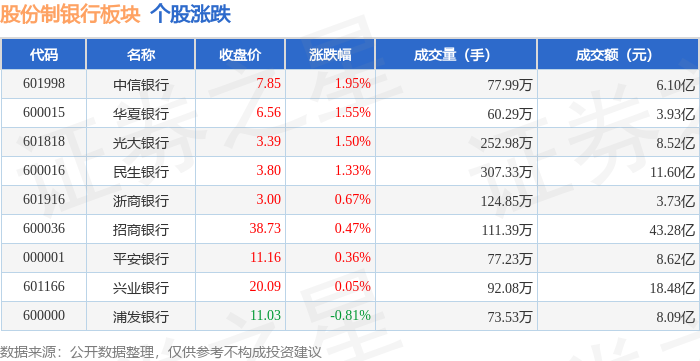
股份制银行板块1月20日涨0.54%,中信银行领涨,主力资金净流入3.9亿元
Zheng Xing Xing Ye Ri Bao· 2026-01-20 08:56
Core Viewpoint - The banking sector saw a slight increase of 0.54% on January 20, with CITIC Bank leading the gains, while the Shanghai Composite Index experienced a minor decline of 0.01% [1] Group 1: Stock Performance - CITIC Bank closed at 7.85, up by 1.95% with a trading volume of 779,900 shares and a transaction value of 610 million yuan [1] - Huaxia Bank closed at 6.56, up by 1.55% with a trading volume of 602,900 shares and a transaction value of 393 million yuan [1] - Everbright Bank closed at 3.39, up by 1.50% with a trading volume of 2,529,800 shares and a transaction value of 852 million yuan [1] - Minsheng Bank closed at 3.80, up by 1.33% with a trading volume of 3,073,300 shares and a transaction value of 1.16 billion yuan [1] - Zhejiang Commercial Bank closed at 3.00, up by 0.67% with a trading volume of 1,248,500 shares and a transaction value of 373 million yuan [1] - China Merchants Bank closed at 38.73, up by 0.47% with a trading volume of 1,113,900 shares and a transaction value of 4.33 billion yuan [1] - Ping An Bank closed at 11.16, up by 0.36% with a trading volume of 772,300 shares and a transaction value of 862 million yuan [1] - Industrial Bank closed at 20.09, up by 0.05% with a trading volume of 920,800 shares and a transaction value of 1.85 billion yuan [1] - Shanghai Pudong Development Bank closed at 11.03, down by 0.81% with a trading volume of 735,300 shares and a transaction value of 809 million yuan [1] Group 2: Capital Flow - The banking sector experienced a net inflow of 390 million yuan from institutional investors, while retail investors contributed a net inflow of 169 million yuan [1] - The sector saw a net outflow of 558 million yuan from speculative funds [1] - Specific capital flows for major banks include: - China Merchants Bank: 14.2 million yuan net inflow from institutional investors, 259 million yuan net inflow from retail investors [2] - Minsheng Bank: 11.2 million yuan net inflow from institutional investors, with net outflows from both speculative and retail investors [2] - Industrial Bank: 68.9 million yuan net inflow from institutional investors, with significant net outflows from speculative investors [2] - Everbright Bank: 38.9 million yuan net inflow from institutional investors, with net outflows from retail investors [2] - Huaxia Bank: 38.3 million yuan net inflow from institutional investors, with net outflows from retail investors [2] - Zhejiang Commercial Bank: 20.2 million yuan net inflow from institutional investors, with net outflows from retail investors [2] - CITIC Bank: 17.7 million yuan net inflow from institutional investors, with net outflows from both speculative and retail investors [2] - Ping An Bank: 4.9 million yuan net inflow from institutional investors, with net outflows from retail investors [2] - Shanghai Pudong Development Bank: 53.2 million yuan net outflow from institutional investors, with a net inflow from speculative investors [2]

高股息精选概念涨1.39%,主力资金净流入这些股
Zheng Quan Shi Bao Wang· 2026-01-20 08:49
Group 1 - The high dividend selection concept increased by 1.39%, ranking 10th among concept sectors, with 16 stocks rising, including Nanshan Aluminum, Dongfang Yuhong, and Lantian Gas, which rose by 7.49%, 7.03%, and 4.21% respectively [1][2] - The leading decliners in the high dividend selection sector included Action Education, Siwei Liekong, and Qianjiang Motorcycle, which fell by 2.62%, 1.43%, and 0.99% respectively [1][2] - The high dividend selection sector saw a net inflow of 388 million yuan from main funds, with 10 stocks receiving net inflows, and 6 stocks exceeding 30 million yuan in net inflow, led by Minsheng Bank with a net inflow of 115 million yuan [2][3] Group 2 - The top stocks by net inflow ratio included Fusenmei, COSCO Shipping, and Minsheng Bank, with net inflow ratios of 14.94%, 10.54%, and 9.95% respectively [3][4] - The high dividend selection concept's top stocks by net inflow included Minsheng Bank, COSCO Shipping, Dongfang Yuhong, and Nanshan Aluminum, with respective net inflows of 115.39 million yuan, 100.27 million yuan, 72.47 million yuan, and 43.30 million yuan [3][4] - The overall market performance showed various sectors with significant fluctuations, with epoxy propylene leading the gainers at 5.78% and military information technology declining by 3.29% [2]



民生银行:创新助力养老机构发展
Cai Jing Wang· 2026-01-20 08:05
Core Insights - The aging population is increasingly becoming a focal point for society, leading to a growing emphasis on "elderly care" services [1] - Minsheng Bank's Dalian branch is actively innovating its service models to enhance "elderly finance" solutions [1] Group 1: Financing Solutions - Minsheng Bank Dalian branch launched the "Hive Plan" which includes tailored financing solutions for elderly care institutions, addressing their diverse funding needs such as daily operations, renovations, and new constructions [2][3] - The bank successfully provided a 1.8 million yuan loan to Songlang Nursing Home within a week, facilitating its operational and renovation needs [1] - A 5 million yuan credit loan was issued to Xinghua Garden Elderly Welfare Service Center to support its expansion and construction projects [2] Group 2: Collaboration and Impact - The Dalian branch collaborates with local government and associations to explore financing and comprehensive services for the elderly care sector [2] - The "Hive Plan" aims to enhance the efficiency of loan approvals and improve the quality of financial services for elderly care institutions [2] - By the end of 2025, the cumulative loan amount issued under the "Hive Plan" is expected to reach nearly 50 million yuan, demonstrating the bank's commitment to supporting the elderly care industry [3]
小摩:预计内银今年股价上升 惟流动性顺风中相对落后 升民行评级至“增持”
Zhi Tong Cai Jing· 2026-01-20 06:49
Core Viewpoint - Morgan Stanley predicts that China Bank (601988) will experience absolute stock price appreciation but may underperform the market by 2026 [1] Group 1: Bank Ratings - Morgan Stanley upgraded the rating of Minsheng Bank (600016) from "Neutral" to "Overweight" [1] - The rating of Agricultural Bank (601288) was downgraded from "Overweight" to "Neutral" [1] Group 2: Market Liquidity and Growth Expectations - Approximately 110 trillion RMB of fixed-term deposits are expected to mature by 2026, including around 7 trillion RMB of excess household savings, which may provide liquidity support to the capital market and boost market performance [1] - The recovery of net interest income and wealth management fees is expected to lead to moderate improvements in revenue and profit growth for domestic banks in 2026 [1] Group 3: Stock Performance Preferences - In the context of high dividend stocks, Morgan Stanley prefers Bank of Communications (601328), China Bank (03988), and China Construction Bank (601939) [1] - Banks such as Ningbo Bank (002142), Shanghai Pudong Development Bank (600000), Industrial Bank (601166), and China Merchants Bank (600036) are seen as having better growth potential [1] - Growth-oriented stocks are expected to outperform high dividend stocks [1]


小摩:预计内银今年股价上升 惟流动性顺风中相对落后 升民行(01988)评级至“增持”
智通财经网· 2026-01-20 06:48
Core Viewpoint - JPMorgan expects Chinese bank stocks to achieve absolute price increases but may underperform the market by 2026 [1] Group 1: Ratings Changes - JPMorgan upgraded the rating of Minsheng Bank (01988) H-shares from "Neutral" to "Overweight" [1] - JPMorgan downgraded the rating of Agricultural Bank of China (01288) H-shares from "Overweight" to "Neutral" [1] Group 2: Market Predictions - JPMorgan anticipates approximately 110 trillion RMB in time deposits maturing by 2026, including around 7 trillion RMB in excess household savings, which could provide liquidity support to the capital market and boost market performance [1] - The bank expects a moderate improvement in revenue and profit growth for domestic banks in 2026, driven by a recovery in net interest income and wealth management fees [1] Group 3: Stock Preferences - Among high-dividend stocks, JPMorgan prefers Bank of Communications (601328.SH), Bank of China (03988), and China Construction Bank (00939) [1] - Banks such as Ningbo Bank (002142.SZ), Shanghai Pudong Development Bank (600000.SH), Industrial Bank (601166.SH), and China Merchants Bank (03968)(600036.SH) are seen as having good growth potential [1] - JPMorgan predicts that growth-oriented stocks will outperform high-dividend stocks [1]
大行评级|小摩:预计内银股将实现绝对股价上涨,偏好交通银行与建设银行
Ge Long Hui· 2026-01-20 06:33
Core Viewpoint - Morgan Stanley forecasts that domestic bank stocks will experience absolute price increases but may underperform the market by 2026 [1] Group 1: Market Outlook - The bank anticipates approximately 110 trillion yuan in time deposits maturing by 2026, including around 7 trillion yuan in excess household savings, which could provide liquidity support to the capital markets and boost market performance [1] - The recovery in net interest income and wealth management fees is expected to lead to moderate improvements in revenue and profit growth for domestic bank stocks by 2026 [1] - Despite the liquidity-driven rally, bank stocks may lag in performance compared to the overall market [1] Group 2: Stock Preferences - Among high-dividend stocks, the bank prefers Bank of Communications and China Construction Bank [1] - Ningbo Bank, Shanghai Pudong Development Bank, Industrial Bank, and China Merchants Bank are identified as having better growth potential [1] - The bank upgraded the rating of Minsheng Bank from "Neutral" to "Overweight," while downgrading Agricultural Bank of China from "Overweight" to "Neutral" [1]