
HT-SAAE(600151)

Search documents
航天+AI跨界整合引爆赛道,SpaceX合并xAI打开太空光伏增量,中国企业凭硬核实力扩份额,出海提速筑牢2026增长根基
Xin Lang Cai Jing· 2026-02-03 12:52
Group 1 - Company Sunlight Power (300274) is a leading domestic enterprise in photovoltaic inverters, covering the entire industry chain including energy storage systems and photovoltaic power station development [1][43] - The company has strong technical capabilities in power electronics and system integration, with products suitable for various applications including residential, commercial, and large-scale ground power stations [1][43] - In the space photovoltaic and computing power sector, Sunlight Power's technology can be adapted for space applications, providing stable power support for space computing centers [1][43][44] Group 2 - Longi Green Energy (601012) is a leading domestic photovoltaic company focusing on the research and production of monocrystalline silicon rods and wafers, with a complete vertical integration in the industry chain [2][45] - The company excels in new generation high-efficiency battery technologies such as N-type TOPCon and HJT, with significant cost control and technical advantages [2][45] - Longi's ultra-thin silicon wafer technology meets the stringent requirements for space photovoltaic components, enabling reduced weight and improved energy efficiency for space computing centers [2][45] Group 3 - Tongwei Co., Ltd. (600438) is a dual leader in photovoltaic silicon materials and battery production, with a strong focus on high-purity crystalline silicon and photovoltaic battery manufacturing [3][46] - The company has a high market share in high-purity silicon production and is well-positioned to meet the rigorous standards required for space photovoltaic components [3][46] - Tongwei's efficient battery technology can enhance power generation in space photovoltaic applications, positioning the company as a key supplier in the space photovoltaic supply chain [3][46] Group 4 - Deye Technology (605117) is a quality enterprise with core businesses in dehumidification equipment and photovoltaic energy storage systems, excelling in household and commercial energy storage solutions [4][43] - The company's energy storage technology is crucial for providing stable energy supply in space photovoltaic applications, addressing intermittent power generation issues [4][43][44] - Deye's experience in developing equipment for extreme environments positions it well to adapt products for space applications [4][43] Group 5 - Jingcheng Machinery (300316) is a leading domestic enterprise in photovoltaic crystal growth equipment, focusing on high-end equipment for photovoltaic manufacturing [5][6] - The company's technology supports the production of high-purity silicon crystals and ultra-thin silicon wafers, essential for space photovoltaic components [5][6] - As the space photovoltaic industry matures, Jingcheng is expected to provide core manufacturing equipment for the space photovoltaic supply chain [5][6] Group 6 - Maiwei Co., Ltd. (300751) is a leading enterprise in photovoltaic battery equipment, specializing in HJT and perovskite tandem battery technologies [7][41] - The company's equipment is crucial for the mass production of high-efficiency batteries that meet the stringent requirements of space photovoltaic applications [7][41] - Maiwei's technology can support the development of space-specific battery manufacturing equipment, enhancing energy system efficiency for space computing centers [7][41] Group 7 - Foster (603806) is a global leader in photovoltaic packaging materials, focusing on EVA and POE films, with a strong market presence [8][43] - The company's packaging materials are essential for ensuring the durability and performance of photovoltaic components in extreme space environments [8][43] - Foster aims to develop specialized packaging materials for space applications, enhancing the reliability of space photovoltaic systems [8][43] Group 8 - JinkoSolar (002459) is a global leader in photovoltaic modules, with a comprehensive business model covering silicon wafers, battery cells, and modules [10][43] - The company has a strong technical foundation and global production capabilities, allowing it to meet diverse application needs [10][43] - JinkoSolar's module manufacturing technology is well-suited for space applications, with the potential to become a core supplier for space photovoltaic systems [10][43] Group 9 - TCL Zhonghuan (002129) is a core enterprise in the silicon wafer sector, focusing on monocrystalline silicon materials and semiconductor materials [12][43] - The company's high-purity silicon technology is critical for space photovoltaic components, meeting the stringent requirements for purity and performance [12][43] - TCL Zhonghuan is positioned to develop space-specific silicon products, enhancing its role in the space photovoltaic supply chain [12][43] Group 10 - Aerospace Electromechanical (600151) is a leading enterprise in the integration of aerospace and photovoltaic technologies, covering the entire industry chain from component manufacturing to power station operation [19][43] - The company's aerospace power technology can be directly applied to space photovoltaic systems, providing essential energy management solutions [19][43] - With its experience in satellite systems, Aerospace Electromechanical is well-positioned to participate in the development of space computing centers [19][43]





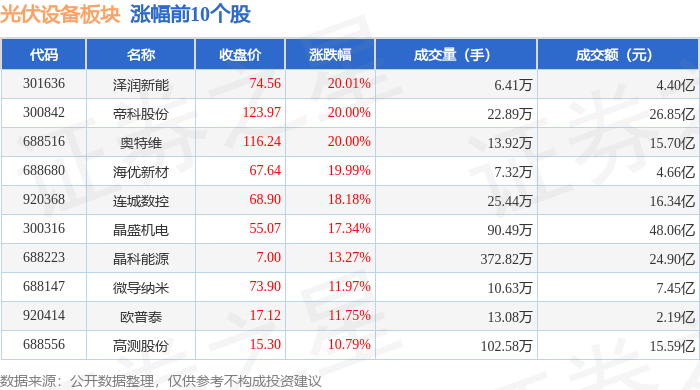
光伏设备板块2月3日涨6.68%,泽润新能领涨,主力资金净流入21.73亿元
Zheng Xing Xing Ye Ri Bao· 2026-02-03 09:03
Core Viewpoint - The photovoltaic equipment sector experienced a significant increase, with a 6.68% rise on February 3, led by Zairun New Energy, amidst a broader market uptrend in major indices [1]. Group 1: Market Performance - The Shanghai Composite Index closed at 4067.74, up 1.29%, while the Shenzhen Component Index closed at 14127.1, up 2.19% [1]. - The photovoltaic equipment sector saw notable individual stock performances, with Zairun New Energy leading with a closing price of 74.56, reflecting a 20.01% increase [1]. Group 2: Stock Performance - Key stocks in the photovoltaic equipment sector included: - Zairun New Energy: 74.56, +20.01%, volume 64,100, turnover 440 million [1] - Jingke Co., Ltd.: 123.97, +20.00%, volume 228,900, turnover 2.685 billion [1] - Aotwei: 116.24, +20.00%, volume 139,200, turnover 1.570 billion [1] - Haiyou New Materials: 67.64, +19.99%, volume 73,200, turnover 466 million [1] - Liancheng CNC: 68.90, +18.18%, volume 254,400, turnover 1.634 billion [1] - Jingcheng Machinery: 55.07, +17.34%, volume 904,900, turnover 4.806 billion [1]. Group 3: Capital Flow - The photovoltaic equipment sector saw a net inflow of 2.173 billion in main funds, while retail funds experienced a net outflow of 209 million [2]. - The capital flow for key stocks indicated: - Longi Green Energy: 429 million net inflow from main funds, with a 8.29% share [3]. - Junda Co.: 416 million net inflow from main funds, with a 12.03% share [3]. - Foster: 323 million net inflow from main funds, with a 17.51% share [3].



电力设备及新能源行业双周报(2026、1、16-2026、1、29):全国已建成投运新型储能装机规模达到1.36亿千瓦-20260130
Dongguan Securities· 2026-01-30 09:54
Investment Rating - The report maintains an "Overweight" rating for the power equipment and new energy industry [2] Core Insights - As of January 30, 2026, the installed capacity of new energy storage in China reached 136 million kilowatts, marking an 84% increase compared to the end of 2024 and over 40 times growth compared to the end of the 13th Five-Year Plan [2][40] - The report highlights significant growth in the photovoltaic and wind power sectors, with new installations expected to reach 315.1 GW and 119.3 GW respectively in 2025, representing year-on-year increases of 13.7% and 50.4% [42] - The report emphasizes the increasing flexibility of new energy storage systems, which play a crucial role in enhancing the stability and safety of the power system [42] Market Review - The power equipment sector experienced a decline of 0.47% over the past two weeks, underperforming the CSI 300 index by 0.53 percentage points, ranking 19th among 31 sectors [11] - In January 2026, the power equipment sector saw a monthly increase of 4.56%, outperforming the CSI 300 index by 1.88 percentage points [11] - The wind power equipment sector rose by 1.77%, while the photovoltaic equipment sector increased by 4.24% during the same period [18] Valuation and Industry Data - As of January 29, 2026, the price-to-earnings (PE) ratio for the power equipment sector was 34.76 times, with sub-sectors such as electric motors and other power equipment showing PE ratios of 59.88 and 59.64 respectively [24] - The report provides detailed valuation metrics for various sub-sectors, indicating significant variations in their market performance [25] Company Announcements - The report notes that several companies, including Gree and Enjie, are expected to turn profitable in 2025, with projected net profits ranging from 34 million to 164 million yuan [41][44] - The report highlights the importance of technological advancements and market strategies for companies in the power equipment sector to maintain competitive advantages [43]


商业航天为何会成为2026年的主线?
Soochow Securities· 2026-01-29 00:20
Investment Rating - The report maintains an "Overweight" rating for the commercial aerospace industry, indicating a positive outlook for the sector in the coming months [1]. Core Insights - The commercial aerospace industry is expected to undergo a significant transformation by 2026, driven by advancements in launch capabilities and the successful deployment of domestic rockets, which will remove previous constraints on industry growth [8][9]. - The competition in commercial aerospace is fundamentally a "land grab" for space sovereignty and resource allocation, emphasizing the need for increased launch frequency to secure China's position in low Earth orbit [10]. - The report highlights the strategic importance of commercial aerospace in national defense and resource acquisition, particularly in the context of lunar resources like Helium-3, which could reshape global energy dynamics [12]. - Key catalysts for the industry include domestic policy support and capital market developments, with significant IPOs expected from leading aerospace companies in 2026 [13][15]. Summary by Sections 1. Why has the domestic commercial aerospace industry reached a qualitative change? - The industry has transitioned from a limited payload capacity to a robust launch capability, marked by the successful launch of the Zhuque-3 rocket, which signifies a shift from speculative themes to a narrative driven by operational capacity [8]. 2. How to understand the importance of commercial aerospace? - The scarcity of low Earth orbit resources has made the commercial aerospace race a critical national strategy, with the need to enhance launch frequency to secure space assets and maintain competitive advantages [10][11]. 3. What subsequent catalysts are worth paying attention to in commercial aerospace? 3.1. Domestic: Accelerated release of policy and capital dividends - The report anticipates significant policy support and capital market activity, with major aerospace companies expected to enter the IPO market in 2026, reflecting the strategic importance of the sector [13]. 3.2. International: Clear policy framework and tight planning timeline - The U.S. has shifted from a public to a private ownership model for space resources, establishing a legal framework that encourages commercial investment in space resource development [15][16]. 4. Investment Recommendations 4.1. SpaceX Concept - Companies that could potentially enter the SpaceX supply chain are highlighted, indicating a strong future in commercial aerospace [17]. 4.2. Rocket Sector: "Many Stars, Few Rockets" Expected to Breakthrough - The report suggests that advancements in large-capacity reusable rocket technology will lead to significant changes and valuation adjustments in the sector [19]. 4.3. Satellite Sector: Certainty in Implementation - The urgency to secure low Earth orbit resources is driving domestic satellite constellations from planning to large-scale deployment [20]. 4.4. Space Computing and Space Photovoltaics: Next-Generation Core Tracks - The report identifies space computing and space photovoltaics as critical future sectors, emphasizing their role in supporting lunar economies and global intelligence ecosystems [22].


深夜利空!65家A股年报预亏,四大龙头暴亏500亿,3家终止上市
Sou Hu Cai Jing· 2026-01-24 12:41
Core Viewpoint - A significant number of companies in the A-share market have reported substantial losses, leading to a collective loss of 500 billion yuan, indicating a severe financial crisis within the industry [1][20]. Group 1: Company Losses - 65 companies disclosed their financial troubles, with major players like Red Star Macalline, Jindi Group, and Jianfa Holdings reporting massive losses of 225 billion, 135 billion, and 100 billion yuan respectively [4][10]. - The losses from these three companies alone could have been sufficient to acquire an entire medium-sized sector, highlighting the scale of the financial damage [5]. - The losses are attributed to asset impairment and the devaluation of previously overvalued properties, leading to a collapse in investor confidence [8][20]. Group 2: Market Reactions - The market appears to be in a state of denial, with indices showing resilience while individual stocks suffer severe declines, indicating a disconnect between market perception and reality [3][10]. - The financial reports have led to a significant drop in stock prices, undermining the belief in "core assets" and revealing the fragility of the market [10][20]. Group 3: Financial Strategies - The phenomenon of "financial big washing" is observed, where companies are using accounting flexibility to report massive losses in one go, potentially to reset their financial baselines for future reporting [17][20]. - This strategy allows companies to clear hidden liabilities and prepare for a potential recovery, but it also risks eroding investor trust [20][21]. Group 4: Regulatory Environment - The current regulatory environment, including the new registration system, has increased the pressure on companies to maintain transparency and avoid continuous losses, which could lead to delisting [21][22]. - Companies are advised to focus on fundamental performance rather than speculative trading, as the market is becoming increasingly unforgiving towards those with deteriorating fundamentals [21].



9点1氪丨高铁车厢二氧化碳浓度超标,12306客服回应;中国太空旅游预售票300万一张;五家韩国航司26日起禁止机舱内使用充电宝
3 6 Ke· 2026-01-24 01:14
Group 1 - IKEA launches instant retail service in partnership with JD.com, marking its entry into the instant retail sector, covering 13 stores across 9 cities in China [7] - Bubble Mart's Valentine's Day limited edition series "Star People" sees prices surge nearly 7 times, with popular hidden items selling for up to 699 yuan [5] - Ideal Auto plans to close underperforming stores as part of a strategic evaluation, with the number of closures yet to be determined [4] Group 2 - Tencent's anti-fraud department reported over 90 employees were dismissed for violating company policies, with some cases referred to law enforcement [4] - Intel's CFO indicates the company is operating at a "hand to mouth" state, focusing on high-end products due to supply constraints, which may affect market share in lower-end segments [4] - Amazon is set to initiate another round of layoffs affecting thousands of employees as part of a broader plan to reduce its workforce by approximately 30,000 [5] Group 3 - Tesla's Full Self-Driving (FSD) system is expected to be approved in China as early as next month, although the company has not confirmed any specific updates [6] - The Chinese securities regulator imposed a record fine exceeding 1 billion yuan on individual Yu Han for manipulating the stock market [7] - Toyota has incurred an additional cost of approximately 5.1 trillion yen over the past four and a half years due to rising prices in the automotive industry [10]




605336,可能被实施退市风险警示!一周牛熊股出炉
Zheng Quan Shi Bao Wang· 2026-01-23 13:48
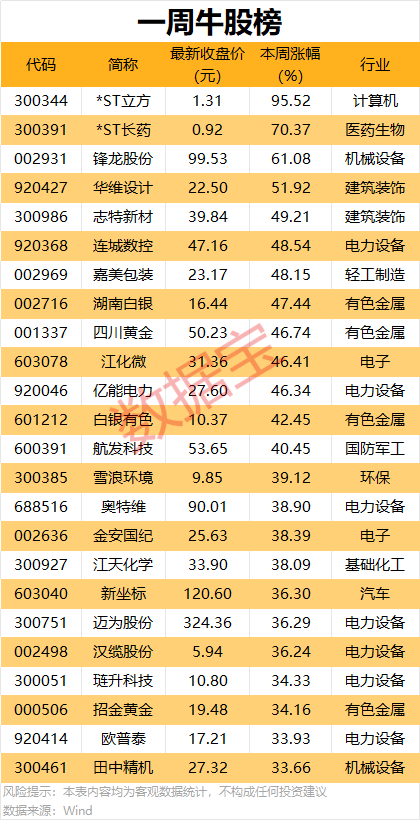
Market Performance - The three major A-share indices collectively rose on January 23, with over 3,900 stocks closing higher, including 121 stocks hitting the daily limit up [1] - For the week, the Shanghai Composite Index increased by 0.83%, the Shenzhen Component Index rose by 1.11%, while the ChiNext Index fell by 0.34% [2] Weekly Stock Performance - Over 4,200 stocks rose this week, with 35 stocks gaining over 30%. The largest increase was seen in *ST Lifan, which surged by 95.52% [3] - Other notable gainers included *ST K Pharmaceutical and Fenglong Co., which both saw increases exceeding 50% [3] - The power equipment sector had 10 stocks listed among those with over 30% gains, while the machinery and non-ferrous metals sectors had 4 stocks each [3] Top Gainers - The top gainers for the week included: - *ST Lifan: 95.52% increase, closing at 1.31 yuan [4] - *ST K Pharmaceutical: 70.37% increase, closing at 0.92 yuan [4] - Fenglong Co.: 61.08% increase, closing at 99.53 yuan [4] - Other significant gainers included companies in construction decoration and power equipment sectors [4] Weekly Decliners - Among the stocks that declined, 46 stocks fell by over 10%, with Koma Materials dropping over 30% [5] - Other notable decliners included Silin Jie and Bofei Electric, which saw declines of over 24% [5] Institutional Activity - Institutions were active in the market, with 160 stocks appearing on the institutional leaderboard, net buying 102 stocks and net selling 58 stocks [7] - The highest net buying was seen in Shengxin Lithium Energy, which rose by 26.38% with a net institutional purchase of approximately 638.55 million yuan [9] - Other stocks with significant institutional net buying included Quanfeng Technology and Hunan Silver, with net purchases of 604.81 million yuan and 352.97 million yuan, respectively [9] Notable Announcements - Shuaifeng Electric announced an expected net loss of 43 million to 62 million yuan for 2025, with projected revenue between 210 million to 250 million yuan [12] - Anqi Yeast plans to invest 222 million yuan in a new green manufacturing project for yeast products [13] - Construction Machinery expects a net loss of approximately 2.072 billion yuan for 2025, attributed to a downturn in the tower crane rental market [13] - Aerospace Electric anticipates a net loss of 39 million to 58 million yuan for 2025, impacted by industry overcapacity and competitive pressures [13] - Lisheng Pharmaceutical forecasts a net profit of 400 million to 440 million yuan for 2025, representing a year-on-year increase of 116.77% to 138.44% [14]


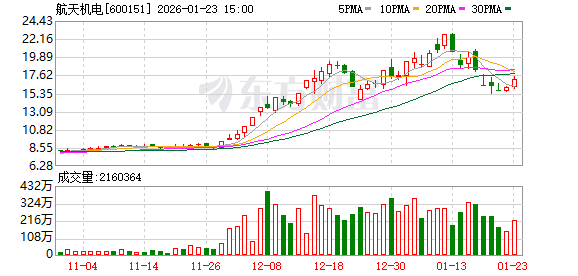
航天机电:关于获得政府补助的公告
Zheng Quan Ri Bao· 2026-01-23 11:19
Group 1 - The company announced that it will receive government subsidies amounting to 6,252,580.00 yuan from January 1, 2025, to December 31, 2025, which are related to revenue [2]
航天机电:2025年年度业绩预亏公告
Zheng Quan Ri Bao· 2026-01-23 11:16
(文章来源:证券日报) 证券日报网讯 1月23日,航天机电发布公告称,公司预计2025年度实现归属于上市公司股东的净利润为 亏损39000万元到58000万元,扣除非经常性损益事项后,归属于上市公司股东的净利润为亏损41900万 元到60900万元。 ...
航天机电发预亏,预计2025年度归母净亏损3.9亿元至5.8亿元
Zhi Tong Cai Jing· 2026-01-23 11:09
Core Viewpoint - Aerospace Electromechanical (600151.SH) has announced a projected net loss of 390 million to 580 million yuan for the fiscal year 2025, primarily due to challenges in its photovoltaic and automotive parts industries [1] Group 1: Financial Performance - The company expects a net profit attributable to shareholders to be a loss between 390 million yuan and 580 million yuan for 2025 [1] - The anticipated loss is attributed to a combination of factors affecting both the photovoltaic and automotive parts sectors [1] Group 2: Industry Challenges - The photovoltaic industry is facing overcapacity, intensified competition, power restriction policies, and adjustments in electricity pricing mechanisms, leading to a decline in both volume and price of photovoltaic components and power generation [1] - The automotive parts sector is experiencing weaker-than-expected demand from major clients and rising aluminum prices, contributing to the overall financial difficulties [1] Group 3: Asset Impairment - Due to the mismatch in supply and demand within the photovoltaic sector, insufficient operating rates, and persistently low market prices for photovoltaic products, the company's profitability in this area has decreased [1] - The company has conducted impairment tests on related assets and has made provisions for asset impairment in accordance with accounting standards and internal policies [1]