
Bank Of Jiangsu(600919)

Search documents
重磅调研来了
Zhong Guo Ji Jin Bao· 2025-12-01 02:20
Core Viewpoint - The integration of technology and finance is driving the high-quality development of innovative enterprises in China, with banks playing a crucial role in providing tailored financial services to support the growth of these companies [1][2]. Group 1: Financial Support for Technology Enterprises - Jiangsu province has over 89,000 technology-based SMEs and 57,000 high-tech enterprises, leading the nation in these categories [2]. - By the end of Q3 2025, the balance of technology loans in Jiangsu exceeded 5 trillion yuan, a year-on-year increase of 16% [2]. - The China Bank Jiangsu branch provided systematic financial services to technology enterprises, adjusting support based on company performance over seven years [3][4]. Group 2: Comprehensive Financial Services - China Bank Jiangsu branch served over 24,000 technology finance clients, with a technology loan balance of 551.7 billion yuan, up 21.9% year-on-year [4]. - Construction Bank Suzhou branch developed a "3+4" technology financial service system, enhancing support for technology innovation [4][5]. - By the end of October 2025, Construction Bank Suzhou branch served over 12,000 technology enterprises, with a technology loan balance exceeding 160 billion yuan [5]. Group 3: Innovative Financial Products - Jiangsu Bank launched products like "Smart Transformation Loan" and "Low Carbon Loan" to meet the needs of growing technology enterprises [6][7]. - By September 2023, Jiangsu Bank's technology loan balance reached nearly 290 billion yuan, serving 24,000 technology enterprise clients [7]. - Changshu Rural Commercial Bank focused on small and micro enterprises, providing tailored financial services and achieving over 2200 technology enterprise loans with a balance exceeding 15 billion yuan [6][7]. Group 4: Collaborative Financial Models - Zhejiang province introduced the "Zheke United Loan" model to enhance cooperation among banks, addressing the limitations of single-bank services [8][10]. - Since its launch, 27 banks in Zhejiang have participated in the "Zheke United Loan," providing loans totaling 10.87 billion yuan to 197 enterprises [11]. - The model allows for risk-sharing among banks, enhancing the capacity to support technology enterprises [10][11]. Group 5: Growth-Focused Financial Initiatives - Anhui province implemented the "Common Growth Plan" to address the mismatch between risk and return in technology credit [15][19]. - By September 2023, the plan had signed over 15,000 enterprises, with a loan balance exceeding 210 billion yuan [17][18]. - The "Common Growth Plan 2.0" introduced a "Stock Option Income Swap Model" to facilitate easier access to financing for technology enterprises [19][21].


长三角6家上市城商行的韧性增长:息差承压之下营收净利双增,对公业务成信贷“主引擎”
Mei Ri Jing Ji Xin Wen· 2025-11-30 12:34
Core Insights - The six A-share listed city commercial banks in the Yangtze River Delta are demonstrating resilient growth despite the pressure of narrowing interest margins, achieving both revenue and net profit growth in the first three quarters of the year [1][2] Revenue and Profit Growth - All six banks reported year-on-year growth in net interest income, with Nanjing Bank and Jiangsu Bank leading with growth rates of 28.52% and 19.61% respectively, ranking among the top in A-share listed banks [2][3] - Jiangsu Bank achieved a revenue of 671.83 billion yuan and a net profit of 305.83 billion yuan, leading among city commercial banks [2] Asset Expansion - As of the end of September, Jiangsu Bank held total assets of 4.93 trillion yuan, marking a 24.68% increase from the beginning of the year, making it the fastest-growing bank in terms of asset size among A-share listed banks [4][5] - Other banks like Ningbo Bank and Nanjing Bank also reported double-digit asset growth rates [4] Loan and Deposit Growth - The six banks experienced robust growth in both loans and deposits, with Jiangsu Bank's deposits reaching 2.54 trillion yuan, a 20.22% increase, the only bank in A-share with such growth [5] - Corporate loans became the main driver for credit expansion, with significant increases in sectors like technology finance, inclusive finance, and green finance [5][6] Asset Quality - The overall asset quality of the six banks remained stable, with non-performing loan ratios either holding steady or declining, indicating effective risk management strategies [7][8] - Jiangsu Bank's non-performing loan ratio decreased to 0.84%, while Nanjing Bank's ratio remained stable at 0.83% [7] Capital Adequacy - Shanghai Bank reported a high core Tier 1 capital adequacy ratio of 10.52%, reflecting improvements in capital management and risk mitigation strategies [8] - Several banks have completed convertible bond conversions to strengthen their capital positions [8] Dividend Distribution - Several banks, including Shanghai Bank and Suzhou Bank, have completed mid-term dividend distributions, with Jiangsu Bank and Ningbo Bank also progressing on their dividend plans [9][10] - The focus on increasing cash dividends reflects a commitment to enhancing shareholder returns, with some banks planning to maintain a cash dividend ratio of no less than 30% in the coming years [10]



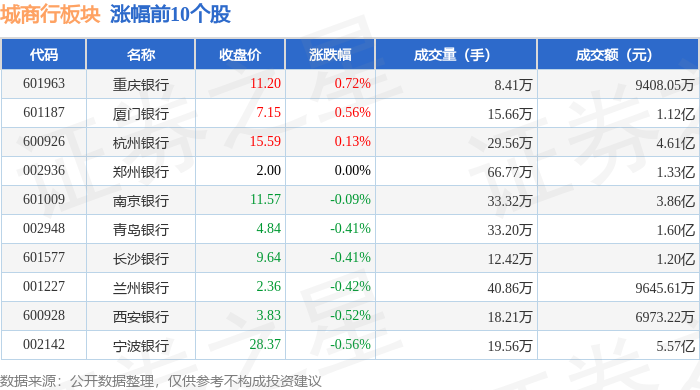
城商行板块11月28日跌0.62%,上海银行领跌,主力资金净流出3.79亿元
Zheng Xing Xing Ye Ri Bao· 2025-11-28 09:05
Core Viewpoint - The city commercial bank sector experienced a decline of 0.62% on November 28, with Shanghai Bank leading the drop, while the overall stock market showed slight gains [1][2]. Market Performance - The Shanghai Composite Index closed at 3888.6, up 0.34% - The Shenzhen Component Index closed at 12984.08, up 0.85% [1]. Individual Stock Performance - Chongqing Bank: Closed at 11.20, up 0.72%, with a trading volume of 84,100 shares and a turnover of 94.08 million yuan - Xiamen Bank: Closed at 7.15, up 0.56%, with a trading volume of 156,600 shares and a turnover of 112 million yuan - Hangzhou Bank: Closed at 15.59, up 0.13%, with a trading volume of 295,600 shares and a turnover of 461 million yuan - Zhengzhou Bank: Closed at 2.00, unchanged, with a trading volume of 667,700 shares and a turnover of 13.3 million yuan - Nanjing Bank: Closed at 11.57, down 0.09%, with a trading volume of 333,200 shares and a turnover of 38.6 million yuan - Qingdao Bank: Closed at 4.84, down 0.41%, with a trading volume of 332,000 shares and a turnover of 16 million yuan - Changsha Bank: Closed at 9.64, down 0.41%, with a trading volume of 124,200 shares and a turnover of 12 million yuan - Lanzhou Bank: Closed at 2.36, down 0.42%, with a trading volume of 408,600 shares and a turnover of 96.46 million yuan - Xi'an Bank: Closed at 3.83, down 0.52%, with a trading volume of 182,100 shares and a turnover of 6.97 million yuan - Ningbo Bank: Closed at 28.37, down 0.56%, with a trading volume of 195,600 shares and a turnover of 557 million yuan [1][2]. Capital Flow Analysis - The city commercial bank sector saw a net outflow of 379 million yuan from institutional investors, while retail investors contributed a net inflow of 86.74 million yuan [2][3]. - The following stocks had notable capital flows: - Hangzhou Bank: Net inflow of 9.48 million yuan from institutional investors - Qilu Bank: Net inflow of 6.55 million yuan from institutional investors - Suzhou Bank: Net inflow of 6.07 million yuan from institutional investors - Qingdao Bank: Net inflow of 3.22 million yuan from institutional investors - Lanzhou Bank: Net inflow of 2.34 million yuan from institutional investors - Zhengzhou Bank: Net outflow of 0.96 million yuan from institutional investors - Guizhou Bank: Net outflow of 1.41 million yuan from institutional investors - Xi'an Bank: Net outflow of 2.69 million yuan from institutional investors - Nanjing Bank: Net outflow of 9.30 million yuan from institutional investors - Chongqing Bank: Net outflow of 9.87 million yuan from institutional investors [3].


十二月金股汇
Dongxing Securities· 2025-11-28 02:52
Group 1: Company Performance Highlights - Rilian Technology (688531.SH) achieved a revenue growth of 44.01% year-on-year, with a total revenue of 737 million CNY in the first three quarters of 2025[10] - Weisheng Information (688100.SH) reported a total revenue of 2.745 billion CNY in 2024, reflecting a year-on-year growth of 23.35%[14] - Foxit Software (688095.SH) recorded a revenue of 676 million CNY in the first three quarters of 2025, up 32.81% year-on-year[16] - Zhejiang Xiantong (603239.SH) maintained a strong position in the automotive sealing strip market, benefiting from the rising demand for high-end products[21] - Jin Yinhe (300619.SH) reported a significant increase in net profit by 220.37% year-on-year, reaching 12 million CNY in the third quarter of 2025[30] Group 2: Market Trends and Strategic Moves - Rilian Technology plans to acquire 66% of SSTI, enhancing its capabilities in semiconductor testing equipment[12] - Weisheng Information is expanding its international business, focusing on energy IoT projects in countries along the Belt and Road[15] - Foxit Software is transitioning to a subscription model, with subscription revenue growing by 68% year-on-year in the third quarter[18] - Zhejiang Xiantong is entering the robotics sector, aiming to diversify its business and enhance growth potential[24] - Jin Yinhe is expected to benefit from the lithium battery industry's growth, with projected revenues of 20.50 billion CNY in 2025[36]



深耕绿色金融“责任田” 江苏银行北京分行以创新实践守护绿水青山
Bei Jing Ri Bao Ke Hu Duan· 2025-11-27 22:44
Core Viewpoint - Addressing climate change and promoting green and sustainable development are key societal concerns, with Jiangsu Bank positioning green finance as a core strategy for transformation and development [1][9]. Group 1: Green Finance Initiatives - Jiangsu Bank has integrated green finance into its strategic framework, focusing on energy low-carbon transition, environmental protection, and urban-rural green development [1][3]. - The "Green Factory Loan" product allows companies to convert their green performance into tangible financial benefits, with a quick loan approval process taking only three days [2][3]. - The bank's innovative approach links loan interest rates to the green factory certification and ESG evaluations, incentivizing companies to enhance their energy-saving and carbon-reduction efforts [3][4]. Group 2: Supply Chain Financing - Jiangsu Bank has introduced a "Green + Supply Chain" financing model to support the sustainable development of entire supply chains, ensuring that both core enterprises and their suppliers engage in green practices [4][5]. - The bank utilizes an API to connect with core enterprises' supply chain management systems, assessing suppliers based on various ESG performance metrics [5][6]. - By September 2025, Jiangsu Bank had provided over 1.3 billion yuan in credit support to more than 100 suppliers through this model, promoting a comprehensive green upgrade across the supply chain [5][6]. Group 3: Green Bonds - Jiangsu Bank has facilitated the issuance of green bonds, such as a 300 million yuan green medium-term note for renewable energy projects, contributing to significant reductions in carbon emissions and other pollutants [7][8]. - The bank's expertise in the green bond market has enabled it to support major clean energy projects, reinforcing the concept that ecological preservation can align with financial growth [7][8]. Group 4: Customized Financial Solutions - The bank has developed a range of tailored financial products to meet the diverse needs of different industries, including loans for solar energy projects and ecological restoration initiatives [8][9]. - Jiangsu Bank actively collaborates with government agencies to enhance its green finance offerings and participates in various green finance events to increase its brand influence [8][9]. Group 5: Performance Metrics - As of September 2025, Jiangsu Bank's green credit balance reached 16.172 billion yuan, a 40.92% increase from the beginning of the year, serving over 300 green industry clients [9]. - The bank has established itself as a key player in the green finance sector, recognized as a partner in green financial services and actively involved in local sustainability initiatives [9].
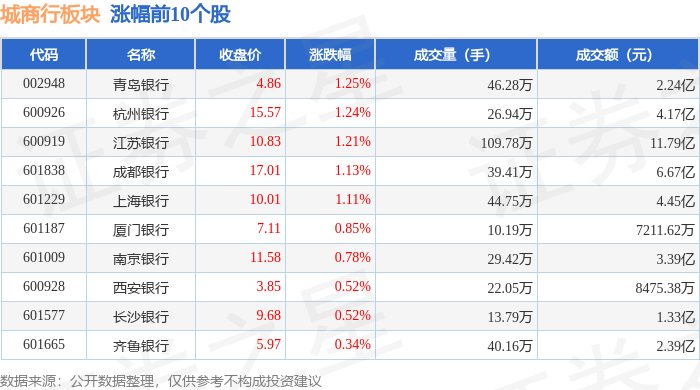
城商行板块11月27日涨0.69%,青岛银行领涨,主力资金净流入7276.85万元
Zheng Xing Xing Ye Ri Bao· 2025-11-27 09:07
Core Insights - The city commercial bank sector experienced a rise of 0.69% on November 27, with Qingdao Bank leading the gains [1] - The Shanghai Composite Index closed at 3875.26, up 0.29%, while the Shenzhen Component Index closed at 12875.19, down 0.25% [1] Stock Performance Summary - Qingdao Bank (002948) closed at 4.86, up 1.25% with a trading volume of 462,800 shares and a transaction value of 224 million [1] - Hangzhou Bank (600926) closed at 15.57, up 1.24% with a trading volume of 269,400 shares and a transaction value of 417 million [1] - Jiangsu Bank (616009) closed at 10.83, up 1.21% with a trading volume of 1,097,800 shares and a transaction value of 1.179 billion [1] - Chengdu Bank (601838) closed at 17.01, up 1.13% with a trading volume of 394,100 shares and a transaction value of 667 million [1] - Shanghai Bank (601229) closed at 10.01, up 1.11% with a trading volume of 447,500 shares and a transaction value of 445 million [1] - Xiamen Bank (601187) closed at 7.11, up 0.85% with a trading volume of 101,900 shares and a transaction value of 72.116 million [1] - Nanjing Bank (6000009) closed at 11.58, up 0.78% with a trading volume of 294,200 shares and a transaction value of 339 million [1] - Xi'an Bank (600928) closed at 3.85, up 0.52% with a trading volume of 220,500 shares and a transaction value of 84.754 million [1] - Changsha Bank (601577) closed at 9.68, up 0.52% with a trading volume of 137,900 shares and a transaction value of 133 million [1] - Qilu Bank (601665) closed at 5.97, up 0.34% with a trading volume of 401,600 shares and a transaction value of 239 million [1] Capital Flow Analysis - The city commercial bank sector saw a net inflow of 72.7685 million from institutional investors, while retail investors experienced a net inflow of 16.4028 million [2] - The sector faced a net outflow of 89.1713 million from speculative funds [2] Individual Stock Capital Flow - Jiangsu Bank (600919) had a net inflow of 75.1851 million from institutional investors, while it faced a net outflow of 38.3807 million from speculative funds [3] - Shanghai Bank (601229) saw a net inflow of 33.6962 million from institutional investors, with a net outflow of 37.6450 million from speculative funds [3] - Qilu Bank (601665) had a net inflow of 23.2129 million from institutional investors, while it faced a net outflow of 7.1943 million from speculative funds [3] - Chengdu Bank (601838) experienced a net inflow of 21.6104 million from institutional investors, with a significant net outflow of 68.9418 million from speculative funds [3] - Hangzhou Bank (600926) had a net inflow of 17.6667 million from institutional investors, while it faced a net outflow of 41.0399 million from speculative funds [3]
江苏银行股份有限公司 关于公司章程修改获监管机构核准 及不再设立监事会的公告
Zhong Guo Zheng Quan Bao - Zhong Zheng Wang· 2025-11-27 02:36
Core Points - Jiangsu Bank has received regulatory approval for amendments to its articles of association, which includes the decision to abolish the supervisory board [1][2] - The board of directors will now exercise the powers previously held by the supervisory board through the audit committee [2] - All related governance documents concerning the supervisory board will be abolished, and current supervisors will no longer hold their positions [2] Summary by Sections - **Regulatory Approval**: Jiangsu Bank's amendments to its articles of association have been approved by the Jiangsu Financial Regulatory Bureau [1] - **Abolishment of Supervisory Board**: The supervisory board will be dissolved, with its functions transferred to the audit committee of the board of directors [2] - **Governance Changes**: All specialized committees under the supervisory board will be dismantled, and relevant governance documents will be nullified [2]
江苏银行:公司章程修改获批,不再设立监事会
Bei Jing Shang Bao· 2025-11-26 10:24
Core Viewpoint - Jiangsu Bank has announced significant changes to its corporate governance structure, including the abolition of the supervisory board and the delegation of its responsibilities to the audit committee of the board of directors [1] Group 1: Corporate Governance Changes - Jiangsu Bank's second extraordinary general meeting of shareholders in 2025 approved the proposal to amend the company's articles of association [1] - The bank received approval from the Jiangsu Financial Regulatory Bureau for the amended articles, which will take effect immediately [1] - Following the approval, Jiangsu Bank will no longer have a supervisory board, and its functions will be assumed by the audit committee of the board of directors [1] Group 2: Committee and Governance Structure - The specialized committees under the supervisory board will also be dissolved [1] - Related governance documents, such as the rules for the supervisory board, will be abolished accordingly [1] - Current supervisors will no longer hold their positions and have confirmed no objections or other matters to notify shareholders and creditors [1]
城商行板块11月26日跌0.59%,南京银行领跌,主力资金净流出1.47亿元
Zheng Xing Xing Ye Ri Bao· 2025-11-26 09:05
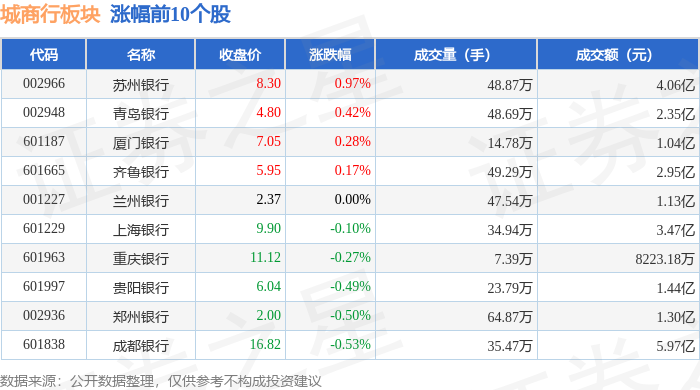
Market Performance - The city commercial bank sector declined by 0.59% on November 26, with Nanjing Bank leading the drop [1] - The Shanghai Composite Index closed at 3864.18, down 0.15%, while the Shenzhen Component Index rose by 1.02% to 12907.83 [1] Individual Stock Performance - Suzhou Bank closed at 8.30, up 0.97% with a trading volume of 488,700 shares and a transaction value of 406 million yuan [1] - Nanjing Bank closed at 11.49, down 1.29% with a trading volume of 514,300 shares and a transaction value of 592 million yuan [2] - Chengdu Bank closed at 16.82, down 0.53% with a trading volume of 354,700 shares and a transaction value of 597 million yuan [2] Capital Flow Analysis - The city commercial bank sector experienced a net outflow of 147 million yuan from institutional investors, while retail investors saw a net inflow of 152 million yuan [2] - Among individual stocks, Suzhou Bank had a net outflow of 31.27 million yuan from institutional investors, while Nanjing Bank saw a net inflow of 27.56 million yuan [3]

江苏银行(600919) - 江苏银行章程
2025-11-26 09:01
江苏银行股份有限公司章程 (2025年11月17日江苏银行股份有限公司2025年第二次临时股东大会审议通过) | | | | | | | | | 第一章 总则 第一条 为维护江苏银行股份有限公司(以下简称"公司")、 股东、职工、债权人和其他利益相关者的合法权益,规范公司的组 织和行为,根据《中国共产党章程》(以下简称"《党章》")、 《中华人民共和国公司法》(以下简称"《公司法》")、《中华 人民共和国商业银行法》(以下简称"《商业银行法》")、《中 华人民共和国证券法》(以下简称"《证券法》")和其他有关规 定,制定本章程。 第二条 公司系依据《公司法》《商业银行法》和其他有关规定 成立的股份有限公司。 公司经《中国银行业监督管理委员会关于筹建江苏银行股份有 限公司的批复》(银监复〔2006〕379号)文件批准,以发起方式设 立,并领取了机构编码为B0243H232010001的金融许可证;公司目前 在江苏省市场监督管理局注册登记,并领有统一社会信用代码为 91320000796544598E的营业执照,具有独立法人资格。 第三条 公司于2016年5月30日经中国证券监督管理委员会(以 下简称"中国证监会 ...