Bank Of Jiangsu(600919)

Search documents
关于景顺长城恒生消费交易型开放式指数证券投资基金发起式联接基金(QDII)新增湘财证券为销售机构的公告
Shang Hai Zheng Quan Bao· 2026-02-02 18:52
Group 1 - The announcement details the addition of Xiangcai Securities as a sales institution for the Invesco Great Wall Hang Seng Consumption ETF linked fund (QDII), effective from February 3, 2026 [1] - The sales institution's information includes its registered address in Changsha and office address in Shanghai, along with contact details [1] - The announcement specifies that subscription and redemption services are only available during normal subscription periods and specific open days, with further details provided in the fund's legal documents [1][2] Group 2 - The announcement also introduces Jiangsu Bank's "Ronglian Chuang" interbank trading platform as a new sales platform for the Invesco Great Wall Stable Gain Bond Fund, effective from February 3, 2026 [6] - Similar to the previous announcement, it outlines the sales platform's information, including its registered address in Nanjing and contact details [6] - Subscription and redemption services are subject to the same conditions as mentioned in the previous announcement, with specific rules and procedures to be followed [6][7] Group 3 - The announcement for the Invesco Great Wall CSI Nonferrous Metals Mining Theme ETF states that daily subscription and redemption services will be available starting February 3, 2026 [12] - The minimum subscription and redemption unit is set at 1 million shares, and the fund manager may impose limits on daily subscription and redemption amounts based on market conditions [12][13] - The fund's sales agents will charge a commission of up to 0.3% on subscription or redemption amounts, which includes fees from relevant parties [12][14] Group 4 - The fund will begin trading on the Shanghai Stock Exchange on February 6, 2026, with the full trading announcement available on the company's website and the China Securities Regulatory Commission's fund disclosure website [23] - The fund management company emphasizes the importance of understanding the fund's risk-return characteristics and encourages investors to make informed decisions [23]


城商行板块2月2日跌0.3%,齐鲁银行领跌,主力资金净流入1792.74万元
Zheng Xing Xing Ye Ri Bao· 2026-02-02 09:15
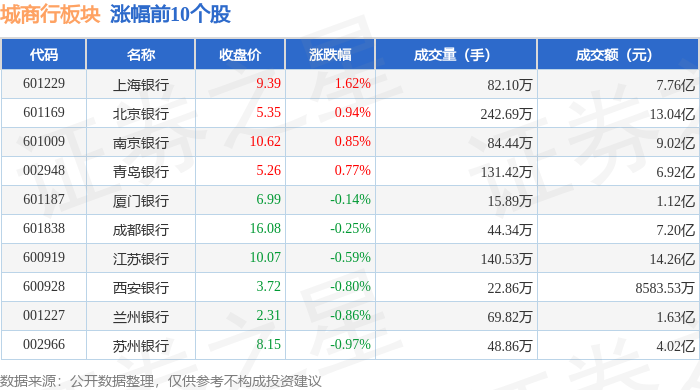
Market Overview - On February 2, the city commercial bank sector declined by 0.3% compared to the previous trading day, with Qilu Bank leading the decline [1] - The Shanghai Composite Index closed at 4015.75, down 2.48%, while the Shenzhen Component Index closed at 13824.35, down 2.69% [1] Individual Bank Performance - Shanghai Bank (601229) closed at 66.6, up 1.62% with a trading volume of 821,000 shares and a transaction value of 776 million [1] - Beijing Bank (601169) closed at 5.35, up 0.94% with a trading volume of 2.4269 million shares and a transaction value of 1.304 billion [1] - Nanjing Bank (6001009) closed at 10.62, up 0.85% with a trading volume of 844,400 shares and a transaction value of 902 million [1] - Qilu Bank (601665) closed at 5.73, down 1.55% with a trading volume of 715,600 shares and a transaction value of 415 million [2] - Hangzhou Bank (600926) closed at 15.92, down 1.49% with a trading volume of 521,800 shares and a transaction value of 840 million [2] Capital Flow Analysis - The city commercial bank sector saw a net inflow of 17.93 million from institutional investors, while retail investors experienced a net outflow of 157.95 million [2] - Major banks like Shanghai Bank and Jiangsu Bank had significant net inflows from institutional investors, with Shanghai Bank receiving 71.52 million, accounting for 9.22% of its total [3] - Conversely, retail investors showed a notable outflow from several banks, including Beijing Bank, which saw a retail net outflow of 64.17 million, representing 4.92% [3]





各银行在售高收益纯固收产品一览!合资理财子产品首次上榜
2 1 Shi Ji Jing Ji Bao Dao· 2026-02-02 09:13
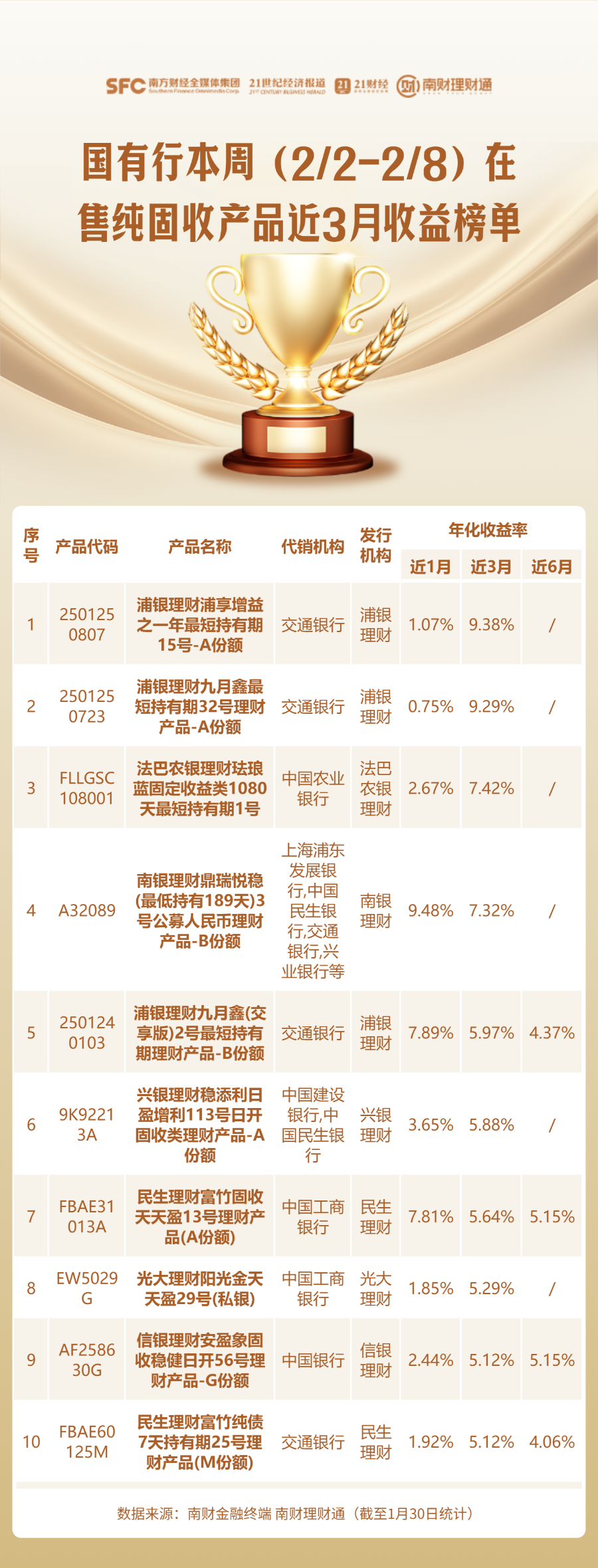
Core Insights - The report focuses on the performance of pure fixed-income products issued by wealth management companies, highlighting the best-performing products available for sale through various distribution channels [1][4] Group 1: Product Performance - The ranking of products is based on their annualized returns over the past month, three months, and six months, with a particular emphasis on the three-month annualized yield to reflect their performance amid recent market fluctuations [1] - A total of 28 distribution institutions are involved, including major banks such as Industrial and Commercial Bank of China, Bank of China, Agricultural Bank of China, and others [1] Group 2: Product Availability - The list of products is categorized as "available for sale," but actual availability may vary due to factors such as sold-out quotas or differences in product listings shown to different customers by banks [1] - Investors are advised to refer to the actual displays on the distribution bank's app for the most accurate information regarding product availability [1] Group 3: Data Source - The data presented in the report is sourced from the Nanfang Financial Terminal and Nanfang Wealth Management, with statistics as of January 30 [3][5]






金融风向标2026-W04:不一样的“开门红”
CMS· 2026-02-01 12:31
Investment Rating - The report maintains a positive outlook on the banking sector, indicating a potential for stabilization and improvement in operational pressures for banks in 2026 [2][5]. Core Insights - The banking sector has shown a "double opening red" phenomenon in both deposits and loans, with a structural difference in credit allocation. The signs of "deposit migration" are not significant, suggesting a stable deposit base [2][5]. - The total assets of the banking industry reached 471 trillion yuan by the end of 2025, reflecting an 8.0% year-on-year growth. Major banks, joint-stock banks, city commercial banks, and rural commercial banks reported asset growth rates of 11.0%, 4.7%, 9.7%, and 5.2%, respectively [3][14]. - The overall net interest margin is expected to decline further, but at a slower pace, indicating some relief in operational pressures. The banks have passed the phase of accelerated risk exposure and are nearing a "stock digestion period" [5][6]. Summary by Sections Regulatory Dynamics - The Financial Regulatory Bureau released data on the total assets and liabilities of the banking sector for 2025, showing a total asset growth of 8.0% year-on-year [3][14]. Industry Dynamics - Qingdao Bank and Xiamen Bank reported their 2025 performance, with Qingdao Bank achieving a net profit growth of 21.66% and an asset quality improvement, while Xiamen Bank also reported significant growth in total assets and loans [15][16]. Market Dynamics - The overall A-share market saw a decline of 1.59%, while the banking sector increased by 0.86%, indicating a defensive characteristic of the banking stocks [2][18]. Data Overview - The report highlights the central bank's net injection of 0.4 trillion yuan and the mixed movement of interest rates across different maturities, with short-term rates showing slight declines and long-term rates experiencing mixed trends [4][21][23].



银行周报(2026/1/26-2026/1/30):战略投资者拟扩围,利好银行长期资本补充
GUOTAI HAITONG SECURITIES· 2026-02-01 02:45
股 票 研 究 股票研究 /[Table_Date] 2026.02.01 战略投资者拟扩围,利好银行长期资本补充 [Table_Industry] 商业银行 本报告导读: 证监会拟扩大可参与定增的战略投资者类型,并明确最低持股比例要求,利好上市 银行长期资本补充、金融机构合作深化,以及银行理财多元资产投资转型。 投资要点: [Table_Report] 相关报告 商业银行《银行快报陆续披露,25A 业绩稳健增 长》2026.01.25 商业银行《全年增量 3.34 万亿元,公募基金配置 占比提升 2.1pct 至 5.1%》2026.01.25 商业银行《国有大行投放力度较大,不良压力或 企稳》2026.01.23 商业银行《主动基金环比持平,被动基金增持》 2026.01.23 商业银行《利息净收入增速转正,业绩延续改善 趋势》2026.01.19 证 券 研 究 报 告 请务必阅读正文之后的免责条款部分 行 银行周报(2026/1/26-2026/1/30) | [姓名table_Authors] | 电话 | 邮箱 | 登记编号 | | --- | --- | --- | --- | | 马婷婷(分析 ...




金融工程市场跟踪周报 20260131:市场交易情绪回落-20260131
EBSCN· 2026-01-31 14:30
Quantitative Models and Construction Methods 1. Model Name: Volume Timing Model - **Model Construction Idea**: The model uses volume-based timing signals to assess market sentiment and provide trading signals[23] - **Model Construction Process**: - The model evaluates the volume timing signals of major broad-based indices - Signals are categorized as "cautious" or "optimistic" based on volume trends - As of January 30, 2026, all major indices (e.g., SSE Composite Index, CSI 300, etc.) showed "cautious" volume timing signals[24] - **Model Evaluation**: The model provides a straightforward approach to gauge market sentiment but may lack granularity in capturing nuanced market dynamics[23][24] 2. Model Name: Momentum Sentiment Indicator - **Model Construction Idea**: This model identifies market sentiment by analyzing the proportion of stocks with positive returns in the CSI 300 Index over a specific period[24] - **Model Construction Process**: - The indicator is calculated as: $ \text{CSI 300 N-day Upward Stock Proportion} = \frac{\text{Number of CSI 300 stocks with positive returns over N days}}{\text{Total number of CSI 300 stocks}} $ - The indicator is smoothed using two moving averages with different window periods (N1 = 50, N2 = 35) to create a "fast line" and a "slow line" - A buy signal is generated when the fast line exceeds the slow line, and a neutral signal is generated when the fast line falls below the slow line[26][28] - **Model Evaluation**: The indicator is effective in capturing upward market opportunities but may fail to predict downturns accurately. It also tends to miss gains during prolonged market exuberance[25] 3. Model Name: Moving Average Sentiment Indicator - **Model Construction Idea**: This model uses an eight-moving-average system to assess the trend state of the CSI 300 Index and generate trading signals[32] - **Model Construction Process**: - Calculate the eight moving averages of the CSI 300 Index closing price with parameters: 8, 13, 21, 34, 55, 89, 144, and 233 - Assign values to the indicator based on the number of moving averages the current price exceeds: - If the price exceeds more than five moving averages, the sentiment is bullish - Generate a buy signal when the current price exceeds five moving averages[36] - **Model Evaluation**: The model provides a clear framework for trend analysis but may oversimplify complex market dynamics[36] --- Model Backtesting Results 1. Volume Timing Model - All major indices (e.g., SSE Composite Index, CSI 300, CSI 500, etc.) showed "cautious" volume timing signals as of January 30, 2026[24] 2. Momentum Sentiment Indicator - The CSI 300 N-day upward stock proportion indicator was above 60% as of January 30, 2026, indicating high market sentiment[25] - The fast line was above the slow line, suggesting a bullish outlook for the CSI 300 Index[26] 3. Moving Average Sentiment Indicator - The CSI 300 Index was in a "sentiment prosperity zone" as of January 30, 2026, indicating a bullish sentiment[36] --- Quantitative Factors and Construction Methods 1. Factor Name: Cross-sectional Volatility - **Factor Construction Idea**: Measures the dispersion of returns among index constituents to assess the Alpha environment[37] - **Factor Construction Process**: - Calculate the cross-sectional volatility of index constituents (e.g., CSI 300, CSI 500, CSI 1000) - Compare the recent quarter's average volatility to historical percentiles to evaluate the Alpha environment[38] - **Factor Evaluation**: The factor effectively captures short-term Alpha opportunities but may not fully reflect long-term trends[37] 2. Factor Name: Time-series Volatility - **Factor Construction Idea**: Measures the volatility of index constituents over time to assess the Alpha environment[38] - **Factor Construction Process**: - Calculate the time-series volatility of index constituents (e.g., CSI 300, CSI 500, CSI 1000) - Compare the recent quarter's average volatility to historical percentiles to evaluate the Alpha environment[41] - **Factor Evaluation**: The factor provides insights into market stability but may be less effective in highly volatile markets[38] --- Factor Backtesting Results 1. Cross-sectional Volatility - CSI 300: Recent quarter average volatility at 2.14%, in the 69.55th percentile of the past two years[38] - CSI 500: Recent quarter average volatility at 2.45%, in the 50.79th percentile of the past two years[38] - CSI 1000: Recent quarter average volatility at 2.61%, in the 66.93rd percentile of the past two years[38] 2. Time-series Volatility - CSI 300: Recent quarter average volatility at 0.96%, in the 57.20th percentile of the past two years[41] - CSI 500: Recent quarter average volatility at 1.22%, in the 50.79th percentile of the past two years[41] - CSI 1000: Recent quarter average volatility at 1.17%, in the 64.94th percentile of the past two years[41]




162家公司获机构调研(附名单)
Xin Lang Cai Jing· 2026-01-30 06:12
Group 1 - In the past five trading days, a total of 162 companies were investigated by institutions, with Jiangsu Bank, Aerospace Hongtu, and Nanjing Bank being the most frequently researched [1][8] - Among the 162 companies, 143 were surveyed by securities firms, accounting for 88.27% of the total investigations, followed by 118 by fund companies and 67 by private equity firms [1][8] - Jiangsu Bank received the highest attention with 133 institutions participating in its research, followed by Aerospace Hongtu with 101 institutions and Nanjing Bank with 76 institutions [1][8] Group 2 - In terms of research frequency, Hai'an Group was the most intensely surveyed, receiving four investigations, while Haixia Co. and Tianlu Technology were each surveyed three times [1][8] - Among the stocks investigated by more than 20 institutions, 12 experienced net capital inflows in the past five days, with Jiangsu Bank seeing a net inflow of 1.047 billion yuan, the highest among them [1][8] Group 3 - In market performance, 17 stocks among those investigated rose in the past five days, with the highest increase seen in Liancheng CNC at 61.55%, followed by Zhongwei New Materials at 11.49% and Huatong Cable at 11.42% [2][9] - Conversely, 17 stocks declined, with the largest drop in Haozhi Electromechanical at 16.74%, followed by Wolong Nuclear Materials at 16.19% and Kaitai Co. at 12.37% [2][9] Group 4 - Among the stocks investigated, Nanjing Bank reported a net profit increase of 8.08% in its 2025 performance forecast, while Shenghong Technology is expected to have a median net profit of 4.36 billion yuan, representing a year-on-year increase of 277.68% [2][9]
银行板块配置窗口开启:从资金流向看银行定价逻辑
Zhong Guo Yin He Zheng Quan· 2026-01-30 00:24
行业点评报告 · 银行行业 银行板块配置窗口开启 —— 从资金流向看银行定价逻辑 2026 年 01 月 29 日 核心观点 银行行业 | | | 分析师 张一纬 :010-80927617 :zhangyiwei_yj@chinastock.com.cn 分析师登记编码:S0130519010001 研究助理:袁世麟 :yuanshilin_yj@chinastock.com.cn ⚫ 市场风格切换,主动型资金延续欠配状态,偏好度维持低点:2025Q4 主 动型基金对银行持仓总市值为 305.45 亿元,占比为 1.88%,环比+0.07pct, 仍处于近五年低位;低配比例为 8.88%,环比扩大 0.5pct。资金主要流向有 色金属、通信、非银金融行业,持仓占比分别较上季度+2.07pct、+1.89pct、 +1.03pct。2025Q3 以来,市场风格切换,板块轮动明显。2026 年年初至 1 月 28 日,沪深 300 指数上涨 1.9%,有色金属、石油石化、传媒行业涨幅居 前,分别上涨 28.89%、12.49%、12.22%,银行板块下跌 7.68%,表现弱于 其他行业。整体来看,银行板块受主动 ...


江苏银行“球宝养成计划”巧融苏超元素深化用户连接
Huan Qiu Lao Hu Cai Jing· 2026-01-29 11:56
在金融消费场景化,年轻化愈发显著的当下,如何打破传统金融的刻板印象成了银行业转型的重要课 题,而江苏银行则给出了一个极具创新性的答案。 在成功牵手苏超并实现"金融+体育"的跨界出圈后,江苏银行在1月正式上线了"球宝养成记"。这项活动 以"专属城市足球形象养成"为核心,打造了一套机制简洁的长期陪伴体系。 用户可认领对应江苏13座城市的专属球宝,并通过完成日常登录、业务办理等指定行为积累"水"和"能 量棒",助力球宝升级,最终解锁"闪光足球"道具,即可兑换其他城市球宝皮肤。未来还将开放趣味抽 奖、城市探索等隐藏玩法,持续提升参与感。 苏超IP再延伸 2025年,江苏省城市足球联赛(以下简称"苏超")成为了一起现象级的体育事件。这场由江苏省体育局 主导,并以"全民参与+城市荣誉"为核心理念的足球赛事,共吸引了243万人次现场观赛,场均观众达 2.8万人,线上直播观看达22.2亿人次。而11月1日晚的苏超决赛更是以62329名现场人数刷新了全国业余 足球赛事纪录。 此次赛事的商业价值同样亮眼,前六轮赛事便带动了旅游、餐饮、住宿等相关服务业实现营收379.6亿 元;而在线上,抖音"苏超"相关内容累计播放达370亿次(5 ...

2026年苏超赞助商公布,小微企业可花5万元上桌
2 1 Shi Ji Jing Ji Bao Dao· 2026-01-29 10:31
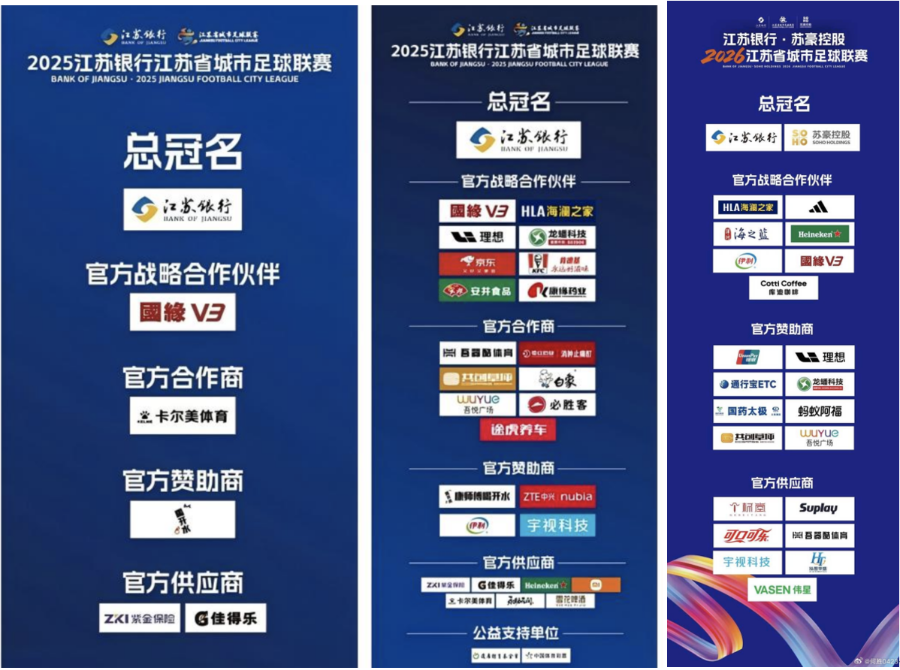
Core Insights - The 2026 Jiangsu Provincial Urban Football League (referred to as "Su Super") is set to continue the momentum generated by its inaugural season in 2025, with a strong lineup of sponsors and heightened public interest [1][2] Sponsorship and Financial Aspects - The 2026 season has attracted 24 sponsors, including notable companies such as Jiangsu Bank, Suhao Holding Group, Heineken, Adidas, and Ant Financial, showcasing a robust sponsorship portfolio [1][2] - The total sponsorship amount for the 2026 season was previously reported to exceed 202 million yuan, although this figure is still subject to confirmation due to pending agreements [2] Audience Engagement and Popularity - The inaugural season of Su Super saw significant audience engagement, with a total attendance of 2.43 million across 85 matches, averaging 28,000 spectators per match, and online viewership reaching 2.2 billion [4] - The league has generated a cultural phenomenon, with various social media trends and memes emerging from the matches, indicating a strong community connection and engagement [4][5] Socioeconomic Context - The success of Su Super is attributed to the unique competitive spirit among the 13 cities in Jiangsu, each with its own economic strengths and cultural pride, creating a vibrant local rivalry [5][6] - The league's rapid growth in sponsorship from 6 to nearly 40 partners within a year reflects the effective governance and responsiveness of local authorities to capitalize on this sporting event [5] Changes and Innovations for the New Season - The 2026 season will introduce a new competition format, including a two-leg knockout stage in the playoffs, increasing the total number of matches to 91 [8] - The league will also expand its sponsorship model to include small and micro enterprises, allowing them to participate as official sponsors, thereby enhancing community involvement [9] Broader Implications and Future Prospects - The success of Su Super has inspired other regions to launch similar sports events, but experts suggest that replicating its success requires a deep understanding of local cultural and social dynamics [10]