
Changshu Bank(601128)

Search documents
银行资负跟踪20260119:降准降息还有空间
GF SECURITIES· 2026-01-19 04:26
Investment Rating - The industry investment rating is "Buy" [3] Core Viewpoints - The report indicates that there is still room for further cuts in reserve requirement ratios and interest rates, with a focus on structural monetary policy support for high-quality economic development [15][19] - The central bank has implemented a reduction of 0.25 percentage points in various structural monetary policy tool rates, signaling a supportive monetary policy stance [15][19] - The report emphasizes the importance of timing for future policy implementations, particularly in relation to government bond issuance peaks and the maturity schedule of high-interest bank deposits [15] Summary by Sections 1. Monetary Policy Adjustments - The report notes a reduction of 0.25 percentage points in structural monetary policy tool rates, with a focus on supporting key areas through increased re-lending [15] - Future attention is directed towards December economic data and January LPR [22] 2. Central Bank Dynamics and Market Rates - The central bank conducted a total of 9,515 billion yuan in 7-day reverse repos at an interest rate of 1.40%, with a net injection of 9,741 billion yuan [16] - The report highlights that the funding rates remained stable, with expectations of slight increases due to tax payments and government bond net repayments [16] 3. Bank Financing Tracking - The report indicates that the total outstanding amount of interbank certificates of deposit (CDs) is 19.09 trillion yuan, with an average issuance rate of 1.65% [20] - The report also notes that there were no commercial bank bond issuances during the period, with a total outstanding commercial bank bond size of 3.38 trillion yuan [20]




负债端稳定,存单提价换量压力不大:存单周报(0112-0118)-20260118
Huachuang Securities· 2026-01-18 14:06
1. Report Industry Investment Rating No information provided in the content. 2. Core View of the Report - The pressure on CDs to "increase prices for volume" is relatively controllable, and there's no need to overly worry about banks' liability - side. Despite a significant increase in CD maturities this week and short - term fluctuations in capital prices, CDs did not "increase prices for volume", indicating a strong continuation of long - term bank deposits after maturity. The current capital frictions are mainly short - term, such as new share subscriptions on the Beijing Stock Exchange and delayed reverse repurchase placements. The central bank actively smoothed out capital fluctuations, and CDs are expected to fluctuate around 1.65% with limited price - increasing pressure [2][46]. 3. Summary According to the Table of Contents Supply: Net financing declines, and the term structure lengthens - This week (January 12 - January 18), CD issuance was 553.58 billion yuan, with a net financing of - 254.88 billion yuan (compared to - 153.30 billion yuan from January 5 - January 11). The issuance proportion of state - owned banks decreased from 19% to 18%, while that of joint - stock banks increased from 11% to 14%, city commercial banks from 44% to 57%, and rural commercial banks from 7% to 9%. The 1M CD issuance proportion dropped from 26% to 8%, while the 3M, 6M, and 9M proportions increased. The weighted issuance term of CDs lengthened to 7.70 months (previously 7.45 months) [2][5]. - Next week (January 19 - January 25), the maturity scale will decline to 681.57 billion yuan, a weekly reduction of 123.80 billion yuan. Maturities are mainly concentrated in state - owned, joint - stock, and city commercial banks. In terms of term, the 3M, 6M, and 1Y CDs have higher maturity amounts, at 163.34 billion yuan, 174.02 billion yuan, and 266.28 billion yuan respectively [2][5]. Demand: Small and medium - sized banks and insurance companies are the main secondary - market allocators, and the primary - market subscription rates vary - In the secondary market, large - scale banks had a net purchase of 26.76 billion yuan this week, small and medium - sized banks had a net purchase of 97.621 billion yuan, wealth management shifted from a net sale of 2.412 billion yuan to a net purchase of 10.777 billion yuan, and money market funds' net sales increased from 57.166 billion yuan to 137.391 billion yuan [2][14]. - In the primary market, the overall market subscription rate (15DMA) decreased from 88% to 87%. Among different institutions, the subscription rate of city commercial banks increased from 81% to 82%, that of joint - stock banks decreased from 89% to 84%, and that of state - owned banks remained at 91% [2][14]. Valuation: The primary - market pricing of CDs shows a divergent trend, and most of the secondary - market pricing declines - In primary - market pricing, the weighted issuance rate of 1Y state - owned bank CDs remained around 1.62%. Specifically, the 1M variety decreased by 9bp, the 3M increased by 3bp, the 6M increased by 1bp, and the 9M and 1Y remained unchanged. The 1Y - 3M term spread of joint - stock banks decreased by 5bp, at the 9% historical quantile. The 1Y credit spread between city commercial banks and joint - stock banks widened from 8.88BP to 9.46BP, at around the 12% quantile, while that between rural commercial banks and joint - stock banks narrowed from 16.17BP to 7.33BP, also around the 12% quantile [2][17]. - In secondary - market yields, most yields of AAA - rated CDs declined. The 1M, 6M, 9M, and 1Y varieties each decreased by 1BP compared to last week, the 3M remained unchanged, and the 1Y remained at the 2% historical quantile since 2019. The 1Y - 3M term spread of AAA - rated CDs remained at the 11% historical quantile [2][29]. Comparison: The spread between CDs and treasury bonds widens - The spread between the 1Y AAA - rated CD yield and the DR007:15DMA capital spread narrowed from 12.32BP to 8.91BP, and the spread with the R007:15DMA capital spread narrowed from 1.56BP to - 0.52BP. The 1Y treasury bond yield decreased by 4.63BP, and the spread between CDs and treasury bonds widened from 34.38BP to 38.26BP, with the quantile rising to around 39%. The spread between CDs and China Development Bank bonds narrowed from 5.46BP to 3.08BP, with the quantile dropping to around 2%. Additionally, the spread between AAA medium - and short - term commercial paper and CDs widened from 6.13BP to 7.36BP, with the quantile rising to around 34% [2][34].


社融增速放缓,信贷仍是企业强、居民弱:银行业周报(20260112-20260118)-20260118
Huachuang Securities· 2026-01-18 09:46
Investment Rating - The report maintains a "Buy" recommendation for the banking sector [1]. Core Insights - The report highlights a slowdown in social financing growth, indicating that credit remains strong for enterprises but weak for households [1]. - In December 2025, the social financing growth rate decreased by 0.2 percentage points to 8.3%, continuing the trend observed in the second half of 2025 [4]. - The report emphasizes that government bonds are the main support for social financing, contributing significantly to the overall increase in financing [4]. - The investment logic for 2026 is expected to shift from purely defensive to a combination of dividends and growth, with a focus on banks with high dividends and low valuations [5]. Summary by Sections Industry Basic Data - The banking sector consists of 42 listed companies with a total market capitalization of approximately 1.15 trillion yuan and a circulating market value of about 790 billion yuan [1]. Market Performance - The absolute performance of the banking sector over the past month is 5.0%, with a relative performance of 2.8% compared to the broader market [2]. Financing and Credit Data - In December 2025, new social financing amounted to 2.21 trillion yuan, which is a year-on-year decrease of 646.2 billion yuan, primarily due to a reduction in government bonds [4]. - The report notes that new RMB loans in December were 910 billion yuan, a year-on-year decrease of 80 billion yuan, with household loans showing a negative growth trend [4]. Investment Recommendations - The report suggests focusing on three main investment lines: state-owned banks and large commercial banks, quality joint-stock banks and city commercial banks with strong performance, and city commercial banks benefiting from regional policies [5]. - Specific banks recommended for investment include China Merchants Bank, CITIC Bank, Ping An Bank, and several city commercial banks [5].

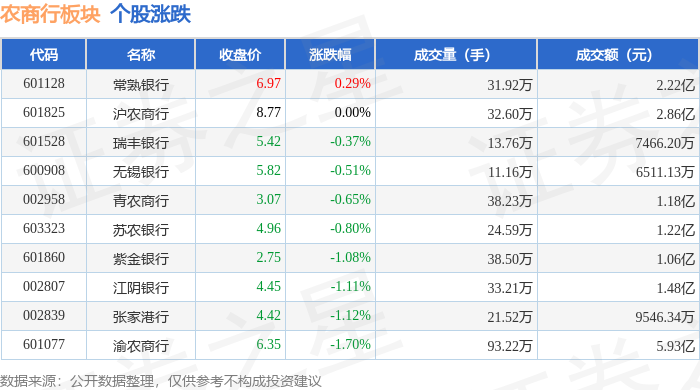
农商行板块1月16日跌0.64%,渝农商行领跌,主力资金净流出617.66万元
Zheng Xing Xing Ye Ri Bao· 2026-01-16 08:56
Group 1 - The agricultural commercial bank sector experienced a decline of 0.64% on January 16, with Yunnan Agricultural Commercial Bank leading the drop [1] - The Shanghai Composite Index closed at 4101.91, down 0.26%, while the Shenzhen Component Index closed at 14281.08, down 0.18% [1] - The trading volume and turnover for various agricultural commercial banks are detailed, with Changshu Bank closing at 6.97, up 0.29%, and Yunnan Agricultural Commercial Bank closing at 6.35, down 1.70% [1] Group 2 - The net outflow of main funds from the agricultural commercial bank sector was 6.1766 million yuan, while retail funds saw a net outflow of 12.6 million yuan [1] - The table shows the net inflow and outflow of funds for individual banks, with notable figures such as 14.69% net inflow for Shanghai Agricultural Commercial Bank from main funds [2] - Jiangyin Bank had a significant net outflow of 30.1445 million yuan from main funds, indicating a 20.35% decrease [2]




农商行板块1月15日跌0.94%,沪农商行领跌,主力资金净流出4296.1万元
Zheng Xing Xing Ye Ri Bao· 2026-01-15 08:59
Group 1 - The agricultural commercial bank sector experienced a decline of 0.94% on January 15, with Hu Nong Commercial Bank leading the drop [1] - The Shanghai Composite Index closed at 4112.6, down 0.33%, while the Shenzhen Component Index closed at 14306.73, up 0.41% [1] - The trading volume and turnover for various agricultural commercial banks are detailed in a table, showing mixed performance among individual stocks [1] Group 2 - The net outflow of main funds from the agricultural commercial bank sector was 42.961 million yuan, while retail funds saw a net outflow of 56.997 million yuan [1] - The table of fund flows indicates that some banks, like Changshu Bank and Zhangjiagang Bank, had positive net inflows from retail and speculative funds, while others like Yunnan Agricultural Bank and Jiangyin Bank faced significant outflows [2] - Specific data shows that Changshu Bank had a main fund net inflow of 8.1314 million yuan, while Yunnan Agricultural Bank had a net outflow of 25.5857 million yuan [2]

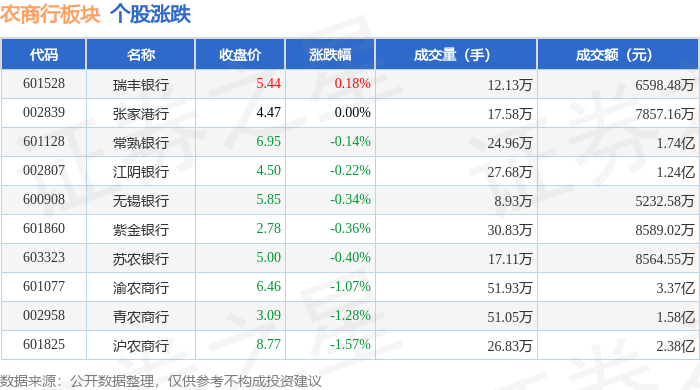
农商行板块1月14日跌1.28%,瑞丰银行领跌,主力资金净流入1.14亿元
Zheng Xing Xing Ye Ri Bao· 2026-01-14 08:58
Core Viewpoint - The rural commercial bank sector experienced a decline of 1.28% on January 14, with Ruifeng Bank leading the drop, while the Shanghai Composite Index fell by 0.31% and the Shenzhen Component Index rose by 0.56% [1] Group 1: Market Performance - The closing price of Qingnong Commercial Bank was 3.13, unchanged from the previous day, with a trading volume of 645,900 shares and a transaction value of 202 million yuan [1] - Zijin Bank closed at 2.79, down 0.71%, with a trading volume of 498,600 shares and a transaction value of 140 million yuan [1] - Changshu Bank's closing price was 6.96, also down 0.71%, with a trading volume of 569,400 shares and a transaction value of 398 million yuan [1] - Wuxi Bank closed at 5.87, down 0.84%, with a trading volume of 183,700 shares and a transaction value of 108 million yuan [1] - The overall rural commercial bank sector saw a net inflow of 114 million yuan from main funds, while retail investors experienced a net outflow of 1.41 billion yuan [1] Group 2: Fund Flow Analysis - Changshu Bank had a main fund net inflow of 22.95 million yuan, accounting for 5.77% of its total, while retail investors had a net outflow of 5.30 million yuan [2] - Yunnan Agricultural Commercial Bank saw a main fund net inflow of 20.12 million yuan, representing 4.30%, but a retail net outflow of 34.64 million yuan [2] - Zhangjiagang Bank recorded a main fund net inflow of 15.78 million yuan, with a retail net outflow of 29.95 million yuan [2] - Wuxi Bank had a main fund net inflow of 12.01 million yuan, which is 11.10% of its total, while retail investors faced a net outflow of 9.00 million yuan [2] - Ruifeng Bank experienced a main fund net inflow of 3.60 million yuan, with a retail net outflow of 9.82 million yuan [2]


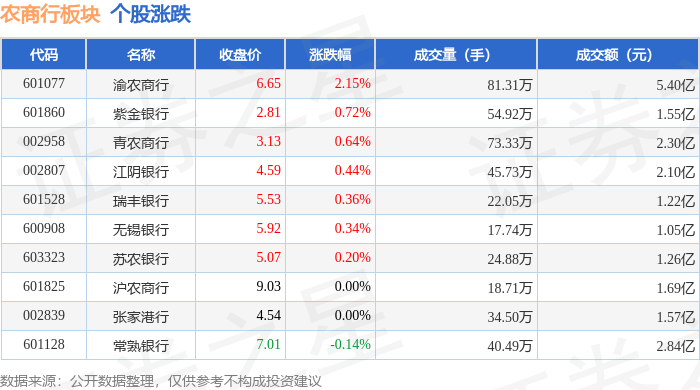
农商行板块1月13日涨0.62%,渝农商行领涨,主力资金净流入5648.9万元
Zheng Xing Xing Ye Ri Bao· 2026-01-13 09:06
Core Viewpoint - The agricultural commercial bank sector experienced a rise of 0.62% on January 13, with Chongqing Rural Commercial Bank leading the gains, while the Shanghai Composite Index fell by 0.64% and the Shenzhen Component Index dropped by 1.37% [1] Group 1: Market Performance - Chongqing Rural Commercial Bank (601077) closed at 6.65, up by 2.15% with a trading volume of 813,100 shares and a transaction value of 540 million yuan [1] - Other notable banks included Zijin Bank (601860) with a closing price of 2.81, up by 0.72%, and Qingnong Bank (002958) at 3.13, up by 0.64% [1] - The overall trading volume for the agricultural commercial bank sector was significant, with total net inflow of main funds amounting to 56.49 million yuan [1] Group 2: Fund Flow Analysis - Main funds saw a net inflow of 17.50 million yuan into Chongqing Rural Commercial Bank, while retail investors experienced a net outflow of 47.08 million yuan [2] - Jiangyin Bank (002807) had a net inflow of 13.55 million yuan from main funds, but retail investors withdrew 8.41 million yuan [2] - The fund flow data indicates a mixed sentiment among retail and institutional investors, with main funds generally showing positive interest in several banks while retail investors were more cautious [2]
银行业 2026 年经营展望:资产负债篇:到期存款流向是资负格局的关键
Guoxin Securities Hongkong· 2026-01-13 05:12
Investment Rating - The report maintains an "Outperform" rating for the banking sector [6] Core Insights - The expected M2 growth rate for 2026 is approximately 7.5%, with credit growth around 6.0% and social financing growth at about 8.0%. This aligns with the goal of stabilizing economic growth and ensuring reasonable price recovery [2][18][19] - The banking sector is expected to see a structural differentiation in retail credit, with corporate lending remaining the primary contributor to new loans, accounting for approximately 80% to 85% of new loans [33][37] - The report highlights the importance of deposit flows, particularly the trend of deposits moving from large banks to smaller banks, which will influence the asset-liability gap for large banks in 2026 [3][41] Summary by Sections M2 and Credit Growth - The M2 increment for 2026 is estimated at about 25.4 trillion yuan, with fiscal net injection contributing approximately 12.0 trillion yuan and bank credit (including write-offs and ABS) contributing around 16.8 trillion yuan [2][29][24] - The anticipated new social financing for 2026 is about 35.3 trillion yuan, reflecting a growth rate of approximately 8.0% [30][32] Credit Allocation - Corporate lending is expected to remain strong, while retail lending will show structural improvements, contributing about 10% to 15% of new loans [33][37] - The report notes that retail credit is likely to experience a slight positive growth, particularly in quality consumption scenarios and personal operating loans [33][37] Asset-Liability Dynamics - The asset-liability gap for large banks is projected to continue, with marginal changes primarily driven by the liability side, influenced by deposit flows [3][41] - The report estimates that the maturity of fixed-term deposits for the six major banks in 2026 will be around 57 trillion yuan, with 2-year and longer-term deposits accounting for 27 to 32 trillion yuan [49][52] Investment Recommendations - The report recommends focusing on high-quality stocks with improving fundamentals, specifically highlighting Ningbo Bank and Changshu Bank, while also suggesting attention to Changsha Bank and Chongqing Rural Commercial Bank for potential excess returns [4] - Additionally, it emphasizes the value of stable, high-dividend stocks, recommending China Merchants Bank, Industrial and Commercial Bank of China, and Jiangsu Bank [4]
银行业周报(20260105-20260111):银行理财收益率走低,打通入市卡点可提升吸引力-20260112
Huachuang Securities· 2026-01-12 14:52
Investment Rating - The report maintains a "Recommended" rating for the banking sector, indicating an expectation that the sector will outperform the benchmark index by more than 5% in the next 3-6 months [25]. Core Insights - The average yield of bank wealth management products has been on a downward trend, with the average yield falling below the average personal deposit rate of listed banks for the first time since 2012. This trend is attributed to regulatory changes and market conditions [7][8]. - There is a potential for increasing the allocation of equity assets in wealth management products, which could enhance overall returns and attract more investors. Currently, equity products account for only 0.08% of the total wealth management product market, which has a total size of 31.63 trillion yuan [2][8]. - The banking sector is expected to see a systematic recovery in valuations in 2026, driven by a combination of improved fundamentals and capital inflows. The investment logic is shifting from pure defensive strategies to a dual focus on dividends and growth [8]. Summary by Sections Wealth Management Products - As of December 2025, the total market size of wealth management products reached 31.63 trillion yuan, with fixed income products making up 76.60%, cash management products 20.87%, mixed products 2.37%, and equity products only 0.08% [2]. - Regulatory bodies are exploring ways to facilitate greater equity market participation by wealth management funds, which could lead to an increase in the proportion of equity investments [2][8]. Company Earnings Forecasts and Valuations - Key companies in the banking sector have been rated as "Recommended" with projected earnings per share (EPS) and price-to-earnings (PE) ratios indicating potential for growth. For example, Ningbo Bank is projected to have an EPS of 4.33 yuan in 2025 with a PE ratio of 6.48 [3]. - The report highlights several banks, including China Merchants Bank and Jiangsu Bank, as having strong growth potential and favorable valuations, suggesting they are well-positioned for investment [3][8]. Market Performance - The report notes that the banking index underperformed the broader market indices, with a weekly decline of 1.90% compared to a 2.79% increase in the CSI 300 index [7]. - The report emphasizes the importance of monitoring market trends and the performance of individual banks to identify investment opportunities [5][8].
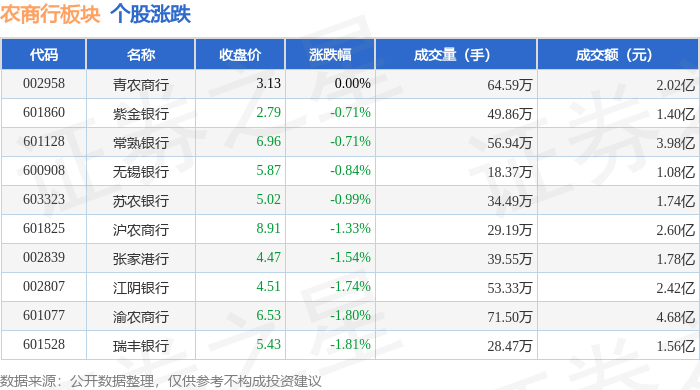
农商行板块1月12日跌0.14%,渝农商行领跌,主力资金净流出5928.29万元
Zheng Xing Xing Ye Ri Bao· 2026-01-12 09:04
Market Overview - The agricultural commercial bank sector experienced a decline of 0.14% on January 12, with Yunnan Agricultural Commercial Bank leading the drop [1] - The Shanghai Composite Index closed at 4165.29, up 1.09%, while the Shenzhen Component Index closed at 14366.91, up 1.75% [1] Individual Bank Performance - Zijin Bank closed at 2.79, with an increase of 0.72% and a trading volume of 386,600 shares, totaling a transaction value of 107 million yuan [1] - Su Nong Bank closed at 5.06, up 0.40%, with a trading volume of 204,900 shares, totaling 104 million yuan [1] - Ruifeng Bank closed at 5.51, up 0.36%, with a trading volume of 181,100 shares, totaling approximately 99.28 million yuan [1] - Qing Nong Bank closed at 3.11, up 0.32%, with a trading volume of 422,100 shares, totaling 131 million yuan [1] - Yunnan Agricultural Commercial Bank closed at 6.51, down 0.91%, with a trading volume of 690,100 shares [1] Capital Flow Analysis - The agricultural commercial bank sector saw a net outflow of 59.28 million yuan from institutional investors, while retail investors contributed a net inflow of 49.11 million yuan [1] - The table of capital flow indicates that Changshu Bank had a net inflow of 7.30 million yuan from institutional investors, while it faced a net outflow of 22.43 million yuan from speculative funds [2] - Yunnan Agricultural Commercial Bank experienced a net outflow of 21.20 million yuan from institutional investors, but a net inflow of 42.56 million yuan from speculative funds [2]
