Changshu Bank(601128)

Search documents
银行业周度追踪2026年第1周:如何理解银行股开年调整?-20260112
Changjiang Securities· 2026-01-12 04:41
Investment Rating - The investment rating for the banking sector is "Positive" and is maintained [12]. Core Insights - In the first week of 2026, the banking sector continued to adjust, with a cumulative decline of 1.9% in the banking index, significantly underperforming the CSI 300 and ChiNext indices by -4.7% and -5.8% respectively. Despite this, the fundamental expectations for the sector remain unchanged, and the market's risk appetite has notably increased [2][6][19]. - The main banks are expected to maintain stable growth in performance throughout 2026. Following recent adjustments, the PB-ROE valuation attractiveness of bank stocks has further increased, suggesting a favorable timing for allocation [2][6][19]. Summary by Sections Market Performance - The banking sector's performance in the first week of 2026 showed a cumulative decline of 1.9%, with significant negative excess returns compared to the CSI 300 and ChiNext indices [6][19]. - Individual stocks such as Chongqing Rural Commercial Bank saw price recovery after management uncertainties were resolved, while stable performers like Hangzhou Bank led the city commercial bank sector [2][6][19]. Fundamental Analysis - The banking sector's performance has been influenced by structural concerns, particularly regarding real estate and retail asset quality. Despite these concerns, overall performance remains stable with steady growth [8][37]. - The LTV (Loan-to-Value) ratios for major banks are stable at 40%-50%, providing a safety margin despite rising asset quality pressures in mortgage loans [8][37]. Trading Dynamics - The increase in market risk appetite has continued to suppress bank stock valuations. Historically, January has seen excess returns for bank stocks, but this year, the rapid recovery in market sentiment has led to underperformance [9][38]. - The report recommends focusing on high-quality city commercial banks such as Hangzhou Bank, Nanjing Bank, and Jiangsu Bank, as well as dividend-oriented assets like Bank of Communications and China Merchants Bank [9][38]. Convertible Bonds - The prices of convertible bonds linked to bank stocks have generally followed the sector's adjustment, with the distance to mandatory conversion prices widening. The report highlights potential trading opportunities in convertible bonds for banks like Changshu Bank and Shanghai Bank, which have stable fundamental performance expectations [7][32].



常熟农商行取得基于大模型的银行数据文件解析方法及系统专利
Sou Hu Cai Jing· 2026-01-09 02:15
Group 1 - Jiangsu Changshu Rural Commercial Bank Co., Ltd. has obtained a patent for a method and system for bank data file analysis based on large models, with the authorization announcement number CN120849363B and an application date of September 2025 [1] - The bank was established in 2001 and is located in Suzhou, primarily engaged in monetary financial services [1] - The registered capital of Jiangsu Changshu Rural Commercial Bank is approximately 3.316 billion RMB [1] Group 2 - The bank has made investments in 7 enterprises and participated in 1,164 bidding projects [1] - It holds 231 trademark information entries and 31 patent information entries, along with 115 administrative licenses [1]
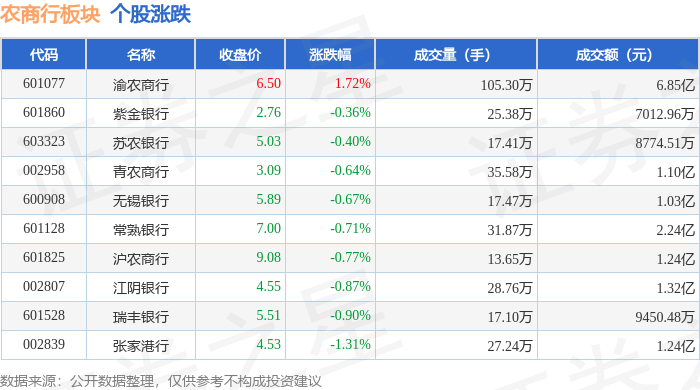
农商行板块1月8日跌0.18%,张家港行领跌,主力资金净流出3731.72万元
Zheng Xing Xing Ye Ri Bao· 2026-01-08 08:56
Core Viewpoint - The agricultural commercial bank sector experienced a slight decline of 0.18% on January 8, with Zhangjiagang Bank leading the drop [1] Group 1: Market Performance - The Shanghai Composite Index closed at 4082.98, down 0.07%, while the Shenzhen Component Index closed at 13959.48, down 0.51% [1] - The agricultural commercial bank sector's individual stock performance showed varied results, with Yunnan Agricultural Commercial Bank rising by 1.72% to a closing price of 6.50 [1] Group 2: Trading Volume and Turnover - The trading volume and turnover for various banks were reported, with Jiangyin Bank having a turnover of 1.32 billion and a trading volume of 287,600 shares [1] - The overall net outflow of main funds from the agricultural commercial bank sector was 37.32 million, while retail funds saw a net outflow of 18.16 million [1] Group 3: Fund Flow Analysis - The main fund inflow for Ruifeng Bank was 4.77 million, accounting for 5.04% of its total, while it faced a retail net outflow of 8.39 million [2] - Zhangjiagang Bank experienced a significant main fund outflow of 6.71 million, with retail investors also withdrawing 7.63 million [2]




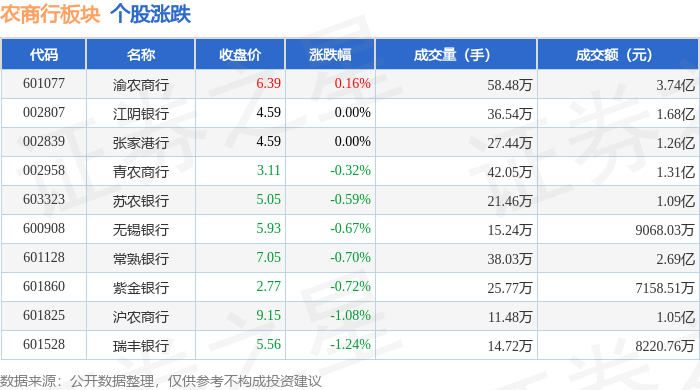
农商行板块1月7日跌0.57%,瑞丰银行领跌,主力资金净流入5042.72万元
Zheng Xing Xing Ye Ri Bao· 2026-01-07 08:58
Core Viewpoint - The rural commercial bank sector experienced a decline of 0.57% on January 7, with Ruifeng Bank leading the drop, while the Shanghai Composite Index rose by 0.05% and the Shenzhen Component Index increased by 0.06% [1] Group 1: Market Performance - The closing prices and performance of key rural commercial banks on January 7 are as follows: - Yunnan Rural Commercial Bank (601077) closed at 6.39, up by 0.16% - Jiangyin Bank (002807) closed at 4.59, unchanged - Zhangjiagang Bank (002839) closed at 4.59, unchanged - Qingnong Bank (002958) closed at 3.11, down by 0.32% - Sunan Bank (603323) closed at 5.05, down by 0.59% - Wuxi Bank (600908) closed at 5.93, down by 0.67% - Changshu Bank (601128) closed at 7.05, down by 0.70% - Zijin Bank (601860) closed at 2.77, down by 0.72% - Hunan Rural Commercial Bank (601825) closed at 9.15, down by 1.08% - Ruifeng Bank (601528) closed at 5.56, down by 1.24% [1] Group 2: Capital Flow - On January 7, the rural commercial bank sector saw a net inflow of 50.43 million yuan from main funds, while retail investors experienced a net outflow of 84.63 million yuan [1] - The capital flow for individual banks is as follows: - Zhangjiagang Bank (002839) had a main fund net inflow of 13.66 million yuan, but a retail net outflow of 13.84 million yuan - Changshu Bank (601128) had a main fund net inflow of 13.25 million yuan, with a retail net outflow of 22.78 million yuan - Qingnong Bank (002958) had a main fund net inflow of 12.24 million yuan, but a retail net outflow of 8.34 million yuan - Wuxi Bank (600908) had a main fund net inflow of 9.53 million yuan, with a retail net outflow of 6.99 million yuan [2]


银行业 2026 年经营展望:资产负债篇到期存款流向是资负格局的关键
Guoxin Securities· 2026-01-07 07:12
Investment Rating - The report maintains an "Outperform the Market" rating for the banking sector [4][5]. Core Insights - The banking industry is expected to see a reasonable M2 growth target of approximately 7.5%, with credit growth around 6.0% and social financing growth at about 8.0% for 2026. This aligns with the anticipated nominal GDP growth of about 5.0% and actual GDP growth of approximately 4.9% [1][15][21]. - The report highlights that the flow of deposits will be a key factor affecting the asset-liability structure of banks in 2026, with a significant amount of term deposits maturing, estimated at around 57 trillion yuan [3][49]. - The credit allocation is expected to show strong support for corporate lending, contributing approximately 80% to 85% of new loans, while retail lending is projected to improve marginally, contributing about 10% to 15% [2][36]. Summary by Sections M2 and Credit Growth - The M2 growth target for 2026 is set at approximately 7.5%, with an expected M2 increment of about 25.4 trillion yuan, driven by fiscal net injection of around 12.0 trillion yuan and bank credit issuance of about 16.8 trillion yuan [1][21][22]. - The anticipated credit growth for 2026 is around 6.0%, with new social financing expected to reach approximately 35.3 trillion yuan, reflecting an 8.0% growth rate [21][26][30]. Deposit Flow and Asset-Liability Structure - The report indicates that the flow of deposits from large banks to smaller banks will be a critical factor in determining the marginal changes in the asset-liability gap for large banks in 2026. The pressure from deposit migration is expected to ease somewhat [2][41][54]. - The maturing term deposits for the six major banks are estimated to be between 27 trillion and 32 trillion yuan, with a significant portion being long-term deposits [3][49][50]. Investment Recommendations - The report suggests focusing on two main lines for investment in 2026: high-quality companies with improving fundamentals, such as Ningbo Bank and Changshu Bank, and stable high-dividend stocks like China Merchants Bank and Industrial and Commercial Bank of China [3][4].



银行业2026年经营展望:资产负债篇:期存款流向是资负格局的关键
Guoxin Securities· 2026-01-07 05:15
Investment Rating - The report maintains an "Outperform the Market" rating for the banking sector [4][5]. Core Insights - The banking sector is expected to see a reasonable M2 growth target of approximately 7.5%, with credit growth around 6.0% and social financing growth at about 8.0% for 2026. This aligns with the goal of stabilizing economic growth and ensuring reasonable price recovery [1][21]. - The report highlights that the flow of deposits will be a key factor affecting the asset-liability structure of banks in 2026, with a significant amount of term deposits maturing, estimated at around 57 trillion yuan [3][49]. - The credit allocation is expected to remain strong for corporate lending, contributing approximately 80% to 85% of new loans, while retail lending is anticipated to show marginal improvement, contributing about 10% to 15% [2][36]. Summary by Sections Economic Outlook - The actual GDP growth target for 2026 is estimated at 4.9%, with a nominal GDP growth target of about 5.0%, which corresponds to a reasonable M2 growth target of 7.5% [1][15]. - The projected M2 increment for 2026 is approximately 25.4 trillion yuan, with fiscal net M2 injection around 12.0 trillion yuan and bank credit (including write-offs and ABS) contributing about 16.8 trillion yuan [21][22]. Credit Allocation - Corporate lending is expected to remain the primary support for new loans, while retail lending will experience structural differentiation, with personal operating loans maintaining good growth and housing loans likely showing slight positive growth [2][36]. - The report indicates that the flow of deposits from large banks to smaller banks will be a critical factor in the marginal changes in the asset-liability gap for large banks in 2026 [3][41]. Investment Recommendations - The report suggests focusing on two main lines for investment in 2026: high-quality companies with improving fundamentals, such as Ningbo Bank and Changshu Bank, and stable high-dividend stocks like China Merchants Bank and Industrial and Commercial Bank of China [4][5].
农商行板块1月5日涨0.09%,沪农商行领涨,主力资金净流入7699.1万元
Zheng Xing Xing Ye Ri Bao· 2026-01-05 09:09
Core Insights - The agricultural commercial bank sector experienced a slight increase of 0.09% on January 5, with Shanghai Agricultural Commercial Bank leading the gains [1] - The Shanghai Composite Index closed at 4023.42, up by 1.38%, while the Shenzhen Component Index closed at 13828.63, up by 2.24% [1] Stock Performance - Shanghai Agricultural Commercial Bank (601825) closed at 9.36, with a rise of 0.75% and a trading volume of 363,400 shares, totaling a transaction value of 337 million yuan [1] - Other notable banks include: - Zijin Bank (601860) at 2.77, up 0.36% with a transaction value of 72.96 million yuan [1] - Zhangjiagang Bank (002839) at 4.58, up 0.22% with a transaction value of 135 million yuan [1] - Changshu Bank (601128) at 7.05, up 0.14% with a transaction value of 257 million yuan [1] - Wuxi Bank (600908) remained unchanged at 5.93 with a transaction value of 88.9 million yuan [1] Capital Flow - The agricultural commercial bank sector saw a net inflow of 76.99 million yuan from institutional investors and 84.57 million yuan from retail investors, while individual investors had a net outflow of 162 million yuan [1] - Specific capital flows for key banks include: - Shanghai Agricultural Commercial Bank had a net inflow of 47.24 million yuan from institutional investors, but a net outflow of 54.86 million yuan from individual investors [2] - Changshu Bank saw a net inflow of 32.72 million yuan from institutional investors, with a net outflow of 33.53 million yuan from individual investors [2] - Suzhou Agricultural Bank had a net inflow of 13.51 million yuan from institutional investors, with a net outflow of 12.27 million yuan from individual investors [2]
常熟银行(601128) - 江苏常熟农村商业银行股份有限公司可转债转股结果暨股份变动的公告
2026-01-05 08:01
证券代码:601128 证券简称:常熟银行 公告编号:2026-001 转债代码:113062 转债简称:常银转债 可转债转股结果暨股份变动的公告 江苏常熟农村商业银行股份有限公司(以下简称"本行")董事会及全体董 事保证本公告内容不存在任何虚假记载、误导性陈述或者重大遗漏,并对其内容 的真实性、准确性和完整性承担个别及连带责任。 重要内容提示: 累计转股情况:截至 2025 年 12 月 31 日,累计已有人民币 535,000 元常 银转债转为本行 A 股普通股,累计转股股数为 76,414 股,占常银转债转股前本 行已发行普通股股份总额的 0.003%。 2025 年第四季度转股情况:2025 年 10 月 1 日至 2025 年 12 月 31 日,累 计有人民币 24,000 元常银转债转为本行 A 股普通股,累计转股股数为 4,065 股。 未转股可转债情况:截至 2025 年 12 月 31 日,尚未转股的常银转债金额 为人民币 5,999,465,000 元,占常银转债发行总量的比例为 99.9911%。 一、可转债发行上市概况 江苏常熟农村商业银行股份有限公司 常银转债的转股期为:2023 ...
125股连续5日或5日以上获主力资金净买入
Zheng Quan Shi Bao Wang· 2026-01-05 02:57
Group 1 - The core point of the article highlights that as of December 31, 2025, there are 125 stocks in the Shanghai and Shenzhen markets that have received net buying from main funds for five consecutive days or more [1] - The stock with the longest consecutive net buying days is Tianlong Co., which has seen net buying for 14 consecutive trading days [1] - Other stocks with significant consecutive net buying days include Dongfang Electric, Huaneng Water Power, Jingwang Electronics, Leao Planning, Jiajia Yue, Meike Home, Aohua Endoscope, and Changshu Bank [1]



银行:银行2026年展望:稳中求进
2025-12-31 16:02
Summary of the Conference Call Transcript Industry Overview - The banking sector is entering a phase of high-quality development, with a focus on absolute and relative returns from bank stocks, driven by high dividend yields and asset quality [3][4][20]. Key Points Financial Performance Projections - Expected revenue growth for listed banks in 2026 and 2027 is +2.5% and +3.6% respectively, with net profit growth of +1.9% and +2.6% [4][20]. - Revenue and profit growth are anticipated to improve due to: 1. Narrowing net interest margin pressure 2. Quality-focused credit issuance amid weak demand [4][20]. 3. Stabilization of fee income growth after several years of fee reductions [4][20]. 4. Stable or improving net non-performing loan generation rates [4][11]. 5. Accelerated supply-side reforms leading to a reduction in the number of bank licenses, improving competition and operational landscape [4][11]. Customer Demand and Market Dynamics - The low-interest-rate environment has shifted customer demand, with government and state-owned enterprises becoming significant contributors to leverage, affecting the structure of new social financing [5][10]. - Regulatory policies are influencing the development of inclusive finance, focusing on risk compensation rather than merely increasing customer numbers [5][10]. Risk Factors - Risks associated with real estate developers and retail sectors are highlighted, with potential for greater-than-expected exposure [6][11]. Profitability and Valuation Adjustments - Adjustments to profitability forecasts for 2025 and 2026 have been made, with a focus on net interest income recovery and fee income growth [20][21]. - The expected net interest margin for 2026 is projected to be approximately 1.34%, a decrease of 6 basis points from 2025 [21][22]. - Fee income is expected to grow by 3.6% and 4.9% in 2026 and 2027 respectively, indicating a positive trend in non-interest income [21][22]. Asset Quality and Credit Costs - The net non-performing loan generation rate is expected to stabilize or slightly decline, with structural characteristics of retail and corporate lending continuing [11][21]. - Credit costs are projected to remain stable at around 0.58% for 2026 and 2027, reflecting the balance between corporate and household debt servicing capabilities [21][22]. Investment Recommendations - The report suggests a continued positive outlook for bank stocks, emphasizing the importance of dividend yield and asset quality in investment decisions [3][4][20]. Additional Insights - The banking sector is undergoing a transformation towards high-quality development, with a shift in focus from scale to quality, driven by macroeconomic pressures and regulatory changes [12][20]. - The reduction in the number of banking licenses over the past five years indicates successful risk management efforts within the sector [11][12]. - The report emphasizes the need for banks to adapt their strategies to maintain competitiveness in a changing regulatory and economic environment [12][20].