
QILU BANK(601665)

Search documents
国有大行首次“上岗”这一职位,由行长兼任!中小银行早已跟进,有何影响?
券商中国· 2026-02-14 03:12
Core Viewpoint - The establishment of Chief Compliance Officers (CCOs) in major state-owned banks marks a significant shift in compliance management, emphasizing the importance of compliance at the highest management level [1][2][6]. Group 1: Establishment of Chief Compliance Officers - On February 13, Agricultural Bank of China and Bank of China announced the appointment of their respective CCOs, with the positions held by the banks' presidents [1][2]. - This move signifies the formal establishment of CCOs in major state-owned banks, replacing the previous supervisory board system that has been in place for over 20 years [2]. - The appointment of CCOs by bank presidents is seen as a way to elevate compliance responsibilities to the highest management level, fostering a culture of compliance within the organization [2][8]. Group 2: Regulatory Background - The "Compliance Management Measures" issued by the Financial Regulatory Authority came into effect on March 1, 2025, with a one-year transition period that is nearing its end [4][5]. - As of February 13, 21 out of 42 A-share listed banks have appointed CCOs, while half of the banks have yet to finalize their appointments [7]. Group 3: Industry Trends and Practices - Many listed banks are following suit in appointing CCOs, with recent announcements from Qilu Bank, Shanghai Bank, and Everbright Bank regarding their CCO appointments [3]. - Approximately half of the banks have adopted a model where senior executives, particularly bank presidents, serve as CCOs, which is prevalent among state-owned banks and some city commercial banks [7][8]. - The practice of having senior executives serve as CCOs is recommended to enhance the importance of compliance management and reduce operational costs associated with appointing separate compliance officers [8].





8000亿之后的齐鲁银行:头部区域行打响“生存战”
阿尔法工场研究院· 2026-02-13 02:33
以下文章来源于阿尔法工场金融家 ,作者银妹妹 规模增长的传统叙事,正在让位于对资产负债管理(ALM)精细化。尤其是对迈过特定资产规模 门槛的区域银 行而言,如何将管理焦点从扩表节奏转向对资产负债表更精细的调控,已不再是战 略选择题,而是生存必答题。 齐鲁银行 (601665.SH) 最新公布的2025年经营数据,成为观察区域银行管理模式进阶的案例。 从经营数据来看,2025年齐鲁银行资产总额达到8043.81亿元,同比增长16.65%;实现营业收 入131.35亿元,同比增长5.12%;归母净利润57.13亿元,同比增长14.58%。 值得关注的是,其净息差从1.51%提升至1.53%,同比提升2个基点,利息净收入105.19亿元, 同比增长16.48%,增幅高于营收整体增幅。 阿尔法工场金融家 . 追踪保险银行业圈内动态,剖析最新风向,分享有料、有价值的"内行人"洞察见解。 导语:低利率与息差收窄背景下,区域银行的竞争演变为精细化资产负债管理能力的较量。 近两年来,净息差持续收窄,已成为中国银行业最明确的共性,将"息差保卫战"写入年度经营关 键词的银行不在少数。 截至2025年末,该行贷款总额3828.34 ...

丈量地方性银行(3):川渝132家区域性银行全梳理-20260212
GF SECURITIES· 2026-02-12 14:21
Investment Rating - The industry investment rating is "Buy" [2] Core Insights - The report analyzes 132 regional banks in the Sichuan-Chongqing area, highlighting the growth and structural changes in the banking sector [6][27] - The asset growth rates of major city commercial banks in the region are higher than those of listed city commercial banks, indicating a robust expansion [38] - Profitability metrics show that city commercial banks in the region have lower ROE compared to listed banks, while rural commercial banks outperform them [6][27] - Asset quality is slightly weaker in regional banks compared to listed banks, with higher non-performing loan ratios [6][27] Summary by Sections Economic Structure Analysis - Sichuan province is positioned as a key driver for western development, with a focus on enhancing the Chengdu-Chongqing economic circle [13][14] - In 2025, Chengdu's GDP is projected to account for 38.7% of the province's total, with significant growth in various sectors [15] Banking Sector Overview - The Sichuan-Chongqing region has 132 commercial banks, including 14 city commercial banks, 65 rural banks, and 51 rural commercial banks [27] - The asset growth rates for major city commercial banks in the region are 15.6% and 18.2%, surpassing the 14.2% growth of listed city commercial banks [38] Asset and Liability Structure - The proportion of loans to total assets has been increasing since 2016, with city commercial banks in Sichuan projected to have a loan ratio of 56.1% by 2024 [38][40] - The financial investment ratio for city commercial banks is on a downward trend, with a slight recovery noted in the first half of 2025 [40][46] Profitability and Asset Quality - The average ROE for city commercial banks in the region is 10.97%, lower than the 11.99% average for listed city commercial banks [6][27] - Non-performing loan ratios for city commercial banks in the region are higher than those of listed banks, indicating potential asset quality concerns [6][27] Capital Adequacy - Capital adequacy ratios for regional banks are comparable to those of listed banks, providing a safety margin for operations [6][27]




多家上市银行“过年红包”密集到账!与此有关!
Mei Ri Jing Ji Xin Wen· 2026-02-12 05:26
Group 1 - The core viewpoint of the article highlights that multiple listed banks in China have announced a total dividend payout of nearly 70 billion yuan for the first half of 2025, indicating a robust trend in bank dividends compared to the previous year [1] - A total of 31 listed banks have declared mid-year dividends for 2025, which is an increase of 8 banks compared to 2024, reflecting a growing trend in dividend announcements within the banking sector [1] - The increase in dividends is partly attributed to the new "National Nine Articles" policy issued in April 2024, which encourages listed companies to enhance incentives for high-quality dividend-paying companies and promote stable and predictable dividend distributions [1] Group 2 - The collective dividend actions of listed banks signal strong profitability and ample cash flow within the banking sector, which can effectively boost investor confidence and lead to a valuation recovery for the sector [1] - In the first three quarters of 2025, 42 A-share listed banks achieved a total operating income exceeding 4.3 trillion yuan, with over 60% of them reporting year-on-year growth [1] - The net interest margin for listed banks was measured at 1.33% in the third quarter of 2025, remaining stable compared to the first half of the year, indicating consistent performance in the banking industry [1]


银行股集体下跌,重庆银行跌超2%
Ge Long Hui· 2026-02-12 02:37
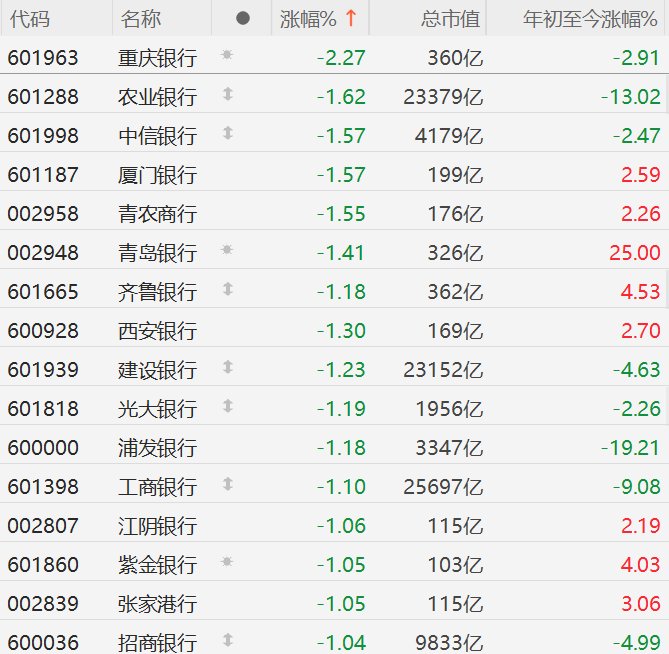
Core Viewpoint - The A-share market for banks experienced a collective decline, with several banks showing significant drops in their stock prices on February 12 [1] Group 1: Stock Performance - Chongqing Bank saw a decline of 2.27%, with a total market value of 36 billion [2] - Agricultural Bank dropped by 1.62%, with a market capitalization of 2,337.9 billion [2] - CITIC Bank decreased by 1.57%, with a market value of 417.9 billion [2] - Xiamen Bank fell by 1.57%, with a market capitalization of 19.9 billion [2] - Qingnong Commercial Bank declined by 1.55%, with a market value of 17.6 billion [2] - Qingdao Bank decreased by 1.41%, with a market capitalization of 32.6 billion [2] - Qilu Bank fell by 1.18%, with a market value of 36.2 billion [2] - Xi'an Bank dropped by 1.30%, with a market capitalization of 16.9 billion [2] - China Construction Bank decreased by 1.23%, with a market value of 23,152 billion [2] - Everbright Bank fell by 1.19%, with a market capitalization of 195.6 billion [2] - Pudong Development Bank decreased by 1.18%, with a market value of 334.7 billion [2] - Industrial and Commercial Bank dropped by 1.10%, with a market capitalization of 25,697 billion [2] - Jiangyin Bank fell by 1.06%, with a market value of 11.5 billion [2] - Zijin Bank decreased by 1.05%, with a market capitalization of 10.3 billion [2] - Zhangjiagang Bank fell by 1.05%, with a market value of 11.5 billion [2] - China Merchants Bank decreased by 1.04%, with a market capitalization of 983.3 billion [2] Group 2: Year-to-Date Performance - Chongqing Bank has a year-to-date decline of 2.91% [2] - Agricultural Bank has seen a year-to-date drop of 13.02% [2] - CITIC Bank's year-to-date decline is 2.47% [2] - Xiamen Bank has a year-to-date increase of 2.59% [2] - Qingnong Commercial Bank's year-to-date increase is 2.26% [2] - Qingdao Bank has a significant year-to-date increase of 25.00% [2] - Qilu Bank has a year-to-date increase of 4.53% [2] - Xi'an Bank's year-to-date increase is 2.70% [2] - China Construction Bank has a year-to-date decline of 4.63% [2] - Everbright Bank's year-to-date decline is 2.26% [2] - Pudong Development Bank has a significant year-to-date decline of 19.21% [2] - Industrial and Commercial Bank has a year-to-date decline of 9.08% [2] - Jiangyin Bank has a year-to-date increase of 2.19% [2] - Zijin Bank's year-to-date increase is 4.03% [2] - Zhangjiagang Bank has a year-to-date increase of 3.06% [2] - China Merchants Bank has a year-to-date decline of 4.99% [2]


A股银行股集体下跌,重庆银行跌超2%
Ge Long Hui A P P· 2026-02-12 02:25
Group 1 - The A-share market saw a collective decline in bank stocks, with Chongqing Bank dropping over 2% and several other banks, including Agricultural Bank, CITIC Bank, and Xiamen Bank, falling more than 1% [1] - Chongqing Bank's stock decreased by 2.27%, with a total market capitalization of 36 billion and a year-to-date decline of 2.91% [2] - Agricultural Bank's stock fell by 1.62%, with a market cap of 2,337.9 billion and a year-to-date decline of 13.02% [2] Group 2 - CITIC Bank's stock decreased by 1.57%, with a market capitalization of 417.9 billion and a year-to-date decline of 2.47% [2] - Xiamen Bank's stock also fell by 1.57%, with a market cap of 19.9 billion and a year-to-date increase of 2.59% [2] - Qingnong Commercial Bank's stock dropped by 1.55%, with a market cap of 17.6 billion and a year-to-date increase of 2.26% [2] Group 3 - Other banks such as Qilu Bank, Xi'an Bank, and China Construction Bank experienced declines of 1.18% to 1.30%, with respective market caps of 36.2 billion, 16.9 billion, and 23,152 billion [2] - The stock of Industrial and Commercial Bank fell by 1.10%, with a market cap of 25,697 billion and a year-to-date decline of 9.08% [2] - China Merchants Bank's stock decreased by 1.04%, with a market cap of 98.33 billion and a year-to-date decline of 4.99% [2]
银行板块午后震荡上涨,青岛银行涨近2%
Mei Ri Jing Ji Xin Wen· 2026-02-11 06:32
Core Viewpoint - The banking sector experienced a volatile afternoon with notable gains, particularly for several banks including Qingdao Bank, Qilu Bank, Nanjing Bank, Zijin Bank, Chongqing Rural Commercial Bank, and Agricultural Bank, which all saw increases in their stock prices [1] Group 1 - Qingdao Bank rose nearly 2% [1] - Qilu Bank, Nanjing Bank, Zijin Bank, Chongqing Rural Commercial Bank, and Agricultural Bank all increased by over 1% [1]

A股银行股普涨,渝农商行涨超1%
Ge Long Hui· 2026-02-11 06:09
Group 1 - The A-share market saw a general rise in bank stocks, with notable increases in Qingdao Bank, Qilu Bank, Nanjing Bank, Zijin Bank, and Chongqing Rural Commercial Bank, all rising over 1% [1]
10家银行跨入10万亿俱乐部
21世纪经济报道· 2026-02-10 09:08
Core Viewpoint - A-share listed banks have shown positive growth in net profit for 2025, with all 11 banks reporting an increase, and four banks achieving double-digit growth, led by Qingdao Bank at 21.66% [1][5]. Group 1: Financial Performance - Qingdao Bank reported a net profit of 518.77 million yuan, up from 426.41 million yuan, marking a growth rate of 21.66% [2]. - Qilu Bank and Hangzhou Bank followed with net profit growth rates of 14.58% and 12.05%, respectively [5]. - In terms of total assets, China Merchants Bank leads with 13.07 trillion yuan, a year-on-year increase of 7.56% [4]. - The overall asset quality of the banks remains stable, with most banks reporting a decrease or stability in non-performing loan ratios [5][6]. Group 2: Revenue Trends - Revenue growth among the banks is varied, with only CITIC Bank experiencing a slight decline of 0.55% [4]. - Nanjing Bank led in revenue growth with a 10.48% increase, while Ningbo Bank and Qingdao Bank reported increases of 8.01% and 7.97%, respectively [4][5]. - The overall revenue growth for A-share listed banks is expected to improve in 2025, driven by narrowing interest margins and increased impairment contributions [9]. Group 3: Market Outlook - Analysts are cautiously optimistic about the banking sector's performance in 2026, with expectations of stable credit growth and improved profitability [9][10]. - The investment focus for 2026 includes identifying banks with potential for growth, particularly Ningbo Bank and China Merchants Bank, and those with convertible bond expectations like Industrial Bank [10]. - The overall market capitalization of the banking sector has surpassed 15 trillion yuan, reflecting a significant increase from the previous year [6].


上市银行2025年年报: 业绩增速有望稳中向好,资产质量持续优化
2026-02-10 03:24
Summary of Conference Call on Banking Sector Outlook Industry Overview - The conference focused on the banking sector, specifically discussing the performance and outlook of 11 listed banks in China for the year 2025 and beyond [1][6]. Key Points and Arguments 1. Overall Performance of Banks - The performance of the 11 banks exceeded expectations, indicating a robust resilience in the banking sector [1][6]. - The net interest margin (NIM) showed signs of stabilization, with a narrowing year-on-year decline contributing significantly to interest income and revenue growth [1][2]. 2. Sensitivity of Interest Income - Interest income is highly sensitive to changes in NIM; a decrease of 10 basis points (BP) in NIM could reduce net interest income growth by 7 percentage points, while a 5 BP decrease would result in a 3.5 percentage point reduction [2]. 3. Fee Income Recovery - There has been a recovery in fee income due to improved capital market conditions and asset allocation by residents, leading to a continuous improvement in bank fees [2][4]. 4. Potential for Old Bond Gains - The banks hold significant unrealized gains on old bonds, which presents a substantial opportunity for realization [3]. 5. Positive Outlook for 2026 - The overall judgment is that the situation in 2026 will be better than in 2025, driven by stable basis points, improving fees, and gains from old bonds [3]. 6. Investment Perspective - The investment strategy focuses on absolute returns, targeting a return on equity (ROE) of around 13% and a price-to-book (PB) ratio of 0.67 times, indicating a reasonable pricing range [3][4]. - The recommendation is to select stocks based on high growth and high dividend yield, particularly in regions like Jiangsu, Nanjing, and Qilu [4][5]. 7. Performance of Specific Banks - Notable banks such as China Merchants Bank and Industrial Bank showed positive revenue growth, with some banks transitioning from negative to positive growth [6][7]. - City commercial banks like Nanjing Bank and Qingdao Bank reported double-digit revenue growth, indicating strong performance [7][10]. 8. Asset Quality and Non-Performing Loans (NPLs) - The asset quality remains stable, with many banks reporting a decrease in NPL ratios. For instance, Qingdao Bank's NPL ratio dropped significantly [10][11]. - The overall trend suggests a gradual improvement in asset quality, with expectations for continued stability in 2026 [11][12]. 9. Credit Growth and Demand - Credit growth is expected to remain strong, particularly in major provinces like Sichuan and Jiangsu, which reported credit growth rates above 8% [12][13]. - The demand for corporate loans remains robust, while retail loan demand is weaker [12]. 10. Future Risks and Projections - There are concerns regarding the potential exposure of retail loans, particularly in mortgage and consumer credit segments, but the overall increase in NPLs is expected to be limited [16][17]. - Projections for 2025 indicate a slight increase in NPL ratios for retail loans, but overall asset quality is expected to remain stable [17][18]. 11. Revenue Growth Expectations - The banking sector is projected to achieve a revenue growth rate of approximately 1.2% year-on-year, with city commercial banks leading in net profit growth [19][20]. 12. Stock Selection Strategy - The stock selection strategy emphasizes high ROE and high dividend yield, with recommendations for both Hong Kong and A-share listed banks [20][21]. Additional Important Insights - The conference highlighted the importance of wealth management in driving fee income, with expectations for continued positive contributions to revenue [19]. - The overall sentiment is optimistic regarding the banking sector's ability to navigate challenges and capitalize on growth opportunities in the coming years [22].


