Bank Of Chongqing(601963)

Search documents
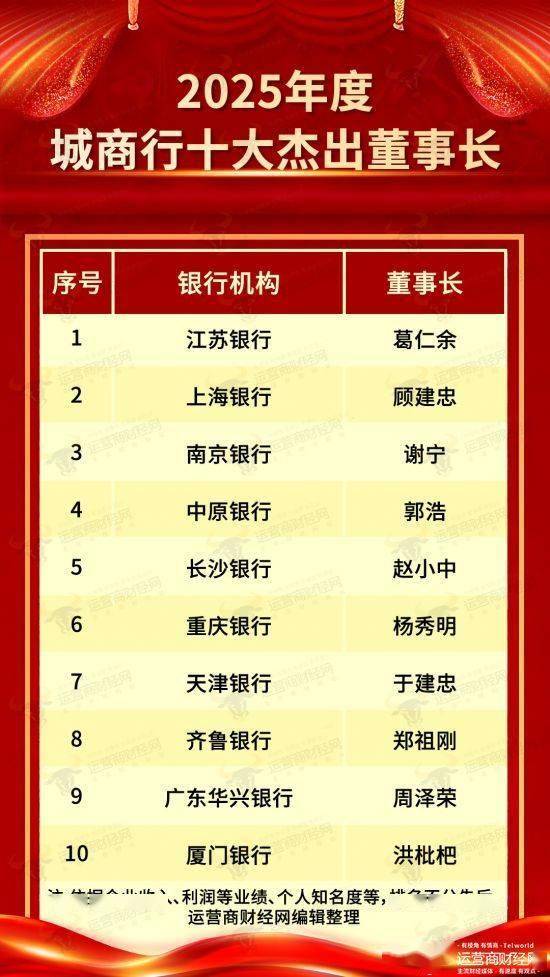
运营商财经网正式推出“2025年度城商行十大杰出董事长”榜单 为业界独家
Sou Hu Cai Jing· 2025-12-16 09:24
Core Viewpoint - The article announces the launch of the "Top Ten Outstanding Chairmen of City Commercial Banks for 2025" list by a well-known financial media platform, focusing on the comprehensive performance of major city commercial banks in China and highlighting key figures from these institutions [1]. Group 1: List of Outstanding Chairmen - The list includes the following chairmen: - Ge Renyu from Jiangsu Bank - Gu Jianzhong from Shanghai Bank - Xie Ning from Nanjing Bank - Guo Hao from Zhongyuan Bank - Zhao Xiaozhong from Changsha Bank - Yang Xiuming from Chongqing Bank - Yu Jianzhong from Tianjin Bank - Zheng Zugang from Qilu Bank - Zhou Zerong from Guangdong Huaxing Bank - Hong Pipa from Xiamen Bank [2][3]. Group 2: Evaluation Criteria - The evaluation for the list considered multiple factors, including the annual revenue, net profit, and performance scale of the banks for 2025, as well as the significant contributions and achievements of the executives [3]. - The rankings are not absolute and do not serve any commercial purpose; they aim to recognize outstanding companies and their leaders for their performance in 2025 [3].




深耕绿色金融结硕果,重庆银行获评GF60最佳可持续金融机构
Jin Rong Jie· 2025-12-16 02:21
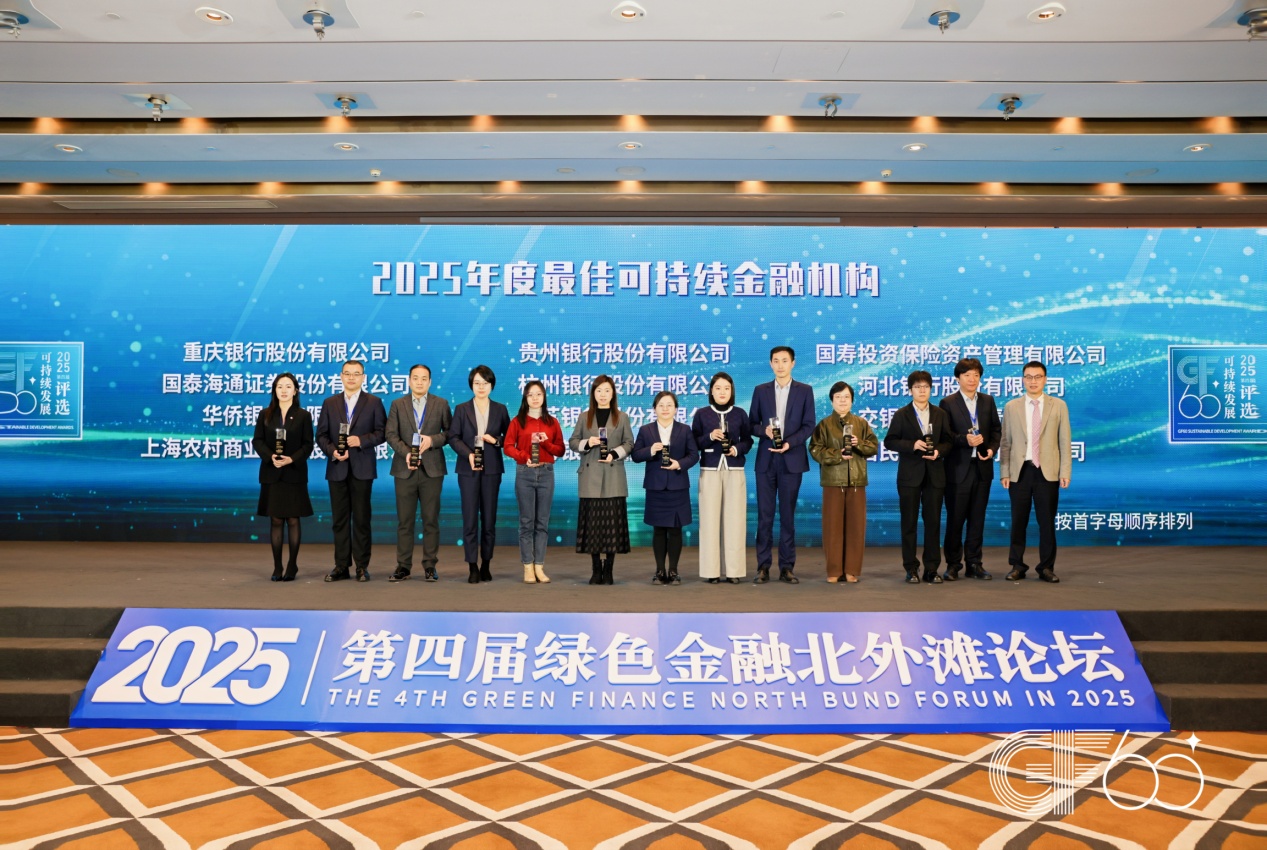
在经营层面,重庆银行将ESG治理深度融入发展战略,率先研发中西部法人银行首个ESG数字化评级系统,实现信贷资产质量全流程优化。通过气候风险压 力测试等工具,持续强化环境风险管理,同步推进绿色运营与数字化转型,不断提升资源使用效率与经营韧性。 责任编辑:栎树 在社会贡献方面,重庆银行积极服务长江经济带绿色发展,助力西部地区筑牢国家生态安全屏障,扎实书写"绿色金融"等五篇大文章,推动经济效益与社会 价值的协同共赢。截至当前,该行绿色金融业务规模已接近千亿元,并连续五年保持年均30%以上的高速增长,展现出强劲的发展动能。 (图说)GF60年度最佳可持续金融机构颁奖现场 12月11日,第四届绿色金融北外滩论坛于上海召开。重庆银行凭借在绿色金融与可持续发展领域的突出表现,获评"最佳可持续金融机构"。值得关注的是, 这已是该行连续第二年荣获GF60奖项——继2024年入选"绿色金融最佳实践案例"后再次获得认可,彰显其在该领域的持续影响力。 重庆银行相关负责人表示,此次获奖是对重庆银行坚定不移推进可持续发展银行战略、深耕绿色金融实践的再次肯定。面向未来,重庆银行将继续以"双 碳"目标为引领,全面融入重庆市绿色金融改革创新试 ...
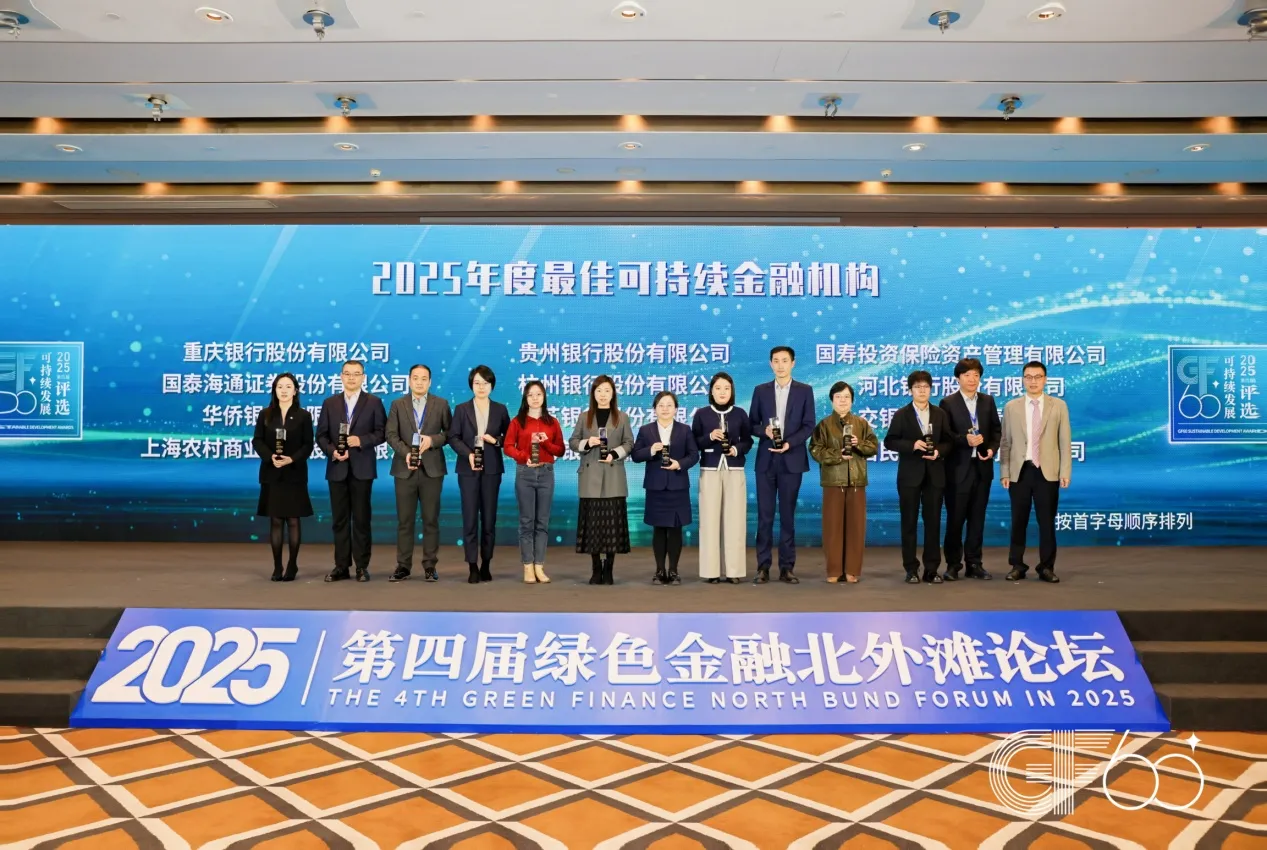
重庆银行荣膺GF60 “最佳可持续金融机构”
Cai Jing Wang· 2025-12-16 01:53
Group 1 - The core viewpoint of the news is that Chongqing Bank has been recognized as the "Best Sustainable Financial Institution" for the second consecutive year at the GF60 awards, highlighting its ongoing influence in the field of green finance and sustainable development [1][4]. Group 2 - The GF60 platform, initiated by financial regulatory bodies, institutions, industry leaders, and academia, aims to promote international exchange and cooperation in green finance, focusing on the actual actions and contributions of financial institutions towards environmental issues [3]. - Chongqing Bank has established a foundational product system around the "green" theme, including "green credit, green bonds, green consumption, and green leasing," and has developed over 20 specialized products covering energy saving, pollution reduction, carbon reduction, and greening [3]. - The bank has pioneered several innovative financial products, such as "Industrial Green Efficiency Loan" and "Collective Forest Land Management Rights + Ecological Product Value Mortgage Loan," contributing to urban low-carbon development and ecological construction [3]. Group 3 - Chongqing Bank integrates ESG governance into its development strategy and has developed the first ESG digital rating system for a legal bank in the central and western regions, optimizing the entire process of credit asset quality [4]. - The bank's green finance business scale has approached 100 billion yuan, maintaining an annual growth rate of over 30% for five consecutive years, demonstrating strong development momentum [4]. - Looking ahead, Chongqing Bank aims to continue contributing to the green low-carbon transition of the economy and society, guided by the "dual carbon" goals and actively participating in the construction of the Chongqing Green Finance Reform and Innovation Pilot Zone [4].
重庆银行(01963) - 二零二五年季度股息-股息货币选择表格
2025-12-15 22:58
Registered shareholders will automatically receive their cash dividends in Hong Kong dollars unless they elect to receive them in Renminbi. No action is required if you wish to receive your cash dividends in Hong Kong dollars. + CCS3700 BCQH + NAME(S) AND ADDRESS OF REGISTERED SHAREHOLDER(S) 登記股東之姓名及地址 DIVIDEND CURRENCY ELECTION FORM FOR QUARTER DIVIDEND FOR THE NINE MONTHS ENDED 30 SEPTEMBER 2025 OF RMB 1.684 PER 10 SHARE ("2025 QUARTER DIVIDEND") 截至 2025 年 9 月 30 日止九個月之季度股息每 10 股人民幣 1.684 元(「2025 年季度股息」) ...
市场回调原因或已找到!商业航天持续强势,国防军工ETF上探1.54%创2个月新高!机构:跨年行情可期!
Xin Lang Cai Jing· 2025-12-15 11:53
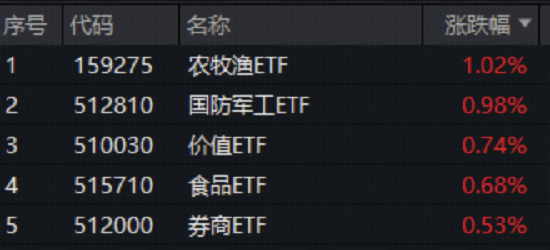
Market Overview - The A-share market experienced a collective pullback, with the ChiNext Index leading the decline at 1.77%. The total trading volume in the Shanghai and Shenzhen markets was 1.77 trillion yuan, a decrease of 318.8 billion yuan from the previous trading day [1][22]. - Despite the overall market decline, sectors such as commercial aerospace and satellite internet remained strong, with the Aerospace Electronics stock hitting a historical high and the National Defense and Military Industry ETF (512810) rising by 1.54%, reaching a two-month high [1][6]. Sector Performance - The National Defense and Military Industry ETF (512810) saw significant inflows, with a net inflow of 6.181 billion yuan, the highest among 31 first-tier industries, and a total of 19.778 billion yuan over the past five days [28][29]. - The Food ETF (515710) also showed resilience, with a peak increase of 1.36% during the day and a total inflow of 65.61 million yuan over the past five days, driven by a recovery in liquor prices, particularly for Moutai [1][33]. - The brokerage sector is expected to distribute nearly 9 billion yuan in dividends, with 80% of listed brokerages planning at least two dividend distributions this year [1][22]. Investment Strategies - Analysts suggest focusing on three key areas for investment: growth sectors benefiting from industrial policy support (e.g., domestic production, robotics, aerospace), cyclical sectors benefiting from "anti-involution" policies (e.g., chemicals, energy metals), and consumer sectors that may see a boost from deepened consumption policies [25]. - The National Defense and Military Industry sector is rated as "overweight" by institutions, with a focus on core assets in commercial aerospace, low-altitude economy, and military AI [30][32]. Future Outlook - The market sentiment is supported by recent meetings of the Federal Reserve and domestic policy-making bodies, which align with market expectations. Historical data suggests that the A-share market tends to perform well in the first year of the 13th and 14th Five-Year Plans, indicating potential for a strong cross-year market [24][25]. - The banking sector is also positioned for recovery, with all 42 listed banks currently trading below their net asset value, suggesting a potential for valuation recovery [19].





城商行板块12月15日涨0.65%,重庆银行领涨,主力资金净流入1.49亿元
Zheng Xing Xing Ye Ri Bao· 2025-12-15 09:08
从资金流向上来看,当日城商行板块主力资金净流入1.49亿元,游资资金净流出1.59亿元,散户资金净 流入994.98万元。城商行板块个股资金流向见下表: 以上内容为证券之星据公开信息整理,由AI算法生成(网信算备310104345710301240019号),不构成投资建议。 证券之星消息,12月15日城商行板块较上一交易日上涨0.65%,重庆银行领涨。当日上证指数报收于 3867.92,下跌0.55%。深证成指报收于13112.09,下跌1.1%。城商行板块个股涨跌见下表: ...

2025年11月金融数据点评:信贷仍弱反映稳内需必要性,M1延续回落
Shenwan Hongyuan Securities· 2025-12-14 14:29
Investment Rating - The report maintains an "Overweight" rating for the banking industry, indicating a positive outlook compared to the overall market performance [4][25]. Core Insights - The report highlights a slowdown in credit growth, with November's new social financing at 2.5 trillion yuan, a year-on-year decrease of 159.7 billion yuan, and new loans of 390 billion yuan, down 190 billion yuan year-on-year. The M1 money supply grew by 4.9%, while M2 increased by 8.0%, both showing a decline in growth rates compared to the previous month [1][4]. - The report anticipates that while credit growth may not accelerate significantly, the central bank's commitment to a "moderately loose monetary policy" and support for banks' net interest margins will likely lead to improved revenue for the banking sector in 2026 [4][2]. - Retail demand remains under pressure, with a net decrease in household credit of nearly 206 billion yuan in November, reflecting ongoing deleveraging among consumers. The report suggests that a recovery in retail demand will depend on improvements in household income [4][2]. Summary by Sections Credit and Financing - In November, new loans totaled 390 billion yuan, a year-on-year decrease of 190 billion yuan, with total new loans from January to November at 15.4 trillion yuan, down 1.7 trillion yuan year-on-year. The growth rate of RMB loans remained stable at 6.3% [4][1]. - The report notes that corporate loans saw a slight increase, with 270 billion yuan in new loans, while the issuance of corporate bonds and off-balance-sheet financing provided support against government debt and credit drag [4][7]. Monetary Supply - The M1 money supply grew by 4.9% year-on-year, down from 7.1% in the previous year, while M2 increased by 8.0%, showing a slight decline in growth rates [4][8]. - The report indicates that the decrease in deposits reflects a shift in non-bank deposits, which is closely related to the activity in the equity market [4][8]. Future Outlook - The report expresses optimism for 2026, expecting that the focus on corporate lending will continue, and improvements in the Producer Price Index (PPI) may enhance corporate profitability, positively impacting bank earnings [4][2]. - The report emphasizes the importance of monitoring the effectiveness of stimulus policies aimed at boosting domestic demand, which could lead to a more favorable environment for banks [4][2].






公募销售新规落地,政银绑定深化下银行扩表动能有望复苏
Western Securities· 2025-12-14 12:55
Investment Rating - The report indicates a positive outlook for the insurance sector, recommending specific companies such as China Pacific Insurance, China Ping An, China Life (H), and China Taiping, while also recommending New China Life Insurance [4][17]. Core Insights - The financial industry experienced a mixed performance, with the non-bank financial index rising by 0.81%, outperforming the CSI 300 index by 0.89 percentage points. The insurance sector showed a notable increase of 2.36%, while the banking sector declined by 1.77% [2][11]. - The central economic work conference emphasized a proactive fiscal policy, which is expected to benefit the insurance sector by increasing infrastructure asset supply and improving credit risk perceptions [14][15]. - The report highlights the potential for valuation recovery in the brokerage sector, driven by regulatory changes that align public fund interests with long-term investor returns [18][19]. Summary by Sections 1. Weekly Performance and Sector Insights - The non-bank financial index rose by 0.81%, with the insurance sector outperforming the CSI 300 index by 2.44 percentage points [2][11]. - The banking sector underperformed, with a decline of 1.77%, attributed to macroeconomic policy expectations [3][21]. 2. Insurance Sector Data Tracking - The insurance sector's premium income showed steady growth, with life insurance and property insurance premiums increasing by 9.6% and 4.0% year-on-year, respectively [17][26]. - The report notes that the 10-year government bond yield decreased to 1.84%, which is favorable for the insurance sector's investment strategies [31]. 3. Brokerage Sector Data Tracking - The brokerage sector's PB valuation stands at 1.37x, indicating potential for valuation recovery as earnings improve [19][42]. - Regulatory changes in public fund sales are expected to enhance the industry's focus on long-term investor interests [18][19]. 4. Banking Sector Data Tracking - The banking sector's PB valuation is at 0.54x, suggesting it remains undervalued [21][25]. - The central economic work conference's focus on domestic demand and flexible monetary policy is expected to support the banking sector's growth [22][23].




消费贷贴息“版图”扩大!多家中小银行接棒送福利,消费者怎么享优惠?
Bei Jing Shang Bao· 2025-12-14 11:51
Core Insights - The article discusses the ongoing expansion of consumer loan interest subsidy policies in China, particularly focusing on the inclusion of regional small and medium-sized banks in the implementation of these policies [1][3][4]. Policy Expansion - Since December, regions such as Sichuan, Chongqing, and Guizhou have rapidly introduced supporting policies that allow regional small and medium-sized banks to participate in consumer loan interest subsidies, thereby broadening the policy's coverage [3][4]. - The policy's origin dates back to August, when the Ministry of Finance, the People's Bank of China, and the financial regulatory authority issued a plan to implement personal consumer loan interest subsidies, designating major national banks as core implementing institutions while encouraging local governments to support other financial institutions [3][4]. Implementation Details - The implementation of these policies has accelerated, with a joint notice issued on December 14 emphasizing the need for collaboration between finance and commerce to boost consumption through various financial mechanisms [3][4]. - Specific policies have been launched, such as Sichuan's initiative to provide a 1% annual interest subsidy for personal consumer loans used for local consumption, effective from October 1, 2025, to March 31, 2026 [4][5]. Regional Bank Participation - Multiple regional banks, including Sichuan Rural Commercial Bank and Chongqing Bank, have announced their participation in the consumer loan interest subsidy program, indicating a significant expansion of the policy's reach [6][7]. - The subsidy standards align with national guidelines but exhibit variations in execution periods, subsidy limits, and application processes among different banks [6][7]. Consumer Guidance - Consumers are advised to focus on four key points when utilizing these policies: ensuring compliance with local consumption requirements, assessing personal financial capabilities, understanding application details, and aligning consumption plans with subsidy limits [8]. - The article suggests that the model of expanding consumer loan interest subsidies at the local level may be promoted nationwide, providing opportunities for small and medium-sized banks while effectively stimulating regional consumption [8].
银行周报(2025/12/8-2025/12/12):11月社融数据:社融增速磨底,对公贷款延续短期化特征-20251214
GUOTAI HAITONG SECURITIES· 2025-12-14 02:34
Investment Rating - The report assigns an "Overweight" rating to the banking sector [6] Core Insights - The growth rate of social financing is stabilizing, with a year-on-year increase of 8.5% in November 2025, remaining unchanged from the previous month. Excluding government bonds, the growth rate is 6.0%, which is an increase of 0.1 percentage points from the previous month [6] - New social financing in November amounted to 2.49 trillion yuan, a year-on-year increase of 159.7 billion yuan, primarily supported by corporate bond issuance, while credit and government bonds showed negative growth [6] - The report highlights a trend of short-term borrowing among enterprises, with corporate loans increasing by 610 billion yuan, a year-on-year increase of 360 billion yuan [6][4] Summary by Sections 1. Social Financing Data - In November, the total social financing growth rate was 8.5%, with a new social financing addition of 2.49 trillion yuan, up 159.7 billion yuan year-on-year. The growth rate excluding government bonds was 6.0% [6][2] - Corporate bond financing net increased by 416.9 billion yuan, a year-on-year increase of 178.8 billion yuan, primarily driven by state-owned enterprises [6][4] 2. Credit and Loan Trends - The report indicates a weak increase in credit, with November's RMB loan growth rate at 6.4%, down 0.1 percentage points from the previous month. New loans for the month totaled 390 billion yuan, a year-on-year decrease of 190 billion yuan [6] - Personal loans decreased by 206.3 billion yuan, with short-term loans down by 215.8 billion yuan year-on-year, indicating pressure on both short-term and medium-to-long-term loans [4][6] 3. Deposit Trends - RMB deposit growth rate in November was 7.7%, down 0.3 percentage points from the previous month, with new deposits amounting to 1.41 trillion yuan, a year-on-year decrease of 760 billion yuan [6] - The report notes a slowdown in deposit migration, with corporate deposits increasing by 645.3 billion yuan, a year-on-year decrease of 94.7 billion yuan [6][4] 4. Investment Recommendations - The report suggests focusing on three investment themes: identifying banks with potential for performance growth, emphasizing banks with convertible bond expectations, and continuing dividend strategies [6]