Sugon(603019)

Search documents
中科曙光:2025年度中期拟差异化分红超1亿元
Xin Lang Cai Jing· 2026-01-29 10:53
Group 1 - The company announced a plan to repurchase shares for equity incentives, with a budget of 20 to 30 million yuan [1] - As of September 30, 2025, the total share capital of the company is 1.463 billion shares, with 784,000 shares repurchased, leaving 1.462 billion shares eligible for profit distribution [1] - The company intends to distribute a cash dividend of 0.70 yuan (including tax) for every 10 shares, totaling 102 million yuan (including tax) [1] Group 2 - The company stated that any changes in total share capital during the equity distribution registration period will not affect the per-share distribution ratio, but will adjust the total distribution amount accordingly [1] - Legal experts believe that the differentiated dividend distribution is compliant and will have a minimal impact on the ex-dividend reference price [1]

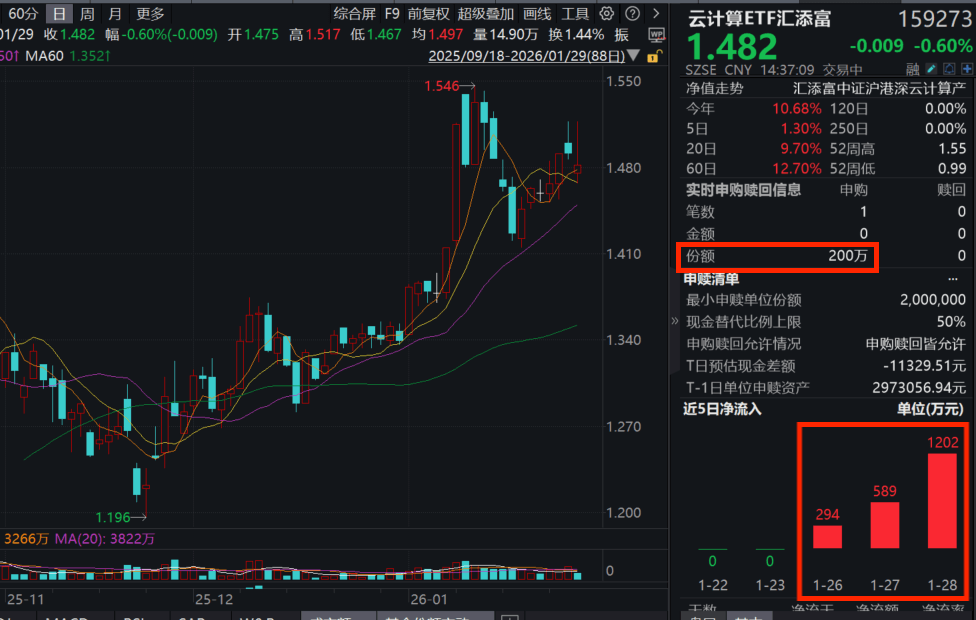
Clawdbot爆火,阿里云、腾讯云支持部署!云计算ETF汇添富(159273)连续4日吸金!机构:算力产业链通胀有望延续,驱动利润改善!
Sou Hu Cai Jing· 2026-01-29 07:35
Group 1 - The core viewpoint of the articles highlights the increasing demand for AI-driven cloud computing services, leading to a tightening supply-demand dynamic in the computing power sector, which is reflected in rising prices from major cloud providers [8][11]. - The "算力ETF" (Computing Power ETF) has seen significant inflows, with over 1.4 billion yuan accumulated in the last ten days, indicating strong investor interest in the sector [1]. - Major tech companies like Microsoft, Meta, and others have reported impressive cloud revenue, with Microsoft achieving $50 billion in cloud revenue for the second fiscal quarter, surpassing analyst expectations [4]. Group 2 - Clawdbot, an open-source AI assistant, has gained significant attention, with deployment support from Tencent Cloud and Alibaba Cloud, indicating a shift towards more personalized AI applications [3][6]. - The pricing strategies of leading cloud providers, such as Google and AWS, have been adjusted upwards, reflecting the increased costs associated with AI training and inference demands [8][9]. - The computing power supply chain is experiencing inflation, with projections indicating significant price increases for DRAM and NAND storage, as well as CPU products, driven by AI demand [9][10]. Group 3 - The rapid growth in token usage for AI models, particularly from OpenAI and Google, suggests a burgeoning market for AI applications across various sectors, with daily token calls reaching unprecedented levels [10]. - The anticipated rise in AI model applications is expected to further drive demand for computing resources, benefiting companies involved in hardware, cloud services, and AI development [11]. - The computing power ETF, 汇添富 (159273), is positioned to capture the growth opportunities in the AI-driven cloud computing market, covering a wide range of sectors including hardware, IT services, and data center operations [12].


字节已开启豆包手机助手正式版项目,AI人工智能ETF(512930)日均成交2.41亿
Xin Lang Cai Jing· 2026-01-29 05:48
Group 1 - The core viewpoint of the news highlights the performance of the AI-themed index and ETF, with notable gains in specific stocks like iFlytek and Kunlun Wanwei, while the AI ETF shows significant trading volume and growth in assets [1][2] - As of January 28, the AI-themed ETF has a total asset size of 34.06 billion yuan, with a recent increase of 2.24 million shares over the past six months, indicating strong investor interest [1][2] - The AI-themed index consists of 50 companies involved in providing resources, technology, and application support for artificial intelligence, with the top ten stocks accounting for 58.08% of the index [2] Group 2 - The storage chip supply tightness and price increases driven by the AI infrastructure boom are expected to persist until 2027, potentially leading to a systematic upcycle in the chip industry [2] - Domestic chip manufacturers are expected to raise prices, reflecting enhanced pricing power and accelerated localization, which may improve gross margins and cash flow, supporting R&D and expansion [2] - The AI ETF closely tracks the performance of the AI-themed index, which is designed to reflect the overall performance of listed companies in the AI sector [2]




中科曙光:公司2025年中期现金分红议案已经董事会审议通过
Zheng Quan Ri Bao· 2026-01-28 11:44
Group 1 - The company, Zhongke Shuguang, announced that its cash dividend proposal for the mid-2025 period has been approved by the board of directors [2] - The specific implementation date for the dividend distribution will be clarified in a future announcement regarding equity distribution [2]
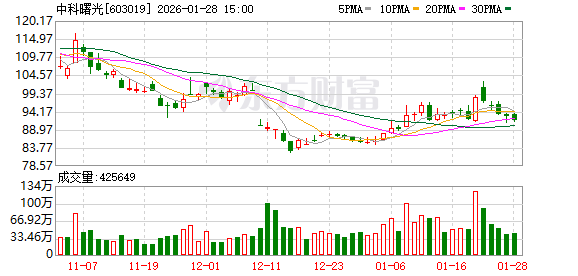
中科曙光股价连续4天下跌累计跌幅5.55%,中信保诚基金旗下1只基金持10.9万股,浮亏损失59.39万元
Xin Lang Cai Jing· 2026-01-27 07:17
Group 1 - The core point of the news is that Zhongke Shuguang's stock has been declining for four consecutive days, with a total drop of 5.55% during this period, currently trading at 92.78 yuan per share and a market capitalization of 135.748 billion yuan [1] - Zhongke Shuguang, established on March 7, 2006, and listed on November 6, 2014, specializes in high-performance computing, general servers, and storage products, with 88.79% of its revenue coming from IT equipment [1] - The company also provides software development, system integration, and technical services, contributing 11.15% to its revenue, while other sources account for 0.06% [1] Group 2 - From the perspective of major fund holdings, CITIC Prudential Fund has a significant position in Zhongke Shuguang, with its CITIC Prudential CSI Information Security Index (LOF) A fund reducing its holdings by 6.46 thousand shares, now holding 10.9 thousand shares, which represents 3.98% of the fund's net value [2] - The fund has experienced a floating loss of approximately 49 thousand yuan today and a total floating loss of 593.9 thousand yuan during the four-day decline [2] - The CITIC Prudential CSI Information Security Index (LOF) A fund was established on January 1, 2021, with a current size of 172 million yuan, and has returned 8.78% this year, ranking 1803 out of 5548 in its category [2]
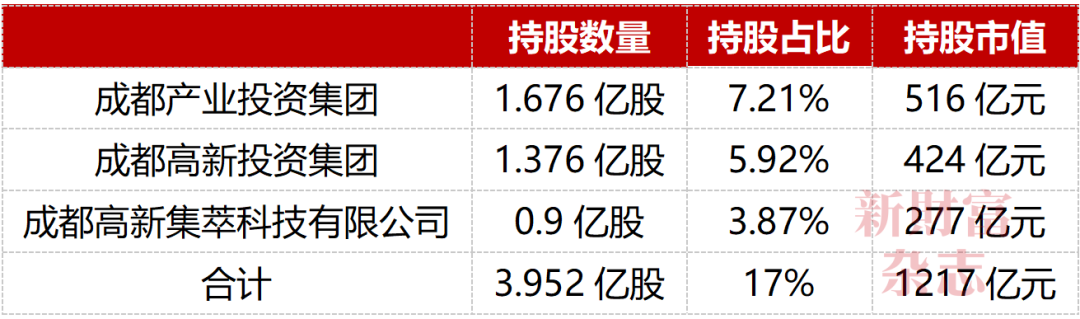
8亿投资海光信息,豪赚1200亿,成都国资跻身“最强捕手”
Zheng Quan Shi Bao Wang· 2026-01-26 12:23
Core Insights - Chengdu's government venture capital investment in Haiguang Information has yielded over 120 billion yuan in returns, establishing a new benchmark for local state-owned investment [1][2][3] - The investment has transformed Haiguang Information into a 700 billion yuan domestic CPU giant, showcasing the potential of government-backed investments in strategic emerging industries [1][2][3] Investment Performance - Chengdu's state-owned enterprises invested 8.125 billion yuan in Haiguang Information, which has now a market value exceeding 121.7 billion yuan, representing a return of over 150 times [2][3][4] - The investment has generated significant financial returns, with Chengdu's state-owned enterprises having already recouped their initial investment through previous share sales [2][3][4] Strategic Implications - The success of Haiguang Information illustrates the effectiveness of government venture capital in driving local economic growth, job creation, and tax revenue [1][2][3] - Chengdu's model of "investment—appreciation—financing—investment" may serve as a reference for other local governments seeking to enhance their industrial landscape [1][2][3] Company Development - Haiguang Information, originally established in Tianjin, relocated to Chengdu after receiving investment from Chengdu's government, which facilitated its growth and development in the CPU sector [10][11][12] - The company has become the only domestic enterprise with x86 processor technology authorization, further solidifying its position in the semiconductor industry [12][13] Financial Restructuring - Chengdu's investment has positively impacted the financial statements of its state-owned enterprises, allowing them to maintain profitability despite challenges in other sectors [18][21] - The increase in the market value of Haiguang Information has enabled Chengdu's state-owned enterprises to issue bonds and secure financing for further investments [21][23] Industry Impact - Chengdu has emerged as a significant hub for semiconductor companies, with over 400 integrated circuit enterprises established, contributing to a growing industry scale [24] - The success of Haiguang Information has positioned Chengdu as a key player in the national semiconductor landscape, influencing local and regional economic strategies [24]

CPU涨价会持续多久
2026-01-26 02:50
Summary of Conference Call Notes Industry and Company Involved - The discussion primarily revolves around the **CPU** industry, particularly focusing on **x86** and **ARM** architectures, with mentions of major players like **Intel**, **AMD**, and cloud service providers such as **Alibaba Cloud** and **Tencent Cloud**. [1][2][4][24] Core Points and Arguments 1. **Demand Growth for CPUs**: The demand for CPUs is expected to grow exponentially, driven by three linear factors rather than a simple linear increase. High-performance x86 and ARM architectures will benefit from this trend. [1][21] 2. **Impact of AI and Agents**: The rise of AI agents is significantly driving CPU demand. The increase in agent numbers and their complexity is leading to higher CPU utilization, as evidenced by various workloads where CPU tasks dominate processing time. [4][6][13] 3. **Price Increases**: CPU prices are anticipated to rise steadily over the next year, although not as dramatically as storage prices. This increase is viewed as a healthy adjustment for the industry. [14][21] 4. **Supply Chain Constraints**: The supply of CPUs is constrained by production capacity issues, particularly for advanced nodes (3nm and 5nm) at foundries like TSMC. This is leading to a competitive environment for resources between CPUs and GPUs. [20][21] 5. **Cloud Service Pricing**: The rising costs of CPUs and storage are expected to be passed on to cloud service providers, leading to potential price increases for services offered by companies like Alibaba and Tencent. [22][24] 6. **Server Manufacturers**: Companies involved in server manufacturing, such as Inspur and Huqian, are expected to experience increased demand and flexibility due to the rising CPU prices. [2][25] 7. **Investment Opportunities**: Key investment opportunities are identified in domestic companies like **Haiguang Information** and **Zhongke Shuguang**, as well as international firms like **AMD** and **Intel**. [24][25] Other Important but Possibly Overlooked Content 1. **Agent Workloads**: Detailed analysis of agent workloads shows that CPU tasks can account for up to 90% of processing delays, indicating a critical need for CPU resources in AI applications. [7][11] 2. **Batch Size and Performance**: Increasing batch sizes in processing tasks can lead to diminishing returns in throughput and increased CPU context-switching bottlenecks, highlighting the need for efficient CPU management in AI workloads. [10][11] 3. **Long-term Trends**: The transition to a new paradigm in AI processing, where CPU tasks are more prominent due to the nature of agent interactions, suggests a long-term shift in resource allocation from GPUs to CPUs. [15][19] 4. **Market Dynamics**: The competitive landscape is shifting, with domestic firms potentially expanding into markets previously dominated by larger players, indicating a changing dynamic in the CPU market. [23][24] This summary encapsulates the key insights and projections discussed during the conference call, emphasizing the evolving landscape of the CPU industry and its implications for investment and market strategies.


2026年中国通讯服务器构配件行业产业链、发展现状、竞争格局及发展趋势研判:服务器市场的快速发展,为通讯服务器构配件行业带来广阔的发展空间[图]
Chan Ye Xin Xi Wang· 2026-01-26 01:14
Core Insights - The development of the communication server components industry is closely linked to advancements in information technology, with significant market demand driven by cloud computing, big data, IoT, and 5G technologies [1][8] - The Chinese communication server components market is projected to reach 14.1 billion yuan by 2025, reflecting a year-on-year increase of 13.3% [8] - The global communication server components market is expected to grow to 9.12 billion USD by 2025, with an annual growth rate of 8.2% [7][8] Industry Overview - Communication servers are high-performance computers that provide computing or application services to client devices, featuring complex internal structures and various components such as CPUs, hard drives, and memory [4] - Communication server components include structural fasteners and assembly parts, which are crucial for the assembly of servers [4] Industry Chain - The upstream of the communication server components industry includes raw materials like stainless steel, copper, and aluminum, while the midstream consists of the components industry itself, and the downstream pertains to the application fields within communication servers [5] Market Size and Growth - The Chinese server industry market size was 165.2 billion yuan in 2022 and is expected to grow to 282.35 billion yuan by 2025, with a compound annual growth rate (CAGR) of 19.6% [7] - The growth of the server market is anticipated to drive demand for communication server components [7] Competitive Landscape - Key players in the communication server components industry include Inspur Information, ZTE Corporation, and Xiamen Meikang Security Technology, among others [9] - Server manufacturers often have in-house design capabilities for core structural components, ensuring supply chain stability [9] Development Trends 1. **Product Design Upgrades**: Focus on high-density integration and multi-scenario adaptability to meet the deployment needs of new data centers and communication networks [11] 2. **Smart and Precise Manufacturing**: Adoption of automated production lines and digital management systems to enhance product precision and consistency [12] 3. **Industry Chain Collaboration**: The competitive landscape is shifting towards deeper integration within the industry chain, with leading companies forming strategic partnerships with suppliers and manufacturers [13]





计算机行业点评:CPU涨价能持续多久?
SINOLINK SECURITIES· 2026-01-25 02:53
Investment Rating - The report suggests a positive investment outlook for the industry, indicating a potential increase in value over the next 3-6 months, with expectations of growth exceeding the market by more than 15% [40]. Core Insights - The report highlights three core logic points driving the rigid demand for CPU in the Agent era, emphasizing the shift in computational load from GPU to CPU due to the complexity of tasks performed by Agents [11][16]. - The global Agent ecosystem is predicted to experience exponential growth, with active Agents expected to rise from approximately 28.6 million in 2025 to 2.216 billion by 2030, alongside a significant increase in task execution and token consumption [16][21]. - A supply-demand imbalance is emerging, with Intel shifting production capacity to server CPUs, leading to delivery issues in consumer electronics, while NVIDIA plans to enhance CPU core counts in response to bottlenecks [33][37]. Summary by Sections Section 1: Three Core Logics Revealing the Rigid Demand for CPU - The shift in computational load towards CPU is driven by the Multi-Agent architecture, which increases OS scheduling pressure due to the complex workflow of Agents [11]. - The challenge of long context scenarios necessitates KV Cache offloading to CPU, which increases CPU load due to the need for task scheduling and data transfer [11][12]. - High concurrency in tool usage by Agents leads to significant CPU consumption, as non-model inference tasks are primarily handled by CPUs [15]. Section 2: Expansion of the Agent Ecosystem Igniting CPU Performance Bottlenecks - The number of active Agents is projected to grow significantly, with task execution expected to increase from 44 billion in 2025 to 415 trillion by 2030, indicating a shift towards deeper reliance on Agents in business processes [16][17]. - Token consumption is anticipated to surge from 0.0005 PetaTokens in 2025 to 152,667 PetaTokens by 2030, reflecting the increasing complexity of tasks handled by Agents [17]. Section 3: Supply-Demand Imbalance and New Shortboards in Computing Power - Intel's urgent shift in production to server CPUs has resulted in a decline in consumer electronics delivery rates, while NVIDIA's new architecture aims to address CPU bottlenecks [33]. - Market data indicates a growth in global client CPU shipments, with a 7.9% quarter-on-quarter increase and a 13% year-on-year increase in the second quarter of 2025 [33][34]. Section 4: Related Companies - Key companies in the CPU sector include Haiguang Information, Zhongke Shuguang, He Sheng New Materials, China Great Wall, Longxin Zhongke, and others [4][38]. - Domestic computing power companies include Haiguang Information, Cambricon, Dongyangguang, and others, while overseas companies include Zhongji Xuchuang, New Yisheng, and others [4][38].


2025Q4计算机持仓环比回落1.1pct,处在历史低位,增配空间明显
GUOTAI HAITONG SECURITIES· 2026-01-24 15:14
Investment Rating - The report assigns an "Overweight" rating to the computer industry [5][13]. Core Insights - As of Q4 2025, institutional holdings in the computer sector have decreased to 2.1%, down 1.1 percentage points from Q3, marking a historical low. This level is only slightly above the 2.0% recorded in Q2 2022. There is significant potential for increase as the current holdings are far below the highs of over 6% seen in 2020 and 2023, and well below the 12% level in 2015 [3][5][7]. - The report highlights that institutions are increasing their positions in sub-sectors such as AI applications and commercial aerospace, while still heavily invested in large models, intelligent computing, and domestic innovation [5][7]. - The top ten companies by number of institutional holders in Q4 2025 include Kingsoft Office, Southern Power Digital, iFlytek, Inspur Information, and others. In terms of market value, Kingsoft Office leads with 139 billion, followed by iFlytek with 108 billion [7][8]. Summary by Sections - **Institutional Holdings Analysis**: The report details that institutional holdings in the computer industry have fluctuated significantly over the past five years, with a notable rise to 6.2% in late 2022, followed by a decline to 2.1% in Q4 2024. The report emphasizes the potential for recovery given the historical context [5][6][7]. - **Sector Performance**: The report indicates that the computer sector is currently underweight, with a significant gap from previous highs, suggesting a favorable environment for future investment [5][6]. - **Key Companies**: The report lists the top ten companies by institutional holdings, noting changes in the composition of these holdings compared to Q3 2025, with new entries and exits among the top firms [7][8].