
Nanhua Futures(603093)

Search documents
港股异动 | 南华期货股份(02691)早盘涨超11% 近期进入港股通名单 公司计划扩大境外业务
智通财经网· 2026-01-26 03:05
值得注意的是,南华期货近期表示,公司境内外经纪业务涉及黄金、白银等期货品种。招股书显示,南 华期货计划将H股上市的全球发售所得额净额全部分配给开展境外业务的横华国际,以增强中国香港、 英国、美国及新加坡境外附属公司的资本基础,扩大公司的境外业务,优化境外业务结构,并增强南华 期货在全球市场的竞争力和风险承受能力。 智通财经APP获悉,南华期货股份(02691)早盘涨超11%,截至发稿,涨8.88%,报11.4港元,成交额 3765.33万港元。 消息面上,1月19日,南华期货股份获纳入港股通。分析人士认为,公司获纳入港股通有望显著提升其 交易流动性。此外,目前南华期货H股较A股有明显折价,或将吸引大量内地投资者出手,南华期货的 AH股股价联动将更紧密,其H股或将迎来价值重估。 ...

南华基金高层人事调整:连省升任总经理助理,填补管理空缺
Xin Lang Cai Jing· 2026-01-22 02:26
Core Viewpoint - Nanhua Fund Management Co., Ltd. has appointed Lian Sheng as the assistant general manager (executive level), effective from January 19, 2026, marking the completion of the company's executive team adjustments and further enhancing its governance structure and management system [1][10]. Group 1: Appointment Details - Lian Sheng's appointment has been approved by the first meeting of the third board of directors of Nanhua Fund and will be filed with regulatory authorities as required [1][10]. - Lian Sheng has 26 years of experience in the financial industry, holding a fund practitioner qualification and a college degree, which qualifies him for the role [3][12]. Group 2: Professional Background - Lian Sheng began his career in September 2000 at the fund custody department of the Industrial and Commercial Bank of China, gaining foundational knowledge in fund custody and compliance [4][13]. - He worked at Shenwan Hongyuan Fund Management Co., Ltd. from September 2005 to October 2006, and then at ICBC Credit Suisse Asset Management from October 2006 to December 2016, accumulating extensive experience in fund management operations and research systems [4][13]. - Lian Sheng joined Nanhua Fund in December 2016 and has a deep understanding of the company's operational system, development strategy, and industry trends, enabling him to adapt quickly to his new role [4][13]. Group 3: Company Background - Nanhua Fund was established on November 17, 2016, with a registered capital of 350 million RMB, making it the first "futures-based" public fund management company in China [5][14]. - As of the end of Q4 2025, Nanhua Fund's asset scale reached 21.74 billion RMB, ranking 110th out of 164 in the industry, indicating a need for accelerated growth in the competitive asset management landscape [5][14][15]. - The company aims to leverage its unique "futures-based" characteristics to innovate product offerings and meet diverse investor needs, despite challenges in brand reputation and research capabilities compared to traditional financial institutions [5][14][15].


南华期货2025年度工作会议顺利召开
Xin Lang Cai Jing· 2026-01-21 10:25
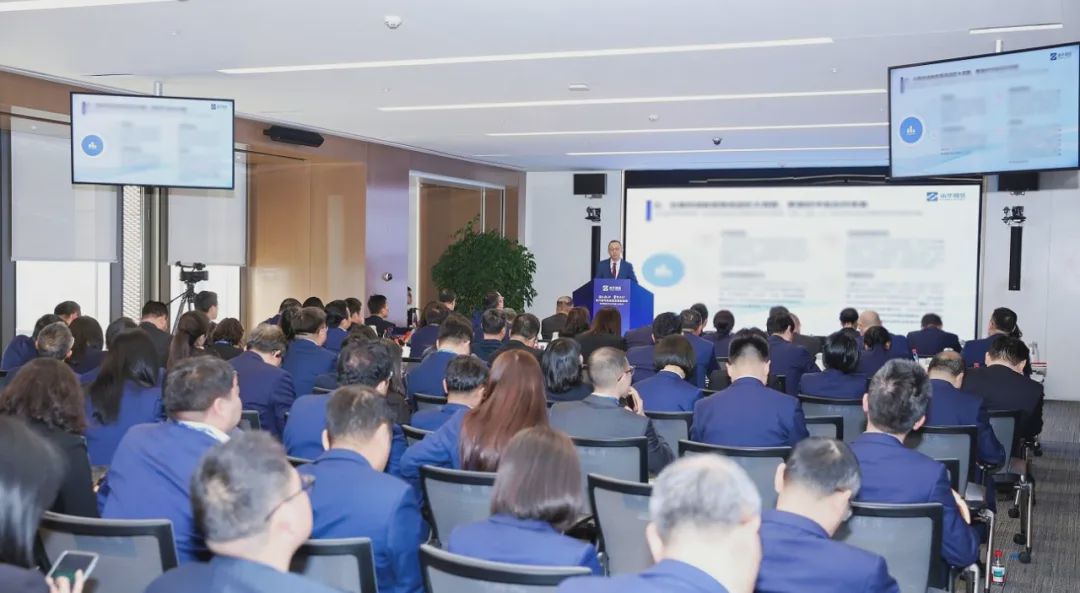
Core Insights - The company emphasizes the importance of integrating into national technological innovation and serving the real economy, advocating for a modern governance system based on "thought, thinking, and systems" [2][9] - The company aims for high-end, intelligent, integrated, and deeply internationalized development in its futures business, encouraging employees to face challenges with determination [2][9] Group 1: Strategic Development - The 2025 annual meeting focused on high-quality development, summarizing the company's management and operational achievements [3][7] - The company aims to align with national strategies and enhance core competitiveness while serving the real economy [7][11] Group 2: Compliance and Risk Management - The chairman highlighted the ongoing strict regulatory environment, urging the company to prioritize compliance as a lifeline for development [5][11] - The company is committed to proactive risk management and adjusting its operational model to ensure sustainable growth [5][11] Group 3: Operational Achievements - The general manager reviewed the company's performance amidst market volatility, emphasizing compliance and customer-centric risk management tools [7][11] - The company successfully completed a Hong Kong IPO, establishing an "A+H" dual capital platform to support its professional and international transformation [7][11]
南华浩淞大豆气象分析报告:巴西产区降雨均匀,阿根廷土墒减弱
Nan Hua Qi Huo· 2026-01-19 13:16
Report Industry Investment Rating - No relevant information provided Core View of the Report - The report analyzes the meteorological conditions in Brazilian and Argentine soybean - producing areas, and points out the current growth status, sowing progress, and potential impacts of weather on yields in these regions, also lists the annual key points of international soybeans [1][2][53] Summary According to Related Contents 1. Brazilian Soybean - Producing Areas - **Overall Situation**: Brazil's soybeans are generally in the middle growth stage, with some areas entering the final stage. The national emergence rate is 6.2%, the vegetative growth period is 24.6%, the flowering period is 48.7%, the pod - filling period is 19.6%, and the harvesting progress is 1.39%, higher than the same period last year and the historical average [1][14] - **Regional Conditions** - **Mato Grosso**: The harvesting progress is close to 5%, and it is expected to accelerate by the end of January, affected by rainfall and crop maturity [1][14] - **Mato Grosso do Sul**: Soil moisture is good, the pest and disease incidence is low, and over 85.7% of the soybean fields are rated as "good" [1][14] - **Goias**: Some irrigated areas have entered the maturity stage, and the rest benefit from regular rainfall [1][14] - **Minas Gerais**: The crop condition is good, and harvesting will start in the last ten days of January [1][15] - **Parana**: Decreased rainfall and high - temperature weather have accelerated the maturity of plots nearing the end of the cycle, and sporadic harvesting has begun in the western part [1][15] - **Rio Grande do Sul**: State - wide rainfall is beneficial to crop growth, and the first - sown crops have entered the pod - filling stage [1][15] 2. Argentine Soybean - Producing Areas - **Sowing Progress**: The sowing progress increased by 5.6% week - on - week to 93.9%, about 5% behind the previous year [2][35] - **Crop Conditions**: 96% of the sown crops are in good condition or above (a 4% decline from the previous period), and 73% of the water conditions are suitable or above (a 12% decline from the previous period) [2][35] - **Potential Risks**: The northeastern region and the north - central part of Santa Fe are affected by excessive water, delaying sowing. In Buenos Aires, the soil surface is showing water deficiency. If there is no effective rainfall in the next 2 - 3 weeks, the potential yield per unit may be reduced [2][35] 3. International Soybean Annual Key Points - **January**: U.S. soybean exports, South American production, global soybean ending stocks, and Chinese imports [53] - **February**: U.S. exports, Chinese imports, Chinese stocks, and (planting intention forecast) [53] - **March**: Brazilian exports, South American production, and U.S. sown area [53] - **April**: South American production, U.S. sown area, and Brazilian exports [53] - **May**: U.S. and Chinese sown areas, and Brazilian exports [53] - **June**: U.S. yield per unit and Brazilian exports [53] - **July - September**: U.S. yield per unit [53] - **October**: U.S. yield per unit, production, and South American planting area [53] - **November**: U.S. production and South American planting area [53] - **December**: U.S. production, South American planting area, and U.S. exports [53] 4. Soybean Growth Cycle and Weather Requirements - **Planting Period**: The average daily temperature of the 5 - centimeter soil layer at the initial sowing stage should reach 10 - 12°C. After germination, the suitable temperature for seedling growth is 15 - 25°C, and the water content should be maintained at 60% - 70%. Risks include floods and extreme drought [61] - **Flowering Period**: The suitable temperature is 20 - 28°C, and the soil water content should be 70% - 80%. Risks include floods, droughts, and continuous rain [61] - **Growth Period**: The suitable temperature is 21 - 23°C, and the soil field water - holding capacity should be about 70%. Risks include heatwaves, droughts, and pests [61] - **Harvest Period**: The suitable temperature is 15 - 25°C, the air relative humidity should be 50% - 60%, and the soil humidity should be 40% - 50% of the field water - holding capacity. Risks include continuous rainfall and storms [61]
南华期货:公司境内外经纪业务、场外衍生品业务等相关业务涉及黄金、白银等期货品种
Zheng Quan Ri Bao· 2026-01-19 13:13
Group 1 - The company, Nanhua Futures, engages in domestic and international brokerage services, as well as over-the-counter derivatives business related to commodities such as gold and silver futures [1]
反内卷逐步推进
Nan Hua Qi Huo· 2026-01-19 02:41
Report Investment Rating - Not provided in the content Core Viewpoints - Recently, there have been signs of adjustment in non-ferrous varieties, with selling pressure emerging at higher levels. The strong upward trend in non-ferrous metals and precious metals is essentially driven by the new economic logic, specifically the demand logic of related commodities driven by the new energy and AI economies. However, their valuations are slightly high. The anti-involution logic of low-valuation varieties is gradually advancing. The daily melting volume of glass has dropped to 150,000 tons, approaching the low limit in 2015. The national policy is determined to rectify involution-style competition and adjust the dynamic adjustment ability of the supply side. It is believed that anti-involution may play a role in the theme market in 2026 [2][5] - The hot spots in the commodity market in the past week still revolved around non-ferrous and precious metal varieties. As prices rose, risks also accumulated, and exchanges at home and abroad introduced corresponding measures to control risks. After the decline of the non-ferrous hot spots, the anti-involution theme may be able to take over [4] Summary by Directory Market Overview - The hot spots in the commodity market in the past week centered on non-ferrous and precious metal varieties. As prices increased, the risks also grew, and exchanges at home and abroad took steps to manage risks. The market's hot money may look for the next theme market [4] Variety Analysis - **Precious Metals**: Gold coins have been falling continuously in recent months, breaking below the 50 mark, and gold has shown continuous stagnant growth, so adjustments need to be watched out for [4] - **Agricultural Products**: It is rumored that the initial agreement on Sino-Canadian trade was reached on Friday, and the tariff on rapeseed may be lowered. The market has already priced in this expectation, causing rapeseed oil and rapeseed meal to open significantly lower on Friday night. The global soybean supply and demand pattern remains weak, but the support around 1000 for US soybeans is still effective [4] - **Chemical Industry**: In 2026, the chemical industry will generally operate within the anti-involution framework. The national policy emphasizes the supply and demand adjustment of the petrochemical sector. The production capacity of glass has declined significantly recently, and the valuation of chemical products is at the limit [4] - **Black Sector**: Steel is one of the key varieties for anti-involution, and the downward space for coal is also limited, and the supply guarantee market is coming to an end [4] Data Tables - **Plate Capital Flow**: The total capital was 8.809 billion. The precious metal sector had 9.738 billion, a decrease of 1.862 billion in the non-ferrous sector, an increase of 1.281 billion in the black sector, a decrease of 189 million in the energy sector, a decrease of 213 million in the chemical industry, an increase of 281 million in the feed breeding sector, an increase of 1.308 billion in the oil and fat sector, and a decrease of 587 million in the soft commodity sector [9] - **Black and Non-ferrous Weekly Data**: It includes the price percentile, inventory percentile, valuation percentile, position percentile, position difference percentile, and annualized basis of various black and non-ferrous varieties such as iron ore, rebar, and gold [9] - **Energy and Chemical Weekly Data**: It shows the price percentile, inventory percentile, valuation percentile, position percentile, position difference percentile, and annualized basis of various energy and chemical varieties such as fuel oil, low-sulfur oil, and asphalt [11] - **Agricultural Product Weekly Data**: It presents the price percentile, inventory percentile, valuation percentile, position percentile, position difference percentile, and annualized basis of various agricultural products such as soybean meal, rapeseed meal, and soybean oil [12] Graphs - There are graphs showing the capital flow of black varieties, olefin varieties, polyester varieties, other chemical varieties, oil and fat varieties, energy varieties, agricultural and sideline varieties, and non-ferrous plate varieties [13][15][18]
南华期货股份(2691.HK)获纳入港股通 短期流动性或将提升 中长期有望估值重评
Ge Long Hui A P P· 2026-01-19 02:29
Core Viewpoint - Nanhua Futures Co., Ltd. (2691.HK) has been included in the Hong Kong Stock Connect as of January 19, 2026, which is expected to unlock a direct inflow channel for mainland funds, potentially increasing attention and allocation from southbound capital and passive funds like index funds, thereby broadening the investor base and attracting incremental mainland capital [1] Company Overview - Nanhua Futures is a leading comprehensive futures company in China, established in 1996 and headquartered in Hangzhou, with services including domestic futures brokerage, risk management, wealth management, and overseas financial services [1] - The company was listed on the Shanghai Stock Exchange in 2019 and officially debuted on the Hong Kong Stock Exchange on December 22, 2025, achieving a dual listing that marks a significant step in its internationalization strategy and business innovation [1] Market Implications - The inclusion in the Hong Kong Stock Connect is anticipated to significantly enhance short-term liquidity and may lead to a medium to long-term revaluation of the company's stock [1] - The company's leading position in the industry and its internationalization potential are expected to attract renewed valuation from the capital markets [1]
深交所:南华期货股份调入港股通标的证券名单
Mei Ri Jing Ji Xin Wen· 2026-01-19 00:57
Group 1 - The Shenzhen Stock Exchange announced an adjustment to the list of Hong Kong Stock Connect eligible securities due to the end of the price stabilization period for Nanhua Futures (603093) shares in the Hong Kong market [1] - The adjustment will take effect from January 19, 2026, following the relevant regulations of the Shenzhen Stock Exchange's implementation measures for the Hong Kong Stock Connect business [1]
南华期货钢材周报:暂无驱动,成材底部震荡-20260118
Nan Hua Qi Huo· 2026-01-18 13:28
1. Report Industry Investment Rating No industry investment rating information is provided in the report. 2. Core Viewpoints of the Report - The fundamentals of finished steel products are neutral, lacking driving forces, and are in a range - bound state. The current core contradiction lies in the furnace charge end. In the short term, finished steel products are supported by the cost end, with limited downside space but lacking upward driving forces. Steel prices are expected to maintain a volatile trend. The price range of the main rebar contract 2605 may be between 3050 - 3200, and that of the main hot - rolled coil contract 2605 may be between 3200 - 3350 [1]. 3. Summary by Relevant Catalogs 3.1 Core Contradictions and Strategy Recommendations 3.1.1 Core Contradictions - Rebar production recovery has slowed down marginally, apparent consumption has rebounded unexpectedly, and inventory has turned to destocking, but the change is small. In the future, inventory may enter a restocking trend again. Overall, rebar inventory is at a low level and is in a destocking trend compared to the same period seasonally. - The destocking speed of hot - rolled coils has accelerated marginally. Although the inventory base is large compared to the same period, it is in a destocking state seasonally. However, the recent increase in hot - rolled coil warehouse receipts is significant, with a 58% week - on - week increase [1]. - For iron ore, steel mills' inventory is low, with restocking expectations supporting prices. But the decline in molten iron production and the continuous restocking of port inventory make it difficult for prices to rise significantly. - For coking coal, the customs clearance volume at the Ganqimao Port is at a relatively high level in recent years, and port inventory is increasing. The recovery of mine开工率 and the accumulation of mine coking coal inventory will suppress prices. Although winter storage supports prices, the large inventory base limits the upside space [1]. 3.1.2 Trading Strategy Recommendations - The driving force for steel production cuts is weakening, and the production of rebar and hot - rolled coils has increased month - on - month, but demand is weak in the off - season. - The coil and plate segment is still in a high - inventory situation, with the highest inventory level in the past five years, and the destocking pressure is high. - The low inventory of steel mills' iron ore at ports supports iron ore prices, while the restocking of port iron ore inventory may affect the price of finished steel products. - Winter storage supports the price of furnace charge [1][5]. 3.1.3 Industrial Customer Operation Recommendations - **Price Range Forecast**: The 05 - contract price range forecast for rebar is 2900 - 3300, with a current volatility of 11.13% and a volatility percentile of 14.3%; for hot - rolled coils, it is 3100 - 3500, with a current volatility of 9.84% and a volatility percentile of 5.83% [7]. - **Risk Management Strategy**: - **Inventory Management**: For enterprises with high finished - product inventory, they can short rebar or hot - rolled coil futures to lock in profits and make up for production costs. They can also sell call options to reduce capital costs. - **Procurement Management**: For enterprises with low procurement inventory, they can buy rebar or hot - rolled coil futures to lock in procurement costs. They can also sell put options to collect premiums and reduce procurement costs [7]. 3.2 Important Information and Next - Week Concerns 3.2.1 Important Information - **Positive Information**: Winter storage supports the price of furnace charge; the profits of blast furnaces and electric furnaces have rebounded; the low inventory of steel mills at ports supports iron ore prices; the destocking speed of hot - rolled coils has improved marginally [14]. - **Negative Information**: The driving force for steel production cuts is weakening, and production has increased month - on - month; the restocking of port iron ore inventory may affect the price of finished steel products; the coil and plate segment is still in a high - inventory situation, and there is no driving force on the consumption side; export controls have taken effect [15]. 3.2.2 Next - Week Important Events - Next Monday, China will announce the GDP growth rate for 2025. - Next Thursday, the United States will announce the number of initial jobless claims for the week [22]. 3.3 Disk Interpretation 3.3.1 Price, Volume, and Capital Interpretation - **Basis**: Analyzed the basis seasonality of rebar and hot - rolled coil 05 contracts in Shanghai [16][17]. - **Coil - to - Rebar Spread**: Analyzed the seasonal changes in the spot coil - to - rebar spread in Shanghai and Beijing, as well as the seasonal changes in 01, 05, and 10 coil - to - rebar spreads [18][19][20]. - **Term Structure**: Analyzed the term structure spread diagrams of rebar, hot - rolled coils, iron ore futures, and coking coal [24][25][26]. - **Month - to - Month Spread Structure**: Analyzed the seasonal changes in the month - to - month spreads of rebar and hot - rolled coil futures (01 - 05, 05 - 10, 10 - 01) [27][28][29]. 3.4 Valuation and Profit Analysis 3.4.1 Upstream and Downstream Profit Tracking in the Industry Chain - The profitability rate of steel mills has declined significantly, falling below 40%, but the profits of blast furnaces and electric furnaces have improved marginally, and the motivation for the five major steel products to cut production may gradually weaken [31]. 3.4.2 Export Profit Tracking - Analyzed the seasonal changes in hot - rolled coil export profit estimates, the relationship between hot - rolled coil export profit and export volume, and the relationship between the difference between overseas and Chinese hot - rolled coils and steel export orders [46][48][49]. 3.5 Supply - Demand and Inventory Deduction 3.5.1 Supply - Demand Balance Sheet Deduction - As of January 16, 2026, the cumulative consumption and production of the five major steel products have decreased year - on - year, and the current inventory has also decreased compared to the beginning of the year [65]. 3.5.2 Supply - Side and Deduction - Analyzed the relationship between steel production, profits, and inventory, as well as the impact of blast furnace and electric furnace production and maintenance on supply [66][70][71]. 3.5.3 Demand - Side and Deduction - Analyzed the predicted seasonality of the apparent demand for crude steel, the consumption of the five major steel products, and the inventory and sales ratio of various steel products [82][91][101].
南华期货丙烯产业周报:PDH检修增加-20260118
Nan Hua Qi Huo· 2026-01-18 13:27
1. Report Industry Investment Rating - Not provided in the document. 2. Core Views of the Report - The core contradictions affecting the propylene trend include cost support with receding geopolitical sentiment, improved supply - demand situation of downstream PP but still with pressure, and expected supply contraction due to increased PDH maintenance. The propylene 03 contract is expected to fluctuate in the range of 5,800 - 6,200 yuan/ton in the short term [2][3]. - In the near - term, the propylene futures price increase is influenced by cost and supply - demand factors. Overseas propane remains strong, PDH maintenance increases, and the fundamentals of downstream PP improve marginally. In the long - term, there are expectations of propylene capacity expansion, PP over - supply pressure, and cost pressure from increased supply of crude oil and LPG [5][9]. 3. Summary by Relevant Contents 3.1 Core Contradictions and Strategy Recommendations 3.1.1 Core Contradictions - Cost support: Geopolitical disputes after the festival brought risk premiums to crude oil and supported propane prices. Iran exported an average of 960,000 tons of LPG per month in 2025, with about 80% going to China. Although the geopolitical situation cooled down at the end of the week, the impact still remains [2]. - Supply - demand of downstream PP: The PP operating rate this week was 75.62%, slightly down from the previous high of nearly 80%. Spot trading improved marginally, but overall, supply - demand pressure still exists [2]. - Supply contraction: Nationally, the supply - demand gap was still loose, but in the Shandong market, the gap narrowed due to maintenance at Jinneng and Wanhua, leading to a stronger spot price. With continuous PDH losses, more maintenance is expected, and attention should be paid to potential load - reduction of cracking units due to naphtha consumption tax issues [3]. 3.1.2 Trading Strategy Recommendations - **Market positioning**: The market is expected to fluctuate and rise. The price range for PL03 is 5,800 - 6,200 yuan/ton. The unilateral strategy is to buy at low prices, as it is affected by cost and supply - demand. PDH maintenance provides stronger support, but the price may correct with the decline of crude oil risk premiums [15]. - **Basis, calendar spread, and hedging arbitrage strategies**: The basis strategy is to expect the spread to widen. The spot price is strengthening due to supply - demand gap contraction, while the futures price may correct with the decline of geopolitical risks. For the PP - PL spread and PL/PG ratio, it is recommended to wait and see [16][17]. 3.1.3 Industrial Customer Operation Suggestions - For inventory management, if the finished product inventory is high, enterprises can short - sell propylene futures at high prices to lock in profits and sell call options to reduce costs. For procurement management, if the inventory is low, enterprises can buy propylene futures at low prices to lock in procurement costs and sell put options to reduce costs [18]. 3.2 This Week's Important Information and Next Week's Events to Watch 3.2.1 This Week's Important Information - **Positive information**: Tensions in Iran and low PG shipments from the Middle East supported CP prices. Poor PDH profits led to increased maintenance of PDH units this week [19]. - **Negative information**: The long - term trading theme in the crude oil market may be oversupply, and the suspension of US military action against Iran led to a decline in risk premiums [20]. 3.2.2 Next Week's Events to Watch - January 19: China's Q4 GDP; January 20: China's LPR; January 22: US PCE index [21]. 3.3 Futures Market Interpretation 3.3.1 Price, Volume, and Fund Analysis - The PL03 contract fluctuated and rose this week. The net positions of major profitable seats increased, with no significant changes in the top 5 long and short positions in the dragon - tiger list. Foreign investors slightly reduced their net long positions, and retail investors slightly increased their net long positions. Technically, it shows an upward trend but may face short - term correction pressure [23]. 3.3.2 Basis and Calendar Spread Structure - The propylene 03 basis was 95 yuan/ton this week, with the spot price rising steadily and the futures price fluctuating. The 02 - 03 calendar spread was - 97 yuan/ton, compared with - 7 yuan/ton last week. The 03 contract had a larger increase, and the calendar spread showed a reverse arbitrage trend [26]. 3.4 Valuation and Profit Analysis 3.4.1 Upstream Profits - The gross profit of major refineries this week was 762 yuan/ton (+85), and the gross profit of Shandong local refineries was 280 yuan/ton (-89). The cracking end declined slightly, and Fujian Refining had a short - term shutdown [28]. 3.4.2 Mid - stream Profits - Propane cracking profit fluctuated at a low level, and LPG cracking was less economical than naphtha. The PDH profit based on FEI was 88 yuan/ton, and the PDH profit based on CP was - 218 yuan/ton [30]. 3.4.3 Downstream Profits - The spread between PP raffia and propylene was 305 yuan/ton, and the spread between PP powder and propylene was 285 yuan/ton, both slightly narrowing. Epoxy propane chlorohydrin method profit was 323 yuan/ton. Acrylonitrile had a large loss of - 2,362 yuan/ton. Acrylic acid profit was - 415 yuan/ton, and its profit was weakening. Butanol and octanol had profits, while phenol - acetone had a loss of - 1,026 yuan/ton [33]. 3.4.4 Import and Export Profits - The Sino - Korean propylene spread remained stable recently, with CFR China at 785 US dollars (+35) [46]. 3.5 Supply - Demand and Inventory Forecast 3.5.1 Shandong Market Supply - Demand Balance Sheet Forecast - In the Shandong market this week, supply decreased and demand increased. The supply - demand gap narrowed due to maintenance at Jinneng and Wanhua [50]. 3.5.2 Market Supply and Forecast - Due to maintenance of some units this week, propylene production was 1.2315 million tons (-10,500 tons), and the operating rate was 75.23% (-0.72%). PDH, MTO, and steam cracking units all had maintenance situations [53]. 3.5.3 Demand and Forecast - **PP**: The spread between PP pellets/powder and propylene slightly rebounded, and the pellet operating rate slightly decreased. Some PP units had maintenance or production - switching, and the operating rate continued to decline, but the spread has returned to the normal range [65][70]. - **Epoxy propane**: The overall load of epoxy propane slightly decreased but remained at a high level, with some enterprises having short - term shutdowns or load - reduction [71]. - **Acrylonitrile**: There were no significant changes this week [73]. - **Butanol and octanol**: The butanol operating rate increased by 4% due to increased loads at some enterprises. The 450,000 - ton unit of Bohua Yongli is expected to start trial production in February, and Shandong Jianlan is operating normally with a 70,000 - ton unit at a low load [79][81]. - **Acrylic acid**: The acrylic acid capacity utilization rate decreased but remained at a high level, and there was a divergence between production and profit [82]. - **Phenol - acetone**: Some enterprises increased their loads, while Wanhua decreased its load [84]. - **Shandong regional demand**: Demand in the Shandong region increased this week, mainly due to the resumption and increased loads of PP, PO, acrylonitrile, and octanol [85].