GigaDevice(603986)

Search documents
东方证券:利基存储紧缺持续 AI需求打开增量空间
智通财经网· 2026-01-29 04:11
Group 1 - The core viewpoint is that niche storage, particularly in the context of AI demand, is expected to open up new growth opportunities beyond the existing market, with price adjustments for products like MCU and NOR Flash ranging from 15% to 50% [1] - AI demand is anticipated to drive incremental growth in niche storage, with increasing requirements for NOR Flash capacity due to the growth of AI terminal BIOS programs and code volume [1] - The supply of niche storage products is being significantly reduced as major international suppliers focus on mainstream storage products, leading to a tightening market for products like MLC NAND Flash, which is projected to see a 41.7% reduction in global capacity by 2026 [2] Group 2 - Domestic manufacturers are positioned strongly in the niche storage market, with companies like Zhaoyi Innovation and Puran achieving significant market shares in NOR Flash and SLC NAND, indicating a competitive advantage as global suppliers exit the niche storage sector [3] - The market share of domestic firms in niche storage is expected to benefit from the ongoing supply constraints caused by the withdrawal of overseas manufacturers, enhancing their competitive position [3] - Investment opportunities are identified in various domestic storage chip design firms and semiconductor equipment companies, highlighting a broad range of potential beneficiaries from the niche storage market dynamics [4]



大中华区科技 - 半导体:MCU 涨价快速点评-Greater China Technology Semiconductors-Quick comment on MCU price hike
2026-01-29 02:42
January 28, 2026 09:59 AM GMT Greater China Technology Semiconductors | Asia Pacific | M January 28, 2026 09:59 AM GMT Greater China Technology Semiconductors Asia | Morgan Stanley Taiwan Limited+ Daniel Yen, CFA | Update | | --- | --- | --- | | Pacific | Equity Analyst | | | | Daniel.Yen@morganstanley.com | +886 2 2730-2863 | | Quick comment on MCU price | Charlie Chan Equity Analyst | | | | Charlie.Chan@morganstanley.com | +886 2 2730-1725 | | hike | Morgan Stanley Asia Limited+ | | | | Daisy Dai, CFA | | ...


利基存储紧缺持续,AI需求打开增量空间
Orient Securities· 2026-01-29 01:45
Investment Rating - The report maintains a "Positive" investment rating for the electronic industry [5] Core Insights - The ongoing shortage of niche storage is expected to continue, with AI demand opening up incremental growth opportunities [2][8] - AI demand is anticipated to drive the need for niche storage, particularly in applications such as automotive, industrial, and security [7] - Domestic manufacturers are positioned competitively in the niche storage market and are likely to benefit from the supply constraints caused by international suppliers exiting this segment [7] Summary by Sections Investment Recommendations and Targets - Key investment targets include domestic storage chip design companies such as Zhaoyi Innovation, Puran, Jucheng, Dongxin, Beijing Junzheng, and Hengshuo [3][8] - Other relevant companies include domestic storage module manufacturers like Jiangbolong, Demingli, and Baiwei Storage, as well as semiconductor equipment firms such as Zhongwei, Jingzhida, and Beifang Huachuang [3][8] - Companies benefiting from storage technology iterations include Lanke Technology, Lianyun Technology, and Aojie Technology [3][8] Market Dynamics - The supply of niche storage products is being significantly reduced as major international suppliers focus on mainstream storage products, leading to a substantial contraction in supply [7] - For instance, the global MLC NAND Flash capacity is projected to decrease by 41.7% in 2026 due to supply shrinkage, which is expected to drive prices significantly higher [7] - Domestic firms are gaining market share in niche storage, with Zhaoyi Innovation holding approximately 18.5% of the NOR Flash market in 2024, ranking second globally [7]



2026年度投资策略:把握AI创新,找寻价值扩张方向
Guolian Minsheng Securities· 2026-01-28 15:40
Core Insights - The report emphasizes the importance of "speed + power" as the core contradiction in the future development of the AI industry, highlighting significant market movements in both speed and power sectors over the past year [1][9] - For 2026, the focus should be on observing the commercial closure rhythms of CSPs and large model vendors to grasp the overall industry beta, while actively seeking value expansion and capital expenditure shifts in specific segments [1][10] - The report suggests that capital expenditure (Capex) and return on investment (ROI) are critical variables in understanding computing power demand, which is primarily driven by token counts and Capex [1][10] Investment Strategy - The computing power industry is viewed as the foundation of technology, with a long-term positive outlook. The report recommends actively seeking value expansion and capital expenditure shifts in specific segments, maintaining the focus on "speed + power" [3][12] - Key areas of investment include domestic computing power, semiconductor equipment, storage, and AI terminals [3][12] Capital Expenditure Analysis - Major cloud service providers (CSPs) have significantly increased their capital expenditures, with the top five CSPs' combined Capex reaching $308.1 billion in Q3 2025, a 75% year-on-year increase [24][27] - Google, Microsoft, Amazon, Meta, and Oracle are leading this trend, with Google and Microsoft showing particularly aggressive Capex growth to support AI infrastructure [27][28] - The report highlights that Google’s Capex for 2024 is projected to be $52.5 billion, a 63% increase year-on-year, while Microsoft’s Capex is expected to reach $75.6 billion, an 84% increase [27][28] AI Model and Chip Development - The report discusses the rapid iteration of Google's Gemini model family, which has introduced significant advancements in AI capabilities, including multi-modal understanding and enhanced reasoning abilities [36][41] - NVIDIA is identified as a key player in the computing power landscape, with its customer base including CSPs, large model vendors, and government clients, driving substantial revenue growth [24][30] - The report notes that the demand for AI chips is expected to grow, with companies like OpenAI forming strategic partnerships with major chip manufacturers to enhance their infrastructure [62][63] Domestic Computing Power Growth - The report anticipates a breakthrough year for domestic computing power in 2026, driven by the acceleration of domestic large models and positive capital expenditure outlook from cloud vendors [2][6] - The supply side is expected to transition from single-point breakthroughs to multi-point developments, indicating a robust growth trajectory for domestic computing power vendors [2][6] Semiconductor and Storage Opportunities - The semiconductor sector is highlighted as benefiting from an AI-driven storage supercycle, with equipment manufacturers poised to gain from original factory expansions [2][8] - The report emphasizes the importance of AI in driving growth in the storage industry, predicting rapid expansion in this sector [2][8]





公募顶流四季报揭秘:科技冲锋与价值深蹲下的业绩分野
2 1 Shi Ji Jing Ji Bao Dao· 2026-01-28 12:31
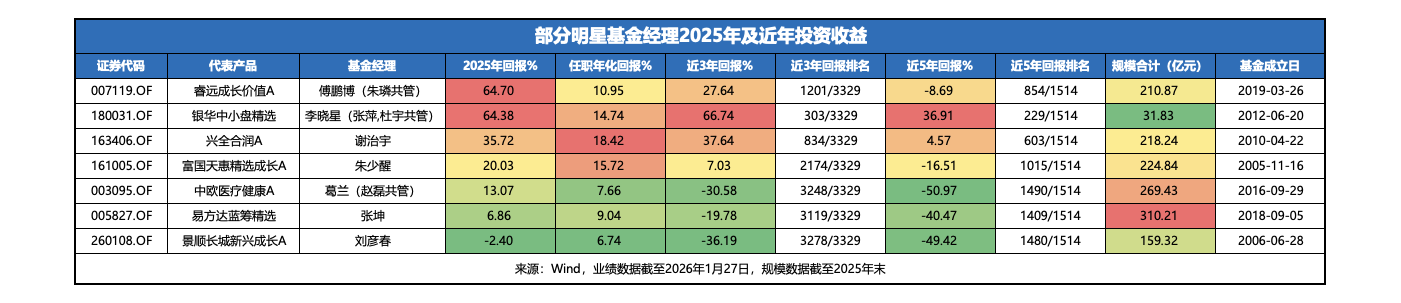
Core Viewpoint - The market experienced increased volatility in Q4 2025, with A-shares and Hong Kong stocks showing mixed performance, while sectors like AI computing and semiconductors thrived, contrasting with weaker performances in real estate and pharmaceuticals [1] Group 1: Market Performance - The Shanghai Composite Index rose by 2.22% in Q4 2025, while the Hang Seng Index fell by 4.56% [1] - The technology growth sector, particularly AI computing and semiconductors, showed significant gains, while industries such as real estate and pharmaceuticals faced challenges [1] Group 2: Fund Manager Performance - Star fund managers like Fu Pengbo and Li Xiaoxing achieved over 60% returns in 2025, focusing on AI computing and semiconductors [2] - Balanced allocation funds, such as Zhu Shaoxing's, demonstrated stability with a 20% annual return, benefiting from diversified investments across various sectors [3][14] Group 3: Investment Strategies - Fu Pengbo's fund increased its allocation to data center cooling and computing-related companies, with a top ten stock concentration of 70.38% [5] - Li Xiaoxing emphasized AI hardware innovation and semiconductor investments, with a focus on domestic advancements in the semiconductor industry [6] Group 4: Traditional Value Investments - Fund managers like Zhang Kun and Liu Yanhun maintained positions in traditional sectors like consumer goods and pharmaceuticals, despite facing net value pressures [8][12] - Liu Yanhun's fund experienced a 5.85% decline in Q4, reflecting the challenges faced by traditional value sectors [12] Group 5: Policy and Market Outlook - Fund managers noted the impact of "anti-involution" policies on corporate fundamentals, suggesting a shift towards supply-side optimization [17] - Despite market rebounds, equity assets are still viewed as attractive, with a focus on high-quality listed companies as scarce income-generating assets [18]






半导体板块1月28日涨1.28%,N恒运昌领涨,主力资金净流出9416.8万元
Zheng Xing Xing Ye Ri Bao· 2026-01-28 08:56
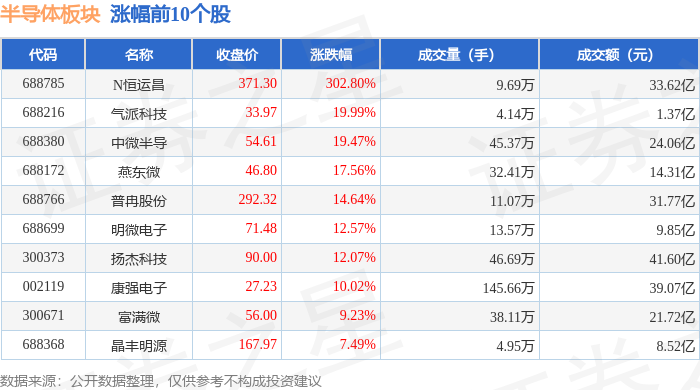
Market Overview - The semiconductor sector increased by 1.28% on January 28, with N Hengyun leading the gains [1] - The Shanghai Composite Index closed at 4151.24, up 0.27%, while the Shenzhen Component Index closed at 14342.9, up 0.09% [1] Top Gainers in Semiconductor Sector - N Hengyun (688785) closed at 371.30, with a remarkable increase of 302.80% and a trading volume of 96,900 shares [1] - Other notable gainers include: - Qipai Technology (688216) at 33.97, up 19.99% [1] - Zhongwei Semiconductor (688380) at 54.61, up 19.47% [1] - Hennian Micro (688172) at 46.80, up 17.56% [1] - Pushen Co. (688766) at 292.32, up 14.64% [1] Top Losers in Semiconductor Sector - Dongxin Co. (688110) decreased by 8.42% to 140.33 [2] - Other significant declines include: - Canxin Co. (688691) down 5.80% to 136.16 [2] - Shengke Communication (688702) down 5.46% to 153.65 [2] - Changsheng Co. (688478) down 4.59% to 38.88 [2] Capital Flow Analysis - The semiconductor sector experienced a net outflow of 94.168 million yuan from institutional investors, while retail investors saw a net inflow of 1.748 billion yuan [2] - The overall capital flow indicates a mixed sentiment, with institutional investors pulling back while retail investors are actively buying [2] Individual Stock Capital Flow - N Hengyun (688785) had a net inflow of 1.855 billion yuan from institutional investors, but a net outflow of 1.788 billion yuan from speculative funds [3] - Other stocks with notable capital flows include: - Zhongxin International (688889) with a net inflow of 1.037 billion yuan from institutional investors [3] - Zhaoyi Innovation (603986) with a net inflow of 685 million yuan from institutional investors [3]


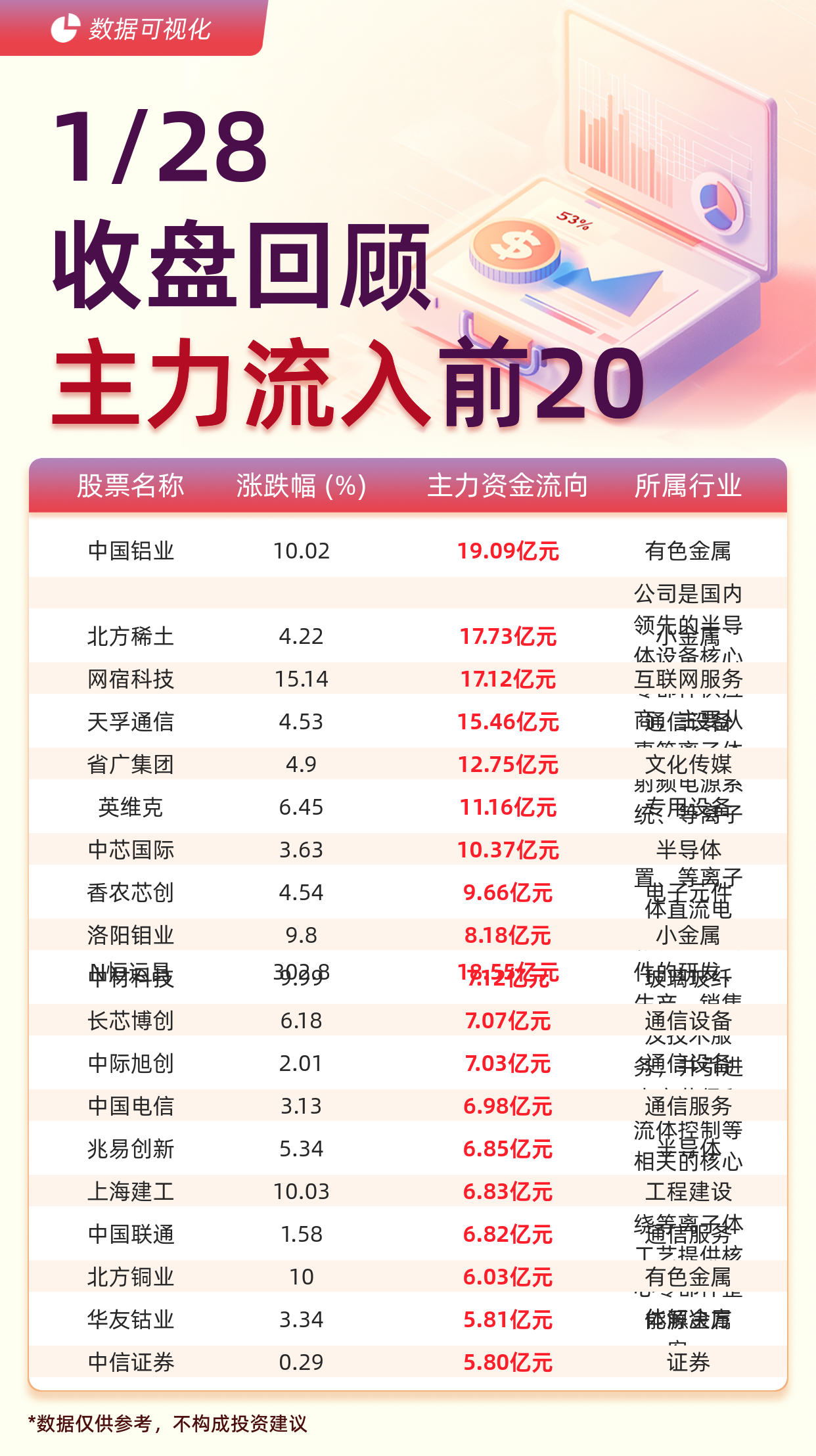
主力资金流入前20:中国铝业流入19.09亿元、N恒运昌流入18.55亿元
Jin Rong Jie· 2026-01-28 07:25
Core Viewpoint - The data indicates significant capital inflows into various stocks, highlighting potential investment opportunities in the market. Group 1: Stock Performance and Capital Inflows - China Aluminum (中国铝业) saw a capital inflow of 1.909 billion, with a price increase of 10.02% [1][2] - Northern Rare Earth (北方稀土) experienced a capital inflow of 1.773 billion, with a price increase of 4.22% [1][2] - Wangsu Science & Technology (网宿科技) had a capital inflow of 1.712 billion, with a notable price increase of 15.14% [1][2] - Tianfu Communication (天孚通信) recorded a capital inflow of 1.546 billion, with a price increase of 4.53% [1][2] - Province Advertising Group (省广集团) attracted a capital inflow of 1.275 billion, with a price increase of 4.9% [1][2] Group 2: Additional Notable Stocks - Invech (英维克) had a capital inflow of 1.116 billion, with a price increase of 6.45% [1][2] - SMIC (中芯国际) saw a capital inflow of 1.037 billion, with a price increase of 3.63% [1][2] - Shannon Chip Creation (香农芯创) experienced a capital inflow of 966 million, with a price increase of 4.54% [1][2] - Luoyang Molybdenum (洛阳钼业) had a capital inflow of 818 million, with a price increase of 9.8% [1][2] Group 3: Other Stocks with Capital Inflows - Changxin Bochuang (长芯博创) recorded a capital inflow of 707 million, with a price increase of 6.18% [3] - Zhongji Xuchuang (中际旭创) had a capital inflow of 703 million, with a price increase of 2.01% [3] - China Telecom (中国电信) saw a capital inflow of 698 million, with a price increase of 3.13% [3] - Zhaoyi Innovation (兆易创新) attracted a capital inflow of 685 million, with a price increase of 5.34% [3] - Shanghai Construction (上海建工) had a capital inflow of 683 million, with a price increase of 10.03% [3] - China Unicom (中国联通) recorded a capital inflow of 682 million, with a price increase of 1.58% [3] - Northern Copper (北方铜业) saw a capital inflow of 603 million, with a price increase of 10% [3] - Huayou Cobalt (华友钴业) had a capital inflow of 581 million, with a price increase of 3.34% [3] - CITIC Securities (中信证券) recorded a capital inflow of 580 million, with a price increase of 0.29% [3]



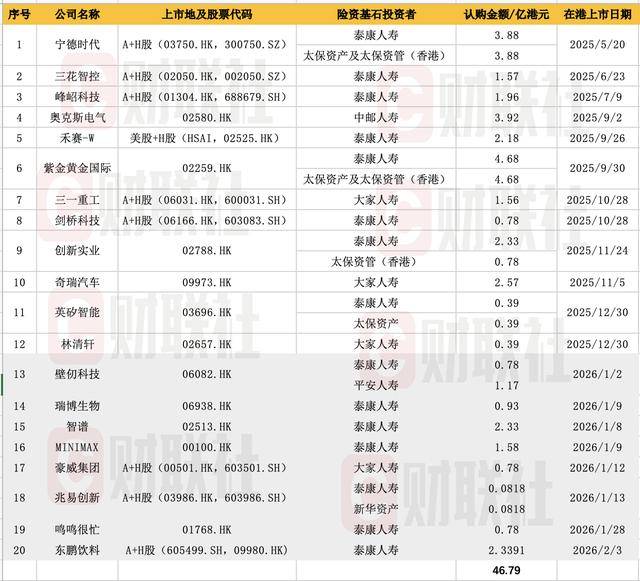
火力全开!2026开年泰康平安新华等超10亿险资南下,狂扫港股AI、生物医药IPO
Sou Hu Cai Jing· 2026-01-28 03:33
Core Viewpoint - Insurance capital is increasingly participating in cornerstone investments in Hong Kong IPOs, signaling strong market confidence, with significant investments from major insurance companies like Taikang Life and Ping An Life [1][3][4]. Group 1: Investment Trends - In early 2026, four insurance companies participated in eight Hong Kong IPO cornerstone investments, with Taikang Life investing $10 million in the IPO of Mingming Hen Mang [1]. - From 2025 to early 2026, seven insurance institutions participated as cornerstone investors in 20 Hong Kong IPOs, with a total subscription amount of HKD 4.679 billion [1][4]. - The average return for Hong Kong IPOs in 2025 was 38%, with the first-day price drop rate at a five-year low of 23.08% [6][10]. Group 2: Challenges Faced - Insurance companies face challenges in accessing IPO projects due to high entry barriers and the need for strong cross-market research capabilities [2][15]. - The balance between high return potential and net asset value volatility is a significant concern for insurance funds, which are generally risk-averse [2][15]. Group 3: Market Outlook - The IPO fundraising scale in Hong Kong is expected to remain strong in 2026, with insurance capital becoming a long-term force in the market [2][15][16]. - The cornerstone investment mechanism is seen as a key entry point for quality assets in the Hong Kong market, enhancing liquidity and valuation flexibility [2][16]. Group 4: Sector Focus - Insurance capital is focusing on sectors such as AI, biomedicine, and new consumer brands, with a notable interest in companies like MINIMAX and Ruibo Biotechnology [9][10]. - The investment strategy is shifting towards a more diversified valuation framework, moving beyond traditional profit metrics to include growth potential [10][11].
门庭若市港交所
创业邦· 2026-01-28 03:21
Core Viewpoint - The article discusses the resurgence of the Hong Kong Stock Exchange (HKEX) as a leading platform for AI companies, highlighting a significant shift from traditional sectors to technology-driven firms, particularly in AI and semiconductor industries [6][9][12]. Group 1: IPO Trends and Market Dynamics - Wall Street's IPO market has seen a drastic decline from approximately 310 billion HKD in 2021 to just over 100 billion HKD in 2022, a drop of about 65% [6]. - In 2023, the HKEX recorded only 68 IPOs, raising around 46 billion HKD, marking the lowest level since 2013 [6]. - The first two weeks of 2026 witnessed an unprecedented AI IPO wave, with companies like Wallran Technology experiencing a 2348 times oversubscription and raising 130 billion HKD [9]. Group 2: Financial Performance of HKEX - The HKEX reported a 41% increase in major business revenue from 14,542 million HKD in 2024 to 20,438 million HKD in 2025 [10]. - The net profit attributable to shareholders rose by 45%, from 9,270 million HKD in 2024 to 13,419 million HKD in 2025 [10]. - The EBITDA for the first three quarters of 2025 reached 17,164 million HKD, a 48% increase compared to the previous year [10]. Group 3: AI Companies and Their Financial Needs - AI companies often have R&D expenditures that are several times their revenue, with companies like Zhipu spending over eight times their revenue on R&D in the first half of 2025 [11]. - Wallran Technology's revenue surged from less than 500,000 HKD in 2022 to over 300 million HKD in 2024, but its R&D expenses reached 830 million HKD, indicating a cash burn situation [11]. - The need for continuous funding is critical for AI companies, as they require a sustainable capital pool to support ongoing operations and development [12]. Group 4: Advantages of HKEX for AI Companies - The HKEX has adapted its listing rules to accommodate frontier technology companies, allowing unprofitable firms to list if they have technological barriers and top-tier capital backing [13][14]. - The minimum market capitalization requirements for companies have been lowered, benefiting many AI firms [13]. - The HKEX's approval process has been streamlined, reducing the time from 8-12 months to 4-6 months, enhancing its attractiveness for tech firms [14]. Group 5: Future Outlook and Market Sentiment - The article suggests that the HKEX will continue to attract more technology-focused companies, with several AI and semiconductor firms already in the pipeline for IPOs [16]. - The success of AI companies is paradoxical; as they succeed, they require more capital, which may lead to prolonged periods of unprofitability [17]. - Investors are betting on the potential of AI companies, despite uncertainties regarding their profitability and market sustainability [18].

兆易创新早盘涨超9% 公司预计全年纯利同比增长46%
Xin Lang Cai Jing· 2026-01-28 02:25
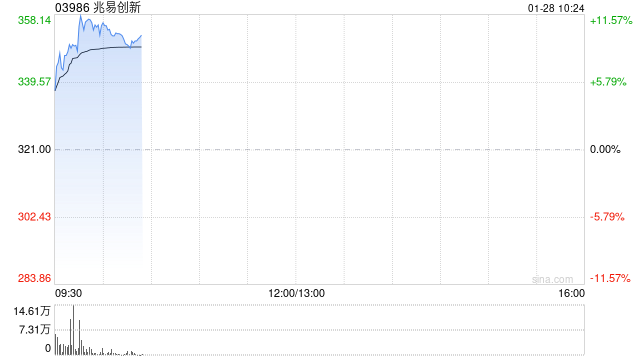
Core Viewpoint - The company Zhaoyi Innovation (03986) has seen a significant stock price increase, attributed to strong performance forecasts driven by AI demand and an improving storage industry cycle [1][5]. Company Summary - Zhaoyi Innovation's stock price rose over 10% during trading, currently at 350 HKD with a trading volume of 367 million HKD [1][5]. - The company forecasts a revenue of approximately 9.2 billion CNY for 2025, representing a year-on-year growth of about 25% [1][5]. - The expected net profit attributable to shareholders is around 1.61 billion CNY, indicating a year-on-year increase of approximately 46% [1][5]. - The growth is primarily driven by accelerated demand from AI computing power construction, benefiting products in PC, server, and automotive electronics sectors [1][5]. Industry Summary - According to a report from China Merchants Securities, global storage prices have been recovering since the first half of 2025, with a notable acceleration in spot and contract prices in the third and fourth quarters of 2025 [1][5]. - It is anticipated that in the first quarter of 2026, the price increases for various storage categories will exceed expectations [1][5]. - The overall global storage supply is expected to remain tight throughout 2026, with AI demand growth outpacing capacity expansion [1][5]. - Other consumer storage and niche storage segments are experiencing price increases due to capacity constraints and downstream panic stocking, leading to price hikes that far exceed normal levels [1][5]. - The domestic storage industry chain is expected to benefit from the shortage and price increase wave this year [1][5].