HitGen(688222)

Search documents
成都先导(688222) - 成都先导药物开发股份有限公司2025年员工持股计划第一次持有人会议决议公告
2026-01-26 08:30
证券代码:688222 证券简称:成都先导 公告编号:2026-002 (一)审议通过《关于设立公司 2025 年员工持股计划管理委员会的议案》 根据《成都先导药物开发股份有限公司 2025 年员工持股计划》和《成都先 导药物开发股份有限公司 2025 年员工持股计划管理办法》等相关规定,同意设 立公司 2025 年员工持股计划管理委员会,负责员工持股计划的日常管理,代表 持有人行使股东权利。管理委员会由 3 名委员组成,设管理委员会主任 1 名,任 期为公司 2025 年员工持股计划的存续期。 表决情况:同意 1,176.1442 万份,占出席持有人会议的持有人所持份额总数 的 100%;反对 0 份,占出席持有人会议的持有人所持份额总数的 0%;弃权 0 份,占出席持有人会议的持有人所持份额总数的 0%。 成都先导药物开发股份有限公司 2025 年员工持股计划第一次持有人会议决议公告 本公司董事会及全体董事保证本公告内容不存在任何虚假记载、误导性陈述 或者重大遗漏,并对其内容的真实性、准确性和完整性依法承担法律责任。 一、持有人会议召开情况 成都先导药物开发股份有限公司(以下简称"公司")2025 年员工 ...

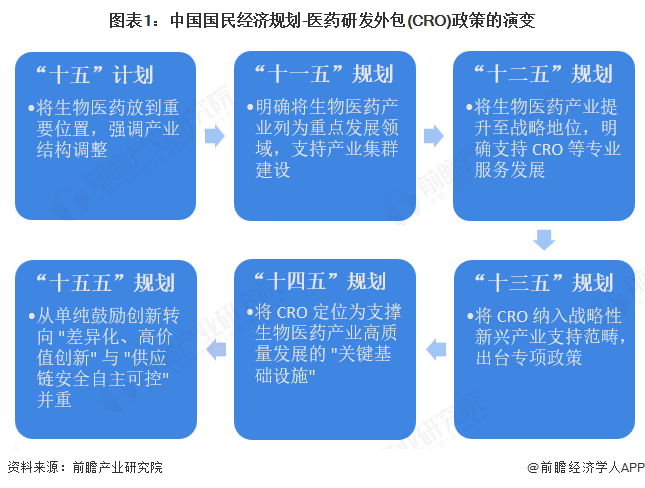
2025年中国医药研发外包(CRO)行业政策分析 药审改革推动行业发展提速【组图】
Qian Zhan Wang· 2026-01-23 09:08
Core Viewpoint - The report highlights the significant growth and development of China's Contract Research Organization (CRO) industry, driven by a comprehensive policy framework and regulatory reforms that enhance innovation and operational efficiency in the pharmaceutical sector [1][3][9]. Group 1: Industry Overview - The main listed companies in China's CRO industry include WuXi AppTec (603259.SH), Kanglong Chemical (300759.SZ), Tigermed (300347.SZ), Kelaiying (002821.SZ), Zhaoyan New Drug (603127.SH), Jiuzhou Pharmaceutical (603456.SH), Haoyuan Pharmaceutical (688131.SH), Boteng Co., Ltd. (300363.SZ), Chengdu XianDao (688222.SH), and Yaoshi Technology (300725.SZ) [1]. - The CRO industry is recognized as a strategic emerging industry that supports pharmaceutical innovation, transitioning China from a major pharmaceutical market to a strong one [1]. Group 2: Policy Framework - The policy framework for the CRO industry is centered around the National Medical Products Administration (NMPA) and includes collaboration with other regulatory bodies such as the National Health Commission (NHC) and the Drug Administration (CDR) [3]. - Key regulatory measures include the Marketing Authorization Holder (MAH) system, implicit licensing for clinical trials, Good Laboratory Practice (GLP) and Good Clinical Practice (GCP) certifications, and priority review and approval processes [3]. Group 3: Industry Support Policies - National policies provide financial support through initiatives like the "Major New Drug Creation" program, tax reductions for high-tech enterprises, and increased deductions for R&D expenses, which lower operational costs for the industry [6]. - Local governments implement differentiated policies that align with regional industrial characteristics, including subsidies for innovative drug development and funding for CRO platform construction [6]. Group 4: Drug Review Reforms - Recent reforms in drug review processes have significantly improved approval efficiency, reducing the average clinical trial review time from 420 days to 30 days in pilot areas, and addressing a backlog of 22,000 cases [9][12]. - The definition of new drugs has shifted from "China New" to "Global New," aligning with international standards and enhancing the quality of innovation [12]. Group 5: Future Trends - The future of the CRO industry in China is expected to be driven by a robust policy framework, with trends including deeper collaboration in service models, increased application of AI and digital platforms, and a focus on specialized market segments [13]. - The competitive landscape is anticipated to evolve with the rise of domestic leaders and accelerated internationalization, benefiting from improved mechanisms for mutual recognition of clinical trial data [13].





医疗服务板块1月23日涨1.19%,诺禾致源领涨,主力资金净流入9.91亿元
Zheng Xing Xing Ye Ri Bao· 2026-01-23 09:04
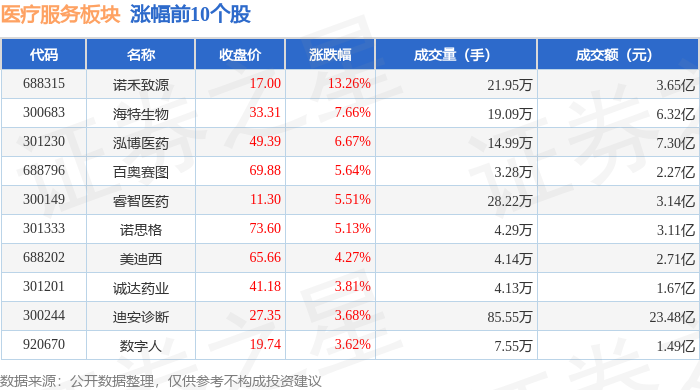
Core Viewpoint - The medical services sector experienced a rise of 1.19% on January 23, with notable gains from companies like Nuohua Zhiyuan, which led the sector's performance [1]. Group 1: Market Performance - The Shanghai Composite Index closed at 4136.16, up 0.33%, while the Shenzhen Component Index closed at 14439.66, up 0.79% [1]. - The medical services sector saw significant individual stock movements, with Nuohua Zhiyuan (688315) closing at 17.00, up 13.26%, and Hai Te Biological (300683) closing at 33.31, up 7.66% [1]. Group 2: Trading Volume and Value - Nuohua Zhiyuan had a trading volume of 219,500 shares and a transaction value of 365 million yuan [1]. - Hai Te Biological recorded a trading volume of 190,900 shares with a transaction value of 632 million yuan [1]. Group 3: Capital Flow - The medical services sector saw a net inflow of 999.1 million yuan from institutional investors, while retail investors experienced a net outflow of 1.069 billion yuan [2]. - The capital flow data indicates that major stocks like Diyan Diagnosis (300244) had a net inflow of 288 million yuan from institutional investors [3].




A股异动丨创新药概念走强,9部门发文鼓励创新药进零售药店销售渠道
Ge Long Hui A P P· 2026-01-23 03:13
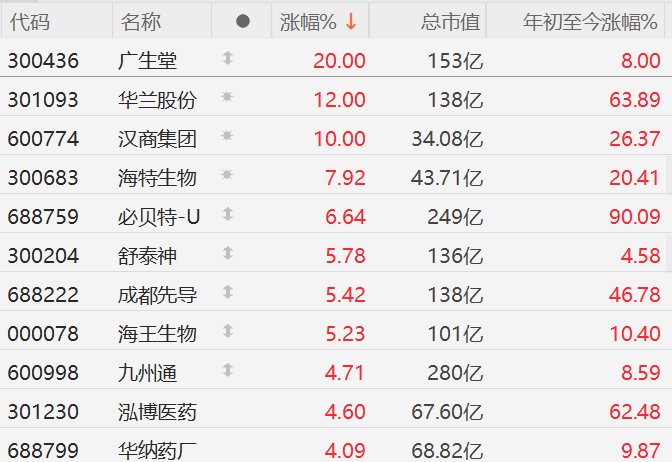
Group 1 - The core viewpoint of the news is that the A-share market is seeing a strong performance in innovative drug concept stocks, driven by a policy encouraging the sale of innovative drugs and reference preparations in retail pharmacies [1] Group 2 - Guangshentang (300436) experienced a 20% increase, with a total market value of 15.3 billion and a year-to-date increase of 8% [2] - Zhongsan Co. (301093) rose by 12%, with a market capitalization of 13.8 billion and a year-to-date increase of 63.89% [2] - Hanshang Group (600774) saw a 10% increase, with a market value of 3.408 billion and a year-to-date increase of 26.37% [2] - Hite Bio (300683) increased by 7.92%, with a market capitalization of 4.371 billion and a year-to-date increase of 20.41% [2] - Bibete (688759) rose by 6.64%, with a market value of 24.9 billion and a year-to-date increase of 90.09% [2] - Shutaishen (300204) increased by 5.78%, with a market capitalization of 13.6 billion and a year-to-date increase of 4.58% [2] - Chengdu Xian Dao (688222) rose by 5.42%, with a market value of 13.8 billion and a year-to-date increase of 46.78% [2] - Haiwang Bio (000078) increased by 5.23%, with a market capitalization of 10.1 billion and a year-to-date increase of 10.40% [2] - Jiuzhoutong (600998) rose by 4.71%, with a market value of 28 billion and a year-to-date increase of 8.59% [2] - Hongbo Pharmaceutical (301230) increased by 4.60%, with a market capitalization of 6.76 billion and a year-to-date increase of 62.48% [2] - Huana Pharmaceutical (688799) rose by 4.09%, with a market value of 6.882 billion and a year-to-date increase of 9.87% [2]


AI制药:从降本增效到分子创新,数据生产构筑长期壁垒
China Post Securities· 2026-01-22 07:31
Investment Rating - The industry investment rating is "Strong Buy" and is maintained [2]. Core Insights - The investment value of the AI + pharmaceutical industry lies in the analysis of the current state and future judgment of the industry. Understanding the role of AI in pharmaceuticals, its business models, growth potential, key growth factors, and competitive barriers is essential [4]. - AI in pharmaceuticals primarily enhances efficiency and innovation. The most mature applications of AI in drug development focus on cost reduction and efficiency improvements in preclinical stages, significantly shortening development cycles and reducing costs [5]. - The global market for AI-enabled drug development is projected to grow from $11.9 billion in 2023 to $74.6 billion by 2032, with a CAGR of 22.6% [5]. - The industry has seen a significant increase in investment, with the AI + CRO/AI + Biotech model being a major trend for profitability. High-quality data production capabilities are identified as a core competitive advantage [5][6]. Summary by Sections AI's Role in Pharmaceuticals - AI in drug development combines technologies like NLP and deep neural networks to enhance efficiency and expand innovation space. It integrates vast biomedical data to empower the entire drug development process [9]. - AI's application is most effective in the preclinical research phase, where it can reduce costs by over 90% and significantly shorten development timelines [21]. Market Size and Commercialization Focus - The AI + pharmaceutical financing landscape has seen rapid growth since 2015, with a total of $24.6 billion raised by 2022. However, there has been a decline in financing activity due to global economic conditions [48]. - The commercial focus is on molecular entities, with the industry not yet forming a unified paradigm, leading to structural differentiation among companies [52][68]. Business Models - The industry features three main business models: SaaS, AI + CRO, and AI + Biotech. The AI + CRO model is predominant, leveraging AI technology to provide outsourced drug development services [62][63]. - SaaS models face challenges due to limited market size and high competition, making them less favorable for new entrants [67]. Key Players and Competitive Landscape - The report highlights leading companies in the AI pharmaceutical space, including Insilico Medicine, Relay Therapeutics, and Schrodinger, which are involved in various stages of drug development [53][54]. - The competitive landscape is characterized by a "Matthew Effect," where leading players dominate due to their established capabilities and resources [6].
发布时间:2026-01-22
China Post Securities· 2026-01-22 07:13
Investment Rating - The industry investment rating is "Strong Buy" [2]. Core Insights - The investment value of the AI+pharmaceutical industry lies in analyzing the current status and future potential of AI's role in drug development, focusing on efficiency and innovation [4]. - AI enhances drug development by reducing costs and increasing efficiency, particularly in the preclinical phase, where AI virtual screening significantly lowers the number of compounds needed for real trials, thus shortening development cycles and costs [5]. - The global market for AI-enabled drug development is projected to grow from $11.9 billion in 2023 to $74.6 billion by 2032, with a CAGR of 22.6% [5]. - The industry is experiencing a structural differentiation trend in financing, with a total of $24.6 billion raised globally for AI+drug development since 2015, although there has been a decline in financing activity in 2022 due to economic downturns [48]. Summary by Sections AI's Role in Pharmaceuticals - AI in drug development combines technologies like NLP and deep learning to enhance efficiency and expand innovation space across the entire drug development process [9]. - AI's most mature applications are in preclinical research, where it can reduce costs by over 90% and significantly shorten development timelines [22]. High-Quality Data Production as Core Competitiveness - The ability to produce high-quality data is identified as a core competitive advantage in the industry, as it enables effective algorithm iteration and data accumulation [6]. - The industry faces challenges with "data silos," where high-quality data is scarce and not shared, making data production capabilities crucial for long-term competitiveness [6]. Market Size and Commercialization Focus - The AI+pharmaceutical financing landscape has seen rapid growth, with significant investments concentrated in the US and China, although the latter's share has decreased recently [48]. - The commercial focus is shifting towards molecular entities, with AI+CRO and AI+Biotech models emerging as dominant trends for revenue generation [58]. Business Models - The industry features three main business models: SaaS, AI+CRO, and AI+Biotech, with the latter two being more prevalent due to their higher revenue potential and lower risk exposure [63][67]. - SaaS models face challenges due to limited market size and high competition, suggesting that they may not be suitable for new entrants in the industry [67].
医疗服务板块1月21日涨0.18%,南模生物领涨,主力资金净流入5050.97万元
Zheng Xing Xing Ye Ri Bao· 2026-01-21 08:53
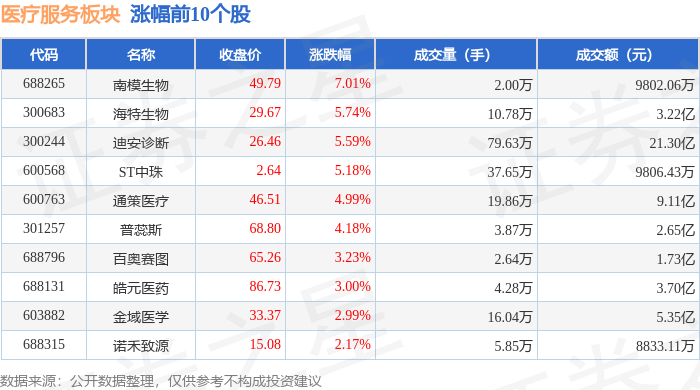
Market Overview - The medical services sector increased by 0.18% on January 21, with Nanmo Biology leading the gains [1] - The Shanghai Composite Index closed at 4116.94, up 0.08%, while the Shenzhen Component Index closed at 14255.12, up 0.7% [1] Top Gainers in Medical Services - Nanmo Biology (688265) closed at 49.79, up 7.01% with a trading volume of 20,000 shares and a transaction value of 98.02 million [1] - Hite Biology (300683) closed at 29.67, up 5.74% with a trading volume of 107,800 shares and a transaction value of 32.2 million [1] - Dean Diagnostics (300244) closed at 26.46, up 5.59% with a trading volume of 796,300 shares and a transaction value of 2.13 billion [1] - ST Zhongzhu (600568) closed at 2.64, up 5.18% with a trading volume of 376,500 shares and a transaction value of 9.81 million [1] - Tongce Medical (600763) closed at 46.51, up 4.99% with a trading volume of 198,600 shares and a transaction value of 911 million [1] Top Losers in Medical Services - Digital Human (920670) closed at 18.72, down 4.44% with a trading volume of 74,500 shares and a transaction value of 143 million [2] - Hongbo Pharmaceutical (301230) closed at 46.36, down 1.88% with a trading volume of 131,200 shares and a transaction value of 614 million [2] - Chengda Pharmaceutical (301201) closed at 41.39, down 1.76% with a trading volume of 36,600 shares and a transaction value of 153 million [2] Capital Flow in Medical Services - The medical services sector saw a net inflow of 50.51 million from institutional investors, while retail investors experienced a net outflow of 375 million [2] - The sector's overall capital flow indicates a strong interest from institutional and speculative investors, with retail investors pulling back [2][3] Notable Capital Inflows - Sanbo Brain Science (301293) had a net inflow of 91.48 million, representing 9.03% of its total capital [3] - Tongce Medical (600763) saw a net inflow of 83.46 million, accounting for 9.16% of its total capital [3] - BGI Genomics (300676) recorded a net inflow of 51.81 million, which is 8.37% of its total capital [3]



预见2025:《2025年中国医药研发外包(CRO)行业全景图谱》(附竞争格局、行业规模等)
Qian Zhan Wang· 2026-01-21 01:09
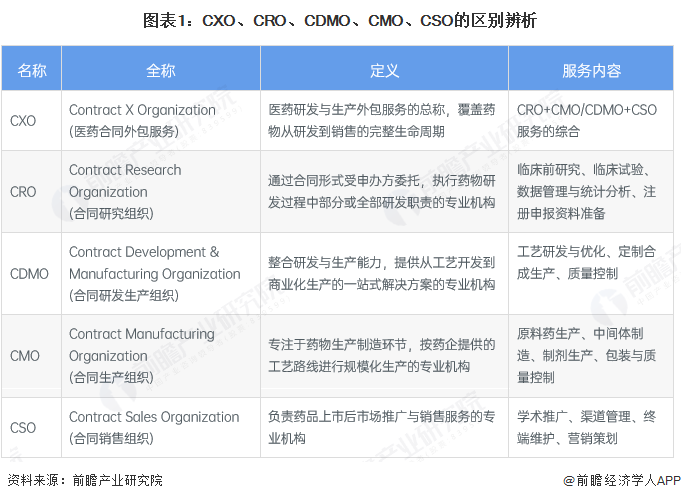
Core Insights - The CRO industry in China is experiencing significant growth, with the market size expected to expand from 90 billion yuan in 2021 to 126 billion yuan by 2024, reflecting a compound annual growth rate (CAGR) of 28%, which is substantially higher than the global average of 10% [13][26] - The industry is characterized by a clear competitive landscape, with WuXi AppTec as the dominant player, achieving revenue exceeding 20 billion yuan, while other key players include Kanglong Chemical, Tigermed, and Kelun Pharmaceutical [17][20] Industry Overview - Contract Research Organizations (CROs) are specialized entities that undertake drug development responsibilities on behalf of pharmaceutical companies, helping to reduce costs and risks while ensuring compliance [1] - The CRO industry is divided into preclinical and clinical segments, with preclinical CROs focusing on drug discovery and safety evaluations, while clinical CROs handle clinical trials and data management [1] Industry Development History - The CRO industry in China began in 1996 with the establishment of the first joint venture, and has evolved from a lack of formal organizations to a competitive landscape dominated by local leaders [9] - The industry has undergone significant changes, including the implementation of Good Clinical Practice (GCP) in 2003 and the introduction of the Marketing Authorization Holder (MAH) system, which has facilitated the growth of CRO services [11] Market Demand and Growth - The number of New Drug Applications (NDA) in China has been increasing, from 210 in 2021 to an expected 320 by 2024, driving demand for CRO services [14] - The global CRO market is projected to grow from 71 billion USD in 2021 to 90 billion USD by 2024, driven by increased healthcare demands due to aging populations and the COVID-19 pandemic [13] Competitive Landscape - The competitive structure of the Chinese CRO industry is categorized into three tiers, with WuXi AppTec leading the first tier, followed by Kanglong Chemical and Tigermed in the second tier, and smaller firms in the third tier [17] - Most companies are diversifying their services to include both CRO and CDMO (Contract Development and Manufacturing Organization) capabilities, enhancing operational efficiency [20] Regional Market Dynamics - The Yangtze River Delta region dominates the CRO market in China, accounting for approximately 43% of the market share, followed by the Beijing-Tianjin-Hebei region at 23% and the Pearl River Delta at 19% [23] Future Outlook - The Chinese CRO market is expected to continue its growth trajectory, potentially exceeding 144 billion yuan by 2028, supported by favorable policies and increasing demand for innovative therapies [26] - Despite challenges such as rising compliance costs and market saturation, the overall outlook remains positive, with expectations of sustained double-digit growth over the next five years [26]
医疗服务板块1月19日跌1.45%,成都先导领跌,主力资金净流出19.83亿元
Zheng Xing Xing Ye Ri Bao· 2026-01-19 08:56
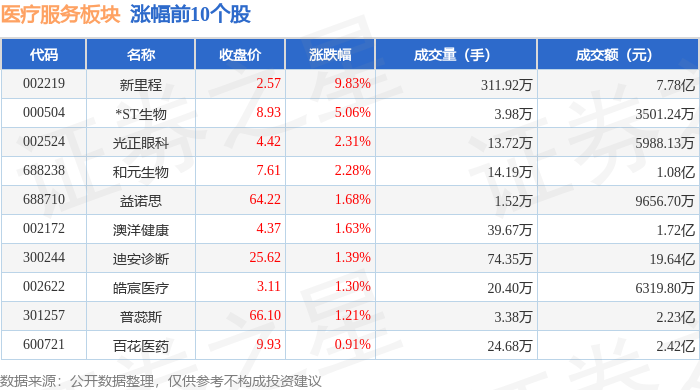
Core Viewpoint - The medical services sector experienced a decline of 1.45% on January 19, with Chengdu Xian Dao leading the drop. The Shanghai Composite Index rose by 0.29%, while the Shenzhen Component Index increased by 0.09% [1]. Group 1: Market Performance - The medical services sector saw a significant outflow of 1.45%, with Chengdu Xian Dao's stock price falling by 6.82% to 32.80 [2]. - Major stocks in the medical services sector included New Mileage, which rose by 9.83% to 2.57, and ST Biological, which increased by 5.06% to 8.93 [1][2]. - The total net outflow of main funds in the medical services sector was 1.983 billion, while retail investors saw a net inflow of 1.942 billion [2][3]. Group 2: Individual Stock Performance - New Mileage had a closing price of 2.57 with a trading volume of 3.1192 million shares, resulting in a transaction amount of 778 million [1]. - Chengdu Xian Dao, despite leading the decline, had a trading volume of 292,200 shares and a transaction amount of 976 million [2]. - The stock performance varied significantly, with some stocks like ST Biological and Huazhong Medical showing positive movements, while others like Chengdu Xian Dao and Meinian Health faced notable declines [2][3].


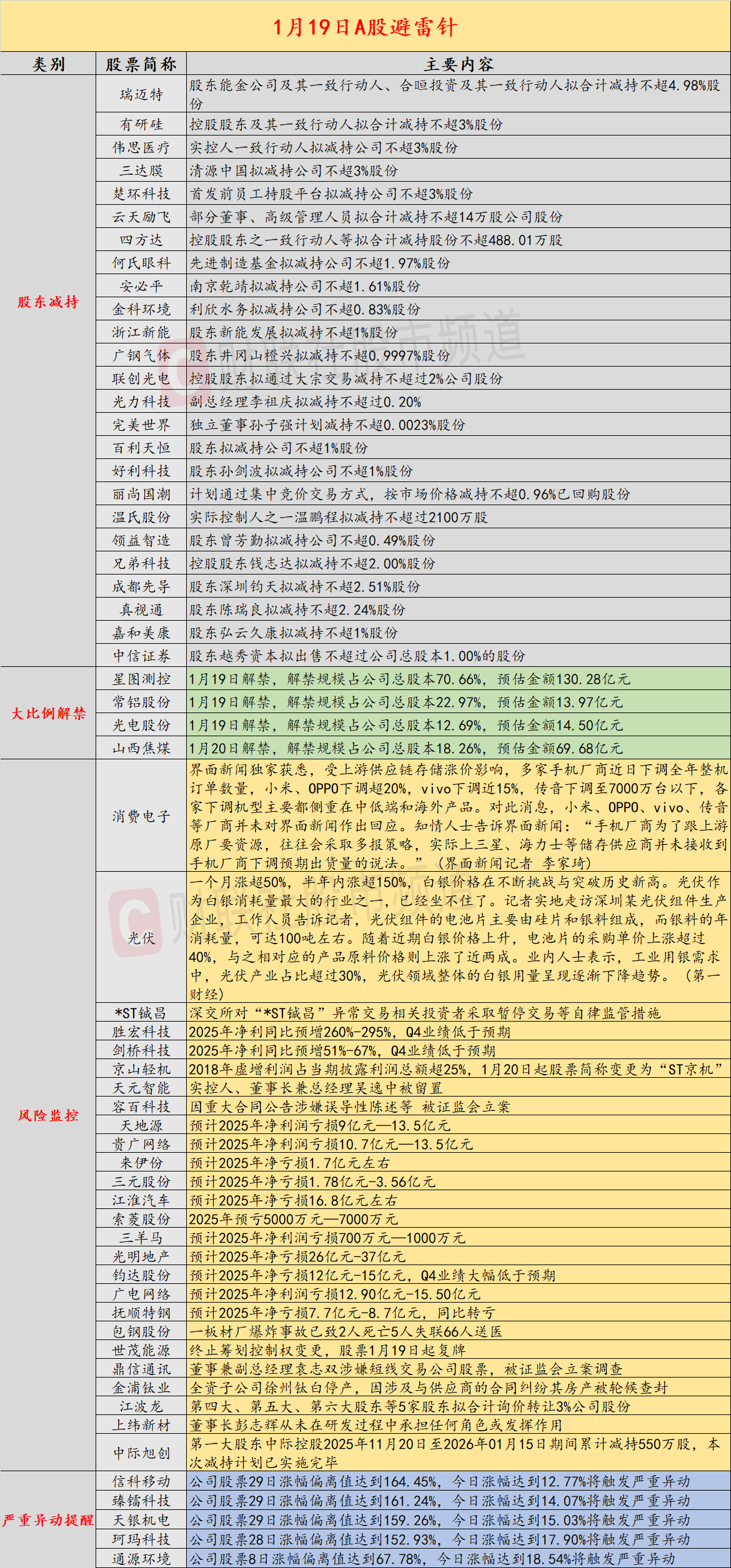
1月19日投资避雷针:2400亿PCB龙头四季度业绩低于预期


Xin Lang Cai Jing· 2026-01-19 00:33
Economic Information - Several smartphone manufacturers, including Xiaomi, OPPO, vivo, and Transsion, have lowered their annual shipment forecasts, with Xiaomi and OPPO reducing by over 20%, vivo by nearly 15%, and Transsion to below 70 million units [2] - Silver prices have surged over 50% in one month and over 150% in six months, impacting the photovoltaic industry, which consumes a significant amount of silver. The cost of raw materials for solar cells has increased by nearly 20% due to rising silver prices [2] - The company Xibei is expected to incur cumulative losses exceeding 600 million yuan from September 2025 to March 2026, leading to the closure of 102 stores, accounting for 30% of its total outlets [2] Company Alerts - Shenghong Technology anticipates a net profit increase of 260%-295% year-on-year for 2025, although Q4 performance fell short of expectations [4] - Cambridge Technology expects a net profit increase of 51%-67% year-on-year for 2025, with Q4 results also below expectations [4] - Multiple companies, including Weimait and Youyan Silicon, have announced plans to reduce their shareholdings by up to 4.98% and 3% respectively [4][11] Overseas Alerts - The three major U.S. stock indices collectively declined last Friday, with the Nasdaq China Golden Dragon Index dropping by 1.15%. Notable declines were seen in Chinese stocks such as Alibaba and JD.com [5] - The European Union is considering imposing tariffs on U.S. goods worth 93 billion euros in response to U.S. tariffs on eight European countries, which could take effect on February 6 if no agreement is reached [5]