LZLJ(000568)

Search documents
酒价内参1月4日价格发布,青花汾20微涨1元
Xin Lang Cai Jing· 2026-01-04 01:41
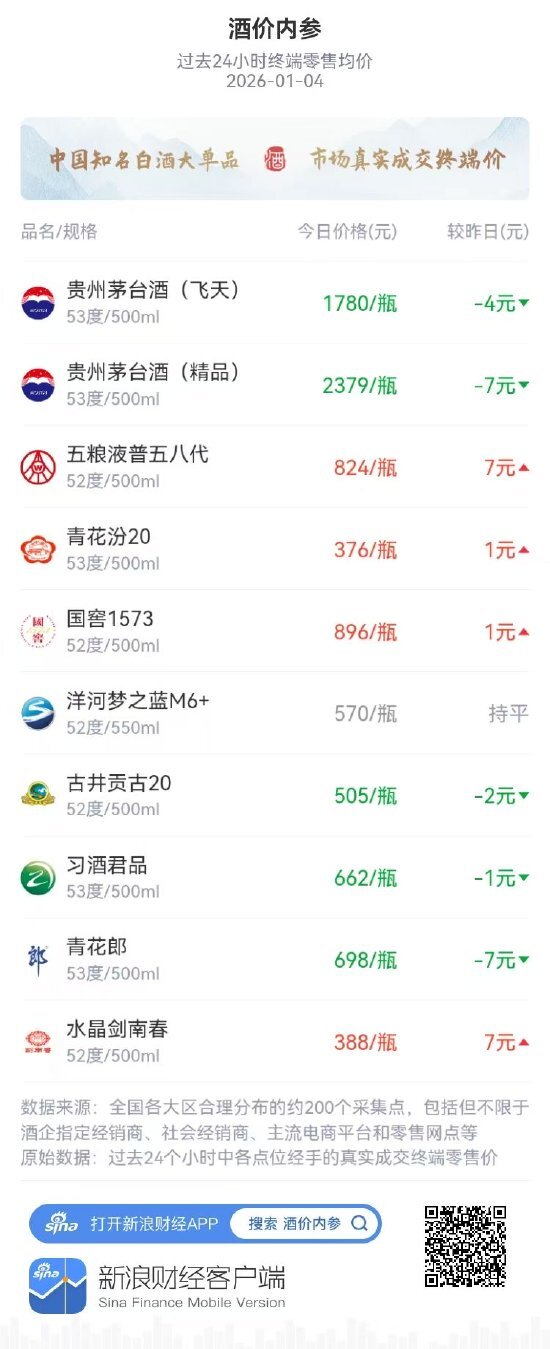
来源:酒业内参 sma 打开新浪财经APP 搜索 酒价内参 Q 新浪财经客户端 Sina Finance Mobile Version 白酒业的重要新闻方面,在元旦假期销售客户数超过十万名之后,茅台旗下数字营销平台"i茅台"于1月 3日宣布了一项关键调整:为迎接春节旺季并满足更广泛消费者的需求,自1月4日至春节前,将每位用 户每日购买53%vol 500ml飞天茅台(2026)的最高限额从12瓶下调至6瓶。此次调整将持续至春节前, 此举旨在通过更均衡的投放,让更多消费者能在节日期间购买到飞天产品。 | 1 1 | | --- | | | 国窖1573 52度/500ml | 896/瓶 | 1元A | | --- | --- | --- | --- | | 1 - 1 | 洋河梦之蓝M6+ | 570/瓶 | 持本 | | | 52度/550ml | | | | | 古井贡古20 | 505/瓶 | -2元▼ | | | 52度/500ml | | | | 2 | 习酒君品 53度/500ml | 662/瓶 | -1元▼ | | | 青花郎 53度/500ml | 698/瓶 | -7元▼ | | | 水晶 ...






酒价内参1月4日价格发布,青花郎下跌7元
Xin Lang Cai Jing· 2026-01-04 01:24
Core Insights - The core viewpoint of the article highlights the ongoing decline in the retail prices of major Chinese liquor brands, with the overall market sentiment remaining cautious as prices continue to slowly decrease [1][4]. Price Trends - The average retail price of the top ten Chinese liquor products on January 4 is reported at 9,078 yuan, down 5 yuan from the previous day, marking a new low for four consecutive trading days [1][4]. - The market shows a mixed performance with five products declining, four increasing, and one remaining stable [1][4]. Price Changes of Specific Products - Notable price increases include: - Wuliangye Pu Wubai: up 7 yuan per bottle [1][4] - Shuijingfang Jianan Chun: up 7 yuan per bottle [1][4] - Qinghua Fen 20: up 1 yuan per bottle [1][4] - Guojiao 1573: up 1 yuan per bottle, achieving four consecutive days of price increases [1][4] - Significant price decreases include: - Premium Moutai: down 7 yuan per bottle [1][4] - Qinghua Lang: down 7 yuan per bottle [1][4] - Feitian Moutai: down 4 yuan per bottle [1][4] - Gujing Gong Gu 20: down 2 yuan per bottle [1][4] - Xijiu Junpin: down 1 yuan per bottle [1][4] Market Data Collection - The data for the "Liquor Price Reference" is sourced from approximately 200 collection points across various regions, including designated distributors, social distributors, mainstream e-commerce platforms, and retail outlets, aiming to provide objective and traceable market price data [2][5]. Industry News - In a significant industry update, Moutai's digital marketing platform "i Moutai" announced a reduction in the daily purchase limit for the 53% vol 500ml Feitian Moutai from 12 bottles to 6, effective from January 4 until the Spring Festival, to better meet consumer demand during the holiday season [2][5].
酒价内参1月4日价格发布,国窖1573微涨1元实现四连阳
Xin Lang Cai Jing· 2026-01-04 01:24
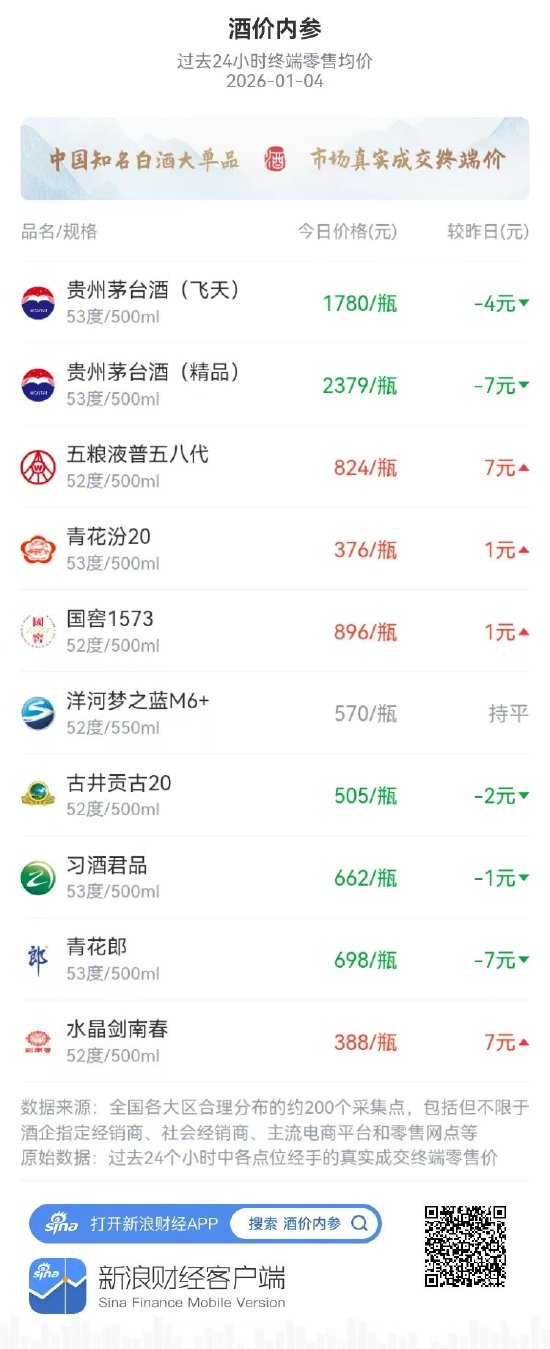
新浪财经"酒价内参"重磅上线 知名白酒真实市场价尽在掌握 新浪财经"酒价内参"过去24小时中收集的数据显示,中国白酒市场十大单品的终端零售均价在1月4日延 续弱势整理,整体价格继续小幅下行。如果十大单品各取一瓶整体打包售卖,今日总售价为9078元,较 昨日回落5元,连续第四个交易日创下近期新低。市场整体情绪依然谨慎,价格中枢在低位持续且缓慢 下移。 今日市场格局分化,五跌四涨一平。上涨产品中,五粮液普五八代表现亮眼,环比上涨7元/瓶,领涨市 场。水晶剑南春价格同样上涨7元/瓶。青花汾20与国窖1573价格分别微涨1元/瓶,后者已经实现四连 阳。洋河梦之蓝M6+价格则与昨日持平。下跌产品方面,精品茅台的价格回调幅度居前,下跌7元/瓶。 青花郎价格下跌7元/瓶。飞天茅台价格下跌4元/瓶。古井贡古20价格下跌2元/瓶。习酒君品价格微跌1 元/瓶。市场缺乏明确的上涨主线,多数产品均在窄幅区间内波动整理。 "酒价内参"的每日数据源自全国各大区均有合理分布的约200个采集点,包括但不限于酒企的指定经销 商、社会经销商、主流电商平台和零售网点等,原始取样数据为过去24个小时中各点位经手的真实成交 终端零售价格,力求为社会各 ...
酒价内参1月4日价格发布,水晶剑南春上涨7元领涨
Xin Lang Cai Jing· 2026-01-04 01:24
新浪财经"酒价内参"重磅上线 知名白酒真实市场价尽在掌握 新浪财经"酒价内参"过去24小时中收集的数据显示,中国白酒市场十大单品的终端零售均价在1月4日延 续弱势整理,整体价格继续小幅下行。如果十大单品各取一瓶整体打包售卖,今日总售价为9078元,较 昨日回落5元,连续第四个交易日创下近期新低。市场整体情绪依然谨慎,价格中枢在低位持续且缓慢 下移。 今日市场格局分化,五跌四涨一平。上涨产品中,五粮液普五八代表现亮眼,环比上涨7元/瓶,领涨市 场。水晶剑南春价格同样上涨7元/瓶。青花汾20与国窖1573价格分别微涨1元/瓶,后者已经实现四连 阳。洋河梦之蓝M6+价格则与昨日持平。下跌产品方面,精品茅台的价格回调幅度居前,下跌7元/瓶。 青花郎价格下跌7元/瓶。飞天茅台价格下跌4元/瓶。古井贡古20价格下跌2元/瓶。习酒君品价格微跌1 元/瓶。市场缺乏明确的上涨主线,多数产品均在窄幅区间内波动整理。 "酒价内参"的每日数据源自全国各大区均有合理分布的约200个采集点,包括但不限于酒企的指定经销 商、社会经销商、主流电商平台和零售网点等,原始取样数据为过去24个小时中各点位经手的真实成交 终端零售价格,力求为社会各 ...
酒价内参1月4日价格发布 市场弱势整理整体价格继续下探
Xin Lang Cai Jing· 2026-01-04 01:09
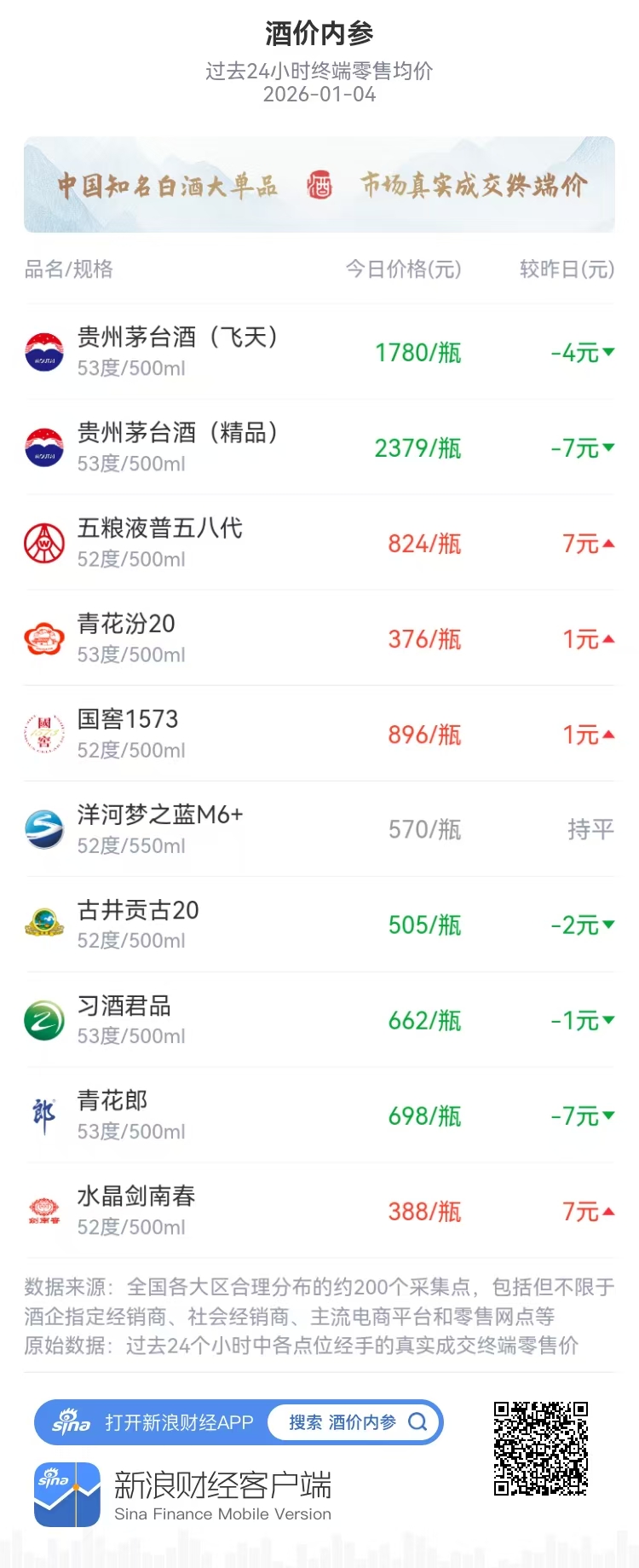
Core Viewpoint - The Chinese liquor market is experiencing a slight downward trend in retail prices for the top ten products, with the overall market sentiment remaining cautious and prices continuing to decline slowly [1]. Price Trends - The average retail price of the top ten liquor products on January 4 is 9,078 yuan, down 5 yuan from the previous day, marking the fourth consecutive day of decline [1]. - The market shows a mixed performance with five products increasing in price, four decreasing, and one remaining stable [1]. Price Changes of Key Products - Notable price increases include: - Wuliangye Pu Wubai: up 7 yuan per bottle [1][3]. - Shuijing Jian Nan Chun: up 7 yuan per bottle [1][4]. - Guojiao 1573: up 1 yuan per bottle, achieving four consecutive days of price increases [1][3]. - Price decreases include: - Premium Moutai: down 7 yuan per bottle [1][3]. - Qinghua Lang: down 7 yuan per bottle [1][4]. - Feitian Moutai: down 4 yuan per bottle [1][3]. - Gujing Gonggu 20: down 2 yuan per bottle [1][4]. - Xijiu Junpin: down 1 yuan per bottle [1][4]. Market Sentiment - The overall market sentiment remains cautious, with a lack of clear upward trends and most products fluctuating within narrow price ranges [1].
现在的年轻人,基本上已远离了白酒,2个根本原因,其他都是借口
Sou Hu Cai Jing· 2026-01-02 08:43
Core Viewpoint - The decline in liquor consumption, particularly in the high-end segment, is primarily attributed to economic conditions and policy changes rather than a shift in young people's drinking habits [1][31]. Economic Environment - The liquor industry, especially high-end liquor, is categorized as an "elastic consumption" good, meaning it is not a necessity and is more likely to be cut from budgets during economic downturns [14][18]. - The turning point for the liquor industry occurred in 2020, with stocks of major brands like Moutai and Wuliangye reaching historical peaks in early 2020 but subsequently declining for over five years [3][5]. - By the third quarter of 2025, even industry giants like Wuliangye reported significant profit declines, a scenario previously unimaginable [5]. - Economic pressures have led to reduced consumer spending, with a notable decrease in the business liquor market, which dropped by 32% year-on-year in 2024 [18][20]. Consumer Demographics - The primary consumer base for liquor has historically been middle-aged individuals, with those under 30 accounting for less than 15% of total consumption, while those over 35 represent 72.8% [9][12]. - The notion that young people are the cause of declining sales overlooks the fact that the main consumer group is facing economic challenges, leading to reduced spending [12][31]. Policy Impact - Recent policy changes, such as the revised regulations on government consumption of alcohol, have significantly altered the consumption landscape, particularly in the business sector [20][22]. - The 2025 revision of the "Regulations on Saving and Opposing Waste in Party and Government Agencies" expanded restrictions on all alcoholic beverages, contributing to a short-term decline of 2%-3% in the liquor sector [22][28]. - Local policies, like those from Guizhou province aimed at transforming the liquor industry, indicate a need for adaptation in response to changing market conditions [24][28]. Market Dynamics - The inventory levels of liquor companies have surged, with 20 listed liquor firms reporting stock levels of 168.39 billion yuan, an increase of 19.29 billion yuan year-on-year [26]. - Many distributors are experiencing price inversions, where the selling price is lower than the manufacturer's suggested price, further dampening market enthusiasm [26][28]. - The combination of economic pressures and policy regulations has compressed the consumption space for high-end liquor, which previously relied heavily on government and corporate events [30][31]. Conclusion - The decline in liquor consumption is fundamentally linked to economic conditions and regulatory changes rather than a simple shift in consumer preferences among younger demographics [31][37]. - The industry must adapt to these economic and policy shifts to meet evolving consumer demands, rather than attributing the decline to younger consumers [35][37].
罗振宇2026跨年演讲:1000天后的世界,当AI连接万物,我们如何连接彼此?
Quan Jing Wang· 2026-01-02 02:36
Core Insights - The future world in 2025 will see AI deeply integrated into daily life, optimizing decision-making and serving as a new foundation for societal operations, while raising questions about maintaining meaningful human connections in a technology-driven era [1] - AI is not about replacement but rather about restructuring human roles, emphasizing that certain fields requiring emotional connection and personalized care will always remain uniquely human [1] Group 1: Long-term Perspective - The discussion highlights the long-term commitment of Luzhou Laojiao, a brand with over 700 years of craftsmanship and continuous production for 450 years, showcasing the value of time in creating quality products [2] - The process of making fine liquor is portrayed as a slow, time-dependent transformation that cannot be expedited by algorithms, paralleling the importance of time in building genuine human relationships [2] Group 2: Emotional Connection - While AI can efficiently transmit information, true emotional connections between people often require a medium that fosters openness, such as sharing a drink, which allows for genuine conversation and connection [3] - The narrative emphasizes that despite the advancements in AI, the act of sharing a drink remains a vital way to connect with others, reinforcing trust and intimacy that cannot be replicated by digital communication [3]

2025白酒年度事件大盘点:告别高增长,行业挑战下的变革与新机
Sou Hu Cai Jing· 2025-12-31 14:12
Core Insights - The Chinese liquor industry is entering an adjustment phase in 2025, facing challenges such as the "ban on alcohol," rising inventory pressure, and declining profits, yet opportunities for growth are emerging through innovation and market expansion [2][4]. Policy Impact - A strict "ban on alcohol" policy was introduced, prohibiting public officials from consuming alcohol during workdays and even at home gatherings, with severe penalties for violations [2][4]. - This policy aims to curb corruption and address public health concerns related to alcohol consumption [4]. Digital Transformation - Leading liquor companies are advancing their digital transformation from isolated upgrades to comprehensive collaborative development, with initiatives like the first "lighthouse factory" by Luzhou Laojiao and 5G-connected factories by Shede [5]. - The Ministry of Industry and Information Technology has released guidelines for digital transformation in the liquor industry, with companies actively contributing to industry mapping [5]. ESG Practices - ESG efforts among listed liquor companies have shifted from compliance to value creation, with companies like Zhenjiu Li Du setting ambitious carbon neutrality goals and achieving high water recycling rates [7]. - Companies are integrating ESG principles into performance assessments and utilizing blockchain for product traceability [7]. Market Dynamics - The liquor market is experiencing severe inventory issues, with major companies implementing supply control measures and channel reforms to reshape pricing structures [8][10]. - In the first three quarters of 2025, liquor exports reached $704 million, a 5.3% increase year-on-year, indicating a growing international market [8][10]. Young Consumer Trends - The younger generation is increasingly favoring low-alcohol and flavored beverages, with participation rates among Gen Z rising from 66% in 2023 to 73% in 2025 [12]. - Major companies are launching low-alcohol products to cater to this demographic, with Wuliangye and Luzhou Laojiao leading the way [12]. Personnel Changes - The liquor industry is undergoing significant personnel changes, with over 20 companies experiencing nearly 30 key position shifts, indicating a trend towards younger management [14][16]. - The new management is expected to focus on refined operations and innovation to navigate industry pressures [16]. Financial Performance - In the first nine months of 2025, only two companies, Kweichow Moutai and Shanxi Fenjiu, reported positive net profit growth, while the average profit of 20 liquor companies fell by 39.2% [18]. - The average inventory turnover days for these companies surged to 1456.29 days, marking a significant increase from the previous year [18]. Health-Oriented Products - The health-oriented liquor market is gaining traction, with sales of functional products like Jinjian's red label liquor increasing by 50% in the first half of the year [20]. - However, the market faces challenges such as product homogeneity and compliance risks, with a projected market size exceeding 58 billion yuan [22]. Price Fluctuations - Moutai's price fell below the official guidance price of 1499 yuan per bottle in December 2025, raising concerns about future price trends [22]. - Following a price drop, Moutai's wholesale prices rebounded due to supply control measures and increased market demand during the peak season [24].

白酒板块12月31日跌1.01%,*ST岩石领跌,主力资金净流出15.73亿元
Zheng Xing Xing Ye Ri Bao· 2025-12-31 08:59
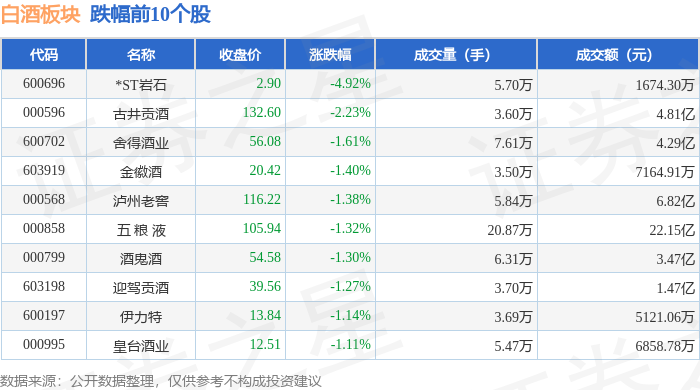
Core Viewpoint - The liquor sector experienced a decline of 1.01% on December 31, with *ST Yanshi leading the drop, while the overall market showed mixed results with the Shanghai Composite Index up by 0.09% and the Shenzhen Component Index down by 0.58% [1] Liquor Sector Performance - The closing prices and percentage changes for key liquor stocks are as follows: - *ST Yanshi: 2.90, -4.92% - Gujing Gongjiu: 132.60, -2.23% - Shede Manye: 56.08, -1.61% - Quanwei Jiu: 20.42, -1.40% - Luzhou Laojiao: 116.22, -1.38% - Wuliangye: 105.94, -1.32% - Zhisi Cha: 54.58, -1.30% - Yingjia Gongjiu: 39.56, -1.27% - Yilite: 13.84, -1.14% - Huangtai Jiuye: 12.51, -1.11% [1] Capital Flow Analysis - The liquor sector saw a net outflow of 1.573 billion yuan from main funds, while retail investors contributed a net inflow of 712 million yuan [1] - The detailed capital flow for selected stocks indicates: - Gujing Gongjiu: Main net inflow of 5.437 million yuan, retail net inflow of 2.302 million yuan - *ST Yanshi: Main net outflow of 4.866 million yuan, retail net inflow of 4.265 million yuan - Other stocks like Jinzhongzi Jiu and Kuozi Jiao experienced significant net outflows from main and retail funds [2]


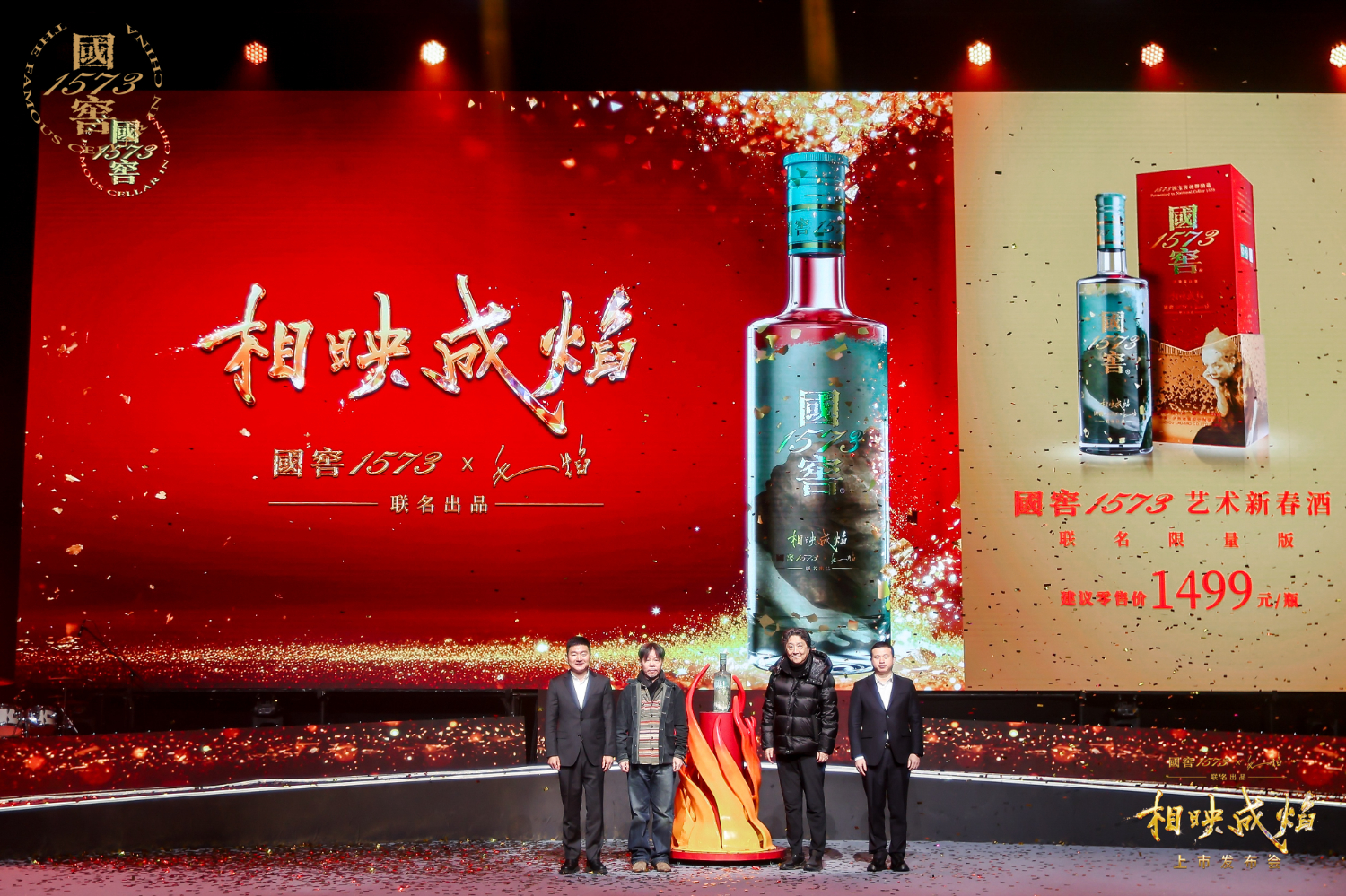
当百年浓香遇见当代艺术:国窖1573第七款艺术新春酒在杭州盛大发布
Xin Hua Cai Jing· 2025-12-31 08:29
Core Insights - The launch event for the "National Cellar 1573 x Mao Yan 'Mutual Flame' Art Spring Wine" took place on December 26, 2025, in Hangzhou, showcasing the collaboration between traditional Chinese liquor and contemporary art [1][6]. Group 1: Product Launch and Collaboration - The seventh edition of the National Cellar 1573 Art Spring Wine was unveiled, featuring artist Mao Yan, known for his contemporary portraiture [3][4]. - The collaboration symbolizes the fusion of traditional liquor craftsmanship and modern artistic exploration, emphasizing the essence of "water" representing the liquor's heritage and "flame" symbolizing the artist's creative spirit [4][7]. Group 2: Brand Positioning and Market Performance - National Cellar 1573 is recognized as a leading ultra-premium Chinese liquor brand, achieving over 10 billion in revenue for both high and low alcohol products, marking a significant milestone in the market [11]. - The brand aims to promote Chinese liquor culture globally, leveraging its rich heritage and innovative approaches to reach wider audiences [7][24]. Group 3: Art and Philanthropy - The event included a charity auction for the art spring wine, raising 187,000 yuan, with proceeds supporting the "Contemporary is Future" art philanthropy project [19][21]. - National Cellar 1573 has been actively involved in art philanthropy, contributing to the preservation and development of contemporary Chinese art through various initiatives [17][14]. Group 4: Digital Marketing and E-commerce Strategy - The new product was launched on Tmall, achieving over 100,000 yuan in sales during the live broadcast, highlighting the effective collaboration between high-end liquor and e-commerce platforms [23][24]. - The brand's strategy focuses on enhancing online distribution channels and creating value through partnerships with leading e-commerce platforms [24].