
GUJING(000596)

Search documents
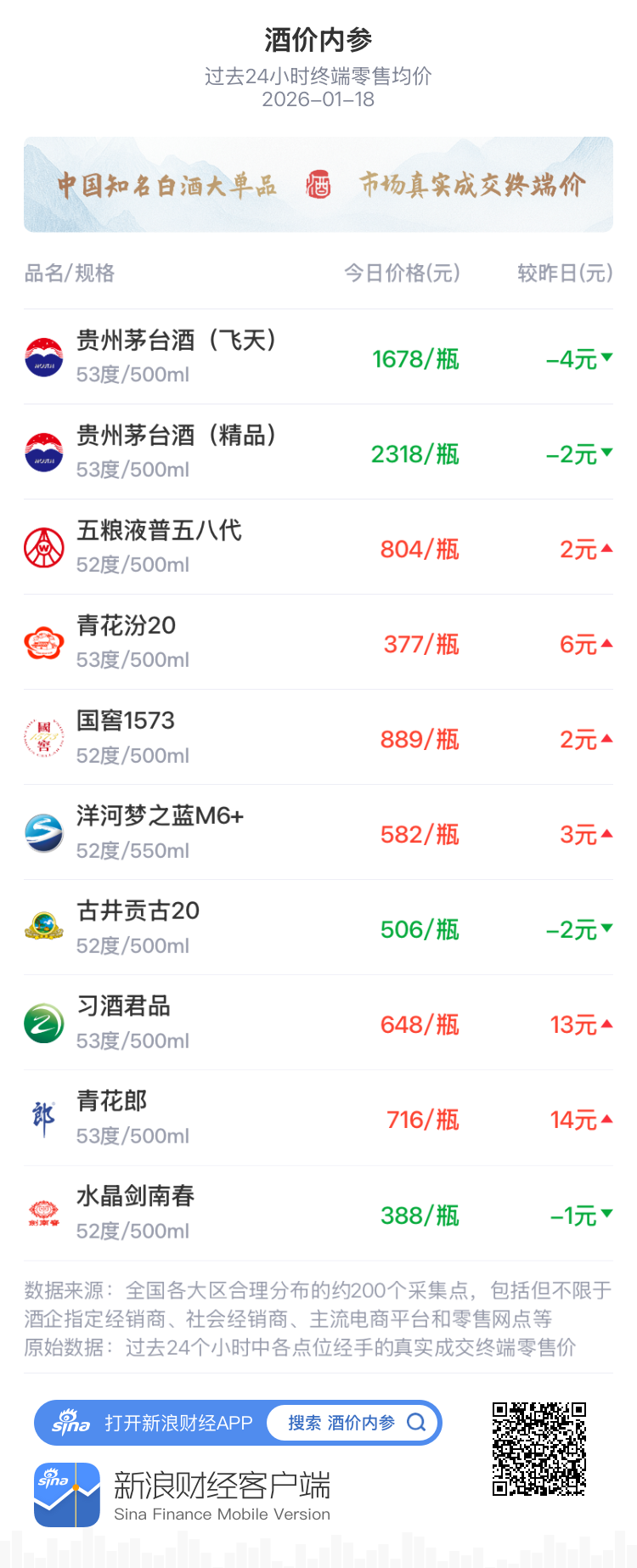
酒价内参1月18日价格发布 十大单品涨跌互现整体价格温和反弹
Xin Lang Cai Jing· 2026-01-18 01:19
Core Insights - The Chinese liquor market shows a mixed trend with six products increasing in price and four decreasing over the past 24 hours, indicating ongoing industry adjustments and a lack of significant improvement in market sentiment [1] Price Movements - The overall price for a package of the top ten liquor products is 8,906 yuan, which is an increase of 31 yuan from the previous day [1] - Among the products that increased in price, Qinghua Lang rose by 14 yuan per bottle, while Xijiu Junpin followed with a 13 yuan increase [1][4] - Other notable increases include Qinghua Fen 20 (up 6 yuan), Yanghe Dream Blue M6+ (up 3 yuan), and Guojiao 1573 and Wuliangye Pu 58th generation (both up 2 yuan) [1][3] Declining Products - Feitian Moutai continues to decline, with a decrease of 4 yuan per bottle, influenced by the "price anchoring" effect from the iMoutai platform [1][3] - Other products that saw a decrease include Boutique Moutai (down 2 yuan), Gujing Gong Gu 20 (down 2 yuan), and Shuijing Jian Nan Chun (down 1 yuan) [1][4]







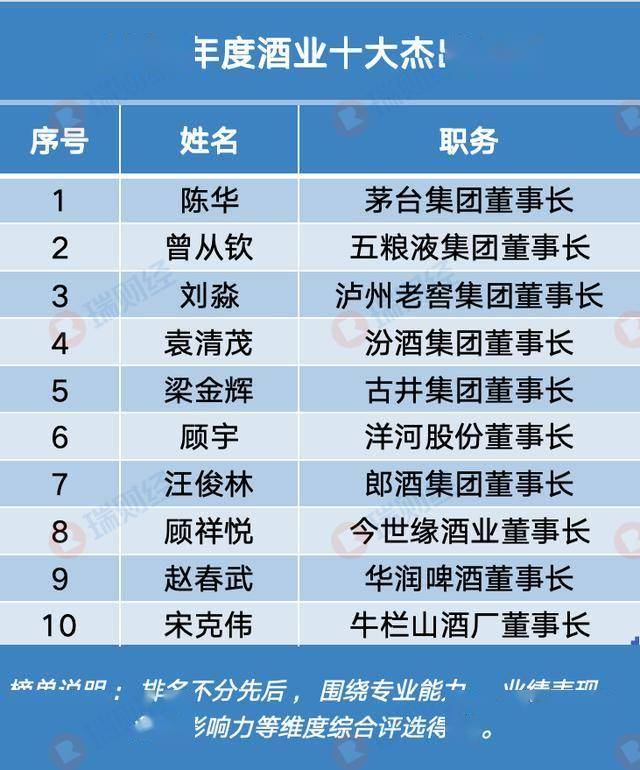
古井集团董事长梁金辉入选“2025年度酒业十大杰出人物”
Sou Hu Cai Jing· 2026-01-16 02:10
Group 1 - The "Top Ten Outstanding Figures in the Liquor Industry for 2025" list was announced by Rui Finance, with Liang Jinhui, Chairman of Gujing Group, being selected [2] - The selection criteria for the list included professional ability, performance, and industry influence [2] - Liang Jinhui has a background in business management and has held various leadership positions within Gujing Group, contributing to its growth and innovation [3] Group 2 - In 2025, under Liang Jinhui's leadership, the group aims to achieve breakthroughs in product innovation, flexible channel strategies, and deeper international expansion [3]
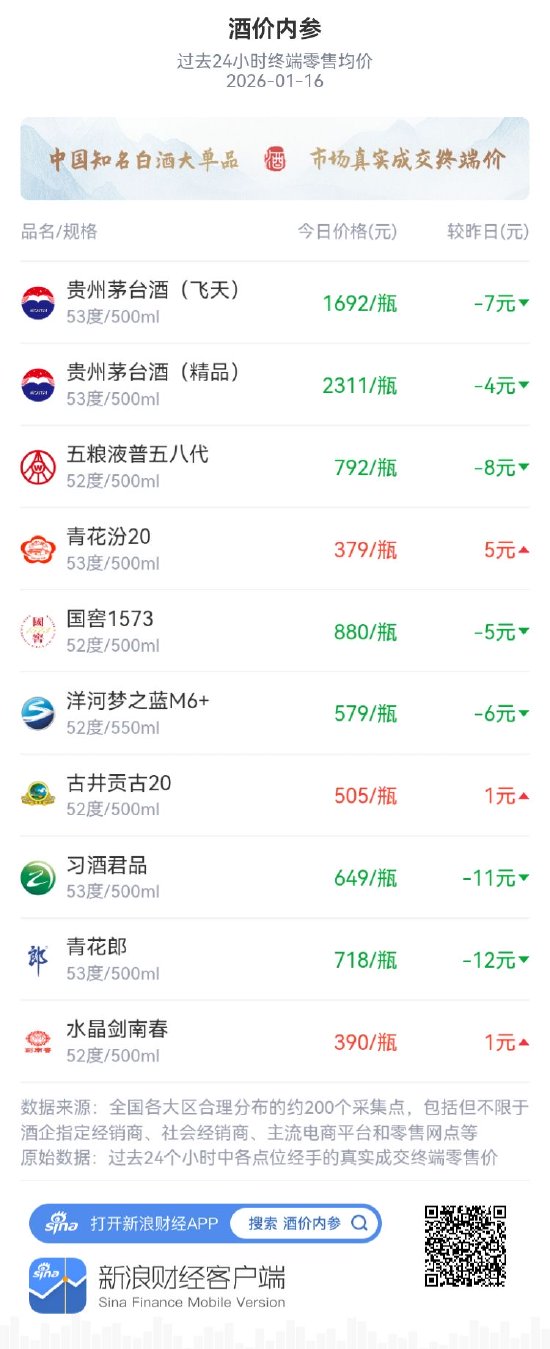
酒价内参1月16日价格发布 青花汾20上涨5元
Xin Lang Cai Jing· 2026-01-16 01:24
Core Insights - The core viewpoint of the article highlights a significant decline in the retail prices of major Chinese liquor brands, indicating ongoing inventory adjustments within the industry [1][7]. Price Trends - The average retail price of the top ten liquor products in China fell to 8,895 yuan on January 16, a decrease of 46 yuan from the previous day, marking the lowest price level in nearly two months [1][7]. - Among the ten products, seven experienced price drops while three saw increases, with key products collectively contributing to the decline in average prices [1][7]. Specific Product Price Changes - Leading the price declines were Qinghua Lang and Xijiu Junpin, which fell by 12 yuan and 11 yuan per bottle, respectively [1][7]. - Wuliangye Pu Wu Eight Generation decreased by 8 yuan, while Feitian Moutai dropped by 7 yuan, influenced by the iMoutai platform's pricing strategies and inventory adjustments [1][7]. - Other notable declines included Yanghe Dream Blue M6+ and Guojiao 1573, which fell by 6 yuan and 5 yuan, respectively [1][7]. - In contrast, Qinghua Fen 20 saw an increase of 5 yuan, while Gujing Gonggu 20 and Shuijing Jian Nan Chun rose by 1 yuan each [1][7]. Market Dynamics - The decline in prices is attributed to differentiated consumer demand and price adjustments by leading brands, reflecting the ongoing inventory reduction process in the liquor industry [1][7]. - The iMoutai platform's recent sales of Moutai products at competitive prices have had a magnetic effect on the market, contributing to the observed price changes [2][8]. Sales and Marketing Strategies - Moutai has been leveraging digital marketing through the iMoutai platform, which has seen significant engagement, including the rapid sell-out of new product releases [3][9]. - The platform's popularity surged, reaching the top of the Apple App Store's shopping category, with over 2.7 million new users added within nine days of launching a new product [3][9]. - Moutai's board has approved a market-oriented operational strategy, enhancing its sales model to include a dynamic pricing adjustment mechanism based on market conditions [3][9].
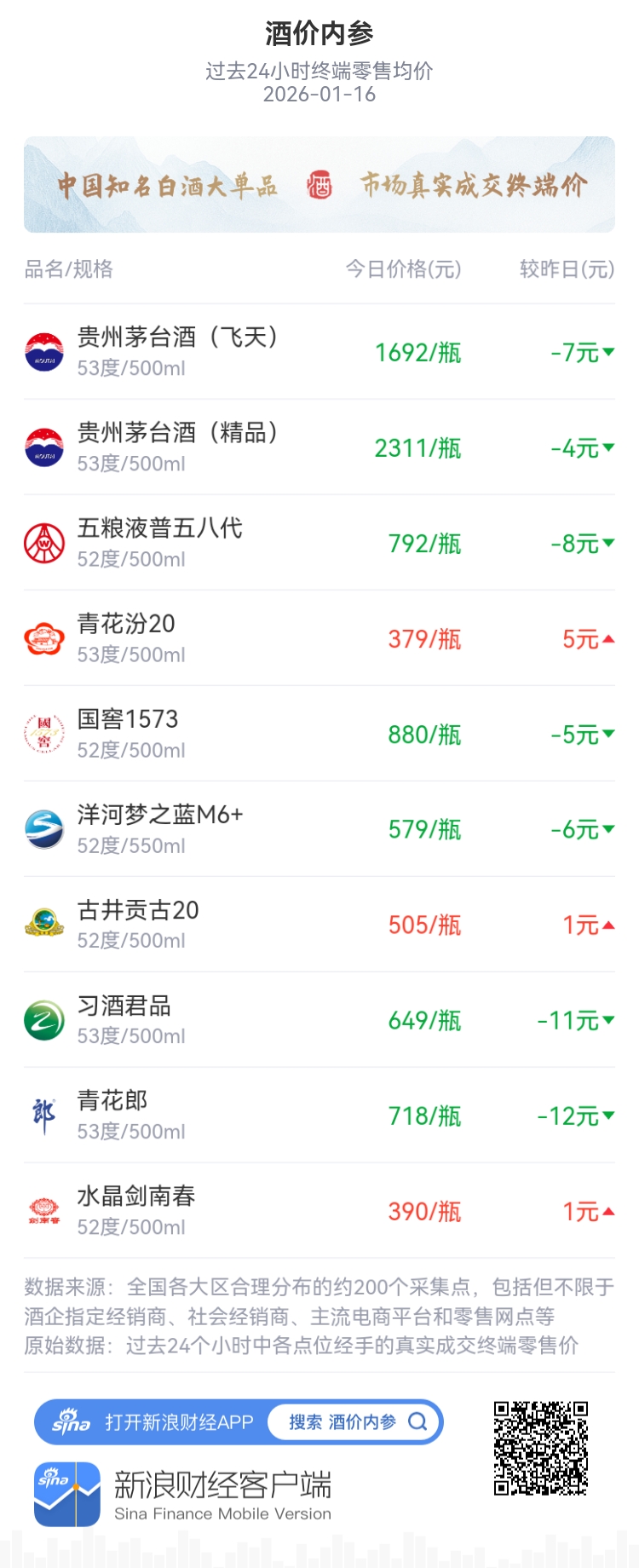
酒价内参1月14日价格发布 市场普跌回调价格中枢下探
Xin Lang Cai Jing· 2026-01-16 01:21
Core Viewpoint - The Chinese liquor market, particularly for the top ten baijiu products, has experienced a general price adjustment, with a moderate decline in retail prices as of January 14, indicating cautious market sentiment [1]. Price Trends - The total retail price for a package of the top ten baijiu products is 8925 yuan, down 44 yuan from the previous day [1]. - Eight out of the ten products have seen price declines, reflecting a bearish market trend [1]. - The leading product, Feitian Moutai, has decreased by 9 yuan per bottle, while other notable declines include Gujing Gonggu and Qinghua Lang, both down 8 yuan per bottle [1][2]. Individual Product Pricing - Feitian Moutai (53 degrees, 500ml) is priced at 1692 yuan, down 7 yuan [2]. - The premium Moutai variant is significantly down by 470 yuan, now at 2311 yuan [2]. - Wuliangye (Pu Wu 8th generation, 52 degrees, 500ml) is priced at 792 yuan, down 8 yuan [2]. - Other products like Guojiao 1573 and Yanghe Dream Blue M6+ have also seen minor declines of 5 yuan and 6 yuan respectively [2][3]. Market Dynamics - The market is characterized by a general decline in prices, with only Wuliangye showing a slight increase of 1 yuan, while Qinghua Fen remains stable [1]. - The overall market sentiment appears cautious, with a narrowing of trading volumes and a clear differentiation in product performance [1].
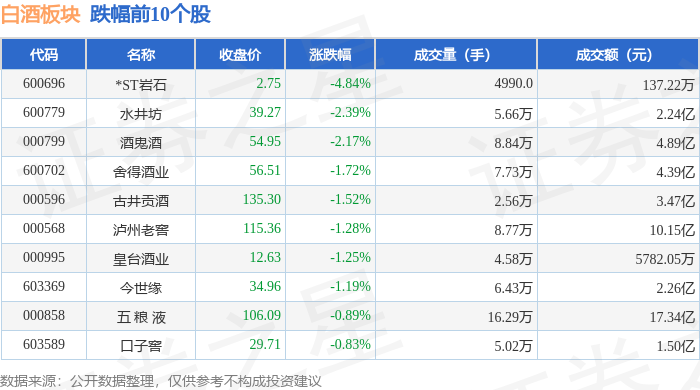
白酒板块1月15日跌0.77%,*ST岩石领跌,主力资金净流出11.52亿元
Zheng Xing Xing Ye Ri Bao· 2026-01-15 08:59
Group 1 - The liquor sector experienced a decline of 0.77% on January 15, with *ST Rock leading the drop [1] - The Shanghai Composite Index closed at 4112.6, down 0.33%, while the Shenzhen Component Index rose by 0.41% to 14306.73 [1] - Major liquor stocks showed varied performance, with *ST Rock down 4.84% to 2.75, and other notable declines including Shui Jing Fang down 2.39% and Moutai down 7.31% in net outflow [1][2] Group 2 - The liquor sector saw a net outflow of 1.152 billion yuan from main funds, while retail investors contributed a net inflow of 528 million yuan [1] - Specific stocks like Moutai and Wuliangye faced significant net outflows of 416 million yuan and 201 million yuan respectively, indicating a shift in investor sentiment [2] - The data indicates that retail investors are increasingly active, with a notable net inflow into stocks like Wuliangye, which saw 157 million yuan from retail investors [2]


中国消费板块 2026 展望:消费信心复苏是否已开启?-China Consumer Sector_ 2026 Outlook_ are we at the beginning of consumer confidence recovery_
2026-01-15 06:33
Summary of the Conference Call Transcript Industry Overview - **Industry**: China Consumer Sector - **Outlook**: The sector is believed to be in the early stage of a multi-year recovery cycle that began in Q3 2024, with expectations for gradual improvement in consumer sentiment and spending through 2026E [2][11][12] Key Insights - **Valuation**: MSCI China Consumer Discretionary and Staples are trading at 17x and 15x 12-month forward PE, approximately one standard deviation below the 10-year averages, indicating that current valuations do not reflect a potential consumption recovery [2][9] - **Consumer Confidence**: The China Consumer Confidence Index has been trending upwards since September 2024, suggesting a gradual restoration of consumer confidence despite ongoing challenges in the property market [12][19] - **K-shaped Recovery**: The recovery is characterized by a K-shaped trend, where mid- to high-income consumers in tier-1 cities are expected to lead spending, while lower-tier city consumers remain focused on value for money [3][48] Consumer Behavior Trends - **Shifting Preferences**: A UBS Evidence Lab survey indicates a divergence in consumer behavior, with over 50% of mid- to high-income consumers reporting investment gains and showing strong spending intentions, particularly in premium and experiential categories [3][37] - **Spending Intentions**: The strongest spending intentions are noted in beauty and skincare (41%) and tourism (37%), reflecting a shift towards experiential and premium spending [51] - **Investment Gains**: 64-74% of mid- to high-income consumers reported increased investment returns, with many planning to reinvest or spend on travel, health services, and consumer electronics [40][41] Stock Implications - **Company Ratings**: - Upgrades to Neutral for Fenjiu due to expected benefits from non-business baijiu consumption - Buy ratings maintained for companies like MIXUE, Guming, China Foods, CR Beer, and YUM China, among others [4] - **Dividend Payouts**: Premium baijiu companies are noted for their >75% dividend payout, which is expected to protect share prices from downside risks [4] Structural Growth Opportunities - **Emerging Themes**: Key investment themes for 2026E include changing consumer preferences, corporate restructuring, and industry consolidation, particularly in sectors like home appliances and mass-market consumption [14][50] - **Corporate Restructuring**: Companies are expected to adapt their business models to align with changing consumer behaviors, which may lead to sustainable long-term earnings growth [4][50] Risks and Challenges - **Property Market Downturn**: The ongoing downturn in the property market is anticipated to weigh on household balance sheets, potentially impacting consumer spending [13][48] - **Policy Support**: The pace of recovery is contingent on stabilizing the property market and effective policy implementation to boost consumption [13][48] Conclusion - The China consumer sector is poised for a recovery, driven by improving consumer confidence and shifting spending patterns. However, the recovery will be uneven across different income groups and city tiers, necessitating a nuanced investment approach to capture emerging opportunities while being mindful of potential risks associated with the property market downturn.



酒价内参1月15日价格发布 国窖1573上涨7元
Xin Lang Cai Jing· 2026-01-15 01:19
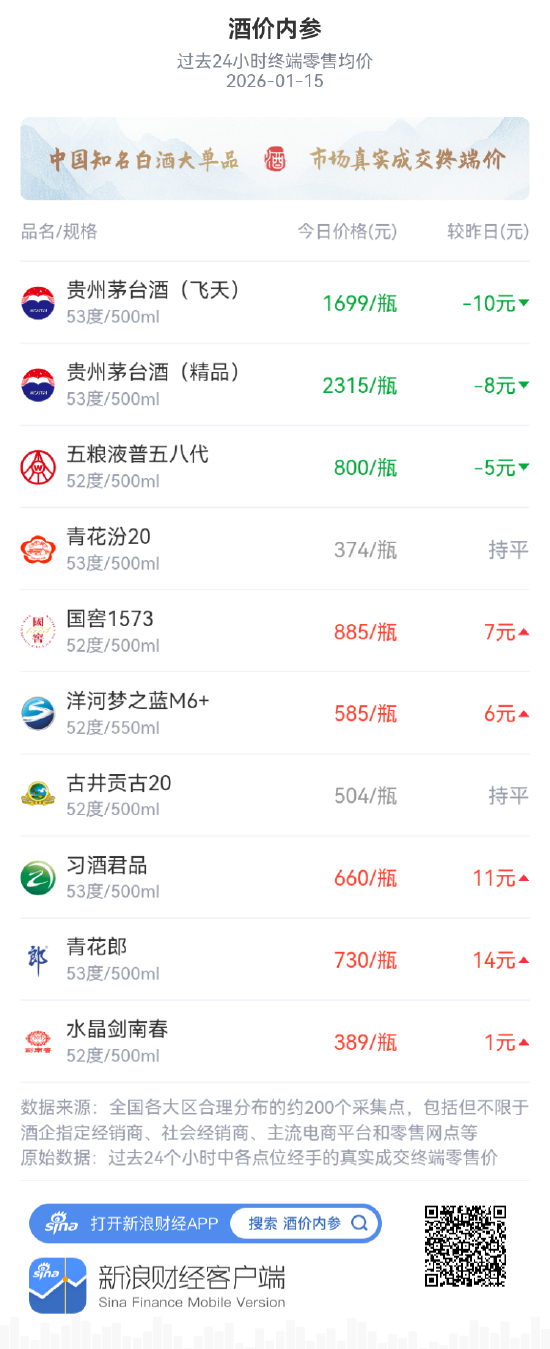
Core Insights - The article highlights the recent slight recovery in the retail prices of China's top ten liquor products, with an overall increase of 16 yuan, bringing the total price to 8941 yuan as of January 15 [1][6][7] - The market is experiencing structural volatility with five products increasing in price, three decreasing, and two remaining stable, reflecting the current industry adjustment phase [1][7] Price Movements - The leading price increase was observed in Qinghua Lang, which rose by 14 yuan per bottle, followed by Xijiu Junpin with an increase of 11 yuan per bottle [1][7] - Other notable price increases include Guojiao 1573 and Yanghe Dream Blue M6+, which rose by 7 yuan and 6 yuan per bottle, respectively [1][7] - Conversely, the prices of Feitian Moutai and Boutique Moutai decreased by 10 yuan and 8 yuan per bottle, respectively, attributed to the impact of the iMoutai platform's pricing strategy [1][7] Data Collection Methodology - The "Wine Price Reference" collects data from approximately 200 sampling points across various regions, including designated distributors, social distributors, e-commerce platforms, and retail outlets, ensuring a comprehensive and objective representation of market prices [2][8] - The data reflects real transaction prices from the past 24 hours, aiming to provide a reliable and traceable source of information for the liquor market [2][8] New Sales Initiatives - Moutai's digital marketing platform, iMoutai, announced a structured sales schedule for multiple core products starting January 15, 2026, including fixed monthly sales for various Moutai products [3][8] - This initiative is part of Moutai's strategy to enhance market supply through digital channels and align more closely with consumer demand, reinforcing its direct sales system [3][8]
酒价内参1月15日价格发布 青花郎上涨14元
Xin Lang Cai Jing· 2026-01-15 01:19
Core Viewpoint - The "Wine Price Reference" by Sina Finance has reported a slight recovery in the retail prices of China's top ten liquor products as of January 15, with an overall price increase of 16 yuan, bringing the total price for a package of these products to 8941 yuan [1][6]. Price Trends - The market shows a clear structural differentiation with five products increasing in price, three decreasing, and two remaining stable. Notably, the core products have experienced price adjustments [1][7]. - The leading price increase was observed in Qinghua Lang, which rose by 14 yuan per bottle, followed by Xijiu Junpin with an increase of 11 yuan per bottle. Other products like Guojiao 1573 and Yanghe Dream Blue M6+ saw increases of 7 yuan and 6 yuan per bottle, respectively. Crystal Jiananspring had a minor increase of 1 yuan per bottle [1][7]. - Conversely, Feitian Moutai and Boutique Moutai led the price declines, dropping by 10 yuan and 8 yuan per bottle, respectively. This decline is attributed to the introduction of the affordable 2026 Feitian Moutai and the pricing anchor effect of Boutique Moutai [1][7]. Data Collection Methodology - The daily data for "Wine Price Reference" is sourced from approximately 200 collection points across various regions, including designated distributors, social distributors, e-commerce platforms, and retail outlets. The data aims to provide an objective and traceable representation of the market prices for well-known liquor products [2][8]. - The recent launch of the iMoutai platform, which offers Feitian Moutai at 1499 yuan per bottle and Boutique Moutai at 2299 yuan per bottle, has begun to influence the market retail prices significantly [2][8]. Product Launches - Moutai's digital marketing platform, iMoutai, announced a structured sales schedule starting January 15, 2026, for several core products, including six vintage versions of Feitian Moutai. The platform will have fixed sales times for various products, enhancing its direct sales system and aligning with consumer demand [3][8].
酒价内参1月15日价格发布 价格小幅回升分化格局凸显
Xin Lang Cai Jing· 2026-01-15 01:16
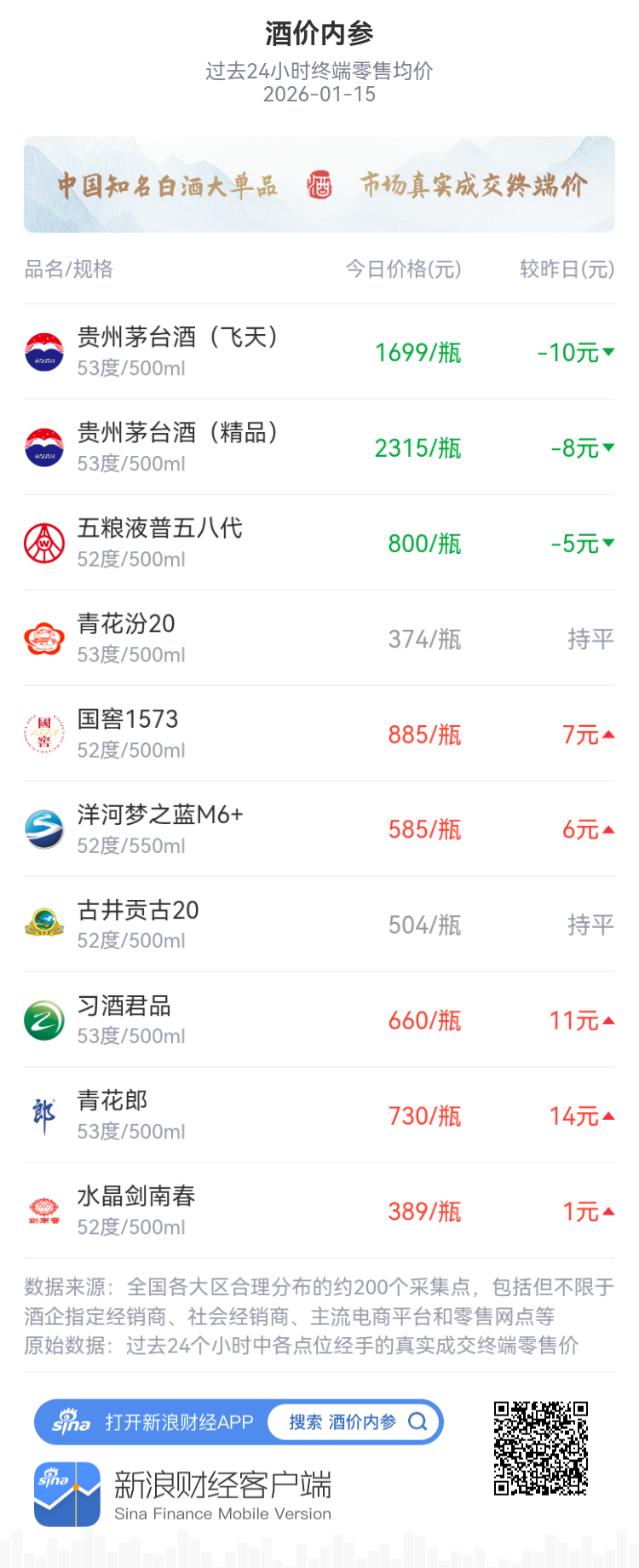
Core Viewpoint - The Chinese white liquor market has shown a slight recovery in retail prices for the top ten products as of January 15, with an overall price increase of 16 yuan, bringing the total price for a packaged set to 8941 yuan, indicating a structural volatility in the market amidst ongoing industry adjustments [1]. Price Movements - The market displayed a clear differentiation today, with five products increasing in price, three decreasing, and two remaining stable. Notably, core product prices have seen a correction [1]. - Among the products that increased in price, Qinghua Lang led with a rise of 14 yuan per bottle, while Xijiu Junpin followed with an increase of 11 yuan per bottle. Other notable increases included Guojiao 1573 and Yanghe Dream Blue M6+, which rose by 7 yuan and 6 yuan per bottle, respectively. The price of Shuijing Jian'nan Chun saw a minor increase of 1 yuan per bottle [1][4]. - Conversely, Feitian Moutai and Jingpin Moutai experienced the largest declines, dropping by 10 yuan and 8 yuan per bottle, respectively. This decline is attributed to the pricing strategy of iMoutai, which has introduced a more affordable 2026 Feitian Moutai, affecting retail prices [1][3]. - Wuliangye Pu 58th generation also saw a decrease of 5 yuan per bottle, while Qinghua Fen 20 and Gujing Gong 20 remained unchanged from the previous day [1][4]. Market Data - The current retail prices for key products are as follows: - Feitian Moutai: 1699 yuan (down 10 yuan) - Jingpin Moutai: 2315 yuan (down 8 yuan) - Wuliangye Pu 58th generation: 800 yuan (down 570 yuan) - Qinghua Fen 20: 374 yuan (unchanged) - Guojiao 1573: 885 yuan (up 7 yuan) - Yanghe Dream Blue M6+: 585 yuan (up 6 yuan) - Xijiu Junpin: 660 yuan (up 11 yuan) - Qinghua Lang: 730 yuan (up 14 yuan) - Shuijing Jian'nan Chun: 389 yuan (up 1 yuan) [3][4].
古井贡酒把“年酒”端上寻常餐桌,让“中国年酒”成为人人举得起的团圆符号
Guan Cha Zhe Wang· 2026-01-14 02:32
Core Viewpoint - Gujinggongjiu has reaffirmed its position as the exclusive partner of the Spring Festival Gala for the eleventh consecutive year, emphasizing its deep integration into Chinese New Year culture and its commitment to making traditional liquor accessible to the general public [1][5][9]. Brand Partnership and Cultural Significance - The partnership with the Spring Festival Gala has transformed Gujinggongjiu from a mere product into a cultural symbol, representing collective memories of Chinese families during the New Year [5][9]. - The introduction of "Gujinggongjiu · Year Thirty [He]" at a price point of 220 yuan aims to democratize the experience of traditional liquor, making it a staple for family gatherings rather than a luxury item [10][11]. Product Development and Market Strategy - The new product "Gujinggongjiu · Year Thirty [He]" retains the brand's cultural essence while lowering the price to appeal to a broader consumer base, thus enhancing its market presence [10][12]. - The product's design incorporates traditional elements, such as the red lantern and auspicious symbols, reinforcing its connection to Chinese New Year celebrations [6][14]. Craftsmanship and Heritage - Gujinggongjiu boasts a rich heritage of over 1800 years, with its brewing techniques recognized as the oldest distillation method in the world, contributing to its unique market position [13][14]. - The brand emphasizes a balance between traditional craftsmanship and modern innovation, ensuring high-quality production while respecting cultural heritage [14][15]. Cultural Impact and Consumer Engagement - The phrase "Celebrate the New Year, drink Gujing, watch the Spring Festival Gala" has become a cultural phenomenon, reflecting the brand's successful integration into the fabric of Chinese New Year celebrations [15][17]. - The brand's strategy not only focuses on sales but also on fostering cultural connections, making it a vital part of family traditions during the festive season [15][17].
