Zhujiang Brewery(002461)

Search documents
珠江啤酒(002461) - 关于公司董事辞职的公告
2025-12-05 07:45
公司董事会对吴家威先生任职期间所做工作表示感谢! 特此公告。 广州珠江啤酒股份有限公司董事会 2025 年 12 月 6 日 本公司及董事会全体成员保证公告内容真实、准确、完整,没有虚假记载、 误导性陈述或重大遗漏。 广州珠江啤酒股份有限公司(以下简称"公司")董事会于 2025 年 12 月 5 日收 到公司董事吴家威先生的书面辞职报告。因已达到法定退休年龄,吴家威先生申请 辞去公司董事及董事会审计委员会委员职务。辞职生效后,吴家威先生不在公司及 公司控股子公司担任任何职务。截至本公告披露日,吴家威先生未持有公司股份, 不存在应履行而未履行的承诺事项。 根据有关规定,吴家威先生辞职未导致公司董事会成员低于法定最低人数,已 按公司相关规定做好工作交接,不会影响公司相关工作的正常开展,吴家威先生的 辞职报告自送达公司董事会之日起生效。公司将按照法定程序补选董事。 证券代码:002461 证券简称:珠江啤酒 公告编号:2025-035 广州珠江啤酒股份有限公司 关于公司董事辞职的公告 ...

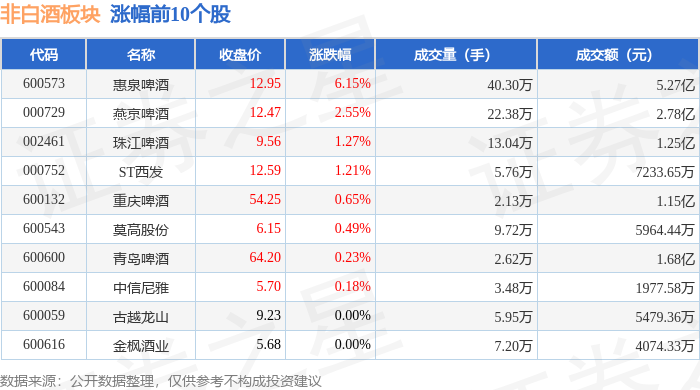
非白酒板块12月2日涨0.52%,惠泉啤酒领涨,主力资金净流入1.13亿元
Zheng Xing Xing Ye Ri Bao· 2025-12-02 09:03
Market Overview - The non-liquor sector increased by 0.52% on December 2, with Huichuan Beer leading the gains [1] - The Shanghai Composite Index closed at 3897.71, down 0.42%, while the Shenzhen Component Index closed at 13056.7, down 0.68% [1] Individual Stock Performance - Huichuan Beer (600573) closed at 12.95, up 6.15% with a trading volume of 403,000 shares and a turnover of 527 million yuan [1] - Wujing Beer (000729) closed at 12.47, up 2.55% with a trading volume of 223,800 shares and a turnover of 278 million yuan [1] - Zhujiang Beer (002461) closed at 9.56, up 1.27% with a trading volume of 130,400 shares and a turnover of 125 million yuan [1] - ST Xifa (000752) closed at 12.59, up 1.21% with a trading volume of 57,600 shares and a turnover of 72.34 million yuan [1] - Chongqing Beer (600132) closed at 54.25, up 0.65% with a trading volume of 21,300 shares and a turnover of 115 million yuan [1] Capital Flow Analysis - The non-liquor sector saw a net inflow of 113 million yuan from institutional investors, while retail investors experienced a net outflow of 94.81 million yuan [2][3] - Huichuan Beer had a net inflow of 191.1 million yuan from institutional investors, but a net outflow of 64.7 million yuan from retail investors [3] - Wujing Beer experienced a net inflow of 24.35 million yuan from institutional investors, with a net outflow of 42.18 million yuan from retail investors [3]


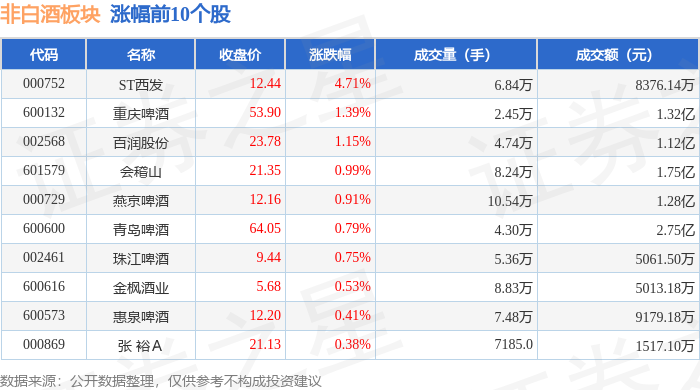
非白酒板块12月1日涨0.81%,ST西发领涨,主力资金净流出2610.67万元
Zheng Xing Xing Ye Ri Bao· 2025-12-01 09:03
Market Performance - The non-liquor sector increased by 0.81% compared to the previous trading day, with ST Xifa leading the gains [1] - The Shanghai Composite Index closed at 3914.01, up 0.65%, while the Shenzhen Component Index closed at 13146.72, up 1.25% [1] Stock Performance - ST Xifa (000752) closed at 12.44, rising by 4.71% with a trading volume of 68,400 shares and a transaction value of 83.76 million yuan [1] - Other notable stocks include Chongqing Beer (600132) at 53.90, up 1.39%, and Baijiu Co. (002568) at 23.78, up 1.15% [1] Capital Flow - The non-liquor sector experienced a net outflow of 26.11 million yuan from institutional investors, while retail investors saw a net inflow of 40.03 million yuan [2] - The detailed capital flow indicates that ST Xifa had a net inflow of 8.10 million yuan from institutional investors, despite a net outflow from retail investors [3]


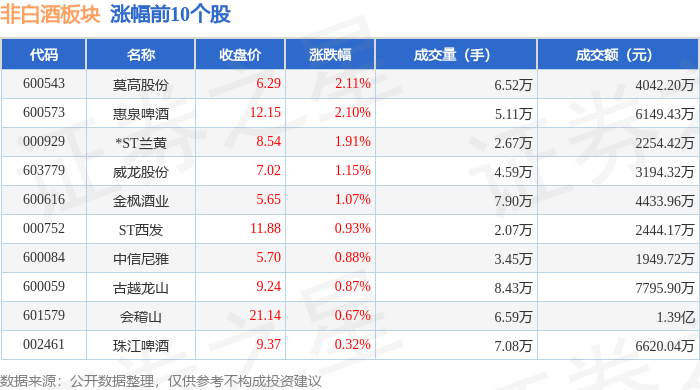
非白酒板块11月28日跌0.01%,青岛啤酒领跌,主力资金净流出1.21亿元
Zheng Xing Xing Ye Ri Bao· 2025-11-28 09:08
Core Viewpoint - The non-baijiu sector experienced a slight decline of 0.01% on November 28, with Qingdao Beer leading the drop, while the overall market indices showed positive movements [1] Market Performance - The Shanghai Composite Index closed at 3888.6, up 0.34% - The Shenzhen Component Index closed at 12984.08, up 0.85% [1] Non-Baijiu Sector Stock Performance - Notable gainers in the non-baijiu sector included: - Mogao Co., Ltd. (600543) with a closing price of 6.29, up 2.11% - Huichuan Beer (600573) at 12.15, up 2.10% - ST Lanhua (000929) at 8.54, up 1.91% - Weilang Co., Ltd. (603779) at 7.02, up 1.15% - Jinfeng Wine Industry (600616) at 5.65, up 1.07% [1] Capital Flow Analysis - The non-baijiu sector saw a net outflow of 121 million yuan from institutional investors - Retail investors contributed a net inflow of 78.65 million yuan, while speculative funds saw a net inflow of 42.59 million yuan [1]


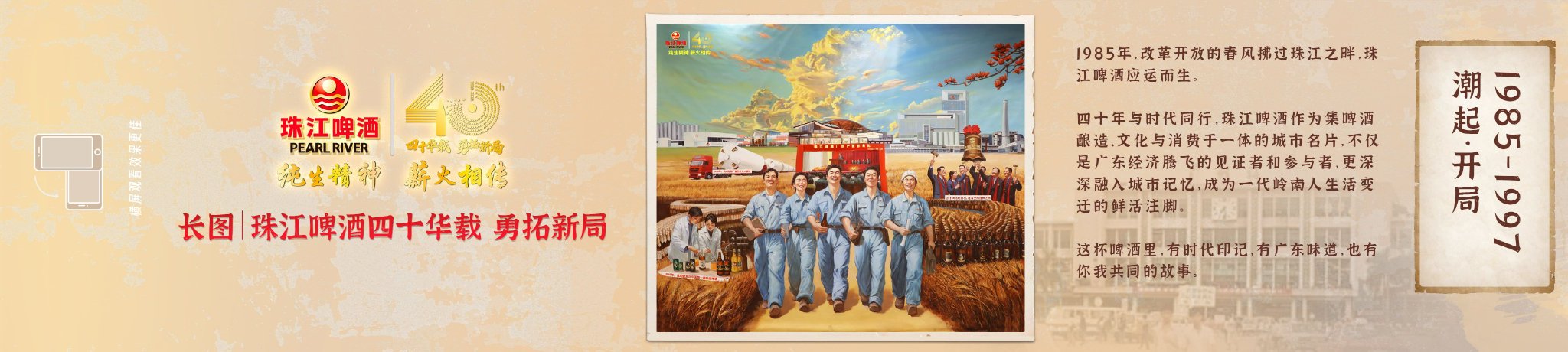
四十华载谋精酿,与时俱进拓新局——珠江啤酒40周年记
Zhong Guo Jin Rong Xin Xi Wang· 2025-11-19 12:38
Group 1 - The "3+N" brand strategy was launched in 2022, focusing on high-end product development and market expansion [3] - The company is undergoing structural reforms and enhancing its market network to improve efficiency [3] - The project for the Pearl River Wine subsidiary officially commenced in 2024, emphasizing brand culture and economic development [4] Group 2 - The company is positioned for high-quality development in the Greater Bay Area, aiming for diversified growth and integration [6] - The company is transitioning from traditional beer production to a more diversified business model [6] - The Jiangfeng Wine Tower construction ceremony indicates ongoing investment in infrastructure and brand presence [7]
非白酒板块11月19日跌0.33%,*ST椰岛领跌,主力资金净流出1298.75万元
Zheng Xing Xing Ye Ri Bao· 2025-11-19 08:52
Market Overview - The non-liquor sector experienced a decline of 0.33% on the previous trading day, with *ST Yedao leading the drop [1] - The Shanghai Composite Index closed at 3946.74, up 0.18%, while the Shenzhen Component Index closed at 13080.09, unchanged [1] Stock Performance - Key stocks in the non-liquor sector showed varied performance, with Kuaijishan (601579) rising by 1.47% to a closing price of 22.76, while *ST Yedao (600238) fell by 3.60% to 6.69 [1][2] - Other notable movements included ST Xifa (000752) increasing by 1.22% and Zhangyu A (000869) rising by 0.28% [1] Trading Volume and Value - Kuaijishan recorded a trading volume of 174,100 shares, with a transaction value of approximately 3.95 million yuan [1] - The total net outflow of main funds in the non-liquor sector was 12.99 million yuan, while retail investors saw a net inflow of 9.51 million yuan [2][3] Fund Flow Analysis - Main funds showed a net outflow in several stocks, including Kuaijishan with a net outflow of 23.57 million yuan, while Zhangyu A had a net inflow of 7.98 million yuan [3] - Retail investors contributed positively to the fund flow in stocks like 百润股份 (002568), which saw a net inflow of 20.47 million yuan despite a main fund outflow [3]


加速出清行业寻底,预期先行板块启动
East Money Securities· 2025-11-19 06:56
Investment Highlights - The report indicates a clear turning point for the food and beverage industry following accelerated clearance, with expectations for leading sectors to initiate recovery [2][7] - The overall revenue for the food and beverage sector showed a slight increase of 0.2% year-on-year, while net profit decreased by 4.6% in the first three quarters of 2025 [18][20] - In Q3 2025, the sector experienced a significant decline, with revenues and net profits dropping by 4.9% and 14.6% respectively [18][20] Sector Review 1. Overall Review - The food and beverage sector faced continuous pressure and adjustments, with traditional consumption accelerating clearance while new consumption trends continued to grow [18][20] - The white liquor segment saw a revenue decline of 18.4% and a net profit decline of 22.2% in Q3 2025, indicating significant pressure on the sector [20][22] - In contrast, sectors like snacks and beverages maintained double-digit growth due to product and channel innovations [20][21] 2. White Liquor - The white liquor industry is undergoing accelerated clearance, with varying rhythms among companies. The demand has weakened, leading to noticeable declines in revenue and net profit for most companies [22][25] - High-end liquor maintained some growth, with Moutai achieving a revenue increase of 0.3% in Q3 2025, while other brands like Wuliangye saw declines exceeding 50% [23][25] - The report emphasizes the importance of supply-demand balance and pricing as key indicators for the industry's recovery [22][23] 3. Low-Alcohol Beverages and Drinks - The beer segment showed stable performance with a revenue increase of 2.0% and a net profit increase of 11.8% in the first three quarters of 2025 [21][22] - The report highlights the potential for recovery in demand for low-alcohol beverages and drinks, driven by health trends and product innovation [22][23] 4. Consumer Goods - The dairy sector is gradually stabilizing, with upstream supply clearing and downstream processing demand increasing, leading to a potential balance in the raw milk cycle [31][33] - The snack sector, particularly the konjac and oat categories, is expected to maintain high growth rates, supported by the expansion of new retail channels [31][36] - The report notes that the overall demand for dining remains weak, but specific segments like Western-style condiments and frozen baking show structural opportunities [31][33] Investment Recommendations - The report suggests focusing on companies that are early in their clearance processes and have strong brand momentum, such as Gujing Gongjiu and Luzhou Laojiao [11][12] - For low-alcohol beverages, attention is drawn to leading companies like Kweichow Moutai and Tsingtao Brewery, which are expected to benefit from demand recovery [11][12] - In the consumer goods sector, companies with strong performance and cost advantages, such as Yili and Modern Dairy, are recommended for investment [11][12]



2025年1-9月中国啤酒产量为3095.2万千升 累计增长3.7%
Chan Ye Xin Xi Wang· 2025-11-19 03:56
Core Viewpoint - The report highlights the growth of China's beer production, indicating a positive trend in the industry with a year-on-year increase in production volume. Industry Summary - As of September 2025, China's beer production reached 3.04 million kiloliters, reflecting a year-on-year growth of 3.1% [1] - From January to September 2025, the cumulative beer production in China was 30.952 million kiloliters, showing a cumulative growth of 3.7% [1] Company Summary - Listed companies in the beer industry include Zhujiang Beer (002461), Chongqing Beer (600132), Yanjing Beer (000729), Lanzhou Yellow River (000929), and Huichuan Beer (600573) [1] - The report by Zhiyan Consulting provides insights into the non-alcoholic beer market dynamics and competitive strategies from 2025 to 2031 [1]

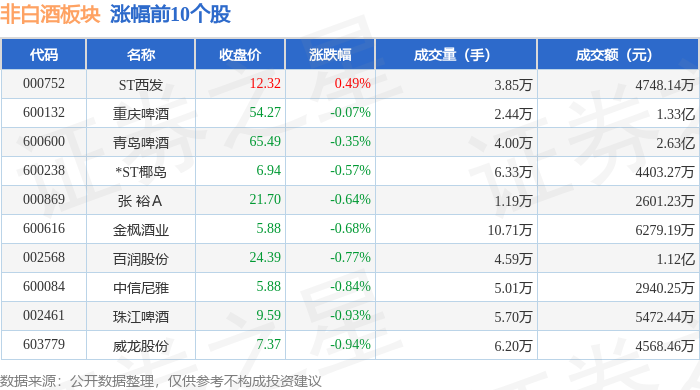
非白酒板块11月18日跌0.95%,燕京啤酒领跌,主力资金净流出1.09亿元
Zheng Xing Xing Ye Ri Bao· 2025-11-18 08:04
Market Overview - The non-liquor sector experienced a decline of 0.95% on November 18, with Yanjing Beer leading the drop [1] - The Shanghai Composite Index closed at 3939.81, down 0.81%, while the Shenzhen Component Index closed at 13080.49, down 0.92% [1] Stock Performance - Key stocks in the non-liquor sector showed varied performance, with ST Xifa closing at 12.32, up 0.49%, while other notable declines included Caijing Beer down 2.41% to 12.14 and Huichuan Beer down 2.41% to 12.15 [2] - The trading volume and turnover for selected stocks indicated significant activity, with Chongqing Beer recording a turnover of 1.33 billion and ST Xifa at 47.48 million [1][2] Capital Flow - The non-liquor sector saw a net outflow of 109 million from major funds, while retail investors contributed a net inflow of 115 million [2] - Detailed capital flow data showed that ST Xifa had a net inflow of 671,900 from major funds, while other stocks like ST Yedao experienced significant outflows [3]
啤酒业破局
Jing Ji Ri Bao· 2025-11-17 22:10
Core Viewpoint - The Chinese beer industry is transitioning from a phase of rapid growth to one of quality improvement and brand building, driven by changing consumer preferences and market dynamics [3][5][6]. Industry Development - The Chinese beer industry has evolved significantly over the past century, becoming the world's largest producer and consumer of beer since 2002, with a peak production of 50.62 million tons in 2013 [2][4]. - The industry has seen a shift from traditional brewing to industrial production, with major policy support since the 1980s leading to a rapid increase in production capacity and the emergence of numerous regional brands [4][5]. Market Dynamics - The beer market is now characterized by intense competition and a focus on quality over quantity, as traditional beer consumption declines and health-conscious trends rise among consumers [5][6]. - By 2023, the proportion of the population aged 60 and above reached 21.1%, while the main consumer demographic (ages 20-40) decreased from 35% to 28%, indicating a shift in market dynamics [5]. Consumer Trends - There is a growing demand for high-end, diverse, and premium beer products, with companies focusing on innovation and brand differentiation to meet these evolving consumer preferences [10][11][12]. - The rise of craft beer reflects a broader trend towards product differentiation and unique consumer experiences, with major brands entering the craft beer space [14][15]. Strategic Initiatives - Major beer companies are implementing high-end strategies, with products priced above 10 yuan gaining traction, and some brands even entering the ultra-premium market [10]. - Companies are also focusing on product diversification to cater to different consumer segments, with a notable increase in the variety of beer offerings [11][12]. Technological Advancements - The industry is leveraging digital and smart manufacturing technologies to enhance production efficiency and reduce carbon emissions, with companies like Qingdao Beer leading the way in smart factory initiatives [30][31]. - The adoption of instant retail models is reshaping sales channels, allowing for rapid delivery and increased consumer engagement [16][17]. Sustainability Efforts - The beer industry is increasingly focused on achieving carbon neutrality and sustainable practices, with initiatives aimed at reducing water and energy consumption throughout the production process [21][22][23]. - Companies are collaborating with upstream and downstream partners to promote green practices across the entire value chain, including the use of low-carbon packaging and transportation methods [26]. Challenges and Opportunities - The industry faces challenges related to raw material dependency, particularly for barley and hops, which are largely imported, impacting supply chain security [34][35]. - There is a need for innovation in product development to create globally recognized Chinese beer brands, emphasizing the importance of cultural elements in marketing strategies [36][37][38].