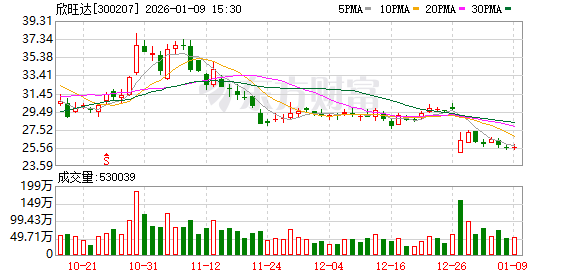
SUNWODA(300207)

Search documents
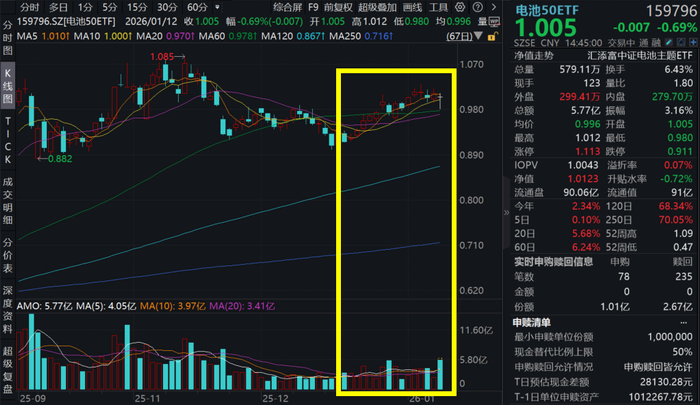
A股现天量,两市成交超3.6万亿元创新高!电池50ETF(159796)逆市爆量收跌,电池出口退税政策调整,影响几何?
Xin Lang Cai Jing· 2026-01-12 08:55
Core Viewpoint - The A-share market experienced a significant surge on January 12, with over 4,100 stocks closing in the green and a record trading volume of 3.64 trillion yuan, surpassing the previous high on October 8, 2024. The adjustment of export tax rebate policies for batteries has influenced market dynamics, leading to a notable increase in trading activity for the Battery 50 ETF (159796), which closed down 0.69% despite a trading volume nearing 600 million yuan [1][3]. Group 1: Market Performance - The Battery 50 ETF (159796) saw most of its constituent stocks decline, with notable drops including Sunshine Power and Xian Dao Intelligent, both down over 3%, while Ningde Times and Guoxuan High-Tech fell over 2% [3]. - The trading volume of the Battery 50 ETF (159796) surged to nearly 600 million yuan, indicating heightened investor interest despite the ETF's decline [1][3]. Group 2: Policy Impact - On January 9, two departments announced adjustments to export tax rebate policies, effective from April 1, 2026, which will reduce the VAT export rebate rate for battery products from 9% to 6%, and eliminate it entirely by January 1, 2027 [4][5]. - The previous reduction in export tax rebates for certain photovoltaic and battery products from 13% to 9% in November 2024 had already triggered a rush in exports, and the latest adjustments may lead to a similar surge, benefiting the lithium carbonate sector [5]. Group 3: Industry Outlook - Global demand for energy storage is expected to grow steadily, with projections indicating that global energy storage installations will reach 404 GWh by 2026, representing a 38% year-on-year increase [5]. - The battery sector is experiencing a sustained upward trend, driven by the growth of the global electric vehicle market, with domestic battery installations expected to maintain high growth rates through 2026 [5][6]. - Solid-state battery technology is advancing, with potential for significant industry upgrades, as companies that can provide stable supply and mature processes are likely to benefit [6]. Group 4: Investment Strategy - The Battery 50 ETF (159796) is positioned to benefit from its high content in energy storage (18.7%) and solid-state batteries (45%), making it a strong candidate for investors looking to capitalize on these growing segments [7][9]. - The ETF's focus on battery chemicals, which account for 31% of its weight, positions it well to benefit from the recovery of upstream material prices, enhancing the overall industry outlook [9][12].





二线电池厂,活在巨头阴影下
首席商业评论· 2026-01-12 04:08
Core Viewpoint - The article discusses the financial and operational challenges faced by second-tier battery manufacturers in the context of a lawsuit involving XWANDA, highlighting the disparity in profitability and market power between leading companies and their competitors [5][13][22]. Group 1: Financial Challenges - XWANDA's subsidiary is facing a lawsuit from Geely's subsidiary, claiming 2.314 billion yuan due to alleged quality issues with battery cells, which could significantly impact XWANDA's financial health and market reputation [5][6]. - Despite XWANDA's annual revenue exceeding 50 billion yuan, its power battery segment has incurred losses exceeding 3.4 billion yuan over the past two years, indicating a reliance on consumer battery profits to sustain its operations [7][9]. - Other second-tier battery manufacturers, such as EVE Energy and Guoxuan High-Tech, are also struggling with profitability, with EVE's net profit declining by 11.7% despite a revenue increase of 32.2% [8][9]. Group 2: Market Dynamics - The current market structure is dominated by two major players, CATL and BYD, which together hold over 65% of the market share, leaving second-tier manufacturers to compete for a shrinking portion of the market [22][25]. - The profitability gap is stark, with CATL earning 0.09-0.12 yuan per watt-hour, while second-tier companies like EVE earn only 0.02 yuan per watt-hour, highlighting the challenges in pricing power and cost control [22][25]. - The article emphasizes that second-tier manufacturers are often forced to lower prices to maintain orders, which further erodes their profit margins and limits their ability to invest in research and development [19][20]. Group 3: Customer Relationships - Second-tier manufacturers often rely heavily on a few major clients, which can lead to a loss of bargaining power and increased vulnerability to market fluctuations [15][20]. - The strategy of binding to large clients can backfire, as seen with XWANDA's dependency on Geely, which has resulted in significant risks when quality issues arise [15][20]. - The trend of automakers increasingly developing their own battery technologies poses a threat to second-tier manufacturers, as they may lose market share and pricing power [20][29]. Group 4: Future Outlook - The article suggests that the future of the battery industry may only accommodate a few key players, with second-tier manufacturers needing to establish unique advantages in specific technologies or markets to survive [29]. - Potential strategies for second-tier manufacturers include focusing on niche technologies, expanding into international markets, or forming deeper partnerships with larger clients, though each comes with its own set of risks [28][29].

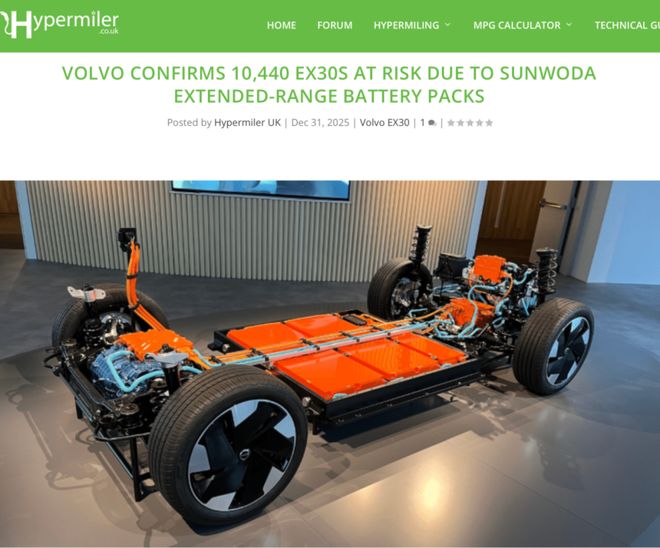
欣旺达电池问题事件继续发酵,沃尔沃EX30因电池问题多国召回
Ju Chao Zi Xun· 2026-01-12 03:33
Group 1 - The core issue involves the recall of Volvo EX30 models in the US and Canada due to fire risks associated with batteries supplied by Sunwoda, affecting 10,440 vehicles in the UK [2] - Volvo's internal quality tracking system identified potential defects in the 69 kWh battery packs used in single-motor long-range and dual-motor high-performance versions of the EX30, covering models from 2024 to 2026 [2] - Volvo has advised UK EX30 owners to limit charging to 70% to mitigate the risk of thermal runaway, which has led to dissatisfaction among vehicle owners due to reduced practical range [2] Group 2 - Sunwoda is currently involved in a legal dispute with Geely-affiliated companies, with a lawsuit claiming quality issues in battery cells delivered between June 2021 and December 2023, seeking compensation of 2.314 billion yuan [3] - Financial data indicates that Sunwoda's revenue for 2024 is projected at 56.021 billion yuan, with a net profit of 1.605 billion yuan, making the lawsuit amount significant at 4.1% of its revenue and exceeding its annual profit [3] - Geely's subsidiary, Weirui Power, which initiated the lawsuit, has been a partner with Sunwoda since 2021, focusing on battery cell development for Geely's PMA platform, which is used across multiple brands [4] Group 3 - The lawsuit against Sunwoda has been accepted by the Ningbo Intermediate People's Court, and the company is currently unable to assess the impact of the lawsuit on its current and future profits [5] - Sunwoda is actively seeking a reasonable resolution to the lawsuit and is enhancing communication with relevant parties to expedite a solution [5]
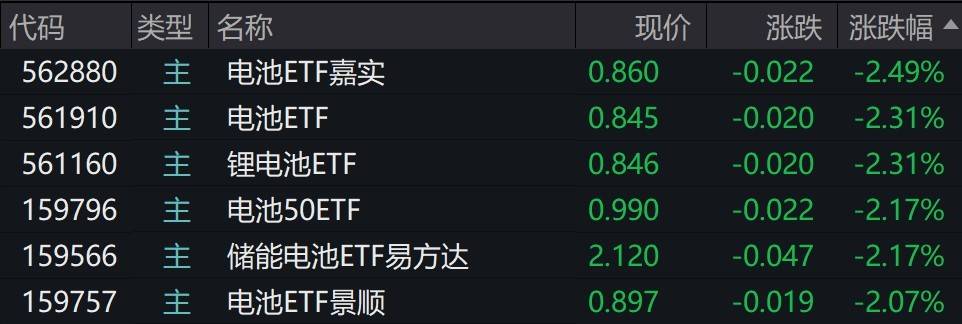
电池概念股走弱,多只电池相关ETF跌超2%
Sou Hu Cai Jing· 2026-01-12 02:50
Group 1 - Battery concept stocks weakened, with major players like Sunshine Power and CATL dropping over 4%, while companies such as Yiwei Lithium Energy, Xianlead Intelligent, Guoxuan High-Tech, and Xinwanda fell more than 3% [1] - Several battery-related ETFs declined by over 2% due to the impact of heavy-weight stock declines [1] Group 2 - Recent analysis indicates that policy support has injected strong momentum into the battery industry, with the government continuously launching encouraging policies for new energy vehicles, including trade-in programs, charging infrastructure development, and promoting new energy in rural areas, which further releases consumer potential [2] - The gradual implementation of "anti-involution" policies is leading to more rational competition within the industry, suggesting an improvement in the overall profitability environment [2]


中银国际:供需格局有望重塑 固态电池加速落地
Zhi Tong Cai Jing· 2026-01-12 02:33
Core Viewpoint - The report from Zhongyin International indicates that global sales of new energy vehicles (NEVs) are expected to maintain high growth, potentially reaching a historical high by 2026, driven by strong demand and technological advancements in the industry [1][2]. Group 1: New Energy Vehicle Market - Global demand for new energy vehicles is projected to continue growing, with sales expected to reach approximately 26 million units in 2026, representing a year-on-year increase of about 15% [2]. - The market is experiencing steady growth, with increasing penetration rates and expanding market space, supported by the introduction of new models and advancements in smart and connected technologies [2]. Group 2: Battery Industry Outlook - The demand for power batteries is expected to grow significantly, with domestic installed capacity projected to maintain a high growth rate in 2026 [3]. - The market share of lithium iron phosphate batteries is anticipated to continue rising, while the costs of lithium battery raw materials have increased since October 2025, posing challenges for battery manufacturers in cost management [3]. Group 3: Material Sector Dynamics - The consensus on "anti-involution" in the midstream materials sector suggests that high demand coupled with cautious capacity expansion may lead to a supply-demand mismatch, particularly in the lithium hexafluorophosphate segment, which is expected to see price recovery [4]. - Companies in the tight supply segments, such as lithium iron phosphate cathodes, separators, anodes, and copper foils, are recommended for investment due to their potential for profit recovery [4]. Group 4: Solid-State Battery Development - The industrialization of solid-state batteries is accelerating, entering a phase of pilot testing and small-scale vehicle validation, which is expected to benefit equipment manufacturers and high-value material segments [5]. - Companies that can achieve stable supply, have mature processes, and clear cost reduction paths are recommended for investment, especially those that have collaborated early with industry leaders [5]. Group 5: Investment Recommendations - The new energy vehicle supply chain is expected to maintain high growth, with battery cell segments showing strong resilience in profitability [6]. - Investment focus is suggested on leading companies in tight supply segments and those involved in solid-state battery technology, including firms like CATL, EVE Energy, and others listed in the report [6].
比23亿更严重:欣旺达或让数万海外车主陷入安全隐患
Tai Mei Ti A P P· 2026-01-11 12:03
Core Viewpoint - Volvo Cars, known for its commitment to safety, is facing unprecedented challenges in the electric vehicle era due to safety concerns related to its EX30 model's battery supplied by Sunwoda [1][4][11]. Group 1: Battery Safety Issues - A total of 10,440 EX30 vehicles in the UK are affected by potential safety issues related to high-voltage batteries from Sunwoda, marking a significant acknowledgment of the problem [12]. - Among 33,777 EX30 vehicles produced with Sunwoda batteries, approximately 0.02% have reported overheating issues [4]. - A fire incident involving an EX30 in Brazil raised alarms, leading Volvo to issue warnings to owners to limit charging to 70% to mitigate fire risks [7][11]. Group 2: Recall and Legal Actions - Volvo is preparing for a large-scale recall, with the South African National Consumer Commission already issuing a recall notice for 372 EX30 vehicles due to potential battery defects [7][14]. - Geely Holding, Volvo's parent company, has filed a lawsuit against Sunwoda for 2.314 billion RMB, citing quality issues with batteries supplied between June 2021 and December 2023 [14][17]. Group 3: Consumer Trust and Market Impact - The battery safety crisis has raised significant concerns among consumers, with many questioning the reliability of electric vehicle batteries and the overall quality control in the industry [23][29]. - Volvo's temporary measure of limiting charging to 70% has led to dissatisfaction among owners, as it significantly reduces the vehicle's usable range [12][13]. - The incident has broader implications for the electric vehicle industry, potentially leading to increased scrutiny and a shift towards prioritizing safety and quality over cost [29].
2025年中国储能BMS行业产业链、SWOT、市场规模、产值、竞争格局及发展趋势研判:行业技术成熟度和标准化程度显著提升,带动储能BMS规模扩张[图]
Chan Ye Xin Xi Wang· 2026-01-11 01:03
Core Insights - The energy storage Battery Management System (BMS) is a critical component for safety in energy storage systems, transitioning the industry from "passive protection" to "active safety" [1][3] - The market for new energy storage systems in China is expected to grow significantly, with the BMS market projected to reach 3.448 billion yuan in 2024 and 2.475 billion yuan in 2025, despite a decline in overall value due to price reductions [1][3] Industry Definition and Classification - Energy storage BMS is the core control component of energy storage systems, responsible for real-time data collection, state diagnosis, and safety protection [2] - BMS can be classified based on enterprise type, application field, and technology architecture [2] Current Industry Status - The global energy storage BMS market is expected to reach 6.252 billion yuan in 2024, with the Asia-Pacific region accounting for 62.01% of the market share [3] - In China, the BMS market is projected to grow from 275 million yuan in 2020 to 3.448 billion yuan in 2024, with a potential decline to 2.475 billion yuan in 2025 due to pricing pressures [3] Industry Value Chain - The energy storage BMS industry value chain includes upstream suppliers of key materials and components, midstream hardware production and software development, and downstream system integrators [4] SWOT Analysis - The energy storage BMS industry is supported by national policies aimed at promoting new energy storage, positioning it as a core component of the new power system [5] Competitive Landscape - The domestic energy storage BMS market features three main types of participants: self-developed BMS by battery companies, system integrators with self-development capabilities, and third-party specialized manufacturers [6][7] - Leading self-developed BMS companies include CATL, BYD, and Guoxuan High-Tech, which leverage their technology to enhance product competitiveness [6] - Comprehensive manufacturers like Sungrow and Haibo Innovation develop BMS products tailored to their systems [7] - Specialized third-party BMS manufacturers focus on technological differentiation and cost optimization [7] Development Trends - The energy storage market in China is expected to maintain rapid growth, driven by the dual carbon goals and the construction of new power systems [8] - The maturity and standardization of BMS technology are anticipated to improve, leading to further industry expansion [9] - Future trends indicate a shift towards integration, intelligence, openness, and scalability in the BMS industry [9]


二线电池厂,活在巨头阴影下
投中网· 2026-01-10 07:07
Core Viewpoint - A significant lawsuit involving a claim of 2.314 billion yuan against Aoxin Wanda by Geely's subsidiary has exposed the financial struggles of second-tier battery manufacturers in the competitive electric vehicle market [6][7]. Group 1: Lawsuit and Financial Impact - Aoxin Wanda's subsidiary, Aoxin Wanda Power, is being sued for 2.314 billion yuan due to alleged quality issues with battery cells supplied to Geely's Zeekr models, leading to a large-scale battery replacement [6][7]. - This lawsuit represents the total net profit of Aoxin Wanda over the past two years, causing its stock price to drop over 10% and erasing more than 6 billion yuan in market value [7]. - The lawsuit highlights the ongoing quality complaints from customers since the second half of 2022, and Aoxin Wanda's previous legal action against Geely for unpaid debts [7][10]. Group 2: Industry Challenges - The financial difficulties faced by Aoxin Wanda are indicative of broader issues within the second-tier battery manufacturing sector, where companies like Aoxin Wanda and EVE Energy are struggling to maintain profitability amid fierce competition from industry leaders like CATL and BYD [8][9]. - Despite Aoxin Wanda's annual revenue exceeding 50 billion yuan, its power battery division has accumulated losses of over 3.4 billion yuan in the past two years, indicating a reliance on consumer battery profits to sustain its operations [10][11]. Group 3: Financial Performance of Competitors - In the first three quarters of 2025, EVE Energy reported revenue of 45 billion yuan with a net profit of 2.82 billion yuan, while Aoxin Wanda's revenue was 43.53 billion yuan with a net profit of 1.41 billion yuan [11]. - Other second-tier players like Guoxuan High-Tech and Zhongxin Innovation also show similar trends of revenue growth without corresponding profit increases, indicating a systemic issue in the industry [12]. Group 4: Cost Pressures and Market Dynamics - The cost pressures faced by second-tier manufacturers stem from their inability to secure stable pricing for raw materials, leading to reduced profit margins [14][15]. - The production capacity utilization rates for second-tier manufacturers are significantly lower than those of leading firms, resulting in higher unit costs and further financial strain [15][16]. Group 5: Customer Relationships and Market Position - Second-tier battery manufacturers often rely heavily on a few major clients, which can lead to a loss of bargaining power and increased vulnerability to market fluctuations [22][24]. - The trend of automakers adopting a dual-supplier strategy, favoring leading manufacturers like CATL while using second-tier suppliers as backup, further complicates the market position of these companies [24][25]. Group 6: Future Outlook and Survival Strategies - The future of second-tier battery manufacturers may hinge on their ability to innovate and differentiate themselves in niche markets or technologies, as the competitive landscape continues to favor larger players [37][38]. - Strategies such as international expansion and forming strategic partnerships may provide pathways for survival, but these approaches come with their own risks and challenges [37][38].

固态电池供应商备战2027:目标定好了,路线还在争
Jing Ji Guan Cha Wang· 2026-01-09 12:33
Core Insights - The solid-state battery industry is experiencing renewed interest from investors due to clear profitability and order visibility in the supply chain, with a significant focus on achieving mass production by 2027 [2][3][6] - Major automotive companies are targeting 2027 for the application of solid-state batteries in vehicles, with many planning to complete product development or testing by 2026 [4][5] Industry Developments - Companies like Tian Shi Ke Feng have begun to engage with potential investors after overcoming initial funding challenges, with plans to expand production capacity significantly in 2026 [2] - The Ministry of Industry and Information Technology has identified solid-state batteries as a key area for development, aiming to establish 3-5 leading companies by 2027 [3] Technical Challenges - The path to mass production of solid-state batteries is fraught with challenges, including material technology discrepancies and shortages in core equipment [6][8] - The industry is divided on material technology routes, with significant competition between oxide and sulfide electrolytes, each having distinct advantages and challenges [10][12] Material Innovations - Solid-state batteries are recognized for their high energy density and intrinsic safety, making them suitable for various applications, although their cost-effectiveness in electric vehicles remains a concern [7][8] - The development of silicon-carbon and lithium metal anodes is ongoing, with companies reporting progress in small-scale trials [9][10] Equipment and Production - The lack of mature mass production equipment poses a significant barrier, with many companies resorting to self-developed solutions to meet production demands [14][19] - The production process for solid-state batteries requires high precision and specialized equipment, which increases costs and complicates the manufacturing process [20][21] Market Dynamics - The solid-state battery supply chain is characterized by a collaborative approach among suppliers and manufacturers, with a focus on meeting evolving technical requirements from cell manufacturers [23][24] - The competitive landscape is marked by a "race" among cell manufacturers to explore various material suppliers, emphasizing the need for continuous innovation and adaptation [24]



欣旺达:关于控股股东部分股份质押及解除质押的公告
Zheng Quan Ri Bao· 2026-01-09 11:45
(文章来源:证券日报) 证券日报网讯 1月9日,欣旺达发布公告称,公司于2026年1月9日接到公司控股股东王明旺先生的函 告,获悉其将所持有本公司的部分股份办理了质押及解除质押业务,本次质押数量为574万股,本次解 除质押股份数量574万股。 ...