
Goldman Sachs(GS)

Search documents
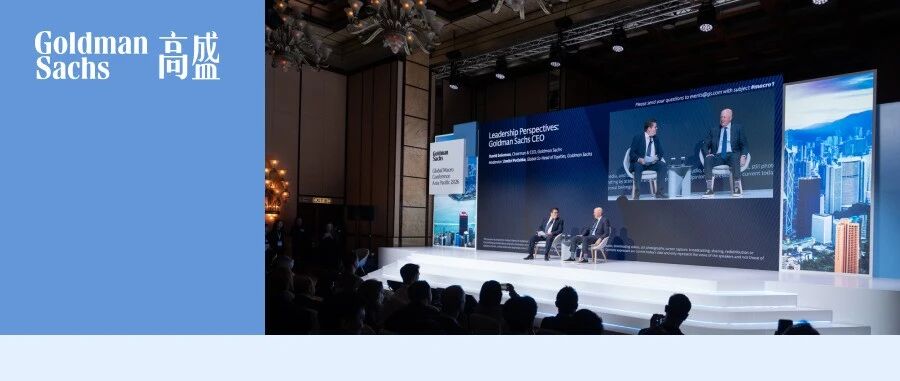
高盛2026年全球宏观论坛精彩回顾
高盛GoldmanSachs· 2026-02-11 09:59
Core Viewpoint - The Goldman Sachs Global Macro Conference highlighted optimistic projections for global economic growth, particularly in the U.S. and Asia, while acknowledging challenges in Europe and the impact of geopolitical tensions on market performance [1][2]. Economic Outlook - Goldman Sachs economists forecast a robust global real GDP growth of 2.9% by 2026, surpassing market expectations, driven by reduced tariff resistance and real income growth [4]. - The U.S. core inflation is expected to decline to 2.1% by the end of 2026, influenced by the waning effects of tariffs and decreasing housing and wage inflation [4]. - In Asia, specifically China, real GDP growth is projected at 4.8% by 2026, supported by strong export growth and ongoing government policy easing, despite weak domestic demand [6]. - The Federal Reserve is anticipated to implement two rate cuts of 25 basis points each in June and September, leading to a final interest rate range of 3-3.25% [6]. - Emerging markets are expected to maintain resilience, with strong growth anticipated in several emerging Asian markets by 2026 [7]. - In Europe, the Eurozone's real GDP growth is projected at 1.3% for 2026, facing challenges from increased export competition with China, while core inflation is expected to drop to 1.8% due to lower energy prices and a stronger euro [9]. Stock Market - The macro environment is favorable for stock growth in the Asia-Pacific region, with stable valuations expected [14]. - The demand for semiconductor manufacturers is anticipated to extend a prolonged super cycle, suggesting continued investment in this sector [14]. - The S&P 500 index is projected to see a 12% earnings growth, which is a key driver of returns in the U.S. stock market [16]. - Companies benefiting from capital expenditures due to investments from other firms are expected to see significant growth, with market consensus forecasts likely to be revised upward [16]. - Despite a challenging macro environment, European bank stocks are outperforming, and there is a positive shift in capital inflows into the European stock market, with increased M&A activity expected among small and medium-sized enterprises [17]. - Over 60% of conference attendees believe that Asian stocks, excluding Japan, will perform the strongest by 2026, with technology stocks anticipated to lead the market [18].


Goldman's India push pays off in crowded Wall Street field
MINT· 2026-02-11 08:35
Core Insights - Goldman Sachs is shifting its strategy in India, moving from viewing it as a future growth market to recognizing its current potential, with stabilized inflation and strong corporate balance sheets [1][2]. Investment Strategy - Goldman Sachs has invested approximately $500 million into its India banking operations over the past three years, indicating a strong commitment to the Indian market [2]. - The firm has improved its market position, ranking fourth in Indian equity offerings last year and fifth in mergers, surpassing Morgan Stanley for the first time in a decade [3]. Market Dynamics - Despite intense competition from established players like JPMorgan and Citigroup, Goldman Sachs anticipates further growth in India's IPO market, with 10 mandates currently in hand and a record $22 billion raised by Indian firms last year [5][12]. - The bank's previous cautious approach is changing, as it has moved its operations to a more prominent location in Mumbai, reflecting its commitment to expanding its presence in the market [6][7]. Competitive Landscape - Goldman Sachs aims to build scale across various financial services, including equity underwriting and mergers, while accepting thinner margins initially to establish a market presence [8]. - The firm is focusing on long-term client relationships, recognizing that success in India requires a broader approach beyond just fee-driven investment banking [9][16]. Recent Developments - Goldman has been involved in significant transactions, including over $4 billion in stock sales across 23 deals last year, highlighting its growing influence in the market [14]. - The bank's private credit business has also been active, with investments exceeding $8.5 billion in India since 2006, showcasing its diversified approach [17]. Organizational Changes - Goldman Sachs has restructured its leadership in India to support its growth strategy, promoting key individuals and expanding its team significantly [19]. - The firm's technology center in India has grown to about 8,000 employees, indicating its commitment to leveraging technology in its operations [20].

高盛CEO罕见发声,软件板块暴跌是市场反应过度,美国经济今年将强劲增长
Jin Rong Jie· 2026-02-11 08:34
近期,围绕人工智能竞争可能冲击传统软件行业的担忧持续发酵,软件板块经历了一轮剧烈调整。高盛 集团首席执行官苏德巍2月11日在佛罗里达州基比斯坎举行的瑞银集团会议上对此作出回应,认为这轮 抛售可能是市场反应过度。 本文源自:市场资讯 作者:观察君 苏德巍表示:"我认为过去一周的市场叙事有些过于宽泛了。会有赢家和输家,许多公司会进行转型。" 此前,Anthropic公司发布了新型人工智能自动化工具,市场对其可能颠覆传统软件即服务(SaaS)业 务模式的忧虑迅速蔓延,导致大批软件股遭遇抛售。 在谈及美国经济前景时,苏德巍给出了较为乐观的判断。他表示,美国经济今年可能会强劲增长,"宏 观环境总体上非常好。"他指出,有几个因素可能继续推动经济增长,包括强有力的财政刺激、放松管 制,以及中期选举前特朗普可能采取一些"利民"行动。 不过,苏德巍同时提醒,贸易、通胀和地缘政治可能仍是投资者挥之不去的担忧。 高盛此前在研究报告中也曾指出,软件行业约占美国IPO储备项目的四分之一,年初软件股的抛售已凸 显出估值方面的风险,股价持续波动以及企业信心变化,是其预测面临的主要宏观风险之一。 声明:市场有风险,投资需谨慎。本文为AI基于 ...
Goldman Sachs Reports $2.3B in BTC, ETH, XRP — The Catch: It Doesn’t Hold Any Tokens
Yahoo Finance· 2026-02-11 08:07
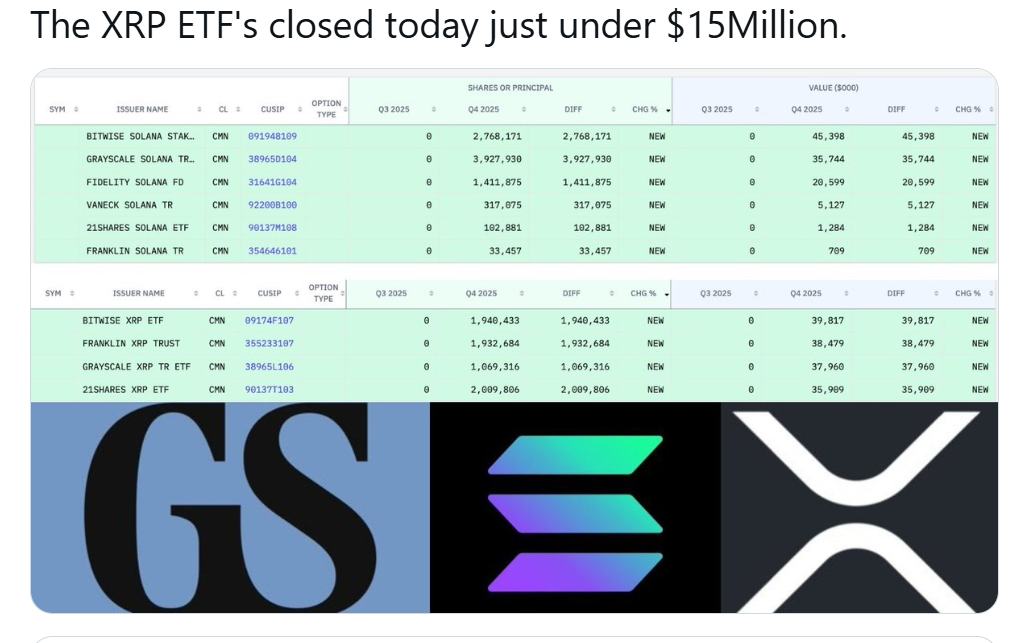
Core Insights - Goldman Sachs disclosed approximately $2.36 billion in crypto exposure in its Q4 2025 13F filing, representing about 0.33% of its total portfolio and a 15% increase quarter-over-quarter [1][5]. Crypto Exposure Structure - The firm's crypto exposure is entirely indirect, holding spot exchange-traded funds (ETFs) tied to assets like Bitcoin, Ethereum, XRP, and Solana, rather than directly holding the tokens [2][3]. - This ETF-only strategy provides regulatory clarity and operational simplicity for the bank [8]. Breakdown of Holdings - Bitcoin: Between $1.06 billion and $1.1 billion in spot Bitcoin ETFs [4]. - Ethereum: Over $1 billion in spot Ethereum ETFs [4]. - XRP: Between $152 million and $153 million in XRP ETFs [4]. - Solana: $108 million to $109 million in Solana ETFs, representing a new position initiated in Q4 2025 [4][7]. Changes in Holdings - Bitcoin and Ethereum remain core allocations, with a reduction of approximately 39-40% in Bitcoin and 27% in Ethereum during Q4 [6][7]. - New allocations were initiated for XRP and Solana ETFs, indicating a tactical expansion into assets associated with payments infrastructure and high-throughput blockchain applications [7]. Institutional Commitment - Despite trimming its largest positions in Bitcoin and Ethereum, Goldman Sachs' overall crypto allocation increased quarter-over-quarter, signaling continued institutional commitment to regulated investment products [5][7].
华尔街推进“合规化”购置加密货币! 高盛借道ETF加码布局 瑞波币与Solana首次入列
智通财经网· 2026-02-11 07:25
高盛对于加密货币的最新此举配置凸显出华尔街金融巨头们似乎开始青睐比特币和以太坊这两大最大市值加密货币之外的其他代币敞口,比如开始积极拥抱 瑞波币以及Solana配置敞口,并且从结构上来看,高盛对于加密货币资产的配置更像是"比特币份额相对回落、以太坊权重上升,并且重磅新增加对瑞波币 (XRP)与Solana相关ETF的配置"。此外,从第四季度的高盛加密货币资产持仓规模来看,Q4超过23.6亿美元的加密货币ETF配置规模超过上年同期以及2025 年第三季度。 | | | | | | | | SHARES OR PRINCIPAL | | | | | VALUE ($000) | | | | --- | --- | --- | --- | --- | --- | --- | --- | --- | --- | --- | --- | --- | --- | --- | | SYM . | ISSUER NAME | 1 CL # | CUSIP 0 | OPTION TYPE | 03 2025 | 0 | Q4 2025 0 | DIFF . | CHG % . | Q3 2025 | 9 | 04 2025 1 ...
信用卡,为什么成了「烫手山芋」
3 6 Ke· 2026-02-11 07:00
Core Insights - The article discusses the challenges faced by financial institutions, particularly in the credit card sector, as they navigate partnerships with technology giants like Apple and the evolving regulatory landscape [1][5][15]. Group 1: Credit Card Industry Challenges - Guangzhou Bank has made significant cuts to its credit card operations, closing all seven of its local branches in Guangdong province, marking a drastic restructuring in the industry [2]. - The bank's credit card loan balance fell sharply to 70.442 billion yuan in 2024, a year-on-year decrease of 18.11%, while net income from fees and commissions dropped by 18.52% [3]. - The bank's non-performing loan ratio surged to 4.88% in 2023, more than doubling in just over two years, indicating rising risks in its credit card portfolio [3][4]. Group 2: Goldman Sachs and Apple Card Partnership - Goldman Sachs faced significant losses in its consumer loan business, with pre-tax losses exceeding $7 billion since early 2020, leading to its decision to exit the Apple Card partnership [5][6]. - The initial terms of the Apple Card were unfavorable for financial institutions, with no annual fees and low interest rates, which placed the credit risk burden primarily on Goldman Sachs [6][11]. - The partnership initially saw rapid growth, with over 10 million customers within three years, but operational costs and high credit loss rates ultimately led to its downfall [8][11]. Group 3: Regulatory and Market Pressures - Regulatory changes and compliance challenges became significant hurdles for Goldman Sachs, culminating in penalties from the Consumer Financial Protection Bureau (CFPB) for customer service failures [14][15]. - The bank's decision to refocus on its core business was influenced by the need to manage its reputation and financial performance amid increasing market volatility [15]. - Morgan Stanley's successful transition to a retail-focused model contrasts with Goldman Sachs' struggles, highlighting the complexities of integrating technology and finance [7][16]. Group 4: Future of Credit Card Business - Morgan Chase is positioned to take over the Apple Card business, leveraging its extensive experience and resources in the credit card sector [16]. - The integration of the Apple Card into Morgan Chase's operations is expected to take two years, reflecting the complexities involved in managing such a business [16].


从“绝不”到“也许”:高盛CEO预言美监管风向巨变,2026将迎战略并购大年
智通财经网· 2026-02-11 06:44
智通财经APP获悉,在高盛集团近期举行的业绩说明会及行业峰会上,首席执行官大卫·所罗门针对全 球资本市场的前景发表了极具洞察力的见解。他明确指出,全球资本市场在经历低迷后正迎来复苏, 2024至2026年交易活动有望实现突破性增长,主要驱动因素包括私募基金积压交易的释放、宏观经济和 政策环境的改善以及资本市场开放与技术周期的推动。他指出,随着监管转向促增长以及人工智能等技 术驱动的整合,高盛预计2026年将成为全球并购态度的一个转折点 作为高盛首席执行官,所罗门带领这家华尔街巨头度过了多个行业寒冬——包括私募股权支出长期低迷 的困境,以及市场极端交易波动带来的冲击。值此2025年业绩实现显著增长之际,所罗门在周二举办的 瑞银金融服务会议上向投资者表示:高盛正以强劲势头迈入2026年新征程。 所罗门称赞美国的政策制定者激发了收购欲望。"在美国经历了一段非常严格的监管时期之后,如今美 国出现了大规模的放松监管趋势,涵盖所有行业,"所罗门说道。 就在几个月前,特朗普还因为高盛经济学家批评关税政策而公开羞辱所罗门(嘲笑他当DJ,让他辞职)。 但现在,所罗门却对特朗普政府支持并购的政策大加赞赏。 尽管有过那次争执,所罗 ...
宏观-经济-近期外资机构观点荟
2026-02-11 05:58
Summary of Key Points from Conference Call Records Industry Overview - Recent adjustments in the US stock market were primarily driven by a sell-off in AI software stocks, with Goldman Sachs predicting that the downward trend may continue, although the peak volatility has passed [4][1] - Foreign institutions are optimistic about gold, with Deutsche Bank and JPMorgan raising their 2026 target prices to $6,000-$6,300 per ounce, while maintaining a cautious stance on silver and copper [5][1] - UBS has revised its GDP growth forecast for the Eurozone in 2026 from 1.1% to 1.3%, mainly due to expansive fiscal policies, particularly defense spending [6][1] Core Insights and Arguments - The stability of the US stock market requires an improvement in earnings prospects, and the recovery of investor sentiment may need several quarters of solid fundamentals to support it [4][1] - AI technology stocks face risks of valuation corrections and exit difficulties, with some listed companies experiencing significant declines. However, Deutsche Bank believes that AI-driven private credit transactions will promote the development of the real economy and reduce risks in the long term [7][1] - Foreign institutions are focusing on major asset classes, including US stocks, commodities, and foreign exchange, with a bullish outlook on precious metals (gold and silver) and copper, while being cautious about silver [8][1] Additional Important Insights - The trend of the Chinese yuan strengthening in the medium term is expected to remain unchanged, driven by improved growth prospects and increased policy tolerance in China. The appreciation of the yuan is characterized by a slow and steady pace, with increased stability in the central parity and a decoupling from the US dollar [9][1] - Foreign institutions view the recent pullback in the A-share market at the end of January as a healthy technical adjustment, optimistic about the transition to a stable liquidity environment in the Chinese stock market, supported by the strengthening yuan and positive regulatory signals [10][1][11]


石油追踪:地缘政治支撑油价-Oil Tracker_ Geopolitics Support Prices
2026-02-11 05:57
Summary of Key Points from the Conference Call Industry Overview - The report focuses on the oil industry, particularly the dynamics surrounding crude oil prices and geopolitical influences affecting supply and demand. Core Insights and Arguments - **Brent Crude Price Movement**: The Brent crude price increased by $3 per barrel due to ongoing US-Iran discussions, despite the US imposing sanctions on more Iranian oil tankers and advising US ships to avoid Iranian waters [3][4][6]. - **Geopolitical Risks**: The Polymarket prediction market indicates a ~56% chance of the US striking Iran by June 30, 2025, leading to increased market premiums for insurance against oil price spikes [3][4]. - **Global Stock Changes**: Global visible stocks built by only 0.5 million barrels per day (mb/d) in January, a significant deceleration from the previous 1.4 mb/d builds over the last 90 days. Total global stocks, including "invisible," built by 1.6 mb/d in January, which is 2.0 mb/d lower than expectations due to supply disruptions in Kazakhstan, Venezuela, and the US [3][4][6]. - **Oil on Water**: There has been a sharp increase in oil on water, likely due to buyers securing oil amid heightened geopolitical uncertainty [3][4]. - **Sanctioned Oil Imports**: Imports of oil from Russia, Iran, and Venezuela increased by 0.8 mb/d (or 10%) over the last two weeks, although sanctioned oil on water remains elevated [3][4]. - **Venezuela's Oil Exports**: Venezuela's crude exports reached a 7-year high as Asian purchases increased, despite being 0.2 mb/d below last November levels [3][4]. - **Russia's Oil Production**: Russia's oil production and total exports rebounded in January, despite a 1.2 mb/d year-to-date decline in exports to India and China due to significant redirection [3][4]. Additional Important Insights - **Investor Behavior**: There has been a rotation towards hard assets, including commodities, which has contributed approximately $6 per barrel to the rise in crude prices year-to-date [7][4]. - **Supply Disruptions**: January supply disruptions are expected to be temporary, with oil exports from the CPC terminal likely remaining 0.3 mb/d below normal levels in February [7][4]. - **Long-to-Short Oil Ratio**: The long-to-short oil ratio increased to 2.6, placing it at the 89th percentile in a sample from May 1, 2024, indicating a bullish sentiment among investors [13][4]. - **OECD Commercial Stocks**: OECD commercial stocks decreased to 2,804 million barrels (mb), which is 38 mb below the end-of-January forecast of 2,842 mb [16][4]. Conclusion - The oil market is currently influenced by geopolitical tensions, particularly involving Iran, and supply disruptions from key oil-producing countries. The dynamics of oil imports and exports, especially from sanctioned countries, are critical to understanding current price movements and future trends in the oil industry.
日本经济:日本央行政策问答-加息节奏、时机及影响检视-Japan Economics Analyst_ Q&A on BOJ Policy_ Rate Hike Pace and Timing, Impact of Rate Check
2026-02-11 05:57
10 February 2026 | 9:53AM JST Economics Research JAPAN ECONOMICS ANALYST Q&A on BOJ Policy: Rate Hike Pace and Timing, Impact of Rate Check Akira Otani +81(3)4587-9960 | akira.otani@gs.com Goldman Sachs Japan Co., Ltd. Investors should consider this report as only a single factor in making their investment decision. For Reg AC certification and other important disclosures, see the Disclosure Appendix, or go to www.gs.com/research/hedge.html. Goldman Sachs Japan Economics Analyst Q&A on BOJ Policy: Rate Hike ...